Pages

Showing posts with label Noodles. Show all posts

Sunday, 3 July 2016

What Happens to Your Body When You Eat Junk Food?

If you overdo it on pizza, macaroni and cheese, chips, and ice cream, you might worry about what it's going to do to your thighs or mid-section. But binging on junk food isn't only a matter of weight gain. It might have far more serious repercussions than that.

Eating Junk Food

Story at-a-glance

  • When men ate a junk-food diet, their muscles’ ability to oxidize glucose was disrupted in just five days’ time
  • If you lose this key player in glucose metabolism it could pave the way for insulin resistance, diabetes, and other health problem
By Dr. Mercola
If you overdo it on pizza, macaroni and cheese, chips, and ice cream, you might worry about what it's going to do to your thighs or mid-section. But binging on junk food isn't only a matter of weight gain. It might have far more serious repercussions than that.
People who ate a diet focused on macaroni and cheese, processed lunchmeat, sausage biscuits, mayonnaise, and microwavable meals with unhealthy fats, for example, showed serious negative changes to their metabolism after just five days.
After eating the junk-food diet, the study participants (12 healthy college-aged men) muscles' lost the ability to oxidize glucose after a meal, which could lead to insulin resistance down the road.1

What Happens to Your Metabolism After Five Days of Junk Food

Even though their caloric intake remained unchanged, when men ate a junk-food diet their muscles' ability to oxidize glucose was disrupted in just five days' time. This is a significant change, because muscle plays an important role in clearing glucose from your body after a meal.
Under normal circumstances, your muscles will either break down the glucose or store it for later use. Your muscles make up about 30 percent of your body weight, so if you lose this key player in glucose metabolism it could pave the way for diabetesand other health problems.2 As reported by TIME:3
"'The normal response to a meal was essentially either blunted or just not there after five days of high-fat feeding,' [Matthew] Hulver, [PhD, department head of Human Nutrition, Food, and Exercise at Virginia Tech Hulver] says.
Before going on a work-week's worth of a fatty diet, when the men ate a normal meal they saw big increases in oxidative targets four hours after eating.
That response was obliterated after the five-day fat infusion. And under normal eating conditions, the biopsied muscle used glucose as an energy source by oxidizing glucose. 'That was essentially wiped out after,' he says. 'We were surprised how robust the effects were just with five days.'"

Just One Bad Meal Can Mess with Your Health

Morgan Spurlock's documentary Super Size Me was one of the first to vividly demonstrate the consequences of trying to sustain yourself on a diet of fast food. After just four weeks, Spurlock's health had deteriorated to the point that his physician warned him he was putting his life in serious jeopardy if he continued the experiment.
But as the featured study showed, it doesn't take a virtual month to experience the health effects of a poor diet. In fact, the changes happen after just one meal, according to research published in the Journal of the American College of Cardiology.4
When you eat a meal high in unhealthy fats and sugar, the sugar causes a large spike in your blood-sugar levels called "post-prandial hyperglycemia." In the long term this can lead to an increased risk of heart attack, but there are short-term effects as well, such as:
  • Your tissue becomes inflamed (as occurs when it is infected)
  • Your blood vessels constrict
  • Damaging free radicals are generated
  • Your blood pressure may rise higher than normal
  • A surge and drop in insulin may leave you feeling hungry soon after your meal
The good news is that eating a healthy meal helps your body return to its normal, optimal state, even after just one. Study author James O'Keefe of the Mid America Heart Institute in Kansas City, Missouri told TIME:5
"Your health and vigor, at a very basic level, are as good as your last meal."

See Inside Your Stomach After a Meal of Instant Meals…


Dr. Braden Kuo of Massachusetts General Hospital used a pill-sized camera to see what happens inside your stomach and digestive tract after you eat ramen noodles, one common type of instant noodles. The results were astonishing…
In the video above, you can see ramen noodles inside a stomach. Even after two hours, they are remarkably intact, much more so than the homemade ramen noodles, which were used as a comparison. This is concerning for a number of reasons.
For starters, it could be putting a strain on your digestive system, which is forced to work for hours to break down this highly processed food (ironically, most processed food is so devoid of fiber that it gets broken down very quickly, interfering with your blood sugar levels and insulin release).
When food remains in your digestive tract for such a long time, it will also impact nutrient absorption, but, in the case of processed ramen noodles, there isn't much nutrition to be had. Instead, there is a long list of additives, including the toxic preservative tertiary-butyl hydroquinone (TBHQ).
This additive will likely remain in your stomach along with the seemingly invincible noodles, and no one knows what this extended exposure time may do to your health. Common sense suggests it's not going to be good…

Eating Processed Foods Linked to Chronic Disease

Research published in the Journal of Nutrition found that women who consumed more instant noodles had a significantly greater risk of metabolic syndrome than those who ate less, regardless of their overall diet or exercise habits.6
Past research also analyzed overall nutrient intake between instant-noodle consumers and non-consumers, and found, as you might suspect, that eating instant noodles contributes little value to a healthy diet.
The instant-noodle consumers had a significantly lower intake of important nutrients like protein, calcium, phosphorus, iron, potassium, vitamin A, niacin, and vitamin C compared with non-consumers.7 Those who ate instant noodles also had an excessive intake of energy, unhealthy fats, and sodium (just one package may contain 2,700 milligrams of sodium).8
Not to mention, refined carbohydrates like breakfast cereals, bagels, waffles, pretzels, and most other processed foods quickly break down to sugar in your body. This increases your insulin and leptin levels, and contributes to insulin resistance, which is the primary underlying factor of nearly every chronic disease and condition known to man, including weight gain.
Not only that, but remember… when you eat junk food you are not just feeding yourself… you’re feeding your microbiome, too, and in so doing altering its construction for better or worse. Your body’s diverse army of microbes is responsible for many crucial biological processes, from immunity to memory to mental health, so feeding it wisely, with fresh unprocessed and naturally fermented foods, is crucial to your overall health and well-being.

Is Junk Food as Dangerous as Cigarettes?

In the US, about one-quarter to one-third of adults fall into the obese category. A staggering two-thirds of Americans are overweight, and poor diet is in large part to blame. Last year, UN Special Rapporteur on the right to food, Olivier De Schutter, said that "obesity is a bigger global health threat than tobacco use," and that this fact isn't taken as seriously as it should be. His statements were delivered at the opening of the 2014 World Health Organization's annual summit. De Schutter ultimately wants nations to join forces to place stricter regulations on unhealthy foods:9
"Just as the world came together to regulate the risks of tobacco, a bold framework convention on adequate diets must now be agreed," he said. 'The Special Rapporteur has previously agitated for greater governmental action on junk foods, including taxing unhealthy products, regulating fats and sugars, cracking down on advertising for junk food, and rethinking agricultural subsidies that make unhealthy food cheaper,' Time Magazine noted. 'Governments have been focusing on increasing calorie availability,' he said, 'but they have often been indifferent to what kind of calories are offered, at what price, to whom they are made available, and how they are marketed.'"
The idea that being overweight can be more harmful than smoking is likely to make many balk, considering how "normal" it has become to carry around extra pounds, but in terms of overall health effects and subsequent health care costs, it's likely true. For example, data collected from over 60,000 Canadians show that obesity leads to more doctor visits than smoking.10
Further, according to a report by The McKinsey Global Institute, the global cost of obesity is now $2 trillion annually, which is nearly as much as the global cost of smoking ($2.1 trillion) and armed violence (including war and terrorism, which also has a global cost of $2.1 trillion).11 For comparison, alcoholism costs are $1.4 trillion annually, road accidents cost $700 billion, and unsafe sex costs $300 billion. What's more, if current trends continue, the McKinsey report estimates that nearly half of the world's adult population will be overweight or obese by 2030.

Junk Food Is Incredibly Addictive

Your body is designed to naturally regulate how much you eat and the energy you burn. But food manufacturers have figured out how to over-ride these intrinsic regulators, designing processed foods that are engineered to be "hyper-rewarding." According to the "food reward hypothesis of obesity," processed foods stimulate such a strong reward response in our brains that it becomes very easy to overeat. One of the guiding principles for the processed food industry is known as "sensory-specific satiety."
Investigative reporter Michael Moss describes this as "the tendency for big, distinct flavors to overwhelm your brain."12 The greatest successes, whether beverages or foods, owe their "craveability" to complex formulas that pique your taste buds just enough, without overwhelming them, thereby overriding your brain's inclination to say "enough." In all, potato chips are among the most addictive junk foods on the market, containing all three "bliss-inducing" ingredients: sugar (from the potato), salt, and fat. Further, as reported by TIME:13
"Studies suggest that fatty, sugary foods promote excretion of the stress hormone cortisol, which seems to further stimulate appetite for calorie-dense foods. And the big post-meal spikes in blood sugar are more likely in people who don't exercise or those who carry weight around their abdomen. All of it makes it tough for people to stop eating junk food once they're in the habit. 'The more you eat it the more you crave it. It becomes a vicious cycle,' says O'Keefe."
And while food companies abhor the word "addiction" in reference to their products, scientists have discovered that sugar, in particular, is just that. In fact, sugar is more addictive than cocaine. Research published in 2007 showed that 94 percent of rats that were allowed to choose mutually-exclusively between sugar water and cocaine, majority chose sugar.14 Even rats that were addicted to cocaine quickly switched their preference to sugar, once it was offered as a choice. The rats were also more willing to work for sugar than for cocaine.
The researchers speculate that the sweet receptors (two protein receptors located on the tongue), which evolved in ancestral times when the diet was very low in sugar, have not adapted to modern times' high-sugar consumption. Therefore, the abnormally high stimulation of these receptors by sugar-rich diets generates excessive reward signals in your brain, which have the potential to override normal self-control mechanisms and thus lead to addiction.

Does Junk Food Have a Hold on You? How to Break Free

Replacing processed foods with homemade meals made from scratch using whole ingredients is an ideal and important way to ensure optimal nutrition. This will automatically cut out the vast majority of refined sugars, processed fructose, preservatives, dyes, other nasty chemicals, and many addictive ingredients from your diet. This will allow your body to depend less on sugar and more on fat as its primary fuel—provided you eat enough healthy fat, that is.
As a result, you will no longer crave sugar to keep you going. The key elements for a healthy diet that can help kick your junk food cravings to the curb are the following. For a comprehensive guide, please see my free optimized nutrition plan:
 Avoiding refined sugar, processed fructose, grains, and processed foods
Eating a healthy diet of whole foods, ideally organic, and replacing the carbs you eliminate with:
 As much high-quality healthy fat as you want (saturated and monounsaturated). Many would benefit from getting as much as 50-85 percent of their daily calories from healthy fats. While this may sound like a lot, consider that, in terms of volume, the largest portion of your plate would be vegetables, since they contain so few calories.
Fat, on the other hand, tends to be very high in calories. For example, just one tablespoon of coconut oil is about 130 calories—all of it from healthy fat. Good sources include:
Olives and olive oil
Coconuts and coconut oil
Butter made from raw grass-fed organic milk
Organic raw nuts, especially macadamia nuts, which are low in protein and omega-6 fat
Organic pastured egg yolks and pastured meats
 Large amounts of high-quality organic, locally grown vegetables, fermented vegetables, and ideally sprouts grown at your home
Low-to-moderate amount of high-quality protein (think organically raised, pastured animals, or eggs)

Planning Your Meals Is Key

Ditching processed foods requires that you plan your meals in advance, but if you take it step-by-step as described in my nutrition plan, it's quite possible, and manageable, to painlessly remove processed foods from your diet. You can try scouting out your local farmer's markets for in-season produce that is priced to sell, and planning your meals accordingly, but you can also use this same premise with supermarket sales. You can generally plan a week of meals at a time, making sure you have all ingredients necessary on hand, and then do any prep work you can ahead of time so that dinner is easy to prepare if you're short on time (and you can use leftovers for lunches the next day).
Finally, if you're an emotional eater, I highly recommend using the Emotional Freedom Technique (EFT). EFT is simple and effective, and can rapidly help you eliminate your food cravings naturally.
http://articles.mercola.com/sites/articles/archive/2015/04/29/junk-food-metabolism.aspx

Friday, 23 October 2015

Instant Noodles - What Happens to Your Body When You Eat It ?

Instant noodles are a popular food for lunch or dinner, but did you know that eating instant noodles is linked to metabolic syndrome?

Article - Instant Noodles


What Happens Inside Your Stomach When You Eat Instant Noodles?


September 03, 2014 

By Dr. Mercola

Story at-a-glance

  • Researchers used a pill-sized camera to see what happens inside your stomach and digestive tract after you eat instant noodles
  • Even after two hours, the instant noodles were remarkably intact, much more so than the homemade noodles, which were used as a comparison
  • During this long digestive time, your stomach gets prolonged exposure to the toxic preservative tertiary-butyl hydroquinone (TBHQ) and other additives, like MSG, found in instant noodles
  • Women who consumed more instant noodles had a significantly greater risk of metabolic syndrome than those who ate less, regardless of their overall diet or exercise habits
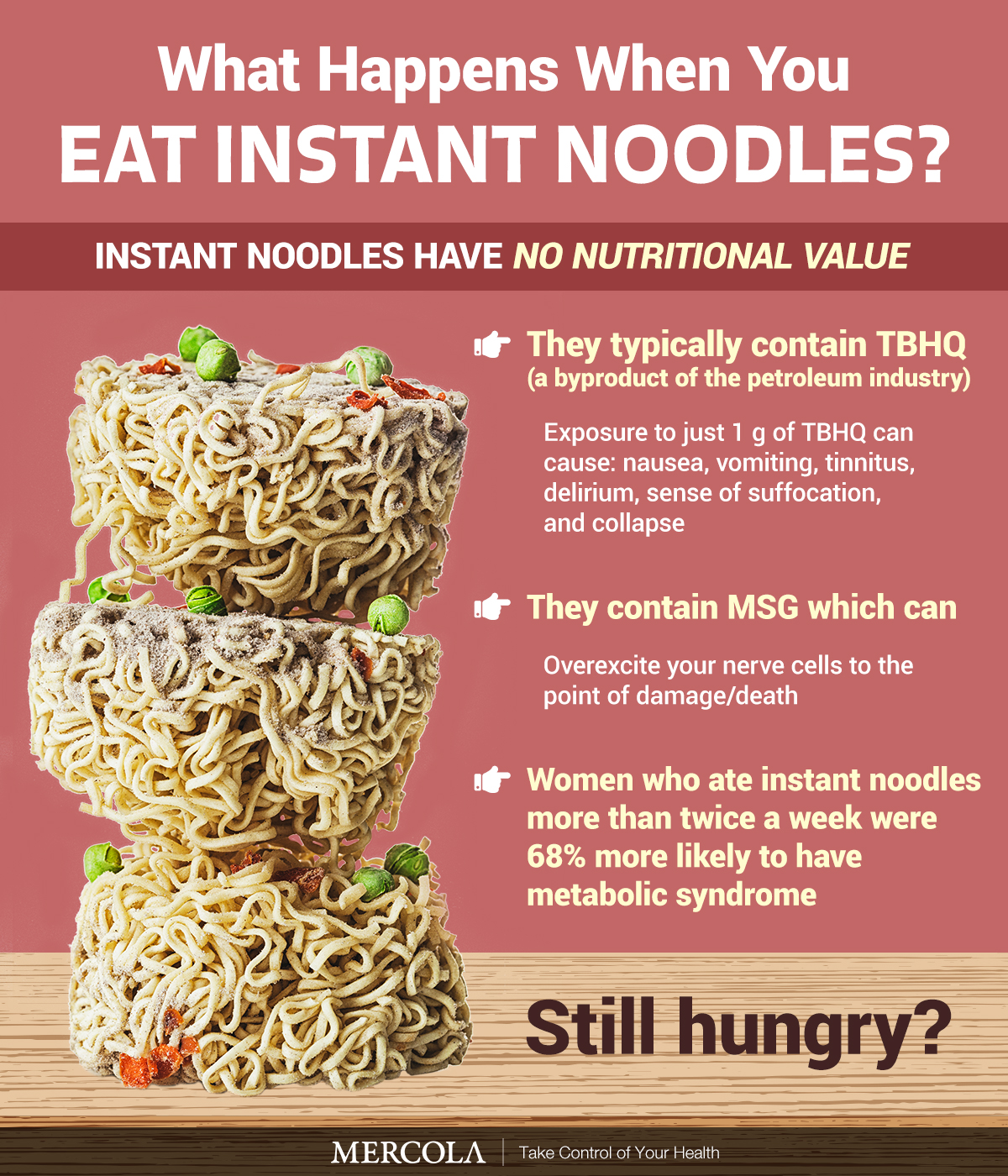
  • Women who ate instant noodles more than twice a week were 68 percent more likely to have metabolic syndrome


Instant noodles are a popular go-to lunch or dinner for those who are strapped for time (or cash), like college students. While you probably don’t consider them a health food, you may think they’re not that bad, or, at least, not as bad as eating a burger and fries or a fast-food burrito.
In a first-of-its-kind experiment, however, Dr. Braden Kuo of Massachusetts General Hospital may make you reconsider your love of instant noodles (assuming you have one).
He used a pill-sized camera to see what happens inside your stomach and digestive tract after you eat ramen noodles, one common type of instant noodles. The results were astonishing…

Ramen Noodles Don’t Break Down After Hours of Digestion

In the video above, you can see ramen noodles inside a stomach. Even after two hours, they are remarkably intact, much more so than the homemade ramen noodles, which were used as a comparison. This is concerning for a number of reasons.
For starters, it could be putting a strain on your digestive system, which is forced to work for hours to break down this highly processed food (ironically, most processed food is so devoid of fiber that it gets broken down very quickly, interfering with your blood sugar levels and insulin release).
When food remains in your digestive tract for such a long time, it will also impact nutrient absorption, but, in the case of processed ramen noodles, there isn’t much nutrition to be had. Instead, there is a long list of additives, including the toxic preservative tertiary-butyl hydroquinone (TBHQ).
This additive will likely remain in your stomach along with the seemingly invincible noodles, and no one knows what this extended exposure time may do to your health. Common sense suggests it’s not going to be good…

Five Grams of Noodle Preservative, TBHQ, Is Lethal

TBHQ, a byproduct of the petroleum industry, is often listed as an "antioxidant," but it's important to realize it is a synthetic chemical with antioxidant properties– not a natural antioxidant. The chemical prevents oxidation of fats and oils, thereby extending the shelf life of processed foods.
It's a commonly used ingredient in processed foods of all kinds (including McDonald’s chicken nuggets, Kellogg’s CHEEZ-IT crackers, Reese’s peanut butter cups, Wheat Thins crackers, Teddy Grahams, Red Baron frozen pizza, Taco Bell beans, and much more).
But you can also find it in varnishes, lacquers, and pesticide products, as well as cosmetics and perfumes to reduce the evaporation rate and improve stability. 

At its 19th and 21st meetings, the Joint FAO/WHO Expert Committee on Food Additives determined that TBHQ was safe for human consumption at levels of 0-0.5 mg/kg of body weight.1
However, the Codex commission set the maximum allowable limits up to between 100 to as much as 400 mg/kg, depending on the food it's added to.2(Chewing gum is permitted to contain the highest levels of TBHQ.) In the US, the Food and Drug Administration requires that TBHQ must not exceed 0.02 percent of its oil and fat content.3
So there’s quite a discrepancy in supposedly "safe" limits, but it’s probably best to have little or no exposure to this toxicant, as exposure to five grams can be lethal and, according to A Consumer's Dictionary of Food Additives, exposure to just one gram of TBHQ can cause:4
  • Nausea and vomiting
  • Ringing in the ears (tinnitus)
  • Delirium
  • Sense of suffocation
  • Collapse
While TBHQ is not suspected to be a persistent toxicant, meaning your body is probably able to eliminate it so that it does not bioaccumulate, if you eat instant noodles your body might be getting prolonged exposures. This is concerning, to say the least. According to the Environmental Working Group (EWG), based on animal studies health hazards associated with TBHQ include:5
  • Liver effects at very low doses
  • Positive mutation results from in vitro tests on mammalian cells
  • Biochemical changes at very low doses
  • Reproductive effects at high doses

Eating Instant Noodles Linked to Metabolic Syndrome

If you’re still considering ramen noodles for lunch, you should know a new study published in the Journal of Nutrition found that women who consumed more instant noodles had a significantly greater risk of metabolic syndrome than those who ate less, regardless of their overall diet or exercise habits.6
Women who ate instant noodles more than twice a week were 68 percent more likely to have metabolic syndrome -- a group of symptoms such as central obesity, elevated blood pressure, elevated fasting blood sugar, elevated fasting triglycerides, and low levels of HDL cholesterol.
Having three or more of the symptoms increases your risk of developing diabetes and cardiovascular disease. Past research also analyzed overall nutrient intake between instant-noodle consumers and non-consumers, and found, as you might suspect, that eating instant noodles contributes little value to a healthy diet.
The instant-noodle consumers had a significantly lower intake of important nutrients like protein, calcium, phosphorus, iron, potassium, vitamin A, niacin, and vitamin C compared with non-consumers.7 Those who ate instant noodles also had an excessive intake of energy, unhealthy fats and sodium (just one package may contain 2,700 milligrams of sodium).8

What Else Is in a Package of Instant Noodles?

Aside from a lot of sodium and the preservative TBHQ, what else is found in a typical serving of instant noodles? Prevent Disease reported:9
“The dried noodle block was originally created by flash frying cooked noodles, and this is still the main method used in Asian countries, though air-dried noodle blocks are favored in Western countries. The main ingredients of the dried noodle are wheat flour, palm oil, and salt. Common ingredients of the flavoring powder are salt, monosodium glutamate, seasoning, and sugar.
…In June 2012, the Korea Food and Drug Administration (KFDA) found Benzopyrene (a cancer-causing substance) in six brands of noodles made by Nong Shim Company Ltd. Although the KFDA said the amounts were minuscule and not harmful, Nong Shim did identify particular batches of noodles with a problem, prompting a recall by October 2012.”
The monosodium glutamate (MSG) in instant noodles is reason enough to avoid them. MSG is an excitotoxin, which means it overexcites your nerve cells to the point of damage or death, causing brain dysfunction and damage to varying degrees -- and potentially even triggering or worsening learning disabilities, Alzheimer's disease, Parkinson's disease, Lou Gehrig's disease, and more.
Part of the problem is that free glutamic acid (MSG is approximately 78 percent free glutamic acid) is the same neurotransmitter that your brain, nervous system, eyes, pancreas, and other organs use to initiate certain processes in your body. Not to mention, MSG is also used to fatten up mice for scientific study. Yes, MSG is the perfect obesity drug. If you want to achieve your ideal body weight and health, avoid MSG at all costs.

Return to Whole, Living Foods for Optimal Health

Occasionally eating a package of instant noodles clearly won’t kill you, but when you make a habit of substituting convenience foods for real food, it’s only a matter of time before health problems will likely develop. Instant noodles are a prime example of the types of processed foods you want to avoid as much as possible, as they are virtually guaranteed to make you sick and fat if you indulge too much (and “too much” may be as little as a couple of times a week).
Processed foods encourage weight gain and chronic disease because they’re high in sugar, fructose, refined carbohydrates, and artificial ingredients, and low in nutrients and fiber. Processed foods are addictive and designed to make you overeat; they also encourage excessive food cravings, leading to weight gain. Eating processed foods also promotes insulin resistance and chronic inflammation, which are hallmarks of most chronic and/or serious diseases. On the other hand, people have thrived on vegetables, meats, eggs, fruits, and other whole foods for centuries, while processed foods were only recently invented.
Ditching processed foods requires that you plan your meals in advance, but if you take it step-by-step as described in mynutrition plan, it's quite possible, and manageable, to painlessly remove processed foods from your diet. You can try scouting out your local farmer's markets for in-season produce that is priced to sell, and planning your meals accordingly, but you can also use this same premise with supermarket sales. You can generally plan a week of meals at a time, making sure you have all ingredients necessary on hand, and then do any prep work you can ahead of time so that dinner is easy to prepare if you're short on time (and you can use leftovers for lunches the next day, so you don’t have to resort to instant noodles).
http://articles.mercola.com/sites/articles/archive/2014/09/03/eating-instant-noodles.aspx

This post is on Healthwise