Pages

Showing posts with label Watercress. Show all posts

Wednesday, 13 November 2019

Watercress Blocks Cancer and DNA Damage

Increasing evidence is finding that watercress inhibits the development of cancer in the body. As the research has matured, active anticancer compounds in watercress are getting more attention among researchers
Cancer development in smokers is slowed

Posted on: 
Wednesday, August 9th 2017 at 8:00 am
Written By: 
Case Adams, Naturopath

Watercress Blocks Cancer and DNA Damage
Originally published at Heal Naturally
Researchers from the University of Minnesota tested 82 smokers for what is called NNK activation. NNK is a carcinogen - long form is also known as 4-(methylnitrosamino)-1-(3-pyridyl)-1-butanone. It is a leading cause of cancer from smoking. The smokers were given either the active compound in watercress - phenethyl isothiocyanate - or a placebo for a week. Previous research has established that phenethyl isothiocyanate or PEITC is significantly anticancer.
The researchers gave the smokers special cigarettes so they could measure NNK metabolism. They found that in just one week, NNK activation was reduced by 7.7 percent. That's not bad for chain-smokers!
The researchers concluded:
The results of this trial, while modest in effect size, provide a basis for further investigation of PEITC as an inhibitor of lung carcinogenesis by NNK in smokers."
The evidence has been mounting
As hinted at above, this is not the first study showing watercress' anticancer ability.
A 2012 study from Scotland’s Edinburgh Napier University found that watercress reduces DNA damage and oxidative stress - two main components of cancer development.
The researchers studied ten healthy young men (average age 23) for four months. The men were tested before and after the study, and on a daily basis, before and after exhausting aerobic exercise. During one eight-week period, the subjects took 85 grams of watercress supplements daily. They took the supplements two hours before exercise. During the other eight-week period, they worked out without the supplements.
When given the watercress supplement, the men showed a significant reduction in reactive oxygen species levels, and reduced DNA damage. Blood samples also revealed that levels of lipid peroxidation - the major cause for artery disease - were also significantly lower when taking the watercress.
Strenuous exercise typically produces DNA damage, which the body will hopefully repair. The ability of watercress to reduce DNA damage confirms earlier research showing that watercress reduces mutation and cancer growth.
The researchers commented on this aspect of the study:
The study demonstrates that exhaustive aerobic exercise may cause DNA damage and lipid peroxidation; however, these perturbations are attenuated by either short- or long-term watercress supplementation, possibly due to the higher concentration lipid-soluble antioxidants following watercress ingestion."
A 2014 study from China's First Affiliated Hospital of Guiyang Medical College found that Phenethyl isothiocyanate halted the growth of leukemia cancer cells.
Another 2014 study from the University of Pittsburgh found that isothiocyanate and sulforaphane - also present in watercress as well as broccoli and other cruciferous vegetables - can halt the growth of prostate cancer.
Georgetown University researchers established in 2011 that isothiocyanate inhibited the growth of cervical cancer and breast cancer cells.

There are other anticancer agents in watercress
Cancer researchers love to hone in on one special anticancer agent. They are looking for single bullets. But nature doesn't work like that. Nature's anticancer foods like watercress will contain other anticancer agents to fight cancer. Yes, nature fights cancer.
Besides isothiocyanate and sulphorophane, watercress contains a host of antioxidant nutrients, including xanthophyll, beta-carotene, alpha-tocopherol and gamma-tocopherol (two forms of vitamin E), each of which have been shown to slow free radical formation in the body. As other studies have shown, this in turn can reduce the rate of DNA damage and cancer formation in the body. Learn more about watercress on the GreenMedInfo database: Watercress Research.


Reference
Yuan JM, Stepanov I, Murphy SE, Wang R, Allen S, Jensen J, Strayer L, Adams-Haduch J, Upadhyaya P, Le C, Kurzer MS, Nelson HH, Yu MC, Hatsukami D, Hecht SS. Clinical Trial of 2-Phenethyl Isothiocyanate as an Inhibitor of Metabolic Activation of a Tobacco-Specific Lung Carcinogen in Cigarette Smokers. Cancer Prev Res (Phila). 2016 May;9(5):396-405. doi: 10.1158/1940-6207.CAPR-15-0380.
Wang X, Govind S, Sajankila SP, Mi L, Roy R, Chung FL. Phenethyl isothiocyanate sensitizes human cervical cancer cells to apoptosis induced by cisplatin. Mol Nutr Food Res. 2011 Oct;55(10):1572-81.
Gerhauser C. Epigenetic impact of dietary isothiocyanates in cancer chemoprevention. Curr Opin Clin Nutr Metab Care. 2013 Jul;16(4):405-10. doi: 10.1097/MCO.0b013e328362014e.
Wang Y, Wei S, Wang J, Fang Q, Chai Q. Phenethyl isothiocyanate inhibits growth of human chronic myeloid leukemia K562 cells via reactive oxygen species generation and caspases. Mol Med Rep. 2014 Jul;10(1):543-9. doi:
10.3892/mmr.2014.2167.
Sakao K, Vyas AR, Chinni S, Amjad AI, Parikh R, Singh SV. CXCR4 Is a Novel Target of Cancer Chemopreventative Isothiocyanates in Prostate Cancer Cells. Cancer Prev Res (Phila). 2015 Feb 23. pii: canprevres.0386.2014.

Thursday, 3 October 2019

Watercress: Nature’s Little-Known Nutrient VIP - MUST READ

Nasturtium officinale, or watercress, is one of the oldest leafy vegetables known to mankind. 

By Charlene Bollinger
July 22, 2019

This ancient veggie is found in freshwater aquatic environments and is commonly used as a garnish. But there’s a reason that this powerful little plant has been used for centuries: it’s a nutritional powerhouse!

What is Watercress?

Used by Hippocrates, the Roman army, and generations of European farmers, watercress is one of the most nutritionally dynamic foods in the world. Despite being made up of 95% water, it is literally ranked by scientists as one of the healthiest foods in the world. It is most in season between April and October and you can find organic watercress at Ralph’s, Wegman’s, Sprouts, and many other grocers. Many online retailers also offer organic watercress and will ship the superfood straight to your door!
The Aggregate Nutrient Density Index (ANDI) ranks food by comparing its nutrient value against its caloric value. Of all the foods ranked this way, watercress came out at the top of the list. It packs such an impressive nutritional punch that it’s considered the healthiest food available.
While many of us may be unfamiliar with watercress, the cruciferous vegetable provides a host of health benefits. Whether you’re trying to boost your immune system, fight off cancer, or just increase your overall health, watercress is the plant for you.
Here are the top 5 reasons why watercress is the most important food you can put on your plate.

Watercress Nutrition

1| Watercress is Packed with Vitamins

When it comes to vitamins and minerals, no plant offers more benefit per ounce. Each leaf is loaded with vitamin A, vitamin C, vitamin B6, vitamin K, calcium, iron, folate, magnesium, phosphorus, and protein. Despite containing only 4 calories per cup, watercress is a nutrient superstar.
Pound-for-pound, watercress contains more calcium than milk, more vitamin C than oranges, and more iron than spinach. These vitamins and minerals are essential for good health and come with an extremely low caloric cost. Let’s take a look at some of the powerful nutrients found in watercress.

Vitamin K

Just a single cup of watercress provides more than 100% of the recommended daily intake (RDI) of vitamin K. This vitamin is a little-known superstar, promoting strong bones and improving calcium absorption. It can also help improve blood pressure and overall heart health by preventing mineral buildup in the arteries.
Need more reasons to love vitamin K? How about its ability to lower the risk of stroke? This nutrient superstar supports more than healthy bones and cardiovascular health – it can help keep your mind sharp. Studies show that people over 70 with higher vitamin K levels demonstrated improved cognition.

Vitamin C

Everyone knows about vitamin C. Orange juice and other citrus fruits are a great source, and it’s the number one way to fight off a cold. But did you know that watercress packs more vitamin C per pound than oranges? Even better, vitamin C provides a host of amazing abilities to help keep your body healthy and strong.
This super vitamin is essential to a strong immune system and reduced inflammation – both of which help fight chronic diseases like cancer. Vitamin C is also a powerful antioxidant. Antioxidants are crucial for combating oxidative stress, caused by an imbalance of free radicals. Antioxidants help reduce the risk of heart attack, Parkinson’s, Alzheimer’s, chronic fatigue, and chronic inflammation.

Calcium

Another great mineral for bone health, calcium is more commonly associated with milk. But once again, watercress takes home the gold with nearly 4 times more calcium than milk. But the benefits of calcium extend beyond healthy bones and teeth. Calcium can also help lower blood pressure, dilating the arteries and releasing excess sodium. Calcium – along with magnesium – also helps to promote healthy skin and hair.
Calcium assists in the prevention of cardiovascular disease and diabetes, both of which are common causes of death. Perhaps most importantly, it can be hard to get the right amount of calcium through supplements, which is why specialists recommend eating a calcium-rich diet. The nutrients in watercress work together to provide abundant calcium AND helps the body absorb it.

2| Watercress is an Excellent Source of Omega 3s

Most of us get our omega-3s from sources like fish or fish oil supplements. But did you know that leafy greens like watercress are also a great source of omega-3s? Omega-3 fatty acids are a healthy fat, and have been shown to protect the brain, heart, and cardiovascular system.
A study published in The BMJ found that omega-3 fatty acids were associated with healthy aging. A long life doesn’t mean much if we aren’t able to prevent chronic diseases. But researchers found that those with high levels of omega-3s were less likely to experience unhealthy aging. For those who don’t eat seafood, watercress may be one of the best sources for this important nutrient.

3| Watercress is Anti-Inflammatory

Watercress has been shown to reduce chronic inflammation, which is linked to almost all chronic disease. Dietary nitrates found in the super plant help maintain healthy blood vessels, which is crucial for lowering inflammation.
Cruciferous vegetables are known for their anti-inflammatory properties, but watercress takes it to the next level. A 2014 study found that watercress extract actually reduced the occurrence of tissue damage in subjects. Watercress can even be used to help with respiratory issues associated with inflammation.
Illnesses like cough, bronchitis, and even the common flu can all be treated with the nutrients found in watercress. We talked before about how antioxidants found in watercress can fight free radicals and reduce inflammation. By reducing chronic inflammation, you reduce the risk of Alzheimer’s, asthma, heart disease, chronic pain, digestive disorders, diabetes, and even cancer.

4| Watercress Fights Cancer

But there are many ways that watercress helps to fight against cancer. Glucosinolates found in watercress can help inactivate harmful carcinogens, protect healthy cells against damage, and even prevent metastasis of the tumors.
Isothiocyanates, created when glucosinolates are chewed, have been shown in studies to prevent breast, prostate, skin, colon, and lung cancers. Another compound found in watercress, diindolylmethane, has been shown to not only protect against cancer, but also protect healthy cells against toxic cancer treatments.
Harsh treatments like chemotherapy and radiation can destroy healthy cells along with cancerous ones, leaving the body depleted and vulnerable to secondary diseases. One study found that diindolylmethane greatly reduces this collateral damage by protecting healthy cells against ionizing radiation.

5| Watercress is Naturally Detoxifying

Finally, watercress helps to improve the body’s natural detoxification pathways. The human body has many God-given mechanisms for purging harmful toxins. But in today’s ultra-toxic world, the load is often too much for the body to handle on its own. Watercress can give the body that extra boost to clear harmful toxins before they do serious damage.
Watercress is rich in hydration and promote healthy alkaline levels. Both of these are important for detoxification. Watercress juice helps to stimulate enzymes that clear the liver – one of the bodies most important detoxifying organs.
Additionally, watercress increases diuresis, or increased urine production. This is a powerful and natural way to help move toxins out of the body. Its high water content also helps support gallbladder function, another important cog in the body’s detox machine.

Fan-Favorite Watercress Recipes

It’s clear that watercress is one of the most nutritious foods on the planet. Packed with nutrients, it can prevent a number of diseases like cancer, reduce chronic inflammation, and help to detoxify your body. But for many of us, watercress is a foreign veggie. So I’ve put together 3 awesome (& simple!) recipes that you can make at home to help get all of the natural goodness that this amazing plant offers!

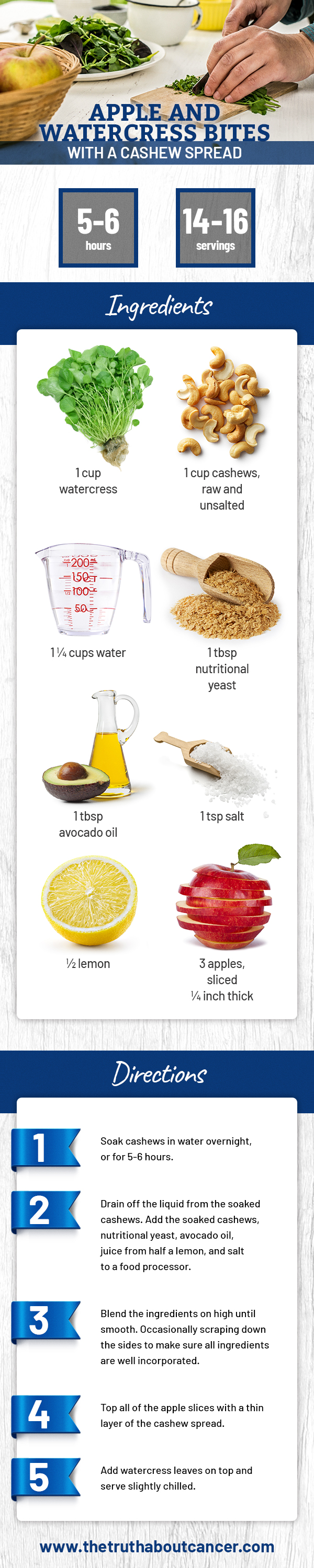
#1. Apple and Watercress Bites with a Cashew Spread Recipe

watercress recipe with apples and cashew spread
Apple and Watercress Bites with a Cashew Spread
Prep Time: 6 hours
Yield: 14-16 servings
Apple and Watercress Bites with a Cashew Spread
Ingredients
  • 1 cup watercress
  • 1 cup cashews, raw and unsalted
  • 1 ¼ cups water
  • 1 tbsp nutritional yeast
  • 1 tbsp avocado oil
  • 1 tsp salt
  • ½ lemon
  • 3 apples, sliced ¼ inch thick
Instructions
  1. Soak cashews in water overnight, or for 5-6 hours.
  2. Drain off the liquid from the soaked cashews. Add the soaked cashews, nutritional yeast, avocado oil, juice from half a lemon, and salt to a food processor.
  3. Blend the ingredients on high until smooth. Occasionally scraping down the sides to make sure all ingredients are well incorporated.
  4. Top all of the apple slices with a thin layer of the cashew spread.
  5. Add watercress leaves on top and serve slightly chilled.

https://thetruthaboutcancer.com/watercress-nutrition/

Hearty Bone Broth and Watercress Soup {Recipe}

Bone broth has widely been referred to as “nature’s multivitamin”… and for good reason. 

By Charlene Bollinger
July 17, 2019

watercress soup recipe
It makes for a hearty, nutritious, and cancer-killing soup that has been a kitchen staple for hundreds of years. Yet it has notably gained popularity with this generation’s cooks and health & fitness enthusiasts.
And why is that? Perhaps because it’s PACKED with 19 amino acids, nutrients like glucosamine, minerals, electrolytes, and collagen.

Get my 5 collagen-inspired recipes for graceful aging here>>

Another incredible benefit of bone broth is the healthy gut boost it provides… which, as we now know, supports about 80% of the immune system.
The collagen/gelatin and the amino acids proline, glutamine, and arginine in traditionally-made bone broths help seal the openings in the gut lining and promote gut integrity.

Read Ty’s article about bone broth nutrition here>>

Watercress, cauliflower, onion, and garlic help the liver to produce more glutathione. Often referred to as the “master antioxidant,” glutathione is a combination of three simple building blocks of protein or amino acids − cysteine, glycine, and glutamine.
Watercress is also a great source of omega-3s and has been shown to reduce chronic inflammation. This cancer-busting watercress soup recipe is a great dish for the whole family!
watercress soup recipe
Short on time?
Substitute the bone broth for Bone Broth Protein.


Hearty Bone Broth and Watercress Soup {Recipe}
Prep Time: 6 hours, 45 minutes
Yield: 12-15 servings
Hearty Bone Broth and Watercress Soup {Recipe}
Ingredients
  • 4 cups bones (organic & grass-fed!)
  • 5 cups water
  • 1 tablespoon apple cider vinegar
  • ⅔ cup onion, chopped
  • 2 cups cauliflower, chopped
  • 1 cup peas
  • 2 cups potatoes (or sweet potatoes), chopped
  • 2 cups watercress leaves
  • ¼ cup chives, chopped
  • ½ teaspoon salt
  • ½ teaspoon pepper
  • ½ teaspoon garlic powder
  • ½ teaspoon onion powder
Instructions
  1. Add 4 cups of bones to a pressure cooker. Then, cover the bones with water and one tablespoon of apple cider vinegar.
  2. Cook the bones on high pressure for 6 hours.
  3. Drain the liquid from the bones. Then, pour the broth to a pot on the stove on medium heat.
  4. Add the chopped onions, chopped cauliflower, peas, chopped potatoes, watercress leaves, salt, pepper, garlic powder, and onion powder.
  5. Simmer the contents of the pot for 30 minutes. Stir the soup occasionally.
  6. Serve hot and garnish with chopped chives.


https://thetruthaboutcancer.com/watercress-soup-recipe/

Tuesday, 12 July 2016

MUST READ: More Reasons to Eat Your Broccoli

Scientists already knew broccoli was loaded with incredible enzymes and compounds like sulforaphane. A new study found phenolic compounds in broccoli may prevent several types of cancer, as well as several other diseases. But as beneficial as broccoli is, sprouting it accelerates the nutrients dramatically.


This post is on Healthwise


July 04, 2016 


Story at-a-glance

    Eating Broccoli
  • Broccoli is becoming increasingly popular because studies show consuming it may reduce your risk of many debilitating diseases
  • Eating broccoli may help reduce lung and prostate cancers due to a powerful compound, sulforaphane, but a new study shows phenolic compounds may prevent several other cancer types, as well as other diseases
  • Researchers analyzed broccoli strains for the best phenolic traits and plan to breed Brassica veggies to be infused with mega-doses of phenolic compounds
  • Sprouted broccoli contains 30 to 50 times more protective chemicals than regular broccoli. Sunflower seeds, radishes and watercress, with similar phenolic compounds, can also be sprouted
By Dr. Mercola
You already know broccoli is good for you, but recent information from the scientific community has revealed that broccoli, the tasty, tiny tree doppelganger, is even better for you than previously thought.
Scientists already knew broccoli and other Brassica vegetables could protect against cancer.
Sulforaphane, a naturally occurring organic sulfur compound within the isothiocyanate group, has caused cell cycle arrest and apoptosis, or programmed cell death, in colon cancer cells1 and exterminated breast cancer stem cells. Another study explained:
“Epidemiological studies suggest that intake of cruciferous vegetables including broccoli reduces the risks for the induction of certain forms of cancer.
This protective effect has been linked to the presence of glucoraphanin, a glucosinolate precursor of sulforaphane, an isothiocyanate that influences the process of carcinogenesis.”2
The same study referenced some of the ways this takes place, including the inhibition of tumor development, cell growth, proliferation and apoptosis.
In other studies, broccoli has played a part in lowering risk factors in lung cancer,3one of the most common cancer types in the U.S., as well as prostate cancer,4 the most common type of cancer in U.S. men (other than skin cancer), due to its isothiocyanate content. It’s important to know that you have to get these compounds through your diet.
In the newest revelation, scientists at the University of Illinois identified the “candidate” genes that influence phenolic compounds such as flavonoids in broccoli and found that eating them is strongly associated with a lower risk of several other diseases, including asthma, type 2 diabetes and coronary heart disease, as well as several cancer types.
Researchers crossed two broccoli strains, analyzed their offshoots and used “quantitative trait locus analysis”5 to find the genes responsible for both the highest phenolic production and the ability to annihilate free radicals.
Significantly, the scientists reported that the more people eat these compounds, the less they tend to contract these and other diseases. According to Jack Juvik, Ph.D., a geneticist at the University of Illinois, in Phys.org:
"Phenolic compounds have good antioxidant activity, and there is increasing evidence that this antioxidant activity affects biochemical pathways affiliated with inflammation in mammals.
We need inflammation because it's a response to disease or damage, but it's also associated with initiation of a number of degenerative diseases. People whose diets consist of a certain level of these compounds will have a lesser risk of contracting these diseases."6
What scientists hope to do with this new information is interesting: they plan to breed broccoli and other vegetables, such as cabbage, cauliflower and kale, and essentially infuse them with “mega-doses” of phenolic compounds. However, as Juvic noted:
"It's going to take awhile. This work is a step in that direction, but is not the final answer. We plan to take the candidate genes we identified here and use them in a breeding program to improve the health benefits of these vegetables.
Meanwhile, we'll have to make sure yield, appearance and taste are maintained as well."7

The Breakdown on Phenolic Compounds in Brassica Vegetables

Regarding phenolic compounds, the term itself is generic to more than 8,000 compounds throughout the plant kingdom. Of all the phytochemicals containing health-promoting and disease-preventing antioxidants, phenolic compounds may be at the top.
Hundreds of studies have revealed their phenomenal effect on cancer and other diseases, especially in terms of inflammation, oxidative stress and toxic load. According to The George Mateljan Foundation,8 a non-profit foundation sharing scientifically proven information about the benefits of healthy eating:
“Any food improving all three of these metabolic problems would be highly likely to lower our risk of cancer. In the case of broccoli, the research is strongest in showing decreased risk of prostate cancer, colon cancer, breast cancer, bladder cancer and ovarian cancer.
We expect that risk of other cancer types will also eventually be shown to undergo reduction from regular consumption of broccoli.”
One of the ways phenolic compounds slow the encroachment of disease is by defending against infection, most dramatically by zapping reactive oxygen species (ROS) linked to serious diseases such as atherosclerosis and neurodegenerative diseases such as Parkinson’s and Alzheimer’s. The most abundant polyphenol and nutritionally beneficial compounds include:
  • Flavonoids, including flavonols and anthocyanins, which play a role in UV protection, pigmentation and disease resistance
  • Hydroxycinnamic acids, most notable for their significant antioxidant properties,9 and include coumaric, sinapic and ferulic acids
One extensive review published in the journal Molecules noted many of the attributes of flavonoids:
“They have been reported to possess many useful properties for human health, including anti-inflammatory, enzyme inhibition, antimicrobial, antiallergic, vascular and cytotoxic antitumor activity, but the most important action of phenolics is their antioxidant activity.
Flavonoids are involved in a vast array of biological functions. Quercetin, a major representative of the flavonol subclass and which is found at high concentration in broccoli, has received considerable attention.
This flavonoid has displayed the ability to prevent the oxidation of LDL by scavenging free radicals and chelating transition metal ions.”10

Brassica Veggies and Their Incredible Health Benefits

When you eat broccoli and other Brassica vegetables, the flavonoids are taken in and distributed throughout your bloodstream. These nutrients can’t be manufactured in your body; they must be ingested through food.
And because the strength of the compounds dissipates after a few days, you likely need to eat broccoli or some other type of Brassica vegetable at least three or four times a week for continued disease-fighting protection against degenerative disease.
Sometimes called cruciferous vegetables, Brassica veggies, encompassing many common vegetables, contain vitamins C and E and carotenoids, and come in four categories:11
  • Brassica oleracea — Kale, collards, Brussels sprouts, cabbage, broccoli, cauliflower and kohlrabi
  • Brassica rapa — Bok choy, Chinese cabbage, turnips, turnip greens and tops, mibuna, komatsuna, broccoleto and yellow sarson
  • Brassica napa — Leaf rape, nabicol and rutabaga
  • Brassica juncea — Mustard greens
Possibly the first of its kind, another recent broccoli-related study12 that impressed the scientific community showed broccoli in particular has the potential to protect you against fatty liver disease, aka non-alcoholic fatty liver disease or NAFLD.
NAFLD can not only impair your liver function but also may trigger cirrhosis or a liver cancer called hepatocellular carcinoma (HCC), which has a high mortality rate.
One of the reasons scientists began focusing on liver cancer was because it’s become an epidemic. This is particularly in men, who are five times more likely to develop NAFLD, especially if they’re obese due to eating what’s now known as the Western diet, which is often high in unhealthy fats and sugar.

What Do Sunflower Seeds, Watercress, Radishes and Broccoli Have in Common?

One of the amazing things about plant-based foods is that many of the same nutrients can be found in seemingly unrelated foods. That’s true with sunflower seeds (technically sunflower kernels), radishes, watercress and broccoli.
When they’re sprouted, the flavonoid content and other phenolic compounds quadruple several times over.
In a study of how germinating broccoli, radish, sunflower seeds and mung bean seeds affected their phenolic acids, flavonoids and antioxidants, scientists concluded that germination increased all three in all of the selected seeds, but especially the sunflower and radish seeds.13 That’s pretty impressive, because according to a New York Times article from nearly 20 years ago:14
“Researchers from Johns Hopkins University School of Medicine in Baltimore have found that broccoli sprouts, grown in plastic laboratory dishes from ordinary broccoli seeds, contain anywhere from 30 to 50 times the concentration of protective chemicals found in mature broccoli plants.
These chemicals, called isothiocyanates, were already known to be potent stimulators of natural detoxifying enzymes in the body, and are thought to help explain why the consumption of broccoli and other cruciferous vegetables like cauliflower, cabbage and kale is associated with a lowered risk of contracting cancer.”
Sunflower kernels provide DPPH (α-diphenyl-β-picrylhydrazyl) scavenging activity, so they’re an excellent antioxidant, as well. According to another study on radish sprouts:
“Radish sprouts contain significantly greater concentrations of glucosinolates and isothiocyanates than the mature radish taproot and also contained significantly greater concentrations of phenolics.”15

Sprouting Sprouts: A Fun, Easy Superfood You Can Grow Year-Round

The thing about sprouting vegetables is that while it may seem difficult or messy, the fact is it’s really easy and even fun! Maybe the best aspect is that it doesn’t require a garden per se; you can grow broccoli sprouts in a jar or in shallow trays in 14 days, and sometimes much less.
You don’t need a lot of special equipment or even a lot of light, and the small effort it takes provides tasty, raw micronutrients with as much as 100 times more enzymes than you get eating raw mature vegetables and fruits. You may prefer growing them in organic potting soil spread in trays.
Besides the advantages already listed, broccoli sprouts deliver essential fatty acids and fiber, as well as a boost in the bioavailability of minerals and protein. Be sure your sprouts are organic though, so you’re not exposing yourself to harmful chemicals and pesticides. You save money and boost your health in ways you may not even notice. You’re too busy eating!
http://articles.mercola.com/sites/articles/archive/2016/07/04/more-reasons-to-eat-broccoli.aspx

This post is on Healthwise