Pages

Showing posts with label Paracetamol. Show all posts

Tuesday, 8 February 2022

Blood pressure warning over long-term paracetamol use

 People with high blood pressure who take paracetamol on prescription could be increasing their risk of heart attacks and strokes, a study suggests.

By Philippa Roxby
BBC Health reporter

8 February 2022


Doctors should think about the risks and benefits to patients taking it over many months, the University of Edinburgh researchers say.

Taking the painkiller for headaches and fevers is safe, they stress.

Other experts say research in more people over a longer timeframe is needed to confirm the findings.

Paracetamol is widely used around the world as a short-term remedy for aches and pains but also prescribed to manage chronic pain, despite little evidence of its benefit for long-term use.

Half a million people - one out of every 10 - in Scotland were prescribed the painkiller in 2018.

High blood pressure affects one out of every three people in the UK.

The study tracked 110 volunteers, two-thirds of whom were taking drugs for high blood pressure, or hypertension.

In a randomised trial, they were asked to take 1g of paracetamol four times a day for two weeks - a common dose for patients with chronic pain - and then dummy pills, or placebo, for another two weeks.

The trial showed paracetamol increased blood pressure, "one of the most important risk factors for heart attacks and strokes" - much more than a placebo, Edinburgh clinical pharmacologist Prof James Dear said.

The researchers advise doctors to start patients with chronic pain on as low a dose of paracetamol as possible and keep a close eye on those with high blood pressure and at risk of heart disease.

Arthritis is one of the biggest causes of chronic pain in the UK. One charity, Versus Arthritis, said safer medicines to treat pain were needed as well as other help, such as mental health support and encouragement to be physically active.

"If you are concerned about the risks from pain medicines you should speak with a healthcare professional to explore your options." said Dr Benjamin Ellis, consultant rheumatologist at Versus Arthritis.

Lead investigator Dr Iain MacIntyre, clinical pharmacology consultant, at NHS Lothian, said: "This is not about short-term use of paracetamol for headaches or fever, which is, of course, fine."

'Many unknowns'

Dr Dipender Gill, clinical pharmacology and therapeutics lecturer, at St George's, University of London, said the study, published in the journal Circulation, had found "a small but meaningful increase in blood pressure in a white Scottish population" but "many unknowns remain".

"Firstly, it is not clear whether the observed increase in blood pressure would be sustained with longer term use of paracetamol," he said.

"Secondly, it is not known for certain whether any increase in blood pressure attributable to paracetamol use would lead to an increased risk of cardiovascular disease."

A large US study previously found a link between long-term paracetamol use and increased risk of heart attacks - but it could not prove one caused the other.

And other smaller studies have been unable to confirm the link.

The Edinburgh team said they could not explain how paracetamol would raise blood pressure but their findings should lead to a review of long-term paracetamol prescriptions.

These were previously considered safer than non-steroidal anti-inflammatory painkillers, such as ibuprofen, which are thought to raise blood pressure in some people.

The British Heart Foundation, which funded the study, said doctors and patients should regularly rethink whether any medication, even something "relatively harmless like paracetamol", was needed.

Dr Richard Francis, from the Stroke Association, said further research in people with normal, healthy blood pressure, over a longer timeframe, was needed "to confirm the risks and benefits of using paracetamol more widely".

More on this story

Related Internet Links

The BBC is not responsible for the content of external sites.

https://www.bbc.com/news/health-60289790

Wednesday, 3 June 2020

Ibuprofen tested as a treatment - Coronavirus

Scientists are running a trial to see if ibuprofen can help hospital patients who are sick with coronavirus.


Lungs infected by CovidImage copyrightGETTY IMAGES
Image captionIt is hoped the treatment will help the severe respiratory symptoms linked to coronavirus

The team from London's Guy's and St Thomas' hospital and King's College believe the drug, which is an anti-inflammatory as well as a painkiller, could treat breathing difficulties.
They hope the low-cost treatment can keep patients off ventilators.
In the trial, called Liberate, half of the patients will receive ibuprofen in addition to usual care.
The trial will use a special formulation of ibuprofen rather than the regular tablets that people might usually buy. Some people already take this lipid capsule form of the drug for conditions like arthritis.
Studies in animals suggest it might treat acute respiratory distress syndrome - one of the complications of severe coronavirus.
Prof Mitul Mehta, one of the team at King's College London, said: "We need to do a trial to show that the evidence actually matches what we expect to happen."
Early in the pandemic there were some concerns that ibuprofen might be bad for people to take, should they have the virus with mild symptoms.
These were heightened when France's health minister Oliver Veran said that taking non-steroidal anti-inflammatory drugs, such as ibuprofen, could aggravate the infection and advised patients to take paracetamol instead.
A review by the Commission on Human Medicines quickly concluded that, like paracetamol, it was safe to take for coronavirus symptoms. Both can bring a temperature down and help with flu-like symptoms.
For mild coronavirus symptoms, the NHS advises people try paracetamol first, as it has fewer side-effects than ibuprofen and is the safer choice for most people. You should not take ibuprofen if you have a stomach ulcer, for example.


Banner image reading 'more about coronavirus'


More on this story


https://www.bbc.com/news/health-52894638


Treatment drugs recommended so far:


Tuesday, 17 March 2020

Coronavirus and ibuprofen: Separating fact from fiction

A woman holds a painkiller pill and a glass of waterImage copyrightGETTY IMAGES
Stories have been circulating online suggesting it's dangerous to take ibuprofen if you have coronavirus. Alongside genuine medical advice, false messages have been spreading, distorting the facts.
Both paracetamol and ibuprofen can bring a temperature down and help with flu-like symptoms.
But ibuprofen and other non-steroidal anti-inflammatory drugs (NSAIDs) are not suitable for everyone and can cause side-effects - especially for people with asthma, heart and circulatory problems.
The NHS website previously recommended both paracetamol and ibuprofen, but has since changed its advice to say that while "there is currently no strong evidence that ibuprofen can make coronavirus (Covid-19) worse... until we have more information, take paracetamol to treat the symptoms of coronavirus, unless your doctor has told you paracetamol is not suitable for you."
The NHS also says that people who are already taking ibuprofen on the advice of a doctor, should not stop taking it without checking first.
Although we don't yet know whether ibuprofen has a particular effect on the severity or length of illnesses caused by coronavirus - either in healthy people or those with underlying conditions - Dr Charlotte Warren-Gash, of the London School of Hygiene and Tropical Medicine, says, especially for vulnerable patients, "it seems sensible to stick to paracetamol as first choice".
But whatever the advice, there's still been a great deal of misinformation online. Bogus messages have been circulating on WhatsApp claiming that:
• "There are four young people in an intensive care unit in Cork who have no underlying illnesses - all were taking anti-inflammatories and there are concerns this has caused a more severe illness" (false)
• The University of Vienna has sent a memo warning people with coronavirus symptoms not to take ibuprofen, "because it has been discovered that it increases the speed of reproduction of the coronavirus Covid-19 in the body and this is the reason why people in Italy have reached the current bad stage and rapid spread" (false)
• "At the university hospital in Toulouse, France, there are four very critical cases of coronavirus in [young people] who do not have any health problems. Their problem is that when they all appeared to have symptoms, they all took painkillers like ibuprofen" (false)
These stories circulating on WhatsApp are also appearing on different platforms including Instagram.
Commonly these kinds of copied-and-pasted texts will claim to be from someone the forwarder says they know, often with a medical background.

All these claims are false

The Infectious Diseases Society of Ireland said a WhatsApp message circulating about coronavirus patients in Cork is "a fake message", asking anyone who receives it to "ignore and delete".
Toulouse University Hospital warned that inaccurate information was circulating on social networks, saying it would not have discussed the care of patients due to medical confidentiality.

So what do we know about ibuprofen and Covid-19?

There has been no research into ibuprofen and the new coronavirus (Covid-19).
But there has been some for other respiratory infections, suggesting ibuprofen is linked to more complications and more severe illness - although we don't know that the ibuprofen itself is causing this, according to Paul Little, a professor of primary care research at University of Southampton.
Some experts believe that ibuprofen's anti-inflammatory properties may affect the body's immune response.
Prof Parastou Donyai at the University of Reading says: "There are many studies that suggest ibuprofen use during a respiratory infection can result in worsening of the disease or other complications."
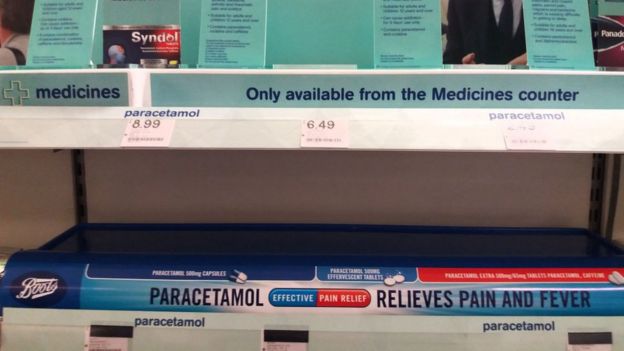
Empty paracetamol shelvesImage copyrightGETTY IMAGES
Image captionParacetamol has sold out in many pharmacies

The spreading of rumours has led to confusion

Worries over the use of ibuprofen appear to have surfaced in France, after Jean-Louis Montastruc, a doctor at Toulouse University Hospital warned on Twitter that: "In this period of coronavirus, it is necessary to remember the risk of complications of the NSAIDs in case of fever or infection."
A subsequent tweet by France's health minister, Olivier Veran, saying that anti-inflammatory drugs "could be an aggravating factor of the infection" was shared more than 43,000 times. But he also said people should consult a doctor before stopping taking them.
Other tweets are also being shared including one saying that ibuprofen "may cause severe cases of the disease, even in young and middle-aged adults with no underlying conditions" which has been shared more than 94,000 times on Twitter.
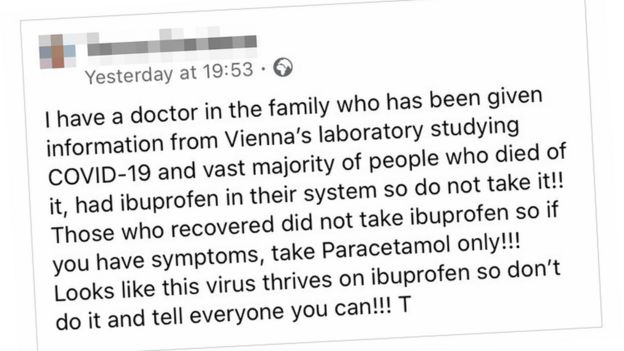
Screengrab from Facebook of a viral message about coronavirus and ibuprofenImage copyrightFACEBOOK
Image captionMany people on social media appeared to have "a doctor in the family" with inside information
A lack of clear consensus on the issue from the medical profession has led to mixed messages and rumours spreading online, and the University of Vienna laboratory claim noted earlier seems to have taken on a life of its own in both English and German.
Twitter and Facebook posts - which seem to be cut-and-pasted and adapted by users - all claim to have a "doctor in the family" who has information from the Vienna lab that "the vast majority of people who died of Covid-19 had ibuprofen in their system". Some of the posts go on to claim that coronavirus "thrives on ibuprofen". There is no evidence that this is the case.
This online rumour also appeared on German-language WhatsApp as voice message and text messages. These messages typically claimed to be from a young mother saying that the Vienna lab had researched Covid-19 deaths in Italy and found that the majority had self-medicated with ibuprofen. The message offers no specific evidence to back up its claims, German aponet.de pharmaceutical news website says. "Such a pattern is typical of conspiracy theories," it concludes.
Reporting by Rachel Schraer, Jack Goodman and Alistair Coleman
Banner image reading 'more about coronavirus'
https://www.bbc.com/news/51929628