A mask that can detect coronavirus in just 10 minutes has been developed by scientists.
The highly sensitive face covering can detect the novel bug in the air and alert the wearer via an app on their phone. It can also pick up swine flu and bird flu.
Those diseases spread through droplets in the air released by infected people when they talk, cough or sneeze.
The tiny, invisible molecules can remain suspended in the air for a long time and people catch the illnesses by breathing in a big cluster of the molecules.
Researchers in China tested the mask in an enclosed chamber by spraying liquid containing virus proteins on to the face covering. The sensor responded to just 0.3 microlitres of the liquid.
That is between 70 and 560 times less than the amount of liquid produced by one sneeze and even less than the amount created by coughing or talking.
The sensor contains aptamers, a type of synthetic molecule that can identify proteins in pathogens. The research model was tested with aptamers that can recognise Covid, swine flu and bird flu.
Once the aptamers bound to the virus proteins in the air, an ion-gated transistor alerted wearers to the pathogens via their phones.
Dr Yin Fang, study corresponding author, of Shanghai Tongji University, said: "Previous research has shown face-mask wearing can reduce the risk of spreading and contracting the disease.
"We wanted to create a mask that can detect the presence of virus in the air and alert the wearer. Our mask would work really well in spaces with poor ventilation, such as lifts or enclosed rooms, where the risk of getting infected is high.
"In the future, if a new respiratory virus emerges, we can easily update the sensor's design for detecting the novel pathogens."
The team now want to develop the mask to detect diseases even faster and create wearable devices that can help people manage other illnesses such as cancer and heart disease.
The findings were published in the journal Matter.
Health department understood to be returning shipment of PPE and seeking refund
Kevin Rawlinson
Thu 7 May 2020 07.14 (This article is more than 3 months old)
The highly publicised shipment of PPE from Turkey arrives two weeks ago after being delayed by several days. Photograph: Steve Parsons/PA
Last month, amid dire warnings of shortages of personal protective equipment for health workers, ministers publicised the imminent arrival from Turkey of a fleet of RAF cargo planes bringing in a “very significant” shipment of PPE for the NHS.
More than a fortnight later, it has emerged that every one of the 400,000 protective gowns that eventually arrived has been impounded after being found not to conform to UK standards.
The Department for Health and Social Care confirmed on Wednesday evening that the items were being held in a facility near Heathrow airport. It is understood that they are due to be sent back and that the DHSC intends to seek a refund, as it has done in similar situations in the past.
Jenrick told the daily Downing Street press briefing that healthcare workers should be “assured that we are doing everything we can to correct this issue”, saying they would have the equipment they “need and deserve”.
Sources later told the Guardian that the DHSC had advised No 10 not to allow Jenrick to publicise the shipment in case it backfired, but was overruled.
The first planeload of gowns eventually arrived on 22 April, but the next day it was reported that “less than a 10th” of the order had arrived. Now all are expected to be returned.
Play Video
1:18
Coronavirus: 84 tonnes of PPE arriving in UK tomorrow, says Jenrick - video
The saga, first reported by the Telegraph, is one of a series of highly publicised government coronavirus initiatives that have failed to deliver the promised results. Its much-trumpeted “ventilator challenge” asked companies such as Rolls-Royce and Dyson to begin producing the machines, but none have reached the final stages of testing and the majority have proved surplus to requirements.
And ministers are facing questions over their testing strategy after it emerged on Wednesday that despite briefly passing the 100,000 per day target set for the end of April, using a tally inflated by including tests that had been sent out but not completed, the government had since fallen short of the mark for a fourth day running.
In the last few days, a British Medical Association survey has revealed that almost half of England’s doctors have sourced their own PPE or relied on a donation when none was available through normal NHS channels.
A Department of Health and Social Care spokesman said: “This is a global pandemic with many countries procuring PPE, leading to shortages around the world, not just the UK.
“We are working night and day to source PPE internationally and domestically, and brought together the NHS, industry and the armed forces to create a comprehensive PPE distribution network to deliver critical supplies to the frontline.
“All deliveries of PPE are checked to ensure the equipment meets the safety and quality standards our frontline staff need. If equipment does not meet our specifications or pass our quality assurance processes, it is not distributed to the front line.”
Health director-general Datuk Dr Noor Hisham Abdullah stressed today that a facemask must be worn properly for it to be effective in preventing the spread of diseases. (123RF.COM)
PUTRAJAYA (July 22): Health director-general Datuk Dr Noor Hisham Abdullah stressed today that a facemask must be worn properly for it to be effective in preventing the spread of diseases.
He said the facemask should cover the entire nose up to the chin, while leaving it around the forehead or neck, or having it only cover part of the nose and mouth was not appropriate, and in fact, posed a risk of contamination or infection.
"The use of a facemask is an important method to prevent the spread of respiratory diseases that are transmitted through viruses, including Covid-19.
"It can be used either to protect healthy people from being infected, or to prevent infected people from infecting others," he said during a press conference on Covid-19 here yesterday.
Prime Minister Tan Sri Muhyiddin Yassin in his special address on the Recovery Movement Control Order (RMCO) yesterday said the government was considering making it obligatory to wear facemasks in public places following the Covid-19 threat, and further details would be announced once the relevant regulations had been finalised.
Dr Noor Hisham said facemasks could be used for six medical and non-medical (non-medical) reasons.
He said the details on the use of facemasks for medical purposes involving health workers are mentioned in the ‘Guidelines on Covid-19 Management in Malaysia’.
Meanwhile, it is recommended for those who do not have any symptoms to use a facemask when they are in a place where Covid-19 is widespread and social distancing is difficult to practice, for example, in public places and crowded environments.
People with respiratory tract issues, as well as those in high-risk groups such as the elderly and with a background of having chronic diseases, should use a surgical 3-ply mask in high-risk and crowded areas, he said.
According to Dr Noor Hisham, the World Health Organisation (WHO) also recommended the use of non-medical fabric type masks with three layers, where the inner layer is water-absorbent (hydrophilic) and the outer layer is made of a material that is water repellent (hydrophobic), which can limit contaminants in the environment from penetrating into the wearer's nose and mouth.
“A middle hydrophobic layer made from synthetic nonwoven materials such as polypropylene or cotton can increase the filtration or resist respiratory droplets.
"The Ministry of Health would also like to remind the public that non-medical facemasks are not considered medical or personal protective equipment," he said.
In addition, he stressed that non-medical facemasks should not be worn by children below the age of two, nor by those who have difficulty breathing, are unconscious, have a disability, or who cannot remove the facemasks on their own.
Dr Noor Hisham said the ministry strongly encouraged the use of facemasks, especially in public places and high-risk areas where it was difficult to practice social distancing.
He said its use was not yet made mandatory, because if this was done under the Prevention and Control of Infectious Diseases Act 1988 (Act 342) those who failed to wear it could be fined or jailed.
According to him, the government is still looking into possible fines or imprisonment for those who did not wear facemasks, but the MOH is recommending its use because it could cut down the risk of infection by up to 65 per cent.
"Now the issue is if it is made mandatory (to wear a mask) whether we will impose a fine of RM1,000 on those who do not wear it in public places, or a prison sentence. That is being examined before we implement the mandatory facemask rule," he said.
Dr Noor Hisham said there were two methods to prevent the spread of Covid-19, namely the use of facemasks and social distancing, which could reduce the chain of infection by up to 70 per cent.
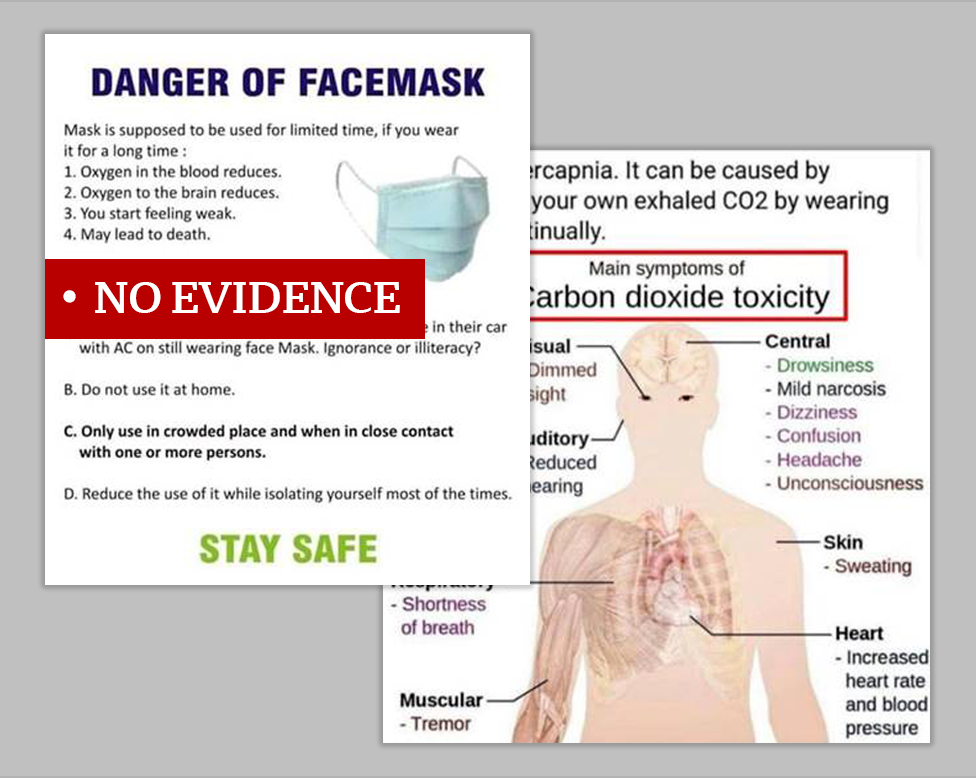
We've seen lots of posts alerting people to this potentially harmful side-effect - called hypercapnia - where there's too much carbon dioxide in the blood.
But it's highly unlikely you'll suffer it wearing a cloth or gauze face mask.
"This simply won't happen unless there is an air-tight fit and you rebreathe your air," says Prof Keith Neal, an infectious disease expert.
Carbon dioxide molecules are tiny - far smaller than droplets containing coronavirus which the masks are designed to stop - and won't be trapped by a breathable material, particularly during relatively short periods like a bus journey.
When you breathe out, the carbon dioxide will go through and round the mask.
Surgeons regularly wear much heavier-duty face coverings all day without coming to harm.
"There have been reports of some medics developing headaches linked to wearing personal protective equipment for long periods of time, but it's still highly unlikely they would suffer from some of the more extreme effects of carbon dioxide toxicity," says Rachel Schraer, BBC Health reporter.
The World Health Organization (WHO) says masks could provide "a barrier for potentially infectious droplets" in areas where "physical distancing of at least one metre is not possible".
"I would rather die of coronavirus than wear a mask"
The question of whether or not to wear a mask has been polarising opinion in the United States for weeks.
Some states and local governments have legislated to make wearing face coverings in public places compulsory, and some stores have introduced their own policies requiring shoppers to wear masks. This has led to a debate online about civil liberties.
Plandemic, a viral conspiracy video full of false claims about coronavirus, included an assertion that wearing a mask "literally activates your own virus", when there is no evidence to support this claim. This led to Facebook removing the video from its platform when it went viral in May.
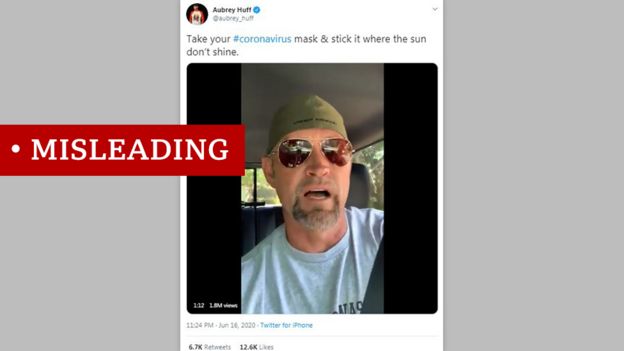
Former professional baseball player Aubrey Huff this week vented his anger about being required to wear a mask, in a video on Twitter, which was viewed 1.6 million times. In it, he claims: "It's not healthy to breathe in your own CO2 all the time", but as we've seen there's no evidence that wearing a face covering causes you to breathe in more CO2.
He concludes: "I would rather die from coronavirus than to live the rest of my life in fear and wearing a damn mask".
Opponents of mandatory mask legislation are protesting against lawmakers' decisions. Last week, the LA Times reported that a public health official resigned from her role after mandating masks in public places in Orange County, California. Protesters created posters of her with a Hitler moustache and swastikas, and she was on the receiving end of what was interpreted as a death threat.
Some people who dispute the need for masks claim the pandemic is either a hoax or exaggerated, despite the hundreds of thousands of deaths worldwide.
A meme that has been widely shared on US Facebook groups since mid-May asks why we are distancing, if masks work. The easy answer is that neither method gives the population full protection, but having both can help limit the spread of the virus.
The meme then goes on to conclude; "Because it's not about the virus. It never was." However, new requirements to wear masks are certainly related to the coronavirus pandemic and efforts to stop the spread of the virus. One example of the meme from a conservative Latino Facebook page has been shared 26,000 times.
Masks won't deprive body of oxygen
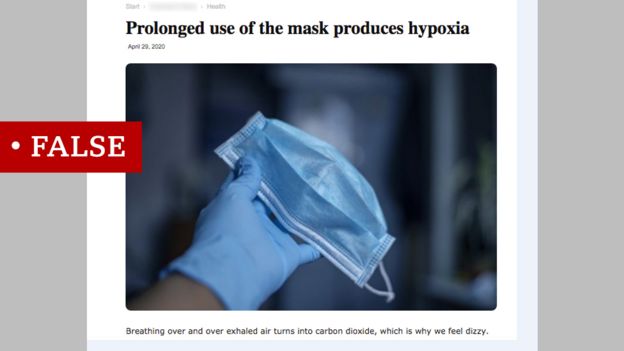
Another theme in misleading posts surrounding the use of masks is that they limit the amount of oxygen getting into the body.
One graphic titled "danger of a face mask" says this "may lead to death".
But the breathable materials recommended for face masks worn properly won't inhibit your breathing.
Breathlessness is a sign that your body is deprived of oxygen - known as hypoxia.
"Thin paper or cloth masks will not lead to hypoxia. Surgeons operate for hours wearing them. They don't get these problems," says Prof Neal.
The WHO says: "The prolonged use of medical masks when properly worn, does not cause CO2 intoxication nor oxygen deficiency.
"While wearing a medical mask, make sure it fits properly and that it is tight enough to allow you to breathe normally. Do not re-use a disposable mask and always change it as soon as it gets damp."
These oxygen-depleting claims have appeared in many different languages: English, German, Serbian and Hebrew Facebook posts alongside the same stock image of a toddler in a mask.
A study has found that not wearing a face mask dramatically increases a person's chances of being infected by the COVID-19 virus. June 12, 2020 Texas A&M University
FULL STORY
Crowd of people wearing medical masks (stock image).
A study by a team of researchers led by a Texas A&M University professor has found that not wearing a face mask dramatically increases a person's chances of being infected by the COVID-19 virus.
Renyi Zhang, Texas A&M Distinguished Professor of Atmospheric Sciences and the Harold J. Haynes Chair in the College of Geosciences, and colleagues from the University of Texas, the University of California-San Diego and the California Institute of Technology have had their work published in the current issue of PNAS (Proceedings of the National Academy of Sciences).
The team examined the chances of COVID-19 infection and how the virus is easily passed from person to person. From trends and mitigation procedures in China, Italy and New York City, the researchers found that using a face mask reduced the number of infections by more than 78,000 in Italy from April 6-May 9 and by over 66,000 in New York City from April 17-May 9.
"Our results clearly show that airborne transmission via respiratory aerosols represents the dominant route for the spread of COVID-19," Zhang said. "By analyzing the pandemic trends without face-covering using the statistical method and by projecting the trend, we calculated that over 66,000 infections were prevented by using a face mask in little over a month in New York City. We conclude that wearing a face mask in public corresponds to the most effective means to prevent inter-human transmission.
"This inexpensive practice, in conjunction with social distancing and other procedures, is the most likely opportunity to stop the COVID-19 pandemic. Our work also highlights that sound science is essential in decision-making for the current and future public health pandemics."
One of the paper's co-authors, Mario Molina, is a professor at the University of California-San Diego and a co-recipient of the 1995 Nobel Prize in Chemistry for his role in understanding the threat to the Earth's ozone layer of human-made halocarbon gases.
"Our study establishes very clearly that using a face mask is not only useful to prevent infected coughing droplets from reaching uninfected persons, but is also crucial for these uninfected persons to avoid breathing the minute atmospheric particles (aerosols) that infected people emit when talking and that can remain in the atmosphere tens of minutes and can travel tens of feet," Molina said.
Zhang said that many people in China have worn face masks for years, mainly because of the bad air quality of the country.
"So people there are sort of used to this," he said. "Mandated face-covering helped China in containing the COVID-19 outbreak."
Zhang said the results should send a clear message to people worldwide -- wearing a face mask is essential in fighting the virus.
"Our work suggests that the failure in containing the propagation of COVID-19 pandemic worldwide is largely attributed to the unrecognized importance of airborne virus transmission," he said. "Social-distancing and washing our hands must continue, but that's not sufficient enough protection. Wearing a face mask as well as practicing good hand hygiene and social distancing will greatly reduce the chances of anyone contracting the COVID-19 virus."
The study was funded by the Robert A. Welch Foundation.
Fight Coronavirus
What is the best way you can help prevent coronavirus from spreading this summer and fall?
Materials provided by Texas A&M University. Original written by Keith Randall. Note: Content may be edited for style and length.
Journal Reference:
Renyi Zhang, Yixin Li, Annie L. Zhang, Yuan Wang, Mario J. Molina. Identifying airborne transmission as the dominant route for the spread of COVID-19. Proceedings of the National Academy of Sciences, 2020; 202009637 DOI: 10.1073/pnas.2009637117
Texas A&M University. "Face masks critical in preventing spread of COVID-19: Study found that wearing a face mask stopped person-to-person spread of the virus." ScienceDaily. ScienceDaily, 12 June 2020. <www.sciencedaily.com/releases/2020/06/200612172200.htm>.