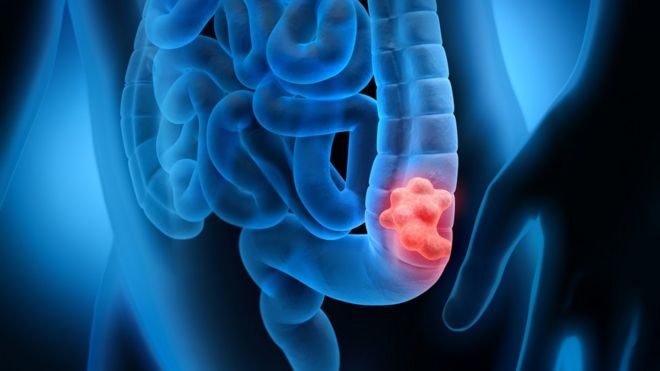
The researchers suspect it may contribute to a minority of bowel cancer cases - one in 20 or five in every 100 - but more research is needed to confirm the link.
There is no routine test for the bacterium currently, and it is not clear yet that people who have it will be at heightened risk.
In some people it may live in the bowel and cause no issue.
It is not the first infection to be linked with cancer, however. HPV is a virus that causes cervical cancer and H pylori infection is associated with stomach cancer.
Is it the same as food poisoning?
No. This particular E. coli strain is not one of the ones linked to food poisoning outbreaks.
There are lots of different types of E. coli. Many are part of the normal gut flora - the trillions of bacteria that naturally live in the bowel.
What did the study find?
The team, from The Netherlands, the UK and the US, used miniature replicas of the human gut, grown in the lab, to test the effects of the toxin on cells.
They then compared the damage seen with more than 5,000 bowel cancer samples taken from patients and found identical patterns or "fingerprints" of DNA damage in around 5% of the samples.
What are bowel cancer symptoms?
a persistent change in bowel habit - going more often, with looser stools and sometimes tummy pain
blood in the stools without other symptoms, such as piles
abdominal pain, discomfort or bloating always brought on by eating - sometimes resulting in a reduction in the amount of food eaten and weight loss
Most people with these symptoms do not have bowel cancer, but the NHS advice is to see your GP if you have one or more of the symptoms and they have persisted for more than four weeks.
Experts say it may be possible to develop a more sensitive test to detect early bowel tumours using this knowledge about the toxin.
The findings may also offer a way to prevent some bowel cancers, by getting rid of the bacterium from the body before it can do any harm, using existing antibiotics.
One of the researchers, Prof Hans Clevers, from the Hubrecht Institute in The Netherlands, said: "Common antibiotics will kill these bacteria.
"This is the first time we've seen such a distinctive pattern of DNA damage in bowel cancer, which has been caused by a bacterium that lives in our gut."
He said there may be other gut bacteria that do the same.
Probiotic treatments that contain a similar strain of E. coli, called Nissle 1917, might also pose a risk potentially, he added - but these are not the same ones found in yoghurt drinks sold in supermarkets.
"Although it might sound scary, there's still lots left to understand about our how our gut bacteria affect our health, what we could do about it, and how much impact it has on bowel cancer risk," says Nicola Smith, senior health information Manager at Cancer Research UK, who funded the work.
"In the future, knowing what role bacteria in our gut plays could change the way we detect and prevent bowel cancer.
"But we do know that around half of bowel cancer cases can be prevented by not smoking, keeping a healthy weight and eating a balanced diet - so there's plenty of changes that you can make right now that will reduce your risk," she added.
Genevieve Edwards, chief executive at Bowel Cancer UK, said: "Although this research is at an early stage, it adds to the growing body of evidence about the role that bacteria and other microorganisms that live in our gut may play in bowel cancer development. "
Would you trust a man who infects himself with tapeworms in the name of science? It sounds crazy, but science journalist and BBC TV presenter Dr Michael Mosley proudly proclaims himself a “Self Experimenter”, according to his Twitter account.
APRIL 18, 2018
BY TAN SHIOW CHIN
Testing whether certain health fads, trends or concepts really work is the basis of Dr Mosley’s work. This shot represents an episode of the Trust Me, I’m A Doctor series where they check out whether coconut oil is harmful or beneficial. — BBC
Speaking to Star2.com on the phone from Taiwan, he says that there are “lots of programmes I do things to myself to test out ideas and claims”, freely admitting that “I think it is partly because it makes better television, and partly because I’m also genuinely interested in finding out about this stuff”.
No surprise that he was inspired by Australian gastroenterologist and Nobel Prize laureate for medicine Prof Dr Barry Marshall, the original modern day self-experimenter who famously downed a broth filled with Helicobacter pylori bacteria in a bid to prove that the microorganism caused gastritis and peptic ulcers.
This was in 1984. Ten years later, Dr Mosley directed a Horizon episode on the work of Prof Marshall and his colleague, pathologist Prof Dr Robin Warren, which was still not widely accepted though it had proven that H. pylori did cause gastritis and peptic ulcers.
The documentary received tremendous response from viewers, including thousands of letters seeking help to treat their gastritis and ulcers (easily curable by a course of antibiotics that kills off the H. pylori). It also triggered an interest that led to Dr Mosley eventually becoming a presenter.
“At that time, I was a director – so I was behind the camera – and I started reading up all about the history of medicine and discovered that it is full of people who experimented on themselves. (For example) anaesthetics was discovered by people snorting and sniffing everything they could lay their hands on.
“And so I proposed a series that was all about the history of medicine told from the lives of self-experimenters. I pitched that idea for 20 years, until eventually, one of the commissioners at the BBC said they wanted it and they wanted me to present it – that’s how I became a presenter,” he shares.
It was, as he described, “his third career within the BBC”, having previously been an executive producer as well. Coincidentally, working with the BBC is actually indeed his third career.
Coming from a family that tended either towards banking or religious service – his maternal grandfather was a bishop of Hong Kong and his paternal family were bankers and traders in the East – a career in the media was certainly not on his radar.
In fact, after studying philosophy, politics and economics at University of Oxford, Dr Mosley followed the family tradition and went into banking. But after two years in the finance industry, he decided to make the leap into medicine.
“I was very interested in what makes people tick, what makes them behave the way they do – psychiatry is what I would have done,” he shares.
However, after qualifying as a doctor, the long hours got to him and he decided that he would take a break, and work for the BBC as a trainee assistant producer for a couple of years before going back to medicine. “That was 32 years ago, so I’m probably not going back,” he says wryly.
Diet For Diabetes
In over three decades that he’s been at the BBC, Dr Mosley has produced, directed and presented dozens of TV series, episodes and documentaries on various science and health topics. He is probably best known for popularising the 5:2 diet.
About six years ago, he was diagnosed with type 2 diabetes – something not altogether surprising, considering that his father had the disease and eventually died from its complications at the age of 72.
His doctor naturally wanted to start him on diabetes medication, but Dr Mosley wanted to see if there was something else he could try, as he knew that the drugs would be a lifelong commitment.
He explains: “The reason you develop type 2 diabetes in most cases, is because you have too much fat in your liver and in your pancreas, not talking to each other. And the best way to get the fat out is through rapid weight loss, and you can effectively reverse your diabetes in as little as eight weeks.”
After doing his research and speaking to various experts, Dr Mosley came up with the 5:2 diet, where you eat only around 700-800 calories for two days in a week, but normally for the remaining five.
He shares that, to his surprise: “I lost 10 kilos, which was about 15% of my body weight at that time, and my blood sugars went back to normal, where they have stayed.
“If you had spoken to me before that, I would have told you that fasting was good for religious people. That was because I didn’t know about all the scientific research, which had been going on for 20 years.”
His self-experiment with this diet, also known as intermittent fasting, was documented in the 2012 Horizon episode Eat, Fast And Live Longer. He also wrote The Fast Diet with Mimi Spencer.
Later, Dr Mosley refined the diet to become the eight-week blood sugar diet, which is specifically tailored to reverse diabetes and written about in his eponymous 2015 book.
“With the eight-week blood sugar diet, you are eating 800 calories seven days a week – it’s a much faster weight-loss diet. Particularly if you want to reverse type 2 diabetes, it is a good idea to do it rapidly,” he says.
He adds that UK-based studies have shown that those on this diet usually lose an average of 14kg after eight weeks, with 85% of those diagnosed with type 2 diabetes for less than five years managing to reverse their condition. For those who have had diabetes for more than five years, the reversal rate is about 50%.
Exploring Good Science
“What I love about the science programmes I do for the BBC is that we go out there and test things, and we do it in a vigorous and proper way, and sometimes, it can be really surprising,” he shares.
The ideas and inspirations for his shows come from a few sources. “In programmes like Trust Me, I’m A Doctor, there is a big research team behind the scenes with scientific PhDs, and we are in close contact with a lot of experts as well. Our viewers also send in ideas,” he explains.
In fact, one of the upcoming episodes in their latest season – in which Dr Mosley is one of five regular presenters – will feature coconut oil as suggested by a viewer. “They had read some claims about the benefits of coconut oil, but their doctor had said it was terrible, so they wanted to know what was the evidence behind it,” he says.
So the show contacted University of Cambridge professors Dr Kay-Tee Khaw and Dr Nita Forouhi to help conduct a study with 94 healthy adults aged 50-75, who were divided into three groups that ate 50g of extra virgin olive oil, 50g of extra virgin coconut oil and 50g of unsalted butter respectively every day for four weeks.
The prediction was that those consuming the coconut oil would have the worst effect on their cholesterol levels, thus increasing their heart disease risk. But, “To everyone’s surprise, coconut oil came out best,” says Dr Mosley.
“It raised the LDL levels, the bad cholesterol, a bit; also, it raised the HDL levels, the good cholesterol, more. In terms of heart disease risk, it appeared to lower it. And it was also the only one of the oils that lead to a reduction in what they call inflammatory factors, which plays an important part in heart disease.”
The study was significant enough to be published in the journal BMJ Open on Mac 6. Dr Mosley himself also throws in ideas that he finds interesting.
“Sometimes, I read things in the newspaper, and I think, is that really true? Then you start to investigate it. And many things you might think are a bit nonsense have a lot of science behind them.”
One of these, for him, was high-intensity interval training (HIIT).
“When I first heard that you could get many of the benefits of exercise from three-minutes-a-week of intense exercise, I thought that has to be nonsense. But it is true,” he says, adding that he has now incorporated the exercise into his life.
Not only did he try out HIIT on himself, but University of Nottingham researchers Dr Beth Phillips and Dr James Blackwell were also recruited to conduct a small study comparing different types of exercise – including HIIT – to see which was the most effective over a period of one month, for the fifth series of Trust Me, I’m A Doctor.
True enough, for the short period of the experiment, the two groups that did HIIT had the most improved fitness levels. Says Dr Mosley: “There’s a big body of scientific knowledge out there that needs to be more widespread, and that’s kind of one of the things we do on Trust Me, I’m A Doctor, which I’m very proud of.”
He adds that all their work is always double-checked by experts to ensure that it is based in good science. “BBC is very vigorous – journalism is very important, so we have to be able to support any claims we make, we have to be able to point to good, strong, robust evidence to back up what we say.”
Oh, and the reason he infected himself with tapeworms? That was to test the theory that these infestations somehow decrease allergies, and true enough, his hay fever episodes did decrease, as can been seen on his show Infested With Michael Mosley.
He recommends increasing our intake of fermented food for the same effect though, rather than ingesting tapeworms.
Trust Me, I’m A Doctor premiered in Asia Monday at 10.50pm on BBC Earth (Unifi channel 501) and online at www.bbcplayer.com.
Read more at https://www.star2.com/health/2018/04/18/he-self-experiments-in-the-name-of-science/
Many believe people with gastric ulcers should avoid eating food with chilli in it when in fact it reduces the amount of stomach acid and lessens symptoms.
April 21, 2017
Eat away. Spicy dishes like this may not give you an ulcer but it is a touch more complex than that.
Do spicy foods cause stomach ulcers?
The short answer: no.
If you’ve ever had a stomach ulcer, you’ll know just how painful and uncomfortable it can be. According to Lisa Griffiths, a homeopath at The Round Clinic on Hong Kong Island, anyone suffering from a stomach ulcer will slowly experience progressively worsening symptoms of heartburn, acid reflux and burping, abdominal pain that is often burning, and changes in appetite and weight.
These symptoms may vary in intensity, and some may be worse than others, but almost all will be linked to the consumption of certain foods and liquids. It’s therefore common to find people with stomach ulcers avoiding certain foods – in particular, spicy foods – so as to not exacerbate the problem.
But spicy foods don’t cause stomach ulcers to develop, says Griffiths. In fact, they actually help the stomach lining because capsaicin – the active component of chilli peppers – has been proven to reduce stomach acid.
Spicy foods can, however, be quite rich. This can make an ulcer flare up because rich foods require more stomach acid to digest. “This increase in stomach acid attacks the already inflamed site of the ulceration, causing intense irritation of the stomach lining,” Griffiths explains. “It’s a bit like pouring vinegar on a cut – instant agony.”
The main causes of stomach ulcers are Helicobacter pylori bacteria and the excessive use of non-steroidal anti-inflammatory drugs (NSAIDs). These can cause the interior lining of the digestive tract around the stomach to break down, creating open sores called ulcers. This interior lining is the stomach’s natural defence against the acid it produces to digest food.
Lifestyle factors such as stress and alcohol causes stomach ulcers. Spicy food may exacerbate the symptoms but not cause it.
“It has to be said that Helicobacter pylori bacteria are relatively common,” says Ines De Beer, an osteopath at The Round Clinic on Hong Kong Island. “The bacteria live in the stomach lining and an infection doesn’t necessarily cause symptoms, but in some people the bacteria can irritate the stomach lining, making it vulnerable to the stomach acid. The real reason why it affects some people and not others is not yet clear, but there’s a general consensus that lifestyle factors, such as stress, smoking and alcohol consumption, play a huge role.”
“So while spicy foods don’t cause stomach ulcers per se, they can certainly aggravate an existing condition if consumed in excess,” adds Griffiths. “If you suffer from this problem, you should get it investigated as soon as possible, rather than treat it on your own with antacids. You should never take antacids for an extended period, because they can lead to chronic kidney disease. They are fine for the occasional bout of heartburn, but if symptoms persist you should see your health practitioner to get your digestive health assessed.”
In addition to learning how to manage your stress and trying to achieve a balanced lifestyle, Griffiths recommends reducing, avoiding or eliminating all foods and substances that are likely to trigger uncomfortable reactions, such as cheese, rich foods, caffeine and alcohol, at least until the problem has been treated and your stomach lining has healed.
You should also increase your intake of foods like garlic, which can help keep levels of Helicobacter pylori in check; unprocessed honey, which kills harmful bacteria that can contribute to the development of ulcers; unripe bananas, which are thought to increase the production of mucous in the gastrointestinal tract, thereby forming a protective coating to help prevent and calm ulcers; and fermented foods, which supply good bacteria to the gut. – South China Morning Post/Sasha Gonzales
Avoiding broccoli didn’t exactly take years off your life. But may we please suggest you replace it with this other cancer-fighting food? And encourage others to do so?
Cabbage doesn’t get the fanfare other vegetables do. But it should. Especially if it’s red cabbage...
Newsletter #659
Lee Euler, Editor
23 November 2016
Dear President Bush,
We all know how much you hate those little tree-shaped veggies called broccoli. You’ve made that abundantly clear.
Back in 1990, when you were President, you let the world know that you refused to eat broccoli – on Air Force One, at the White House, or anywhere else in America. And by all appearances, you haven’t changed your tune in the past 26 years…
We know this because earlier this year a letter from a five-year-old fan named Cooper failed to change your mind. You tweeted, “His declared love of broccoli is genuine, if unpersuasive.”
I guess this has worked for you. You’re 92 years old. Avoiding broccoli didn’t exactly take years off your life.
But may we please suggest you replace it with this other cancer-fighting food? And encourage others to do so?
Cabbage doesn’t get the fanfare other vegetables do. But it should. Especially if it’s red cabbage.
If you don’t enjoy it, maybe it’s time to try preparing it a different way.
A potent cancer fighter
Cabbage contains many potent anti-cancer substances. One that stands above the rest is glucosinolates that break down into indoles, sulforaphane, and other cancer-preventive substances.
The glucosinolates of cabbage convert to isothiocyanate compounds. These, in turn, prevent many cancers – including cancers of the bladder, breast, colon, and prostate.
Your cell cycle is a rigidly controlled set of steps your cells undergo before they divide into two. Before that final split, a cell must duplicate all its contents, so the two daughter cells are exact clones of the parent.
This means if you can alter specific components of the cell’s cycle, you can keep cancer cells from growing, without killing normal cells.
Sulforaphane – another by-product of glucosinolates – selectively targets cancer stem cells, thereby helping to keep cancer in check.
Certain compounds in cabbage change how your body uses estrogen, which may prevent breast cancer.
Cabbage also boasts powerful antioxidants and anti-inflammatory benefits.
Can cabbage kill this cancer-triggering pathogen?
In case you haven’t heard, researchers have linked H. pylori with stomach cancer.
Back in the 1800s, cancer surgeons thought stomach cancer was linked to ulcers, citing inflammation and persistent stomach irritation. But no one really understood it.
To make matters worse, before the 1980s, dominant dogma attributed ulcers and gastritis to stress and diet.
That changed in the early 1980s when two Australian scientists noticed that most ulcer patients had H. pylori bacteria. Their claims were dismissed amid the belief that bacteria couldn’t possibly survive in stomach acid.
To prove his point one of the scientists, Barry Marshall, heroically drank a broth containing H. pylori. Sure enough, he quickly got gastritis. Fortunately, that was before antibiotic resistance had become widespread, so he was able to cure himself of his self-induced illness with antibiotics.
Today, it’s widely accepted that H. pylori triggers ulcers and chronic gastritis.
Chinese study reveals a secret link
Meanwhile, other researchers tried to tease out stomach cancer triggers.
In the 1970s, a large South American study showed that long-term stomach inflammation is often associated with stomach cancer. A link, but still no proof of how one caused the other.
But scientists also knew that stomach cancer rates were highest in infection-prone areas.
Finally a 1990 study collected blood samples from Chinese men of all ages living where H. pylori infections were rampant… then matched them to death records. The results were shocking. Stomach cancer deaths were the only cancer deaths related to H. pylori infection.
Today stomach cancer is the second biggest cancer killer worldwide. If you have H. pylori infection, you’re a whopping six times more likely to develop stomach cancer than if you don’t.
What does this have to do with cabbage? Plenty!
Cabbage juice contains a huge amount of vitamin U. Technically it’s not a vitamin… it’s an enzyme called S methylmethionine and sometimes dubbed “cabbagen.”
Vitamin U effectively promotes rapid healing of peptic ulcers.
Cabbage also stimulates your stomach to produce acid. And while you might not think that’s a good thing, it is. Many people have low stomach acid, which it turns out is a hidden cause of digestive issues. Low stomach acid drastically boosts your risk of infections.
So enjoying a few teaspoons of cabbage juice (or better yet, fermented cabbage juice from sauerkraut) before meals can do wonders for your digestion.
Red cabbage or green cabbage?
Not all cabbage is the same. Red cabbage isn’t the same as green. And it’s not just about looks. It’s about nutritional profile.
To be clear, no matter what color cabbage you eat, you can hardly go wrong.
They’re both low in calories, high in fiber and nutrients. Cabbage is ranked fifth on the Environmental Working Group’s list of the “Clean 15” veggies, containing less pesticide residue than other produce.
As vegetables go, cabbage is also pretty inexpensive.
But make note of these differences between red and green.
Red cabbage – or purple or blue depending on soil pH – contains ten times more vitamin A than green cabbage. One cup of chopped red cabbage provides a third of your recommended daily intake of vitamin A. An equal amount of green cabbage only gives three percent.
Vitamin A helps prevent early stage macular degeneration from progressing to blindness. It promotes healthy teeth, skin, tissues, and immune system.
Then there’s vitamin C…
One cup of chopped red cabbage has 51 milligrams, whereas green cabbage only contains 37 milligrams.
Anti-inflammatory nutrients called anthocyanins are only found in red cabbage. They give it the red or purple color. Besides their anti-cancer benefits, these nutrients help improve memory and promote weight loss.
Iron carries oxygen to your cells for energy and DNA synthesis. Your immune system needs it to fight viruses. Most of us don’t need more iron (you should not take iron supplements, for example, unless a blood test shows you need them.) But you do need some iron, and if you don’t eat red meat you need to find vegetable sources for the mineral.
Red cabbage has twice the iron of green cabbage.
But green cabbage outshines red cabbage for vitamin K (for blood clotting and bone density). One cup of chopped green cabbage provides 57 percent of your daily requirements, compared to just 28 percent in red cabbage. Low vitamin K equates to increased risk of hip fracture.
Best ways to prepare cabbage
To get the most from your cabbage, eat it raw or barely cooked (tender-crisp). Otherwise you’ll lose its anti-cancer effects. All cooking methods reduce anthocyanins, glucosinolates and other nutrients. And skip the microwave. It destroys cancer-fighting enzymes.
Cabbage is popular as a primary fermented vegetable. Sauerkraut is an excellent choice, and try to get it unpasteurized, because it will then be rich in probiotics.
Other do’s and don’ts:
Use firm, undamaged, unblemished heads of cabbage. No limp leaves.
Buy the whole head – not pre-cut or shredded, as the processing loses nutrients to oxidation.
Drink your cabbage juice fresh. Don’t refrigerate.
Limit yourself to four ounces of cabbage juice at once. Best, drink small amounts three times a day on an empty stomach.
If you have a thyroid disorder, avoid large quantities of cabbage. It can interfere with iodine absorption.
Rotate the various types of cabbage into your diet for broadest health benefits.
Cabbage may trigger gassiness in some people.
For a tasty cabbage superfood salad, mix shredded cabbage, chopped kale, carrots, golden beets, orange slices, green onions, Goji berries, raw cashews, sunflower seeds, orange juice, one to two teaspoons sesame oil, sea salt… and sesame seeds for garnish. How much you use of each ingredient is your choice. Enjoy!
Avoiding broccoli didn’t exactly take years off your life. But may we please suggest you replace it with this other cancer-fighting food? And encourage others to do so?
Cabbage doesn’t get the fanfare other vegetables do. But it should. Especially if it’s red cabbage...
Newsletter #659
Lee Euler, Editor
23 November 2016
Dear President Bush,
We all know how much you hate those little tree-shaped veggies called broccoli. You’ve made that abundantly clear.
Back in 1990, when you were President, you let the world know that you refused to eat broccoli – on Air Force One, at the White House, or anywhere else in America. And by all appearances, you haven’t changed your tune in the past 26 years…
We know this because earlier this year a letter from a five-year-old fan named Cooper failed to change your mind. You tweeted, “His declared love of broccoli is genuine, if unpersuasive.”
I guess this has worked for you. You’re 92 years old. Avoiding broccoli didn’t exactly take years off your life.
But may we please suggest you replace it with this other cancer-fighting food? And encourage others to do so?
Cabbage doesn’t get the fanfare other vegetables do. But it should. Especially if it’s red cabbage.
If you don’t enjoy it, maybe it’s time to try preparing it a different way.
A potent cancer fighter
Cabbage contains many potent anti-cancer substances. One that stands above the rest is glucosinolates that break down into indoles, sulforaphane, and other cancer-preventive substances.
The glucosinolates of cabbage convert to isothiocyanate compounds. These, in turn, prevent many cancers – including cancers of the bladder, breast, colon, and prostate.
Your cell cycle is a rigidly controlled set of steps your cells undergo before they divide into two. Before that final split, a cell must duplicate all its contents, so the two daughter cells are exact clones of the parent.
This means if you can alter specific components of the cell’s cycle, you can keep cancer cells from growing, without killing normal cells.
Sulforaphane – another by-product of glucosinolates – selectively targets cancer stem cells, thereby helping to keep cancer in check.
Certain compounds in cabbage change how your body uses estrogen, which may prevent breast cancer.
Cabbage also boasts powerful antioxidants and anti-inflammatory benefits.
Can cabbage kill this cancer-triggering pathogen?
In case you haven’t heard, researchers have linked H. pylori with stomach cancer.
Back in the 1800s, cancer surgeons thought stomach cancer was linked to ulcers, citing inflammation and persistent stomach irritation. But no one really understood it.
To make matters worse, before the 1980s, dominant dogma attributed ulcers and gastritis to stress and diet.
That changed in the early 1980s when two Australian scientists noticed that most ulcer patients had H. pylori bacteria. Their claims were dismissed amid the belief that bacteria couldn’t possibly survive in stomach acid.
To prove his point one of the scientists, Barry Marshall, heroically drank a broth containing H. pylori. Sure enough, he quickly got gastritis. Fortunately, that was before antibiotic resistance had become widespread, so he was able to cure himself of his self-induced illness with antibiotics.
Today, it’s widely accepted that H. pylori triggers ulcers and chronic gastritis.
Chinese study reveals a secret link
Meanwhile, other researchers tried to tease out stomach cancer triggers.
In the 1970s, a large South American study showed that long-term stomach inflammation is often associated with stomach cancer. A link, but still no proof of how one caused the other.
But scientists also knew that stomach cancer rates were highest in infection-prone areas.
Finally a 1990 study collected blood samples from Chinese men of all ages living where H. pylori infections were rampant… then matched them to death records. The results were shocking. Stomach cancer deaths were the only cancer deaths related to H. pylori infection.
Today stomach cancer is the second biggest cancer killer worldwide. If you have H. pylori infection, you’re a whopping six times more likely to develop stomach cancer than if you don’t.
What does this have to do with cabbage? Plenty!
Cabbage juice contains a huge amount of vitamin U. Technically it’s not a vitamin… it’s an enzyme called S methylmethionine and sometimes dubbed “cabbagen.”
Vitamin U effectively promotes rapid healing of peptic ulcers.
Cabbage also stimulates your stomach to produce acid. And while you might not think that’s a good thing, it is. Many people have low stomach acid, which it turns out is a hidden cause of digestive issues. Low stomach acid drastically boosts your risk of infections.
So enjoying a few teaspoons of cabbage juice (or better yet, fermented cabbage juice from sauerkraut) before meals can do wonders for your digestion.
Red cabbage or green cabbage?
Not all cabbage is the same. Red cabbage isn’t the same as green. And it’s not just about looks. It’s about nutritional profile.
To be clear, no matter what color cabbage you eat, you can hardly go wrong.
They’re both low in calories, high in fiber and nutrients. Cabbage is ranked fifth on the Environmental Working Group’s list of the “Clean 15” veggies, containing less pesticide residue than other produce.
As vegetables go, cabbage is also pretty inexpensive.
But make note of these differences between red and green.
Red cabbage – or purple or blue depending on soil pH – contains ten times more vitamin A than green cabbage. One cup of chopped red cabbage provides a third of your recommended daily intake of vitamin A. An equal amount of green cabbage only gives three percent.
Vitamin A helps prevent early stage macular degeneration from progressing to blindness. It promotes healthy teeth, skin, tissues, and immune system.
Then there’s vitamin C…
One cup of chopped red cabbage has 51 milligrams, whereas green cabbage only contains 37 milligrams.
Anti-inflammatory nutrients called anthocyanins are only found in red cabbage. They give it the red or purple color. Besides their anti-cancer benefits, these nutrients help improve memory and promote weight loss.
Iron carries oxygen to your cells for energy and DNA synthesis. Your immune system needs it to fight viruses. Most of us don’t need more iron (you should not take iron supplements, for example, unless a blood test shows you need them.) But you do need some iron, and if you don’t eat red meat you need to find vegetable sources for the mineral.
Red cabbage has twice the iron of green cabbage.
But green cabbage outshines red cabbage for vitamin K (for blood clotting and bone density). One cup of chopped green cabbage provides 57 percent of your daily requirements, compared to just 28 percent in red cabbage. Low vitamin K equates to increased risk of hip fracture.
Best ways to prepare cabbage
To get the most from your cabbage, eat it raw or barely cooked (tender-crisp). Otherwise you’ll lose its anti-cancer effects. All cooking methods reduce anthocyanins, glucosinolates and other nutrients. And skip the microwave. It destroys cancer-fighting enzymes.
Cabbage is popular as a primary fermented vegetable. Sauerkraut is an excellent choice, and try to get it unpasteurized, because it will then be rich in probiotics.
Other do’s and don’ts:
Use firm, undamaged, unblemished heads of cabbage. No limp leaves.
Buy the whole head – not pre-cut or shredded, as the processing loses nutrients to oxidation.
Drink your cabbage juice fresh. Don’t refrigerate.
Limit yourself to four ounces of cabbage juice at once. Best, drink small amounts three times a day on an empty stomach.
If you have a thyroid disorder, avoid large quantities of cabbage. It can interfere with iodine absorption.
Rotate the various types of cabbage into your diet for broadest health benefits.
Cabbage may trigger gassiness in some people.
For a tasty cabbage superfood salad, mix shredded cabbage, chopped kale, carrots, golden beets, orange slices, green onions, Goji berries, raw cashews, sunflower seeds, orange juice, one to two teaspoons sesame oil, sea salt… and sesame seeds for garnish. How much you use of each ingredient is your choice. Enjoy!
 GETTY IMAGES


