For guests checking into a high-profile California hotel, they might be staying in rooms that have been sanitized in part by an unusual new staff member: a three-foot-tall robot named Kennedy.
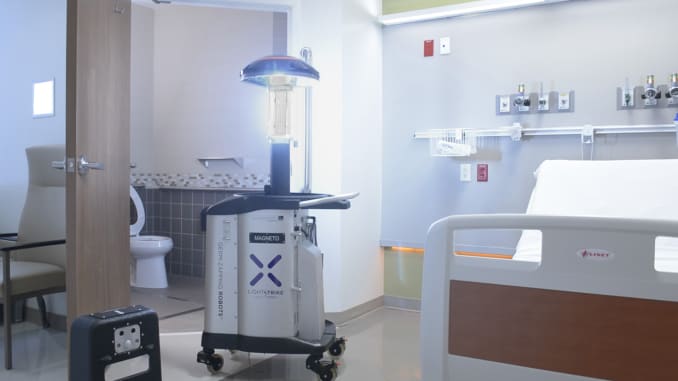
Kennedy is among the Beverly Hilton Hotel's newest lines of defense against coronavirus. It's a machine designed to kill the virus by flashing intense, germ-killing ultraviolet light through the room, after the room has undergone the usual cleaning by Kennedy's human coworkers.
"We really shifted our focus to researching and investing in state-of-the-art hospital-grade technologies to further protect our team members and guests more than we already were," David Alagem, one of the hotel's executives, told ABC News. In addition to the rooms themselves, guests' luggage and packages will also be sanitized using the UV light robots, Alagem said.
Ultraviolet, or UV, light has long been used as a disinfectant in health care settings, but as businesses cautiously reopen their doors in the wake of the coronavirus pandemic, the technique is beginning to spread far more widely, from the hospitality industry to public transportation, even potentially to entertainment.
“UV light disinfection has been around about 100 years,” said James Malley, professor of civil and environmental engineer at the University of New Hampshire. “Done well, it can be a great tool in the toolbox, because it’s an extremely rapid physical disinfectant that is chemical free and it literally works at the speed of light.”
Since the start of the pandemic, scientists have worked to determine how long the virus can live on various surfaces -- and found it's from a few hours to a few days depending on the surface. The Centers for Disease Control and Prevention said the virus that causes COVID-19 spreads easily from person to person and that close contact is the driver for the current pandemic. It may also be possible that a person can get COVID-19 by touching a surface or object that has the virus on it and then touching their own mouth, nose or eyes.
That may be why some industries are turning to new methods to sanitize their spaces in hopes of keeping people safer.
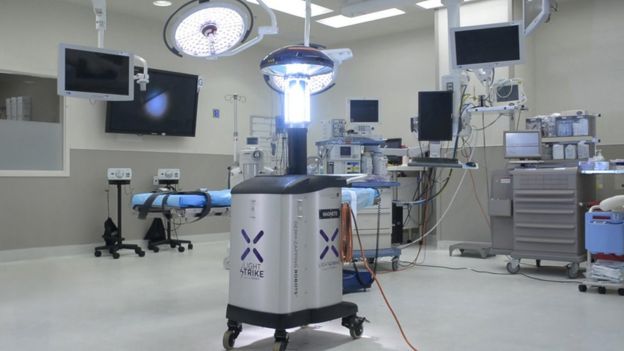
Kennedy is one of three robots the Beverly Hills Hilton is using from the San Antonio-based company Xenex Disinfection Services. The firm said it has been deploying UV light robots in over 500 hospitals around the world for nearly a decade, working with large health care institutions like the Mayo Clinic and MD Anderson.
Recently, the Texas BioMedical Research Institute tested the Xenex’s “Light Strike” robot against SARS-COV2, the virus that causes COVID-19. It found that after two minutes of exposure to the UV light at one-meter distance, about three feet, the virus was eliminated by 99.999%.
“The robot creates a high-energy pulse of UV light that gets into the DNA and the RNA, the genetic material of viruses and bacteria, and basically makes it so they can't replicate anymore," said Dr. Mark Stibich, Xenex's founder and Chief Science Officer. "By pulsing the light, we're able to create very, very high intensity. So in a microsecond we're hitting [those] viruses and bacteria with all sorts of high-energy photons and that really messes up their genetic materials."
The robots "phone home" to Xenex where they can be monitored for any malfunctions, and they have a safety feature that shuts off if it detects movement in the room. Xenex requires purchasers of their product to undergo training sessions to learn how to safely operate the robot.
That's because the kind of UV light used to kill germs, known as UV-C, can be extremely harmful to humans if they are directly exposed to it at high intensities or for extended periods of time.
“We worry about UV light exposures doing damage to the eyes and to the skin,” said Malley.
Damage to the eyes can include cataracts, problems with cornea and temporary, or in some cases, loss of vision. Prolonged exposure to UV light can also impact the skin, making it harder for it to heal, and can cause skin cancer, he said.
Malley said it was imperative the technology be used in secure spaces where no humans could potentially be exposed, and it should only be used by trained operators wearing proper Occupational Safety and Health Administration-approved personal protective equipment.
UV light is not believed to have any lingering effects on the surfaces after the "cleaning" is over, Malley said. When it's gone, it's gone, and does not leave residual particles in air, water, or on solid surfaces, he said.
Now, done right and safely, more businesses are exploring ways to use the technology.
In addition to the Beverly Hilton, the InterContinental Hotels Group, which includes hotel brands Holiday Inn and Candlewood Suites, told ABC News they are now using UV light sanitizing technology in some of their hotels, including at the Crowne Plaza Hotel in White Plains, New York.
Monika Henry, the general manager at the Plaza, said the hotel uses four UV light lamps from the company Fight with Lights as part of their cleaning process. Henry pointed out the importance of this extra step because their hotel has been “home” to many medical first responders who work at nearby hospitals.
Stibich, who was an epidemiologist before founding Xenex, said that major airlines are in discussion with them about using a robot that would fit in a beverage cart. And movie studios who are looking to sanitize their sets have also shown interest.
“Movie studios pose a unique challenge. For example, the costumes are very difficult to disinfect. You can’t use chemicals. You can’t use sprays or anything. But we know our robot won’t fade the materials and it will be effective in reducing the amount of potential contamination on costumes and props,” Stibich told ABC News.
In New York City, the Metropolitan Transportation Authority, which runs the city’s subway system, said a pilot program announced last month using portable UV lamps from PURO Lighting is expanding Friday to test the lights on a full train.
"UV is a proven technology that has worked effectively in hospital emergency rooms, hospital operating rooms, urgent care centers, universities and first-responder locations," Patrick Foye, chairman and CEO of the MTA, said at a news conference last month where the technology was demonstrated. "I don't want to mislead anybody into thinking this is a cure-all. There is still much work to be done, but this is a significant and promising new development."
Amazon recently announced its robotics team developed a UV light robot that they tested in a Whole Foods Market.
“We’re excited about the possibilities and will continue to innovate,” said Amazon spokeswoman Alyssa Bronikowski, though she added none of the UV light mobile units are currently deployed in any Amazon or Whole Foods Market location.
PBA Group, a robotics group based in Asia, has developed and deployed its “Sunburst UV Robot” in malls across Singapore. The company told ABC News they have orders from countries across Southeast Asia and estimate a rollout of over 500 robots in the future.
But experts said UV sanitation does have its limitations and should only be part of a cleaning regimen, especially for consumers.
“UV light only travels in straight lines,” said Charles Gerba, Professor of Epidemiology and Environmental Sciences at the University of Arizona, whose team of researchers have tested the efficacy of multiple disinfectants, including UV light. “You have to be directly pointing to the surface you want to disinfect, and it’s really tricky for a consumer to use.”
He also said that proximity to the light source is a very important factor, because the amount of energy can vary based on the distance you are from the UV light source.
“UV light is best used on a table top,” said Gerba.
Dr. Kinna Thakarar, an infectious disease specialist at Maine Medical Center, also stressed that it would take more than UV light to defeat the spread of the coronavirus.
"UV light should not be used alone as a disinfectant," Thakarar said. "To protect yourself and others from COVID-19, it is important to follow CDC guidelines around prevention: hand-washing, wearing a mask, physically distancing yourself and cleaning surfaces."
Jay Bhatt, a practicing internist and Aspen Health Innovators Fellow, is an ABC News contributor.
Earlier this month, a field hospital staffed by robots opened in the Hongshan Sports Center in Wuhan, China, where the pandemic began.
Dubbed the Smart Field Hospital, the facility can serve 20,000 patients and is a project involving Wuhan Wuchang Hospital, China Mobile and CloudMinds, a maker of cloud robotics systems based in China and the U.S.
It is a trial aimed at relieving exhausted health-care workers even as the outbreak in China slowed in recent weeks.
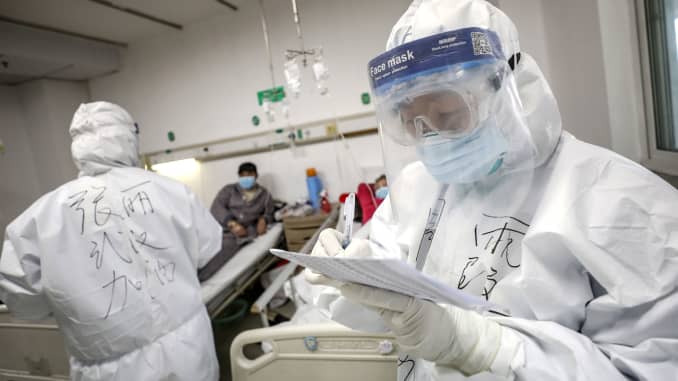
A medical worker in a protective suit checks a patient’s records at Jinyintan hospital in Wuhan, the epicenter of the novel coronavirus outbreak, in Hubei province, China, February 13, 2020.
China Daily via Reuters
After a passenger infected with the novel coronavirus boarded the Diamond Princess cruise ship in January, the virus quickly spread, eventually infecting at least 712 and killing seven. Critics labeled the ship quarantined in Yokohama a floating petri dish, and at least one Japanese expert attributed the explosion of cases to food trays passed out by infected crew. Could robots have made a difference?
As countries around the world grapple with COVID-19, front line medical workers are deploying robots, telemedicine and other technologies to help contain the pandemic. China and Spain have used drones to monitor people during lockdown campaigns, while South Korea has deployed them to help disinfect areas in Daegu, an epidemic hotspot. Antwork, a group company of Japanese industrial drone maker Terra Drone, flew medical samples and quarantine materials in China’s Xinchang in February during the height of the epidemic.
Earlier this month, a field hospital staffed by robots opened in the Hongshan Sports Center in Wuhan, China, where the pandemic began. Dubbed the Smart Field Hospital, the facility is a project involving Wuhan Wuchang Hospital, China Mobile and CloudMinds, a maker of cloud robotics systems based in China and the U.S. The Smart Field Hospital is a trial aimed at relieving exhausted health-care workers even as the outbreak in China slowed in recent weeks.
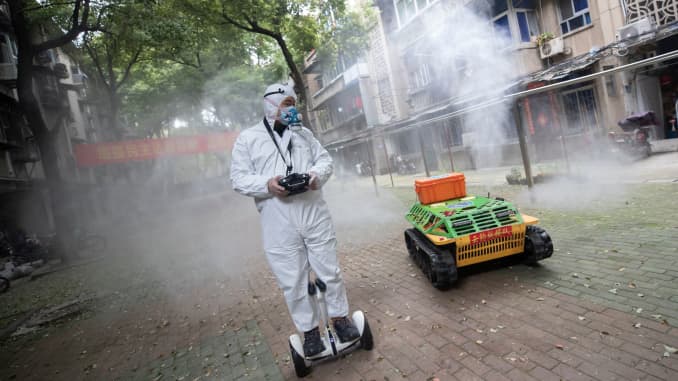
A volunteer operates a remote-controlled disinfection robot to disinfect a residential area amid the COVID-19 coronavirus outbreak in Wuhan in China’s central Hubei province on March 16, 2020.
STR | AFP | Getty Images
All medical services in the facility were carried out by robots and other IoT devices. Patients entering were screened by connected 5G thermometers to alert staff for anyone feverish. Patients wore smart bracelets and rings that synced with CloudMinds’ AI platform so their vital signs, including temperature, heart rate and blood oxygen levels, could be monitored. Doctors and nurses also wore the devices to catch any early signs of infection.
Meanwhile, other robots provided food, drinks and medicine to patients, as well as information and entertainment through dancing, and still other autonomous droids sprayed disinfectant and cleaned the floors.
The field hospital is one of several in Wuhan designed to accommodate some 20,000 patients if regular hospitals are overburdened. The facility and its robots are now on standby in case there’s a resurgence in cases, according to CloudMinds.
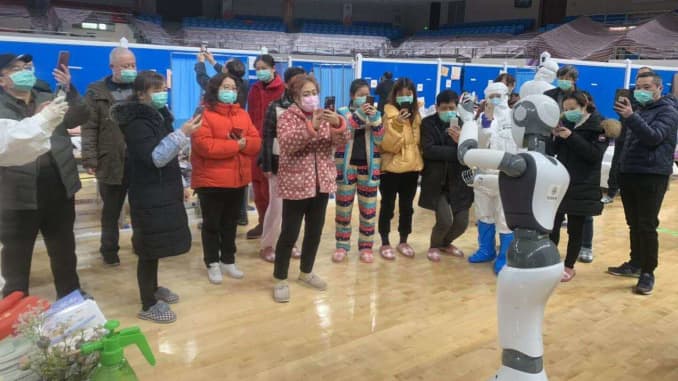
Coronavirus patients at a “smart field” hospital in Wuhan, China, with a robot from CloudMinds.
Source: CloudMinds
Autonomous carts that can carry food or other items are nothing new; they’ve been in use at a growing number of hotels around the world. The experiment was part of CloudMinds’ deployment of more than 100 robots to Chinese hospitals, hotels and schools. Getting them into Wuhan involved flying to an airport in Changsha, driving 373 miles and getting through multiple government checkpoints to enter the city, according to the company.
Robots that were modified specifically for the coronavirus fight include a humanoid called Cloud Ginger (aka XR-1) and the Smart Transportation Robot, which can carry food and medicine to patients from health-care providers without person-to-person contact, which is the overall goal.
“Bored patients in quarantine found the humanoid robots such as Cloud Ginger very helpful, as they offered useful information and much needed interaction and entertainment,” says CloudMinds founder and CEO Bill Huang. “Doctors have found the robots and smart devices helpful in monitoring patient vital signs remotely without direct contact.”
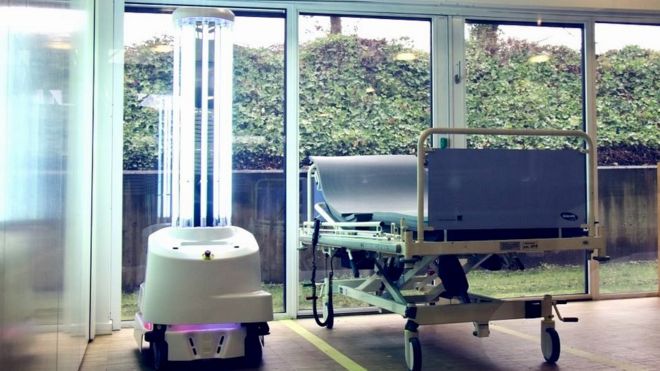
UVD Robots is another robotics company, based in Odense, Denmark, that has sent hundreds of robots to the front lines in the battle against coronavirus. It has dispatched disinfection robots to Wuhan as well as hospitals in Rome and Veneto, a region in northern Italy that has been hard hit by the epidemic. The machines emit powerful ultraviolet light that can decontaminate surfaces By tearing apart strands of virus DNA. After mapping their environment, such as hospital corridors and patient rooms, they move around autonomously guided by lidar, shining 360-degree UV-C light from a mast.
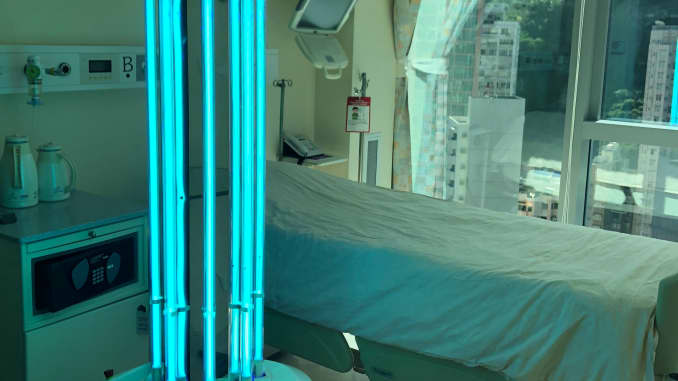
The UVD Robot uses ultraviolet light to zap viruses and sanitize surfaces.
Source: UVD Robots
The UV units can operate for roughly 2.5 hours on a charge and disinfect about nine or 10 rooms, according to the Danish company. They can kill 99.99% of bacteria in 10 minutes and are also effective against viruses.
“The UVD Robot will kill the coronavirus, as it has a proven efficacy against MERS CoV and MHV-A59, showing over 6 log reductions in viral particles within 30 minutes,” says UVD spokesperson Camilla Harkjær Frederiksen, adding that truckloads of robots are being shipped every week.
The company is also seeing interest from the U.S., not only hospitals but prisons, hotels and airports. “It’s ideal for disinfection of large premises. You can map large areas and have the UVD Robot doing disinfection in autonomous mode, and thereby protecting staff and guests,” she said.
Texas-based health-care services company Xenex Disinfection Services is also sending virus-zapping robots to East Asia and Italy, as well as Houston. The Westin Houston Medical Center is rolling out Xenex’s LightStrike robots, which use UV light to disinfect guest rooms and common areas of coronavirus. The company says its robots can disinfect dozens of rooms per day per robot. It has provided hospitals with disinfection protocols, such as operating the UV robots near the emergency department or in ambulances if suspected coronavirus patients were present.
Xenex says it has thousands of robots in operation and it’s ramping up U.S. production. Its orders have jumped 400% in the first quarter of this year against all of 2019. The majority of those orders have been from overseas — Italy, Japan, Singapore, Thailand and South Korea.
“Hundreds of our customers are treating suspect (and now confirmed) coronavirus patients and using our robots to disinfect rooms where those patients are treated,” says Xenex CEO Morris Miller. “What makes our robots different is the use of pulsed xenon to create intense flashes of germicidal UV light.”
Telemedicine rediscovered
Telehealth is another technology that’s been around for years but is finding new demand. In China, JD Health, a subsidiary of e-commerce giant JD.com, has seen monthly consultations for its online health platform grow tenfold since the coronavirus epidemic began, according to The Economist. Last week President Donald Trump said federal rules will be waived so that more doctors can provide patient care through video chats and other means.
Hospitals such as Rush University Medical Center in Chicago and George Washington University Hospital in Washington, D.C., are using telemedicine to help screen patients for possible coronavirus cases. Telehealth companies are struggling to meet surging demand for their services.
Minneapolis-based Zipnosis is deploying online questionnaires for patients that doctors can use to quickly distinguish COVID-19 from other respiratory illnesses; the interaction is often asynchronous, meaning doctors review the information after it’s submitted. The platform was also used in the 2017 measles outbreak in the U.S., and the company says providers take an average of 1 minute, 29 seconds to assess a patient through the service.
“Providers can take care of many, many patients quickly with accurate information, which has already proven to be essential for health systems needing to scale to meet patient demands from COVID-19,” says Lisa Ide, chief medical officer at Zipnosis.
She adds, “We work with a health system in Washington state, for example, that opted to direct all COVID-19 visits to asynchronous visits (versus video or phone synchronous virtual visits) because their providers couldn’t meet the demand for synchronous care due to the much longer clinical work time. When they transition to asynchronous only, they found with only a handful of providers that they could handle a 400-plus daily visit volume with asynchronous care.”
Automation and communication technologies are becoming key in the struggle to put a lid on the coronavirus pandemic, according to experts.
“Robots and telemedicine are great tools, but often supplemental to basic infection prevention measures,” says Saskia Popescu, an epidemiologist and infection-prevention specialist based in Phoenix. “I think telemedicine can help reduce the strain if there are physician shortages, or help reduce use of personal protective equipment in some cases (i.e., less people going in and out of the patient’s room). Technologies can help add an extra layer of infection prevention efforts —UV disinfection is one.”
Image copyrightADRIENNE MURRAYImage captionThe UVD robot takes about 20 minutes to treat a room
"Please leave the room, close the door and start a disinfection," says a voice from the robot.
"It says it in Chinese as well now," Simon Ellison, vice president of UVD Robots, tells me as he demonstrates the machine.
Through a glass window we watch as the self-driving machine navigates a mock-hospital room, where it kills microbes with a zap of ultraviolet light.
"We had been growing the business at quite a high pace - but the coronavirus has kind of rocketed the demand," says chief executive, Per Juul Nielsen.
He says "truckloads" of robots have been shipped to China, in particular Wuhan. Sales elsewhere in Asia, and Europe are also up.
"Italy has been showing a very strong demand," adds Mr Nielsen. "They really are in a desperate situation. Of course, we want to help them."
Image copyrightADRIENNE MURRAYImage captionPowerful UV light is already a proven means to kill microbes
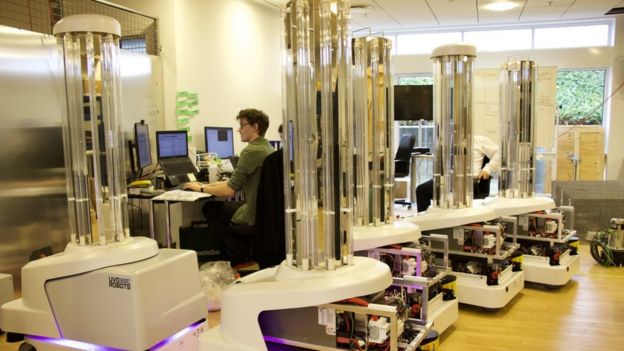
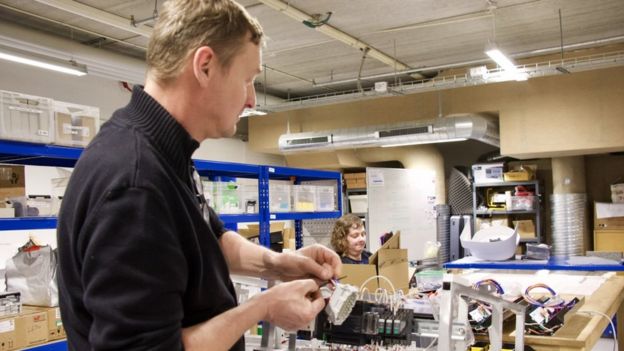
Production has been accelerated and it now takes less than a day to make one robot at their facility in Odense, Denmark's third largest city and home to a growing robotics hub.
Glowing like light sabres, eight bulbs emit concentrated UV-C ultraviolet light. This destroys bacteria, viruses and other harmful microbes by damaging their DNA and RNA, so they can't multiply.
It's also hazardous to humans, so we wait outside. The job is done in 10-20 minutes. Afterwards there's a smell, much like burned hair.
"There are a lot of problematic organisms that give rise to infections," explains Prof Hans Jørn Kolmos, a professor of clinical microbiology, at the University of Southern Denmark, which helped develop the robot.
"If you apply a proper dose of ultraviolet light in a proper period of time, then you can be pretty sure that you get rid of your organism."
He adds: "This type of disinfection can also be applied to epidemic situations, like the one we experience right now, with coronavirus disease."
Image copyrightADRIENNE MURRAYImage captionUVD has tripled output of its disinfecting robots
The robot was launched in early 2019, following six years of collaboration between parent firm, Blue Ocean Robotics and Odense University Hospital where Prof Kolmos has overseen infection control.
Costing $67,000 (£53,370) each, the robot was designed to reduce the likelihood of hospital-acquired infections (HAIs) which can be costly to treat and cause loss of life.
While there's been no specific testing to prove the robot's effectiveness against coronavirus, Mr Nielsen is confident it works.
"Coronavirus is very similar to other viruses like Mers and Sars. And we know that they are being killed by UV-C light," he says.
Dr Lena Ciric, an associate professor at University College London and expert on molecular biology, agrees that UV disinfection robots can help fight coronavirus.
Disinfection robots are no "silver bullet", says Dr Ciric. But she adds: "These [machines] provide an extra line of defence."
"We're in the run up to having a lot of coronavirus patients in the various hospitals. I think it's wise to be on top of the cleaning regimes… from an infection control point of view. "
To be fully effective, UV needs to fall directly on a surface. If lightwaves are blocked by dirt or obstacles, such shadow areas won't be disinfected. Therefore manual cleaning is needed first.
UV light has been used for decades in water and air purification, and used in laboratories.
But combining them with autonomous robots is a recent development.
Image copyrightXENEXImage captionXenex also has a device which uses UV light
American firm Xenex has LightStrike, which has to be manually put in place, and delivers high-intensity UV light from a U-shaped bulb.
The company has seen a surge in orders from Italy, Japan, Thailand and South Korea.
Xenex says numerous studies show that it's effective at reducing hospital-acquired infections and combating so-called superbugs. In 2014, one Texan hospital used it in the clean-up after an Ebola case.
More than 500 healthcare facilities, mostly in the US, have the machine. In California and Nebraska, it has already been put to use sanitising hospital rooms where coronavirus patients received treatment, the manufacturer says.
In China, where the outbreak began, there has been an adoption of new technology to help fight the disease.
The nation is already the highest spender on drones and robotics systems, according to a report from global research firm IDC.
Leon Xiao, Senior Research Manager at IDC China says robots have been used for a range of tasks, primarily disinfection, deliveries of drugs, medical devices and waste removal, and temperature-checking.
'I think this is a breakthrough for greater use of robotics both for hospitals and other public places," says Mr Xiao. However space in hospitals to deploy robots and acceptance by staff are challenges, he says.
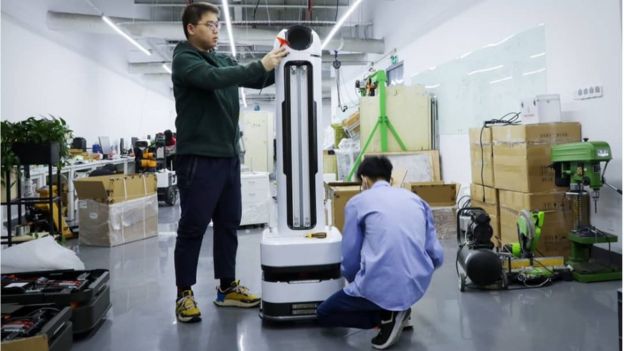
Image copyrightYOUIBOTImage captionYouiBot has quickly developed its own disinfecting robot
The coronavirus has spurred home-grown Chinese robotics companies to innovate.
Shenzhen-based YouiBot was already making autonomous robots, and quickly adapted its technology to make a disinfection device.
"We're trying to do something [to help], like every one here in China," says YouiBot's Keyman Guan.
The startup adapted its existing robotic base and software, adding thermal cameras and UV-C emitting bulbs.
"For us technically, [it's] not as difficult as you imagine… actually it's just like Lego," says Mr Guan.
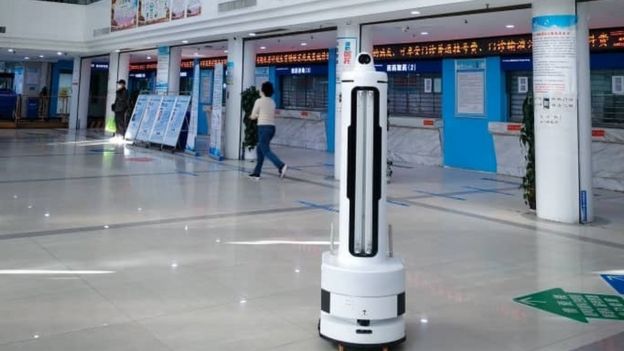
Image copyrightYOUIBOTImage captionYouiBot at a hospital in Wuhan
It has supplied factories, offices and an airport, and a hospital in Wuhan. "It's running right now in the luggage hall… checking body temperature in the day, and it goes virus killing during the night," he says. However the robot's efficacy hasn't yet been evaluated.
Meanwhile plant closures and other restrictions to curb coronavirus, have hampered getting parts. "The lack of one single component, [and] we cannot build a thing," adds Mr Guan, though he notes things have improved in the last couple of weeks.
"There are not many good things to say about epidemics," says Professor Kolmus, but it has forced industry "to find new solutions".
UV module: 2-2.5 hours (equal to 9-10 rooms) ... The UVD Robot is used as part of the regular cleaning cycle, and aims at preventing and reducing the spread of ..
- - - - - - - - - - - - - -
Company offers germ-killing robot to airports to address coronavirus outbreak
Los Angeles-based Dimer UVC Innovations, which develops the GermFalcon germ-killing robot aimed at sanitizing airplanes, today offered to provide its services to three U.S. airports to help address an outbreak of a pneumonia-like illness that originated in China.
The coronavirus, which is in the same family as severe acute respiratory syndrome (SARS), has spread to 473 patients in China, and that 17 people have died from the virus. In the U.S., officials at the U.S. Centers for Disease Control and Prevention confirmed one case of a Washington State resident testing positive for the virus after a trip to China.
Image: Dimer UVC Innovations’ GermFalcon robot
Dimer said its GermFalcon robot was specifically created to improve airplane hygiene, using ultraviolet-C (UVC) light to kill viruses, bacteria, and “superbugs on surfaces and in the surrounding air.” The GermFalcon is also designed to navigate an airplane cabin, with strategically placed UVC lamps that can expose all high-touch surfaces to the UVC light.
The company said it will offer the germ-killing system to “contribute to emergency response efforts at the Los Angeles International Airport (LAX), San Francisco International Airport (SFO), and John F. Kennedy International Airport (JFK) in New York.
“The threat of coronavirus infecting innocent passengers on an airplane is one we must work to eliminate immediately,” said Elliot Kreitenberg, co-founder of Dimer. “This is a dangerous virus that has already taken lives. GermFlacon is a fast and effective response to this threat, and we are pleased to offer it at no expense to contribute to emergency response efforts at LAX, SFO, and JFK airports during this crisis.”
UVC germ-killing robots in hospitals
A UVD robot disinfects an intensive care unit in a hospital. Image: UVD Robots
UVC disinfection robots are typically seen in healthcare facilities and hospitals, being used to disinfect air, water, and surfaces in rooms and operating rooms. Companies in this space include Tru-D (recently acquired by PDI Healthcare), XENEX Disinfection Services and its LightStrike Robots, and UVD Robots, a spinoff from Denmark’s Blue Ocean Robotics robot incubator. A spokeswoman for UVD Robots said several partners of the company in Asia are collaborating with health authorities in the region to disinfect larger areas in airports, as the robot is too large to be used inside an airplane.
The outbreak in China originated in Wuhan, and centered on a seafood market. The CDC said while originally thought to be spreading from animal-to-person, “there are growing indications that limited person-to-person spread is happening.” But it also noted that it was unclear on how easily the virus is spreading between people.
The CDC said it began implementing public health entry screening at SFO, JFK and LAX airports on Jan. 17, and will add entry health screening at two more airports – Atlanta (ATL) and Chicago (ORD). The agency is providing updates on the outbreak at this site.