Pages

Showing posts with label Probiotics. Show all posts

Friday, 29 November 2019

The health benefits of sauerkraut - BBC Good Food

It's packed with vitamins, fibre and probiotics, but can sauerkraut boost your overall well-being? We look at the surprising research on this fermented food.
Sauerkraut in a bowl with a jar in the background
Sauerkraut is essentially fermented cabbage. Fermentation is a method of preserving food that dates back more than 2,000 years. During the fermentation process, beneficial probiotics, or ‘live bacteria’, are produced, and these probiotics are what give sauerkraut most of its health benefits.
Sauerkraut is a good form of dietary fibre and contains vitamins C and K, potassium, calcium and phosphorus.
Try our simple sauerkraut recipe to make your own at home. One serving of sauerkraut is approximately ½ cup or 50g.

What are the health benefits of sauerkraut?

The beneficial probiotics found in sauerkraut are important for good digestive health, and whilst more research is needed into the exact types of beneficial bacteria found in sauerkraut and other fermented foods, we do know that they ‘feed’ the good bacteria in your gut and can help to combat inflammation.
Research has shown that probiotics help to reduce some digestive symptoms such as gas, bloating, constipation and may be beneficial to those suffering with conditions such as Crohn’s and ulcerative colitis.
There is increasing research on the importance of good gut bacteria in supporting overall long-term health, including how probiotics from cultured foods such as sauerkraut may reduce your risk of conditions such as depression and Alzheimer’s.
Sauerkraut also contains enzymes that help the body to break down food into smaller, and more easily digestible molecules which in turn helps the body to absorb more nutrients.
Sauerkraut in a jar with a spoon on top

Can sauerkraut help to support your immune system?

Most of our immune system is found in our gut, so with its gut-supporting properties it’s easy to see how sauerkraut can also be of benefit to your immune system too. The good bacteria from sauerkraut helps to keep the lining of your digestive system healthy. A strong gut lining stops any unwanted substances or toxins from ‘leaking’ into your body and thereby causing an immune response. These same bacteria may also support your natural antibodies and reduce your risk of infections.

Can sauerkraut help with weight loss?

Some research has shown that consuming probiotic-rich foods such as sauerkraut can reduce your risk of obesity and aid weight loss, although more research needs to be done in this area. Sauerkraut is a good source of fibre which helps to keep you fuller for longer.
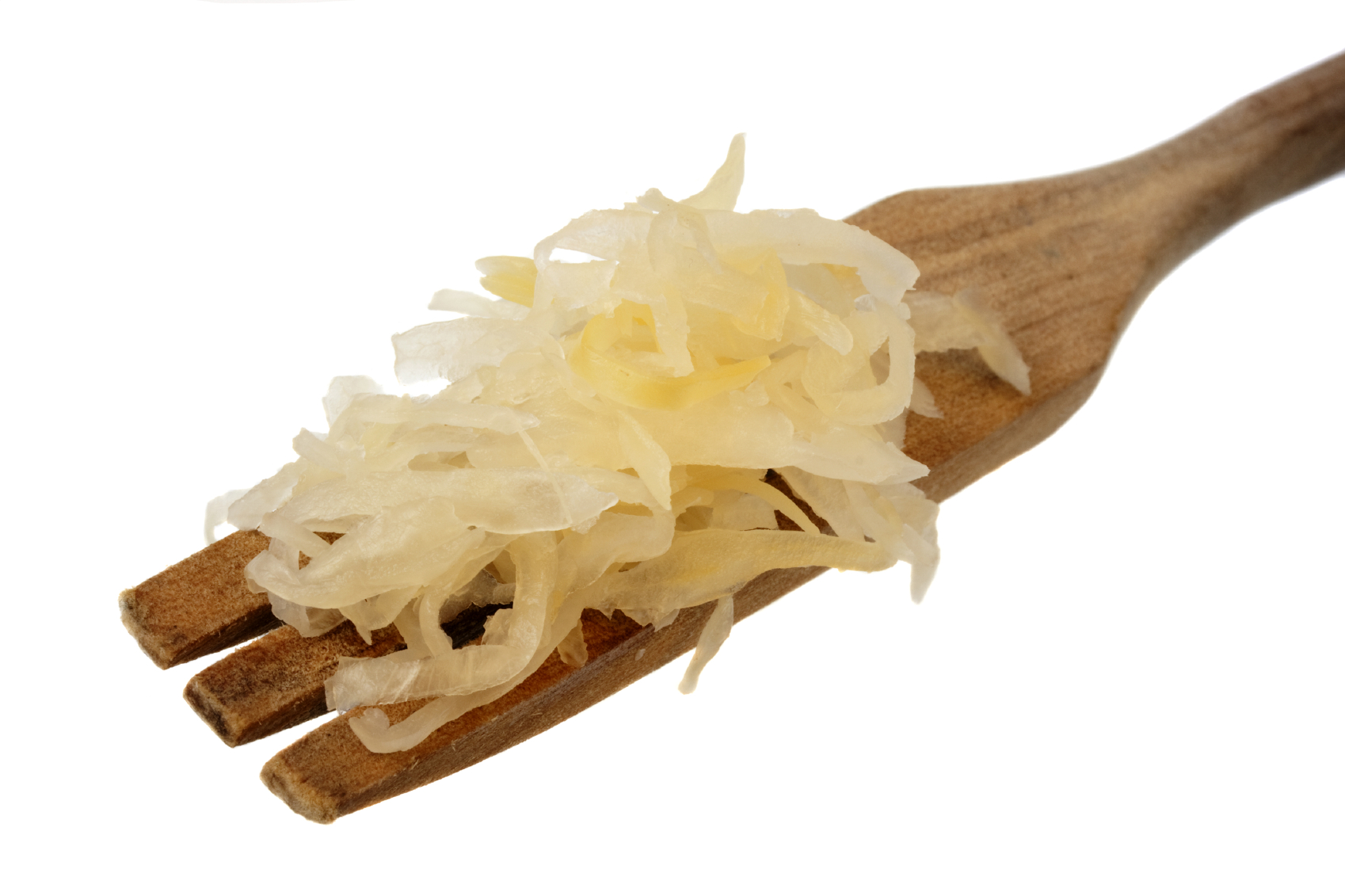
Sauerkraut on a spoon resting on a wooden table

What about the salt content in sauerkraut?

Sauerkraut is high in sodium. Just one ½ cup/50g serving will provide approximately a third of your RDA sodium intake for a UK adult, so keep an eye on your salt intake if you add sauerkraut to your diet.

This article was last reviewed on 4th July 2018 by Kerry Torrens.
A nutritionist (MBANT) Kerry Torrens is a contributing author to a number of nutritional and cookery publications including BBC Good Food magazine. Kerry is a member of the The Royal Society of Medicine, Complementary and Natural Healthcare Council (CNHC), British Association for Applied Nutrition and Nutritional Therapy (BANT).
Nicola Shubrook is a nutritional therapist and works with both private clients and the corporate sector. She is an accredited member of the British Association for Applied Nutrition and Nutritional Therapy (BANT) and the Complementary & Natural Healthcare Council (CNHC). Find out more at urbanwellness.co.uk.
All health content on bbcgoodfood.com is provided for general information only, and should not be treated as a substitute for the medical advice of your own doctor or any other healthcare professional. If you have any concerns about your general health, you should contact your local healthcare provider. See our website terms and conditions for more information.
mafigrub
11th Jul, 2017
Recipe: Sauerkraut - Spaghetti cook 350g spaghetti al dente. drain 2 tins sauerkraut. dice 200g bacon & fry until crisp. add drained sauerkraut & 400ml single cream. When heated through, add cooked spaghetti, season & mix well. food of the gods!

https://www.bbcgoodfood.com/howto/guide/health-benefits-sauerkraut

Simple sauerkraut - BBC Good Food

The simplest way to make classic sauerkraut - a fermented food that's great for your gut. It's extra tasty served with sausages and mustard


PREP: 30 MINSplus at least 5 days fermenting, no cook

EASY

MAKES 4 X 450ML JARS,


By 


Ingredients

  • 2kg very firm, pale green or white cabbage (any leathery outer leaves removed), cored
  • 3 tbsp coarse crystal sea salt (or 6 tbsp flaky sea salt)
  • 1 tsp caraway seeds
  • 1 tsp peppercorns

Method

  1. Thoroughly wash a large tub or bowl (mine was the size of a small washing- up bowl), then rinse with boiling water from the kettle. Make sure that your hands, and everything else coming into contact with the cabbage, are very clean. It’s wise to use a container that will comfortably fit the softened cabbage, allowing several inches of room at the top to avoid overflow.
  2. Shred the cabbage thinly – a food processor makes light work of this. Layer the cabbage and the salt in the tub or bowl. Massage the salt into the cabbage for 5 mins, wait 5 mins, then repeat. You should end up with a much-reduced volume of cabbage sitting in its own brine. Mix in the caraway seeds and the peppercorns.
  3. Cover the surface of the cabbage entirely with a sheet of cling film, then press out all the air bubbles from below. Weigh the cabbage down using a couple of heavy plates, or other weights that fit your bowl, and cover as much of the cabbage as possible. The level of the brine will rise to cover the cabbage a little. Cover the tub with its lid (or more cling film) and leave in a dark place at a cool room temperature (about 18-20C) for at least 5 days. It will be ready to eat after 5 days, but for maximum flavour leave the cabbage to ferment for anywhere between 2-6 weeks (or until the bubbling subsides).
  4. Check the cabbage every day or so, releasing any gases that have built up as it ferments, and give the cabbage a stir to release the bubbles. If any scum forms, remove it, rinse the weights in boiling water and replace the cling film. You should see bubbles appearing within the cabbage, and possibly some foam on the top of the brine. It’s important to keep it at an even, cool room temperature – too cool and the ferment will take longer than you’d like, too warm and the sauerkraut may become mouldy or ferment too quickly, leading to a less than perfect result.
  5. The cabbage will become increasingly sour the longer it’s fermented, so taste it now and again. When you like the flavour, transfer it to smaller sterilised jars and keep it in the fridge for up to 6 months.
  6. Recipe Tip

    CABBAGE KNOW-HOW

Wednesday, 27 November 2019

Five Probiotic-Packed Fermented Foods

A few days ago we told you probiotics may help you prevent high blood pressure. It could be one of the easiest things you do to help protect your heart.

 INH ResearchAugust 29, 20141 Comment
Fermented foods come with some major health benefits. Here are the top five probiotic-packed fermented foods.
 But the benefits of probiotics go way beyond heart health… It’s a long list of perks—from a whiter smile to easing allergies.
Getting enough probiotics isn’t always easy. Most people rely on yogurts. They don’t provide nearly enough and are usually loaded with sugar. This deletes all the benefits anyway. Some people take supplements. It’s a good idea. But fermented foods are another option. Lucky for us, their rising popularity is making them easier to find.
Here are our top five probiotic-packed fermented foods:
1. Kimchi: This popular Korean dish uses fermented Chinese cabbage as its base. But it gets mixed with probiotic-feeding foods like garlic and onion. This means more potent germs. It also comes with a lot of heat from hot pepper flakes. But studies show that kimchi can help obese subjects lower their blood pressure, shed body fat, and even stabilize blood sugar.1
Another study found that men who ate kimchi helped lower LDL cholesterol. And the more they ate, the lower their numbers dropped.2 This fiery food is also rich in vitamins A, B, and C. But most important of all, experts claim it has 1,000 times the amount of probiotics you’ll find in most yogurts.3
2. Sauerkraut: Think of it as kimchi’s helpful—but less exciting—cousin. It might not have the added flavor and benefit of ingredients like garlic and onion… But sauerkraut may be just as valuable as kimchi when it comes to supporting your health. It may even help reduce breast cancer risk. That’s because it’s rich in glucosinolates. These are potent anti-cancer enzymes.
A study of Polish women found that their breast cancer risk nearly triples after immigrating to America. Researchers found that the women living in Poland were 72% less likely to develop breast cancer. And the key difference in their diet was eating about four-times more sauerkraut each week.4
3. Kombucha: This one may be the strangest of them all… Kombucha is a type of fermented tea. It comes from a “mother” strain of bacteria that brewers use to make batch after batch. And it may remind you of beer. It has a light carbonation and a foamy head…even a small amount of alcohol from the fermentation process. But it also comes with serious health benefits.
Researchers found that Kombucha’s antioxidant power was just as effective as the prescription drug omeprazole in healing ulcers in mice.5 Another study revealed that Kombucha is a strong detoxifier. It helped boost the immune systems of rats exposed to lead acetate.6 Making this one on your own can be difficult—even dangerous. But you can find raw, organic Kombucha teas in most health food stores.
4. Miso: This seasoning is a staple of Japanese cooking. You’ve probably come across miso soup before. This is the product of fermenting barley, brown rice, or soybeans with koji. It’s a fungus that also goes by the name aspergillus oryzae. Koji has an antimicrobial and antibacterial effect. It has potential to be a safer, natural alternative to the antibiotics commonly found in chicken feed.7 But more important, miso contains dipicolinic acid (DA). It binds to heavy metals and helps carry them out of your body.8 Try to find a probiotic miso paste that comes from rice or another grain and soy-free source.
5. Kefir: It’s a beverage that comes from fermenting goat, cow, sheep, or nut milk and mixing it with live bacteria. Kefir looks like a cross between milk and yogurt. And the taste takes some getting used to… It’s a little bit like sour milk with a squeeze of lemon juice. But the benefits make kefir worth trying.
It may help support liver, gallbladder, and heart health. It may even boost blood and oxygen supply to your brain.9 Some research suggests that kefir may help prevent cancer. It does this by acting as an antioxidant. Kefir also helps slow down the enzyme activity that converts pro-carcinogenic compounds to carcinogens.10 You can make your own… But most grocers now carry at least one variety. Always go with the plain version with no added flavoring.
It may take you a while to warm up to fermented foods… Kefir definitely isn’t for everybody. But they all offer probiotic support. They also come with important health benefits. But start slow. Try adding some sauerkraut to your dinner. There are also some nice-tasting Kombucha products that won’t overpower you.
References:
1http://www.ncbi.nlm.nih.gov/pubmed/21745625
2http://www.nydailynews.com/life-style/health/kimchi-cholesterol-lowering-superfood-study-article-1.1279677
3http://www.foxnews.com/health/2014/04/27/health-benefits-kimchi/
4http://www.medpagetoday.com/HematologyOncology/BreastCancer/2035
5http://www.ncbi.nlm.nih.gov/pubmed/21776478
6http://www.ncbi.nlm.nih.gov/pubmed/14631833?dopt=Citation
7http://docsdrive.com/pdfs/ansinet/ijps/2006/1-3.pdf
8http://nourishedmagazine.com.au/blog/articles/mysterious-marvellous-miso
9http://www.probiotic.org/Kefir.htm
10http://www.ncbi.nlm.nih.gov/pmc/articles/PMC3833126/
https://www.institutefornaturalhealing.com/2014/08/five-probiotic-packed-fermented-foods/

Thursday, 3 October 2019

5 Diseases You Can Avoid by Maintaining a Healthy Gut

There is a growing amount of research-based evidence that shows how crucial having a “healthy gut” (meaning a good balance of gut flora) is for your overall health and wellness − including your mental and emotional health.


Editor’s note: This post was originally published in February 2017. It has been updated and republished in June 2019.
Your gut contains a delicate system of over 100 trillion organisms – fungi, bacteria, yeasts, and other microbes – collectively known as your “microbiota.” Each of these organisms has a purpose within the symbiotic community that is your microbiome.
More to the point, NOT having a well functioning microbiome with the microbiota working in harmony can have some distinct health consequences.
Depleting the diversity of your microbiota, or allowing specific strains to gain the upper hand, is an imbalance. This is also known as dysbiosis. Everyday things like sucralose, antibiotics, and your diet can adversely affect your gut flora balance. When this system is permitted to get out of balance, the synergy dissipates, and true chaos can occur… wreaking havoc on your body and mind.
Here are just five specific areas of health and wellness that have been linked to gut health, or lack thereof:

Healthy Gut Impact #1 – Poor Nutrient Absorption

Probably the most obvious consequence of an imbalanced microbiome is what it can do to compromise your nutrition.
The microbiota in your system carry out countless processes that assist in digestion and the absorption of nutrients. As an article by Tufts University put it, “Your microbiota also work as vitamin-production plants. Bacteria in the gut synthesize vitamins, and those that they don’t use are excreted to benefit their host.”1
The body’s inability to properly absorb nutrients is known as malabsorption syndrome.
Mess with the balance of microbes, and it follows, the body will not get the full range of nutrients.2,3,4 You can be eating the healthiest foods on the planet, but if you can’t absorb them, there’s little benefit.
In addition, there are chemicals and vitamins created within your gut, as a result of the many interactions between the different microbiota. Likewise, there are several amino acids and hormone processes created by and connected to what happens in your microbiome.5,6,7 If your microbe family is in disharmony, these interactions may be altered, or not present at all, leading to deficiencies that affect your health, mood and wellness.1,8,9

Healthy Gut Impact #2 – Weight Gain & Obesity

There is a growing amount of research connecting weight imbalance (gain, obesity) to your gut health.10,11,12
As stated in a Scientific American article, the “wrong mix” of microbes can “set the stage for obesity and diabetes from the moment of birth.” This is because the microbiome affects how your body stores fat, balances glucose, and responds to hunger-stimulating hormones, among other things.13
Experiments on mice suggest that we pass microbes back and forth between those close to us in our environment. The research seems to show that living with healthy people with healthy microbiomes, can have benefits for those predisposed to weight problems, as long as they are living a healthy, probiotic-promoting lifestyle, as well.14
However, it has also been noted that diet can significantly alter the microbiome in just a single day! The mice experiments observed that if the typical high-fat, high-carb Western diet was eaten, the healthy microbes didn’t “move in” to the obese mice, as they had previously observed. Diet still remains the biggest contributor to weight issues, even as it relates to a healthy microbiome, and how your body processes fat, nutrients, hormones, etc.14
Bottom line (pun intended), seeking gut balance is a vital step to anyone with weight concerns.

Healthy Gut Impact #3 – Autoimmune Issues & Disease

The term “autoimmune disease” comprises over 80 health issues.15 What generally defines an autoimmune problem is the body starts attacking itself – tissues, organs, cells, etc. – normally referred to as an “inappropriate response.”
This creates damage and inflammation that creates further problems and can be a vicious cycle.
Ironically it can often be inflammation that contributes to the development of autoimmune and allergic disorders, not the least of which can be caused by a microbiome imbalance.16-19
Common autoimmune disorders include: lupus, rheumatoid arthritis, leaky gut, multiple sclerosis, and autoimmune thyroid disease.20,21

Healthy Gut Impact #4 – Brain Health (Depression & Chemical Imbalances)

You may be thinking: What? My gut affects my brain!? It sure does. To an even greater extent than known before, according to scholars and scientists investigating the “gut-brain axis.”22,23
Here are a few facts to help you understand how your brain is directly influenced by your microbiome:
  • There are more than a billion nerve endings in the gastrointestinal tract. Scientists have referred to this complex system of neurotransmitters, officially called the enteric nervous system, or ENS, as “the second brain.”
  • Your ENS contains over 100 million neurons. This is more than both the spinal cord and peripheral nervous system, combined.
  • Your ENS can function independently without the brain. The brain doesn’t overly influence the gut, but the second brain, your enteric nervous system, does influence the brain by sending signals and creating most of the body’s serotonin, around 50% of dopamine, and a host of other brain influencing chemicals and hormones.16 This is called the gut-brain axis, or GBA.
  • The effects of the gut-brain axis include emotional and cognitive functions.24
Also of note, there is emerging evidence that the microbiome is observed to have specific characteristics within Alzheimer’s patients, as well as children with autism. However, more research is required in both these areas.25,26,27
One area that has had much more defined conclusions is the effect of the GBA on mood.28,29
As mentioned in the bullets above, serotonin30 and dopamine are just two brain chemicals that are produced in the gut.31-33 The interplay of chemicals and hormones between the brain, gut, and body can be affected by microbiome imbalance, to the point of creating “high levels of major depression and anxiety.”24
A 2014 study noted that depressed patients held certain strains of bacteria in common.33 In Sweden, researchers noted that mice bred microbe-free were naturally more daring, and had less anxiety, over mice that developed normal microbiota, or had various forms of it implanted.34
A healthy microbiome is so important to brain balance and psychological disorders, that work is being investigated in “psychobiotics” – the use of probiotics to repair the microbiome, and thus reverse disorders.24,33,35

Healthy Gut Impact #5 – Cancer

I certainly can’t leave out the connection between your microbiome balance and cancer. Research abounds linking the development of cancer to a compromised microbiome. Essentially, the systemic failures that results when the microbiota is out of harmony can lead to tumors and cancer.36
A 2015 paper, Cancer and the gut microbiota: An unexpected link, revealed that epidemiological studies indicate damage to the microbiome as a major risk factor in cancer development. Once again, a GI system that is imbalanced leads to inflammation locally and systemically, which can so severely affect the body as to allow several different types of cancer to flourish.37
The improper balance of microbes in the body have been linked to colorectal cancer, breast and liver, among others.38
One thing seems true: anyone wanting optimal health, or to reverse already existing problems, should look at their gut balance as a matter of profound importance.
A quality probiotic diet, supplemented with substances of and contributing to microbiota diverse richness is essential to your health and wellness.
Imbalanced-gut-health-cancer

What is a Probiotic Diet?

A probiotic diet would be one that includes quality probiotic foods and microbe promoters, such as fermented foods, those rich in antioxidants and phenols, and lactic acid; prebiotic foods (these feed the probiotics). Be sure to avoid microbiome disrupters such as sucralose, antibiotics, alcohol, and preservatives.
We also recommend supplementing with a really good probiotic, preferably one with strong strains of probiotics known to survive the digestive system, to colonize well, and contain other microbiota enhancing substances.

With so much information out there about gut health, it’s hard to get a clear picture of what will work best for you. Here are a few helpful articles you may also enjoy:

ghc turmeric

Turmeric has been used in the Chinese and Indian pharmacopoeia for thousands of years... and many have even called it the most amazing herb in the world.

>>Read more

Article Summary

  • Research shows how crucial a “healthy gut” is for your overall health and wellness − including your mental and emotional health.
  • Your gut contains a delicate system of over 100 trillion organisms that serve a purpose within your microbiome.
  • 5 areas of health and wellness linked to gut health, or lack thereof:
    • Poor nutrient absorption
    • Weight gain & obesity
    • Autoimmune issues & disease
    • Brain health (depression & chemical imbalances)
    • Cancer
  • A quality probiotic diet is essential to your health and wellness.

[]- Sources and References

https://thetruthaboutcancer.com/healthy-gut/