Pages

Showing posts with label Water. Show all posts

Saturday, 26 March 2022

Is there any point in drinking oxygenated water? Simple answer. No!


Oxygen is critical for life and that also makes is susceptible to chicanery. If oxygen is so essential that the brain is permanently injured after just four minutes of deprivation, then surely more must be better! That’s the argument used by sellers of “oxygenated water” who often target athletes with claims that their product can improve athletic performance. 

Well, all water is actually oxygenated water because oxygen from the air dissolves in water, although not to a great extent since its solubility is only about 25 mL per liter. 

Still, this is enough for fish to extract with their gills to sustain life. More oxygen can be squeezed into water under pressure, which is exactly what the “oxygenated water” people do. 

However, most of this oxygen escapes into the air as soon as the pressure is released by opening the bottle.

Whatever dissolved oxygen remains is inconsequential since we do not breathe through our gut. Only a trace of the trivial amount of oxygen in the water will pass through the intestinal lining into the bloodstream, which is already saturated with oxygen anyway. 

The most salient point is that a single breath of air contains more oxygen than a liter of oxygenated water. A single breath is about 500 mL of air, of which is roughly 20% or 100 mL is oxygen. 

A sampling of a variety of oxygenated waters reveals an average of about 10 mL oxygen per 100 ml of water. 

Clearly, even if the oxygen from the water were absorbed, it would be less than taking an extra breath.

Of course, in science we do not go by theory, but by experimental evidence. And a number of studies clearly show that drinking oxygenated water has no effect on any sort of performance. 

Subjects performing standard maximal cardiopulmonary exercise tests drank either regular water or oxygenated water and there were no significant differences in results. Furthermore, participants were unable to identify the type of water they had consumed.

Often there is even more absurd hype piled on oxygenated water. There are claims that the oxygen content of the atmosphere is decreasing due to pollution, so we must supplement our intake with “superoxygenated water.” Total nonsense. 

Then there are these stupefying statements: “The oxygen is stabilized in micro-encapsulated water clusters.” “Our patented method of expansion and contraction of the water molecules several times per minute allows more oxygen consumption while taking on donor electrons.” “We use monoatomic oxygen in addition to other salutary forms of oxygen: O2, O4, O5, O6 and O7 which is less than half the diameter of regular diatomic oxygen.” Absolute mind-boggling gobbledigook!

For the cherry on top, these oxygenated waters are often sold in health food stores in an aisle next to dozens of types of antioxidants that claim to confer eternal health by neutralizing those dastardly free radicals generated by the body’s use of oxygen. 

I hope we have now thrown enough cold water on the hot hype of oxygenated water.


@JoeSchwarcz

https://www.mcgill.ca/oss/article/health-and-nutrition-you-asked/there-any-point-drinking-oxygenated-water

Monday, 23 March 2020

No, drinking water doesn't kill coronavirus - BBC

A rumour about Covid-19 has been spreading – that drinking water regularly and keeping your mouth moist can protect you. Here BBC Future examines the evidence.


By Zaria Gorvett

20th March 2020


HEALTH


F
First there was the bizarre suggestion that it can be cured with cocaine. After the erroneous idea circulated widely on social media, the French government had to quickly issue a statement saying that it’s definitely pas vrai. Then came the claims that avoiding ice cream could help, prompting Unicef to issue a statement that this is also not true. Finally the – extremely dangerous and also false – idea emerged that it can be prevented by drinking bleach.
Though the coronavirus pandemic started just a few months ago, it has already spawned an abundance of online fables and urban legends about how to evade it. One suggests that drinking water can help to prevent the infection. Here’s why that’s extremely unlikely.
You might also like:
The original posts shared on social media say that we should make sure our mouths and throats are always moist, and drink water every 15 minutes. The logic is that this will help to wash the virus down the oesophagus, so it that it can be killed by our stomach acid.  
“This is just so simplistic, I can’t even get my head around it,” says Kalpana Sabapathy, a clinical epidemiologist at the London School of Hygiene and Tropical Medicine.
Sabapathy explains that infections often begin after we’ve been exposed to thousands or millions of viral particles, so sweeping a few down the oesophagus is unlikely to have much of an impact. “One gaping hole in it is the likelihood that you managed to flush all of them down into your stomach,” she says. “You would probably have already got them in your nostrils by then, for example – it’s not fool proof,” she says. And here lies another of the main flaws in the idea. Even if the virus hasn’t already managed to find its way inside the cells of your respiratory tract, it can also get into the body in other ways. While some people might become infected by touching their mouth with contaminated fingers, it can also enter the body by touching the nose or eyes.
As it happens, this is not thought to be the main route of transmission. Instead, the main risk is from breathing in tiny droplets containing thousands of viral particles after a person coughs or sneezes – either when they’re hot-off-the-press or have been lingering in the air hours afterwards. (Read more about how long the Covid-19 coronavirus can stay on surfaces and in the air.)

Woman drinking water while working (Credit: Getty Images)

The latest thinking is that Covid-19 might survive even after it’s been through your stomach (Credit: Getty Images)

And there’s another reason the water-drinking technique might not work. You would think that, once a Covid-19 particle had made its way into your stomach, it would be killed immediately. After all, gastric acid has a pH of between one and three; it’s roughly as potent as battery acid, which is capable of dissolving steel. A few years ago, scientists invented a way to use it as a power source.
But the virus might be far more robust than this. After Mers emerged from Saudi Arabia in 2012, researchers discovered that the pathogen – which is a coronavirus and relative of Covid-19 – is “considerably resistant” to the slightly diluted acid that you would find in the stomach of a person who had recently eaten. They found signs that the virus had managed to colonise one patient’s gut, and showed that it can easily colonise cells from the intestine. The team speculated that it might be possible to become infected this way.
It’s not yet clear if this is also true for Covid-19. Some patients have been reporting symptoms such as nausea and diarrhoea, and now experts from China are warning that there are signs it can infect the digestive tract. According to one report, more than 50% of people with Covid-19 have the virus in their faeces, where it’s lingering long after it’s been cleared from the lungs.

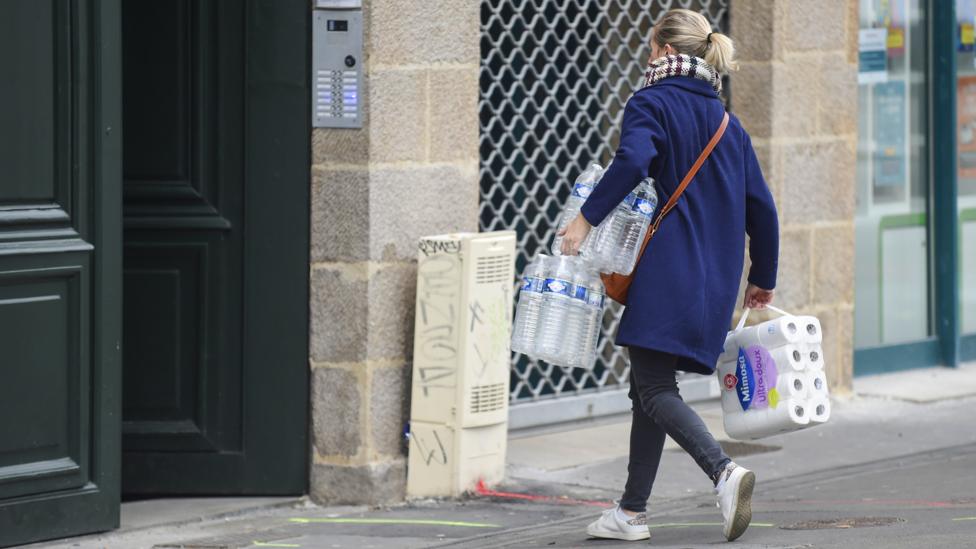
Woman carrying toilet rolls and bottled water back to her home (Credit: Getty Images)
There are lots of possible ways for Covid-19 to enter the body, so drinking water is unlikely to significantly reduce your risk of infection (Credit: Getty Images)

Perhaps most compellingly, there hasn’t been any research looking into whether drinking water can prevent infection with Covid-19, so this technique is not based on science or fact – just wobbly theory. In fact, the only study that comes close is from 15 years ago.
The research looked at whether gargling with water might help to prevent respiratory infections, because the practice is popular in Japan. They found that, over a 60-day period, participants who gargled with water three times a day were indeed less likely to report respiratory symptoms than those who gargled with an antiseptic solution or who did neither. However, the findings don’t necessarily apply to Covid-19 – and it’s dangerous to assume that they do.
First, the study focused on infections of the upper respiratory tract, which mostly involve the sinuses, throat and, airways, while Covid-19 is also known to infect the lower respiratory tract, infiltrating the chest and lungs. Secondly, it’s worth noting that it was a relatively small study, in which the participants were asked to self-report their symptoms (rather than being assessed objectively) and knew which treatment group they were in. This kind of study is thought to be less reliable than the gold standard – a placebo-controlled randomised trial.
Sabapathy says that, though telling people to keep their mouths moist and drink water every 15 minutes might sound harmless, it’s important to squash this kind of misleading advice quickly.
The danger lies in the false sense of security that it provides. “People will think that by doing that, they're going to be OK,” she says. “It diverts from the much more important messages.”
The overwhelming evidence suggests that the best approach remains avoiding unnecessary social contact and washing your hands. So her advice is to put down the water and pick up the soap instead.
--
As an award-winning science site, BBC Future is committed to bringing you evidence-based analysis and myth-busting stories around the new coronavirus. You can read more of our Covid-19 coverage here.
--

SIMILAR ARTICLES

Sunday, 15 September 2019

The 'underground cathedral' protecting Tokyo from floods

An intricate system of dams, levees and tunnels defends the Japan’s capital. Will it be able to cope with climate change?

(Credit: Getty Images)

  • By Diego Arguedas Ortiz
29 November 2018
Cecilia Tortajada recalls making her way down a long staircase and into of one of Japan’s engineering marvels, an enormous water tank that crowns Tokyo’s defences against flooding. When she finally reached the tank’s ground, she stood among the dozens of 500-tonne pillars supporting the ceiling. In the cavernous, shrine-like cistern, she felt humbled.
“You find yourself being a tiny part of this humongous system,” recalls Tortajada, a water management expert at Lee Kuan Yew School of Public Policy’s Institute of Water Policy, in Singapore. “You realise how well prepared Tokyo is.”
If Japan is a pilgrimage destination for disaster and risk-management experts like her, this is one of its main temples. The floodwater cathedral hidden 22 meters underground is part of the Metropolitan Area Outer Underground Discharge Channel (MAOUDC), a 6.3 km long system of tunnels and towering cylindrical chambers that protect North Tokyo from flooding.
In the past several decades, the Japanese capital perfected the art of coping with typhonic rains and moody rivers, and its intricate flood defence system is a global wonder. But the future seems uncertain as the climate changes and rain patterns shift.
Tokyo’s battle with flooding stretches back through its history. The city sits on a plain crossed by five rowdy river systems and dozens of individual rivers that naturally swell each season. Intense urbanisation, rapid industrialisation and imprudent water extraction that caused some regions to sink have exacerbated the city’s vulnerability.
(Credit: Getty Images)View a stunning tour of the floodwater cathedral above
(Click here to watch the video presentation)
“I don’t know who decided to set-up Tokyo there,” Tortajada, who’s worked in water management for over two decades, says only half-jokingly.  
Even if Japan has dealt with floods for centuries, Tokyo’s current system truly started to take shape in the post-war years. Typhoon Kathleen hit in 1947, destroying around 31,000 homes and killing 1,100 people; one decade later Typhoon Kanogawa (also known as Ida) devastated the city when around 400mm of rain in a week. Streets, homes and businesses were inundated.
Amidst the chaotic aftermath, the Japanese government stepped up its monetary commitment.
“Even in the 1950s and 1960s, when the Japanese were recovering from the war, the government was investing 6-7% of the national budget on disaster and risk reduction,” explains Miki Inaoka, a disaster expert at the Japan International Cooperation Agency (JICA).
Tokyo’s planners must be wary of serveral different kind of floods. If heavy rain falls upstream, maybe a river breaks it banks and inundates a centric neighbourhood downstream. Perhaps a downpour in the city overpowers that area’s drainage system or a high tide or tsunami could threaten the coastline. What if an earthquake destroys a dam or a levee?
After decades of planning for these scenarios and non-stop construction, the Japanese capital now boasts dozens of dams, reservoirs and levees. Cut into the city’s ground, as you would with a birthday cake, and you will find an underground maze of tunnels alongside the subway lines and gas pipelines that criss-cross the city.
You might also like:
The $2 billion Metropolitan Area Outer Underground Discharge Channel (MAOUDC) and its ‘floodwater cathedral’ is one of the capital’s most impressive engineering feats. Completed in 2006 after 13 years of works, it is the world’s largest diversion floodwater facility and the result of Tokyo’s continuous improvement efforts.  
(Credit: Getty Images)
Tokyo's rivers - so beautiful for much of the year - can pose a danger 
in times of heavy rainfall (Credit: Getty Images)
“Japan is a country that believes in learning,”, says Tortajada, who visited the MAOUDC in 2017. “That makes it a very interesting case for study.”
The Channel sucks in water from small- and mid-size rivers in Northern Tokyo and moves it to the bigger Edo River, which can handle the volume with more ease.
Each of these tanks is big enough to accommodate a space shuttle or the Statue of Liberty
When one of these rivers overflows, the water falls to one of five enormous 70-meter tall cylindrical tanks spread across the Channel’s length. Each of these tanks is big enough to accommodate a space shuttle or the Statue of Liberty and they are interconnected through a 6.3km long network of underground tunnels. As the water approaches the Edo River, the ‘floodwater cathedral’ Tortajada visited reduces its flow, so the pumps can push it to the river.
A mental exercise can explain the potency of the Discharge Channel. Imagine a standard 25m pool, filled to the brim, connected to the 13,000 horse power pumps that release water from the Channel. If the pumps went on, if would only take them two to three seconds to empty the pool, as they can push 200 tons of water per second.
(Credit: Getty Images)
The pumps in the Discharge Channel could empty a 25m swimming pool 
in less than three seconds (Credit: Getty Images)
“It’s like a science-fiction kind of facility,” says JICA’s Inaoka, whose job involves collaborating with experts from developing countries to share Japan’s expertise.
Yet Inaoka also acknowledges that changing patterns in rainfall will challenge Tokyo’s infrastructure. Climate change makes it very hard to plan ahead, she says.  
Based on historical rainfall records, the city planning authorities designed Tokyo’s defences to withstand up to 50 millimetres of rain per hour, particularly in areas were people and property are concentrated. But what was considered normal fifty years ago is not anymore.  
As in other parts of the world, the number of days with heavy precipitation have increased in the past 30 years says the Japanese Meteorological Agency, a sign that patterns are changing. Some estimates suggest that over the 21st Century, rainfall in Japan could increase by 10%. In the summer, that number could go up to 19%.
The Tokyo Metropolitan Government Bureau of Construction claims to be aware of these shifts and has raised the rainfall criteria in response. In at least three areas, projects are now built to withstand between 65 and 75mm of rain per hour. But experts like Nobukuyi Tsuchiya, former chief civil engineer of Tokyo’s Edogawa ward, say the authorities are lingering too long on discussing what to do.
“Unfortunately, the flood control action in vision of climate change has not yet been established in Japan,” says Tsuchiya, director of the Japan Riverfront Research Centre. 
(Credit: Getty Images)
The Metropolitan Area Outer Underground Discharge and its floodwater cathedral 
cost $2 billion to build (Credit: Getty Images)

In his 2014 book “Shuto Suibotsu” (‘Capital Submerged’), Tsuchiya warns that Tokyo is not prepared to deal with the downpours that could arrive with with global warming. On the low-lying areas of Tokyo, around 2.5 million people could be affected by flooding in the event of record-high tides and their fate should be a major planning priority, says the Japanese expert. 
Earlier in 2018, heavy rains in Western Japan killed hundreds of people and caused millions in economic damages as rivers burst their banks and overflowed. Were that to happen in Tokyo, Tsuchiya says, the city would be devastated.
That risk is not unique to Tokyo. Major cities like New York, Shanghai and Bangkok will become increasingly vulnerable to floods and storms as a result of climate change and, like Japan’s capital, most showcase a mix of assessing options and slowly working to set up new defences.
London’s climate change adaptation plan, for instance puts flooding as its number one threat, as one fifth of the city lies on the Thames river floodplain. The area is well-defended by embankments and the robust Thames Barrier east of the city, but planners believe there may come a time when those safeguards fail. Across the Atlantic, Miami is already battling rising sea level rise one street at a time.
In Singapore, Cecilia Tortajada and other experts are working on how to protect the city-state from rising waters in the years to come. The local Building and Construction Authority (BCA) recently commissioned a study to inform the national framework for coastal protection and new measures are introduced yearly.
But everyone is keeping an eye on Tokyo, trying to gauge how well it weathers the typhoons and summer downpours testing its shields.
“If a country as prepared as Japan is suffering, and a city like Tokyo suffers, we should all be paying attention,” sighs Tortajada.
--
Diego Arguedas Ortiz is a science and climate change reporter for BBC Future. He is @arguedasortiz on Twitter.

Source: http://www.bbc.com/future/story/20181129-the-underground-cathedral-protecting-tokyo-from-floods

Friday, 29 March 2019

Does this viral photo of kidney stones really show the effect of too many energy drinks?

A graphic image of severe kidney stones has been circulating for years online, with a message about the dangers of consuming too many energy drinks. 

Claudia Tanner 8 months Thursday August 9th 2018

This image has been shared online hundreds of thousands of times – but experts warn it's message is somewhat misleading (Photo: Facebook/Jason Hallman)
This image has been shared online hundreds of thousands of times – but experts warn it’s message is somewhat misleading (Photo: Facebook/Jason Hallman)

One version of the photo, which has been shared hundreds of thousands of times on Facebook, claims that it “belonged to someone who overindulged in energy drinks” and tells other users, “Show this to folks that’s [sic] addicted”. 

But experts say that while guzzling gallons of the stuff isn’t advisable, the viral post doesn’t paint an entirely accurate picture. i spoke to one urologist who warned that he’s seen a rise in young people suffering with the condition which he blames on increased consumption of protein drinks.

What are kidney stones? 

Kidney stones are hard deposits made of minerals and salts that form inside your kidneys. They are quite common with around three in 20 men and up to two in 20 women developing them at some stage of their lives, according to the NHS. Stones can develop in one or both kidneys and most often affect people aged 30 to 60. 

Small kidney stones may go undetected and be passed out painlessly in the urine. But it’s fairly common for a stone to block part of the urinary system which can cause severe pain in the abdomen or groin and sometimes causes a urinary tract infection (UTI). 

Larger stones may need to be broken up using ultrasound or laser energy. Occasionally, keyhole surgery may be needed to remove very large kidney stones directly. 

Is there a link between kidney stones and energy drinks? 

Kidney stones are usually formed following a build-up of certain chemicals in the body, such as calcium, oxalate, uric acid and cysteine, according to the NHS. Most are calcium stones, usually in the form of calcium oxalate. Energy drinks and other caffeinated beverages like coffee, tea and soda contain oxalate, hence the belief that they can cause the problem. 

Spire consultant urologist Subu Subramonian confirmed that the case pictured did appear to be kidney stones. However, he said such a severe case is unlikely to be caused entirely by excessive consumption of energy drinks.

“The appearance suggests that the patient may have a congenital condition such as renal tubular acidosis which predispose them to multiple calcification in the meat and tubes of the kidney due to a fault in the filtration mechanism for calcium in the micro tubes of the kidney. This condition leads to recurrent and multiple stones in the kidney and patient may end up with some kidney dysfunction as well.” 

He explained that kidney stones often have no definite, single cause, and that several factors increase risk. “Other contributing factors in play here could be inadequate water intake (as in most patients with kidney stones) and high consumption of animal protein and salt,” he said. 

“Although energy drinks could be responsible for a number of health hazards such diabetes due to excessive sugar content, there is no direct evidence to link it with kidney stone disease. It has been shown that people with diabetes have more incidence of kidney stones and therefore there might be indirect link.” 

Therefore, drinking a lot of energy drinks isn’t a good idea for their sugar content, but this alone is very unlikely to cause kidney stones. “Kidney stones tend to be calcium based, but it usually has no relationship with consuming calcium through diet and supplements,” added Mr Subramonian. 

The risks of protein drinks 


A diet rich in animal protein, because of its high purine content, which produces uric acid as it metabolises, may increase the risk of uric acid stone formation, experts say. 

Mr Subramonian said: “As a stone specialist, I am more worried more about the recent trend in increased consumption of protein drinks amongst youngsters as I see a lot of these young people coming to my stone clinic with new onset kidney stones. This is a trend I am seeing more recently over the last 10 years as protein drinks are promoted by sports shops, advertisements and even some gym trainers. 

“My advice to the public is to drink at least two litres of water a day and eat a healthy balanced diet to prevent kidney stones.” 

5 steps for preventing kidney stones 

The following advice appears from an expert on a Harvard Health Blog: 

Drink plenty of water: Drinking extra water dilutes the substances in urine that lead to stones. Strive to drink enough fluids to pass 2 liters of urine a day, which is roughly eight standard 8-ounce cups. It may help to include some citrus beverages, like lemonade and orange juice. The citrate in these beverages helps block stone formation. 

Get the calcium you need: Getting too little calcium in your diet can cause oxalate levels to rise and cause kidney stones. To prevent this, take in the  amount of calcium appropriate to your age. Ideally, obtain calcium from foods, since some studies have linked taking calcium supplements to kidney stones. Men 50 and older should get 1,000 milligrams (mg) of calcium per day, along with 800 to 1,000 international units (IU) of vitamin D to help the body absorb the calcium. 

Reduce sodium: A high-sodium diet can trigger kidney stones because it increases the amount of calcium in your urine. So a low-sodium diet is recommended for the stone prone. Current guidelines suggest limiting total daily sodium intake to 2,300 mg. If sodium has contributed to kidney stones in the past, try to reduce your daily intake to 1,500 mg. 

Limit animal protein: Eating too much animal protein, such as red meat, poultry, eggs, and seafood, boosts the level of uric acid and could lead to kidney stones. A high-protein diet also reduces levels of citrate, the chemical in urine that helps prevent stones from forming. If you’re prone to stones, limit your daily meat intake to a quantity that is no bigger than a pack of playing cards. 

Avoid stone-forming foods: Beets, chocolate, spinach, rhubarb, tea, and most nuts are rich in oxalate, and colas are rich in phosphate, both of which can contribute to kidney stones. If you suffer from stones, your doctor may advise you to avoid these foods or to consume them in smaller amounts.


https://inews.co.uk/news/health/does-this-viral-photo-of-kidney-stones-show-the-effect-of-drinking-too-many-energy-drinks/

Thursday, 5 July 2018

A sticky situation with non-stick chemicals

For decades, consumers have been buying water-resistant packaging and clothing, stain-resistant carpets and Teflon cookware.
A sticky situation with non-stick chemicals
PFAS are water-resistant. and used in firefighting foam and cookware for their ability to stand up against high temperatures. Despite that resistance, microscopic particles break off and end up in the food chain, causing health problems from high cholesterol to cancer.
JULY 5, 2018
BY AGENCY
Now, there is growing alarm that the chemical components that give those products their appeal are ending up in the water supply.
Drinking water in 33 states in the United States from New Jersey to California has been tainted by per- and polyfluoroalkyl substances, more commonly referred to as PFAS.
Now they are also showing up in human blood: A 2015 study found PFAS in 97% of blood samples tested.
A newly released draft of a report by the US Environmental Protection Agency (EPA) says the substances that have made their way into drinking water are more dangerous to human health than previously thought.
Its release was delayed for months after a Trump administration aide said it would create a “public relations nightmare”.
The substances are uncommonly difficult to break down.
PFAS, of course, are water-resistant, but they are also used in firefighting foam and cookware for their ability to stand up against high temperatures.
Despite that resistance, microscopic particles break off and end up in the food chain, causing health problems from high cholesterol to cancer.
“It’s like the terrible comedian standing in front of a brick wall saying, ‘If Teflon doesn’t stick to anything, how do they get it to stick to the pan?’” said Mark Benvenuto, an industrial chemistry professor at the University of Detroit Mercy who has written about PFAS in a textbook.
“Well, it didn’t. It would slide right off. They had to add things to it to make it less pure.”
Amid growing health concerns, policymakers in multiple US states want to ban PFAS from food packaging and limit the substances in drinking water.
New York is suing six companies that use PFAS in foams used to put out fires, hoping to recoup US$39mil (RM156.96mil).
One study found the chemicals in one-third of fast-food packaging. Another found PFAS were at or above the EPA’s recommended level in water systems in 33 states, serving more than 16 million people.
The Environmental Working Group thinks the number of people affected could be closer to 110 million.
The advocacy group has a map of sites it says are contaminated. The sites are spread across the US, though some places have higher contamination levels than others.
The water-systems study found that areas close to military sites and airports where firefighting foam is used had more PFAS in their water.
Last year, DuPont paid US$670mil (RM2.7bil) to settle a lawsuit filed by 3,500 residents near Washington, West Virginia, home to a DuPont plant that made Teflon.
The company took female workers off the Teflon production line in 1981 after spotting birth defects in rats exposed to the products, but it wasn’t until 2005 that a medical study of 30,000 residents in the surrounding area was conducted.
In New Jersey, the Department of Environmental Protection last year pushed for a drinking water standard after PFAS showed up in 11 public water systems near a polymer plant close to the Delaware River.
Xindi Hu, a postdoctoral fellow at Harvard who coauthored the water-systems study, said scientists are still discovering how PFAS get into the environment. Scientists are also still examining how, and at what levels, PFAS affect humans.
So far, studies have found ties between PFAS and high cholesterol, cancer and weakened human immune systems.
Even as researchers continue to investigate, some policymakers argue the science is clear enough to take preventive measures.
Lawmakers this year in Washington state enacted a ban on some firefighting foams with PFAS. Another new law requires businesses such as fast-food restaurants and others selling packaged foods to stop using products with PFAS once the state settles on a suitable alternative.
A bill in California would require companies to disclose the presence of PFAS in packaging, and a bill in New York would ban them outright.
“People now realise it doesn’t just matter what you put in your mouth, but what that food product is wrapped in,” said Washington state representative Joan McBride, the Democrat who sponsored the packaged-foods legislation.
“These chemicals are called persistent chemicals. They stay with you, they’re insidious.”
In testimony on her bill, scientists warned of the dangers of PFAS while companies insisted they are safe. McBride said waiting for the state to determine a safer alternative gives companies time to work through stockpiles, and even help develop a suitable replacement.
California assemblyman Phil Ting, a Democrat, sponsored a bill to put a warning on products with PFAS “so consumers and restaurants can make that educated decision” about using them. “Because I’m not sure even restaurants understand the decision they are making.”
Manufacturers insist PFAS are safe.
“Fluorinated chemistries (PFAS) provide oil and grease repellent properties that help protect the quality and integrity of food, extend shelf life and help in the safe transport and storage of food.
“These attributes may help ensure our food is safer for consumption by protecting it from contamination,” the American Chemistry Council wrote in a statement in response to an interview request. “Banning packaging containing PFAS is unnecessary.”
In New Jersey, efforts have focused squarely on water. The EPA recommends water contain no more than 70 parts per trillion of PFAS. New Jersey has suggested 13 and 14 parts per trillion for two different types of PFAS.
The guidelines are in the comment phase of rule-making. If approved, New Jersey would become the first state to set a maximum contamination level for PFAS.
The goal of the new standard is to help utilities monitor sources and keep it out of drinking water.
Local water utilities have three main options to deal with PFAS: They can stop using certain wells that have high levels of PFAS, dilute the chemical by adding more water, or add a carbon-based treatment that removes the substance but can cost up to US$1mil (RM4.02mil) for large utilities to install.
“It can be treated, but it requires treatment that is above and beyond what a lot of these systems have in place,” said Lawrence Hajna, a spokesman for New Jersey’s Department of Environmental Protection.
“Seeing this persistent chemical show up in water supplies is kind of opening up new questions of what kind of treatment systems can be put in place, what their effectiveness is going to be, and how costly is it going to be.” – Stateline.org/Tribune News Service

https://www.star2.com/health/2018/07/05/sticky-situation-with-non-stick-chemicals