Pages

Showing posts with label Surgeries. Show all posts

Thursday, 12 August 2021

Surgical glue inspired by ... barnacles

The rapid-sealing paste is based on the oily adhesive barnacles secrete to clean a surface and repel moisture and was created by scientists at the Mayo Clinic and Massachusetts Institute of Technology.


Surgical glue inspired by the sticky substance that BARNACLES use to cling to rocks stops bleeding in as little as 15 seconds

  • Scientists have developed new surgical glue which stops bleeding in 15 seconds
  • It's inspired by sticky substance barnacles use to cling to rocks and hulls of ships
  • Hope is that it could one day help save the lives of soldiers and stabbing victims
  • Created and tested in preclinical studies by researchers at Mayo Clinic and MIT

Often seen clinging to rocks, the hulls of ships or even whales, barnacles may not seem overly imaginative at first glance. 

But it turns out the sticky substance that allows them to attach to almost anything has inspired scientists to develop a new surgical glue that stops bleeding in as little as 15 seconds.  

The hope is that it could one day help save the lives of soldiers, stabbing victims and car crash survivors.

Scroll down for video 
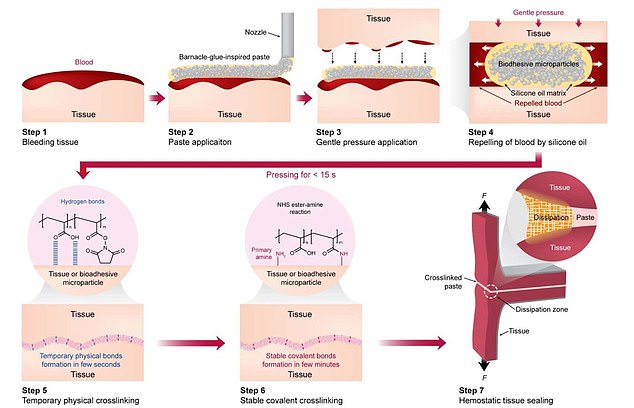
Scientists have developed new surgical glue which stops bleeding in just 15 seconds. It was inspired by the sticky substance that barnacles use to stick to rocks and ships. The graphic above shows how the rapid-sealing paste works to stop bleeding before clotting even begins

Scientists have developed new surgical glue which stops bleeding in just 15 seconds. It was inspired by the sticky substance that barnacles use to stick to rocks and ships. The graphic above shows how the rapid-sealing paste works to stop bleeding before clotting even begins

HOW DO BARNACLES STICK TO SHIP HULLS? 

Barnacles secrete an oily adhesive that allows them to clean a surface and repel moisture before latching onto it.

Once they have done this, they follow it up with a protein that cross-links them with the molecules of the surface.

The same two-step process is how a new type of surgical glue, developed by researchers at the Mayo Clinic and MIT, works to stop bleeding in as little as 15 seconds when applied to organs or tissues.

The glue-like substance barnacles secrete binds together exactly the same way as human blood does when it clots. 

Barnacles are often seen attached to rocks, the hulls of ships and even whales. 

Researchers at the Mayo Clinic and Massachusetts Institute of Technology (MIT) created the rapid-sealing paste based on the oily adhesive barnacles secrete to clean a surface and repel moisture. 

This glue-like substance binds together exactly the same way as human blood does when it clots. 

Surgeons typically use synthetic agents to speed up coagulation and form a clot to stop the bleeding, but even in the fastest cases this still takes several minutes.  

In preclinical studies, researchers found the paste stopped bleeding in as little as 15 seconds, even before clotting had begun.

Once barnacles have secreted the sticky substance they follow it up with a protein that cross-links them with the molecules of the surface. 

That two-step process is what happens when the sealing paste is applied to organs or tissues. 

'Our data show how the paste achieves rapid haemostasis in a coagulation-independent fashion. The resulting tissue seal can withstand even high arterial pressures,' said Christoph Nabzdyk, a Mayo Clinic cardiac anesthesiologist and co-author of the study.

'We think the paste may be useful in stemming severe bleeding, including in internal organs, and in patients with clotting disorders or on blood thinners. 

'This might become useful for the care of military and civilian trauma victims.'
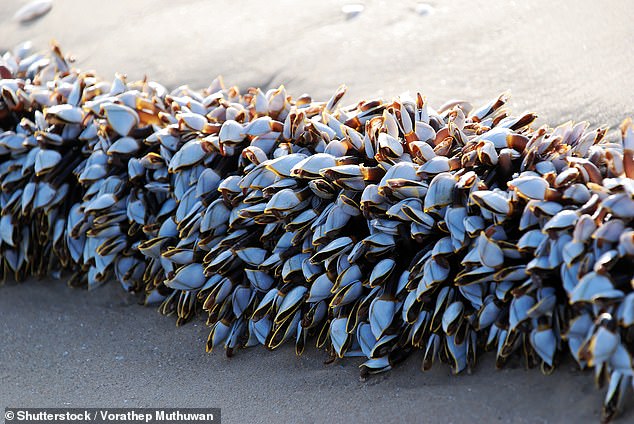
Sticky: Barnacles (pictured) are often seen clinging to rocks, the hulls of ships or even whales

Sticky: Barnacles (pictured) are often seen clinging to rocks, the hulls of ships or even whales

The paste contains a water-repelling oil matrix and bioadhesive microparticles. 

It's the microparticles that link to each other and the surface of the tissue after the oil has provided a clean place to connect. 

The biomaterial then slowly resorbs over several weeks. 

Scientists have previously suggested that slug slime could create stronger glue to prevent scarring and infection in surgery.

The defensive slime is produced by a common garden slug found in the UK, called the Dusky Arion, to foul the jaws of any would-be predator. 

In 2019, undergraduate researcher Rebecca Falconer at Ithaca College in New York conducted the first study to explore possible medical uses of the slime.

She said: 'Typical sutures like staples and stitches often lead to scarring and create holes in the skin that could increase the chance of infection after surgery.

'Understanding the roles of adhesive proteins in the slug glue would aid in the creation of a medical adhesive that can move and stretch yet still retain its strength and adhesiveness.' 

The new research is published in the journal Nature Biomedical Engineering. 

Weird sea creatures washed up on South Wales beach 'worth £50,000'
Loaded: 0%
Progress: 0%
0:00
Previous
Play
Skip
Mute
Current Time0:00
/
Duration Time0:26
Fullscreen
Need Text

Surgical glue inspired by barnacles stops bleeding in 15 seconds


https://www.dailymail.co.uk/sciencetech/article-9877177/Surgical-glue-inspired-barnacles-stops-bleeding-15-seconds.html

Monday, 18 June 2018

Chemotherapy before breast cancer surgery might fuel metastasis

W
hen breast cancer patients get chemotherapy before surgery to remove their tumor, it can make remaining malignant cells spread to distant sites, resulting in incurable metastatic cancer, scientists reported last week.
JULY 10, 2017

A breast cancer tumor imaged with a technique that highlights aspects of its microenvironment.NATIONAL CANCER INSTITUTE/UNIV. OF CHICAGO COMPREHENSIVE CANCER CENTER

The main goal of pre-operative (neoadjuvant) chemotherapy for breast cancer is to shrink tumors so women can have a lumpectomy rather than a more invasive mastectomy. It was therefore initially used only on large tumors after being introduced about 25 years ago. But as fewer and fewer women were diagnosed with large breast tumors, pre-op chemo began to be used in patients with smaller cancers, too, in the hope that it would extend survival.
But pre-op chemo can, instead, promote metastasis, scientists concluded from experiments in lab mice and human tissue, published in Science Translational Medicine.
The reason is that standard pre-op chemotherapies for breast cancer — paclitaxel, doxorubicin, and cyclophosphamide — affect the body’s on-ramps to the highways of metastasis, said biologist John Condeelis of Albert Einstein College of Medicine, senior author of the new study.
Called “tumor microenvironments of metastasis,” these on-ramps are sites on blood vessels that special immune cells flock to. If the immune cells hook up with a tumor cell, they usher it into a blood vessel like a Lyft picking up a passenger. Since blood vessels are the highways to distant organs, the result is metastasis, or the spread of cancer to far-flung sites.
Depending on characteristics such as how many tumor cells, blood vessel cells, and immune cells are touching each other, the tumor microenvironment can nearly triple the chance that a common type of breast cancer (estrogen-receptor positive/HER2 negative) that has reached the lymph nodes will also metastasize, Condeelis and colleagues showed in a 2014 study of 3,760 patients. The discovery of how the tumor microenvironment can fuel metastasis by whisking cancer cells into blood vessels so impressed Dr. Francis Collins, director of the National Institutes of Health, that he featured it in his blog.
The new study took the next logical step: Can the tumor microenvironment be altered so that it promotes or thwarts metastasis?
To find out, Einstein’s George Karagiannis spent nearly three years experimenting with lab mice whose genetic mutations make them spontaneously develop breast cancer, as well as mice given human breast tumors. In both cases, paclitaxel changed the tumor microenvironments in three ways, all more conducive to metastasis: The microenvironment had more of the immune cells that carry cancer cells into blood vessels, it developed blood vessels that were more permeable to cancer cells, and the tumor cells became more mobile, practically bounding into those molecular Lyfts.
As a result, the mice had twice as many cancer cells zipping through their bloodstream and in their lungs compared with mice not treated with paclitaxel. Two other neoadjuvants, doxorubicin and cyclophosphamide, also promoted metastasis by altering the tumor microenvironment. “This showed that the tumor microenvironment is the doorway to metastasis,” Condeelis said.
The scientists also analyzed tissue from 20 breast cancer patients who had undergone pre-op chemo (12 weeks of paclitaxel and four of doxorubicin and cyclophosphamide). Compared to before the chemo, the tumor microenvironment after treatment was more conducive to metastasis in most patients. In five, it got more than five times worse. No patient’s microenvironment got less friendly to metastasis.
Pre-op chemo “may have unwanted long-term consequences in some breast cancer patients,” the Einstein researchers wrote.
That finding is “fascinating, powerful, and very important,” said Julio Aguirre-Ghiso, of Mount Sinai School of Medicine, an expert in metastasis who was not involved in the study. “It raises awareness that we might have to be smarter about how we use chemotherapy.”
Dr. Julie Gralow, a medical oncologist at the University of Washington, said that if pre-op chemo promoted metastasis, that should have shown up in studies that compared it to post-op chemo, but for the most part it hasn’t. However, that could be because only tumor cells containing certain proteins that make them especially mobile are affected in this way. “This is an interesting study, to say the least,” Gralow said. “I am willing to keep my mind open to the possibility that there are some breast cancer patients in whom things get worse” with pre-op chemo.
One reason to question the findings, however, is that if pre-op chemo promotes metastasis in some patients, that might be expected to have shown up in studies of the therapy. Overall, in fact, those studies show that “neoadjuvant chemotherapy does not seem to improve overall survival,” as the authors of an editorial in the Journal of Clinical Oncology wrote.
That’s not as bad as decreasing survival, of course. But Einstein’s Dr. Maja Oktay, a co-author of the new research, cautioned that the typical length of the studies — six or so years — is too short to assess the risk of metastasis, “which can take more than 20 years” to appear, she said. Such patients might never be flagged as having metastatic cancer, let alone having it linked to pre-op chemo decades earlier, said Aguirre-Ghiso.
On a brighter note, not all breast cancer patients have the kind of tumor microenvironment in which pre-op chemo can promote metastasis. Whether they do or not can be determined by a simple lab test, but one that is not routinely done, Condeelis said.
Serendipitously, an experimental compound called rebastinib, being developed by Deciphera Pharmaceuticals, seems to be able to block the on-ramp to the metastasis highway. In a study currently recruiting patient volunteers, the Einstein scientists (who have no financial relationship with Deciphera) are studying whether rebastinib can improve outcomes in metastatic breast cancer.

Tuesday, 5 June 2018

Breast cancer: Common drugs may halt post-surgery relapse

After cancer surgery — particularly for breast cancer — many patients experience an early tumor recurrence. It is not clear why, but new research suggests that common pain-reducing, anti-inflammatory drugs may prevent that from happening.
Published
  
generic white tablets
The answer to early relapse after breast cancer surgery may be closer than we think.
In many cancer types — especially in the case of breast cancer — surgery is often preferred when it comes to removing primary tumors.
However, the recurrence of cancer after surgery is not an uncommon occurrence.
Some who have gone through surgery are at an increased risk of early recurrence, although the precise reasons why are currently unclear.
In a new study whose results have been published in the journal Science Translational Medicine, first author Jordan Krall and colleagues — from the Whitehead Institute for Biomedical Research in Cambridge, MA, and other institutions — have begun to uncover some clues and investigate how these cases of early relapse might be avoided.
"A partial explanation for these outcomes has become clear: in as many as one third of patients diagnosed with localized breast cancer, carcinoma cells have already disseminated to distant anatomical sites at the time of initial diagnosis," the authors explain in their paper.
Until surgery, such tumor cells may remain in a state of limbo, with their harmful potential blocked by the body's immune response.
"In a subset of patients, however," the authors say, "a small fraction of such clinically inapparent cancer cells ultimately renew proliferation and spawn life-threatening metastases [or secondary tumors]."
However, Krall and team's recent study on mice has revealed a ray of hope in the shape of a type of commonly available drug used to fight pain and reduce inflammation: nonsteroidal anti-inflammatory drugs (NSAIDs).
NSAIDs seem to reduce the risk of early post-operatory relapse in the patients to whom they are administered during surgery.
"This represents the first causative evidence of surgery having this kind of systemic response," says Krall. "Surgery is essential for treating a lot of tumors, especially breast cancer. But there are some side effects of surgery, just as there are side effects to any treatment."
"We're starting to understand what appears to be one of those potential side effects, and this could lead to supportive treatment alongside [...] surgery that could mitigate some of those effects."
Jordan Krall


https://www.medicalnewstoday.com/articles/321505.php?_1