Pages

Showing posts with label Ventilator. Show all posts

Monday, 27 April 2020

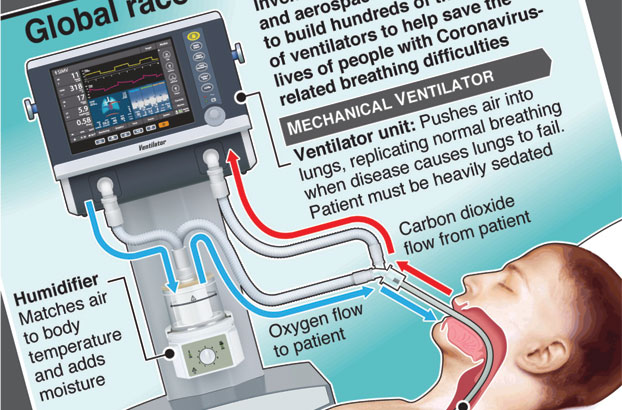
How ventilators work

How ventilators work

BY JORDI BOU
March 31, 2020 - Inventors, academics, carmakers and aerospace firms are rushing to build hundreds of thousands of ventilators to help save the lives of people with Coronavirus-related breathing difficulties.
For patients with the worst effects of the infection, a ventilator offers the best chance of survival.

A mechanical ventilator unit pushes air into a patient’s lungs, replicating the normal breathing when disease causes the lungs to fail.

Big names of industry such as General Motors, Airbus, McLaren and Dyson have offered their engineering expertise or factory lines, which in many cases have slowed or halted because of the pandemic.

University College London engineers have worked with clinicians at UCLH and Mercedes Formula One to build what is known as the Continuous Positive Airway Pressure (CPAP) device. Mercedes F1 is offering to build up to 1,000 CPAP machines per day.

According to the World Health Organization (WHO), some 80% of people with Covid-19 recover without needing hospital treatment.

But one person in six becomes seriously ill and can develop breathing difficulties. In these severe cases, the virus causes damage to the lungs.
PUBLISHED: 31/03/2020; STORY: Graphic News; PICTURES: UCL
Graphic News Standards


See Graphics picture on:

https://www.graphicnews.com/en/pages/40110/health-global-race-to-make-ventilators


Health authorities bid to install more ventilators


Friday, 24 April 2020

Life After Ventilators Can Be Hell for Coronavirus Survivors

Some never fully recover, and those who do often must relearn basic skills such as walking and swallowing.


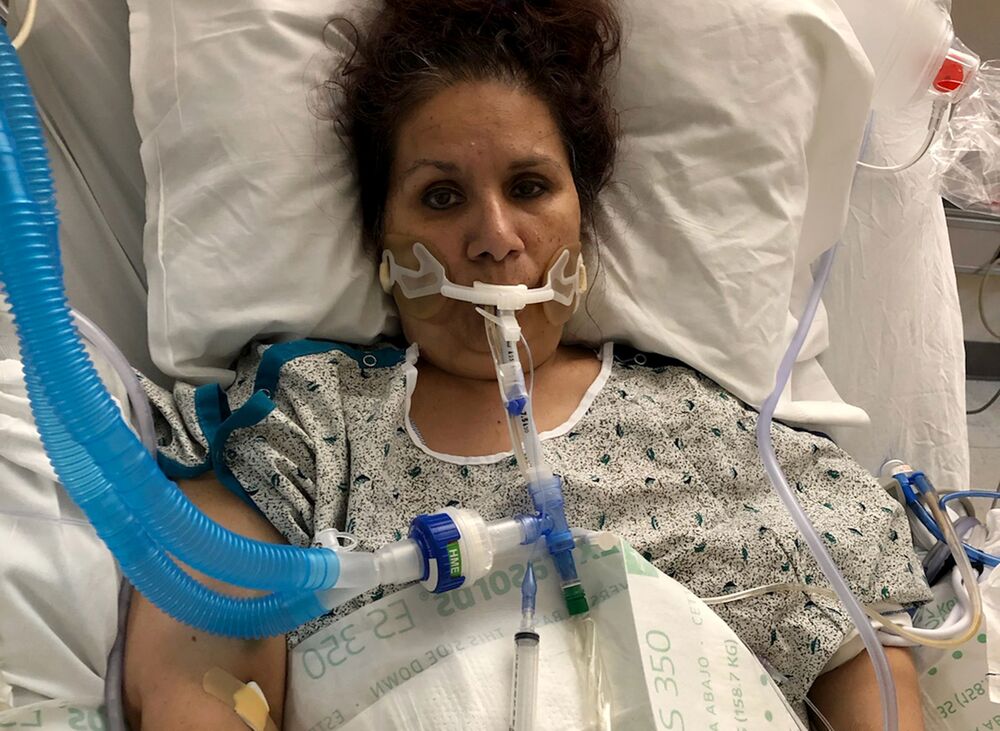
Diana Aguilar, 55, spent 10 days on a ventilator fighting for her life in Somerset hospital, New Jersey.
Diana Aguilar, 55, spent 10 days on a ventilator fighting for her life in Somerset hospital, New Jersey.Source: Aguilar family


Her fever hit 105 degrees. In her delirium, Diana Aguilar was sure the strangers hovering over her, in their masks and gowns, were angels before they morphed into menacing aliens. As a doctor prepared to slide a ventilator tube down her throat, all she remembers thinking was: “I cannot breathe. I have no air. I give up, I give up.”


Aguilar, in the throes of Covid-19, was starting her 10-day descent into ventilator limbo. The mechanical device to which her tube was attached is coveted for its ability to push life-saving oxygen deep into damaged lungs. Yet it also is feared and reviled for the damage it inflicts — and for the slim odds of survival it affords. Aguilar wasn’t aware of any of that, yet she sensed this could be the end. She whispered her goodbyes to her husband, son and daughter, none of whom were anywhere nearby, and then she prayed to God in her native Spanish.


“You’re going to be fine,” a voice reassured her. “Start counting now; one, two…”


The voice belonged to an anesthesiologist, the last she heard before drifting off. Diana was diagnosed with Covid-19 on March 18, the day she arrived in the emergency room at Robert Wood Johnson University Hospital Somerset in Somerville, New Jersey. The virus had already been ravaging her body for weeks, infecting the tiny cells in her lungs that deliver oxygen to her blood.

She was struggling to breathe, and every inch of her body ached as she felt it failing. And then came the intubation, a last-resort intervention to save her life. It’s an awful moment for each of the many thousands of patients who are estimated to have undergone the procedure.


As the cases of Covid-19 infection soar, already approaching 900,000 Americans, more and more patients are going through the same dreaded treatment. The lucky ones pull through, but their journey back to health is long and perilous. Doctors are only now learning about the challenges ahead for people who arrive at the hospital so breathless and low on oxygen that a ventilator, many believe, is all that’s standing between them and death.

“Mechanical ventilation is a life-saving intervention,” says Hassan Khouli, chair of critical care at the Cleveland Clinic in Ohio. Yet even when patients survive, “some of them will continue to be profoundly weak,” he says. “It can get to the point where they can’t perform daily activities — shaving, taking a bath, preparing a meal — to the point they could be bedridden.’’


Some people never fully recover, says Michael Rodricks, medical director of Somerset’s intensive-care unit. And those who do often must relearn basic skills such as walking, talking and swallowing.

Just a few weeks ago, when the success of social-distancing strategies was far from assured, various models estimated that the U.S., with about 63,000 of the devices available across the country, would fall dramatically and tragically short of the numbers needed. At one point, it was estimated that New York City alone may need 40,000 ventilators. Auto manufacturers agreed to work with medical-device makers to ramp up emergency production. And as makeshift hospitals sprang up in New York’s Central Park and in conference centers and gymnasiums across the country, plans were hatched to put two patients on a single ventilator to double capacity.

Now there’s good news: It appears that U.S. hospitals will need fewer than 17,000 devices to treat Covid-19 patients, according to one widely used model. What the final numbers will look like as the virus continues its march across the country is anyone’s guess. But there’s little doubt there will be thousands of ventilator survivors once the pandemic is over. And the quality of their lives is still an open question.


When Aguilar, 55, woke up in intensive care at the end of March, she found her wrists tied to the bed frame. That, she later learned, was to stop her from tearing out the tube that ran down her throat all the way to her lungs. It was connected to a mechanical ventilator that had been breathing for her for 10 days as she lay in a medically induced coma.

A nurse slowly peeled the tape off her face and, with a flick of her wrist, yanked out the tube. Aguilar had made it through the most harrowing phase of her Covid-19 gantlet.


Nurses and doctors lined the hallway outside her room in the 361-bed regional medical center, located halfway between Trenton, New Jersey, and New York City. When she looked up through the glass window, they started cheering and chanting. “Yay, Diana! You made it!” she remembers hearing.

“They were jumping and clapping, and everybody was so happy,” she says. “I didn’t know I had all these people waiting for me, waiting to see how I’d do.”

She hadn’t yet fully grasped how close she had come to death and the long odds she had just beaten. The cheers were also because many of the patients with whom she shared the ICU eventually were rolled out in body bags. Here’s why: The lungs are dynamic, delivering inhaled oxygen into the blood supply in seconds. If they aren’t working, the damage is swift. A person can go from healthy to dead in fewer than six minutes.


She also didn’t know that her husband, Carlos Aguilar, was in the room next to her. While Diana was sedated as the machine helped her breathe, Carlos had grown ill with the same virus. A few days earlier, he’d been admitted to the hospital. And hours after Diana regained consciousness, Carlos, 64, was sedated so doctors could slide a tube down his throat as his breathing worsened.


Carlos Aguilar
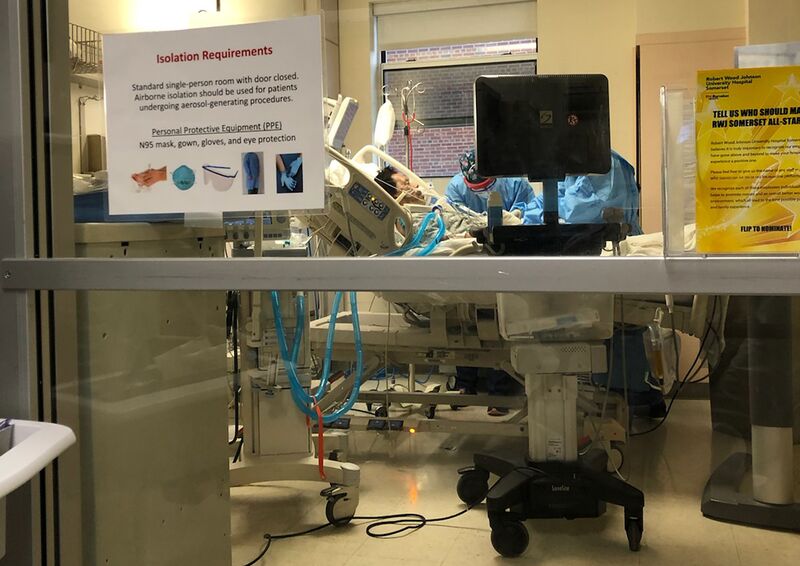
When Diana Aguilar was extubated and wheeled out of intensive care, she snapped a photo of her husband, Carlos Aguilar, intubated in the room beside her own.
Source: Aguilar family
When a person inhales, oxygen flows through the trachea, down branches that divide again and again, to end in 600 million tiny buds of air sacs known as alveoli. The oxygen passes easily through their walls, just one cell thick, and into the blood stream, where it fuels the rest of the body. 

Coronavirus and the inflammation it causes is like slime, clogging up the intricate system. One of the most troubling aspects is the virus’s ability to penetrate deep within the lungs, burrowing into cells and churning out viral particles. The issue isn’t just losing those cells in the lungs that are supposed to help oxygenate the body. The problem is the lungs then become the battleground for the fight, where the human immune system takes on the foreign invader. The tightly packed cells become so swollen from fluid and inflammation they stop functioning. Survivors have likened it to the sensation of drowning. 

Because SARS-CoV-2 is new to the human body, the infection can trigger a massive immune response, says Christopher Petrilli, an assistant professor at NYU Langone Health in New York.

“If you have an infection, your body tries to recruit as many immune cells as it can to fight that infection,’’ he says. “While it is effective at destroying the cells that have the virus, it has the potential to damage the surrounding tissue as well.’’


The interplay between the respiratory and circulatory systems, which run oxygen-enriched blood through the body, is delicate. In Covid-19 patients, the lungs don’t move enough oxygen. This restricts the amount that makes it into the blood, where it is supposed to fuel the body, repair and replace damaged cells and support the immune system.
That’s where a ventilator comes in.

It can be adjusted to boost oxygen, pressure and volume, pushing the air more forcefully into the lungs. But even when a patient is severely ill, some alveoli still function well. The goal is to take the pressure off the sick regions while supporting those that are still working, making sure they have the ideal amounts of oxygen and pressure so they can enrich the blood as efficiently as possible.


“I call this the Goldilocks approach,’’ says J. Brady Scott, an associate professor of cardiopulmonary sciences at Rush University Medical Center in Chicago. “When we put people on ventilators, one of my goals is to give a person the oxygen they need but not cause damage to the parts of the lungs that are still healthy. You don’t want to get too little, not too much. You want to give just what’s right.’’

Though weak, Diana felt a wave of euphoria when she was free of the ventilator. But her sense of joy was short-lived. A doctor informed her that her husband was on life support in the ICU room next to hers. Diana was crushed. Had she made it this far, only to see her husband of 35 years taken away from her? The couple had been together since Diana was just 17 years old. She wasn’t about to say goodbye to him now. The following day, as she was wheeled out of intensive care, her nurse pulled her bed up beside his room to let her peer through the glass window so she could catch a glimpse of Carlos, who was now on a ventilator, too.

“I don’t know how I pulled my body to sit up, but I wanted to see him,” she says. Her cell phone felt like a brick in her weak hand, but Aguilar managed to lift it above the bed frame to snap a photo of Carlos. She blessed him before she was whisked away, exhausted.


Somerset Hospital handout
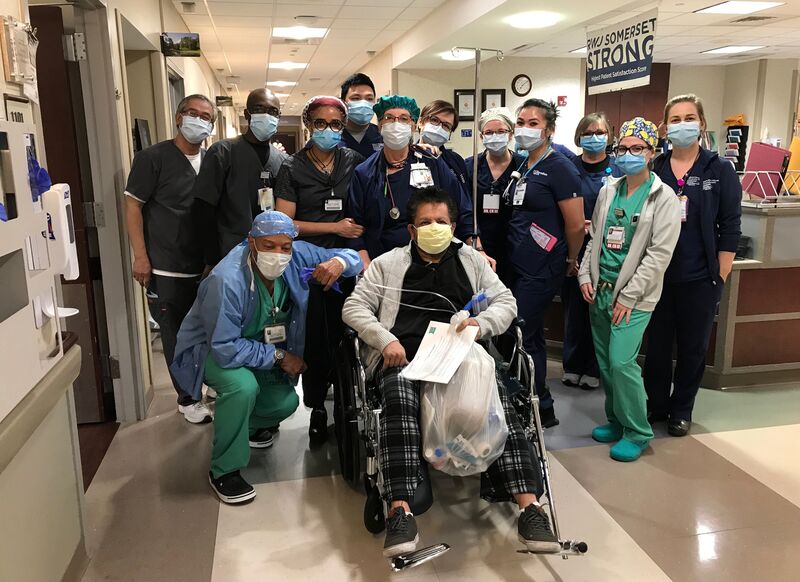
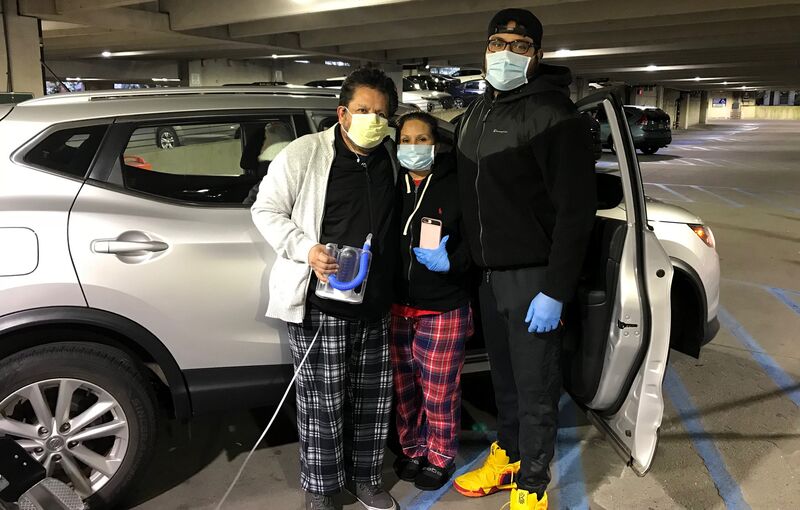
Health-care workers celebrate as Carlos Aguilar, 64, is discharged, with 'Here Comes the Sun' blasting over the speaker system.
Source: Somerset hospital
With both parents in intensive care, the Aguilar’s grown children were distraught. Carlos Aguilar Jr., 32, lives with his parents in New Jersey and had watched them both rapidly deteriorate from Covid-19 at home. “I felt helpless,’’ he says, especially after dropping his dad off at the hospital, waiting in the silent house for a phone call. “Not knowing what’s next is so hard.”

For years, the main focus of critical-care doctors who intubate patients has been keeping them alive, fine-tuning the treatments in an effort to improve survival rates. The machines, first introduced in 1928, were initially called iron lungs and used to help polio patients breathe. Only recently have researchers learned that the biological responses to the breathing machines that kick in almost immediately often have lasting harm.


“There are a lot of other dangers when we use mechanical ventilation,’’ says Richard Lee, interim chief of pulmonary diseases and critical-care medicine at the University of California at Irvine. “We have to sedate patients for them to tolerate a mechanical breathing tube in their lungs, and the longer you are in an ICU on sedation requiring a machine, all those other things — like decreased muscle tone and strength and the risk of hospital-acquired infections — increase.’’


When a person goes on a ventilator, the muscles that typically handle their breathing start to atrophy within hours. Many patients are put on sedatives to make it easier for the machine to take over. But this immobilizes other parts of their body and leads to widespread weakness.

The risk of dying remains higher than average for at least a year after getting off a ventilator, a risk tied to both the number of days spent on the machine and other health conditions the patient had before falling sick.


Somerset Hospital handout
Carlos Aguilar Jr., right, picks up his father, Carlos Aguilar, left, after he was discharged from Somerset hospital on April 14. Ten days earlier he picked up his mother, Diana, from the same hospital.
Source: Somerset hospital
Diana didn’t have the best health track record going in. She is a two-time colon-cancer survivor with high blood pressure, iron deficiency and a few extra pounds. She has only vague memories of her days on a ventilator, waking up in pain unable to talk or move, before drifting back into a troubled sleep full of dreams of her deceased relatives. Her husband, Carlos, with no previous medical condition, had a totally different experience. He spent three days on a ventilator, mildly sedated, spending his days napping or sitting in an armchair watching television.

Yet both now face the ordeal of recovering from their treatments. Fortunately, they were able to avoid the worst-case scenario, a condition known as Post-ICU syndrome that can afflict as many as half of Covid-19 patients who survive on a ventilator, says the Cleveland Clinic’s Khouli.


“These patients become deconditioned,’’ he says. “Some behave like they are really paralyzed, as if they are quadriplegics. They can barely move their muscles.’’
Hospitals are gearing up to treat these survivors, who already number in the hundreds. 

Some, like SUNY Downstate Medical Center in New York, are setting up entire rehabilitation floors to help people coming off ventilators learn how to live again. Others are trying to cut back use of the device, avoiding a rush to ventilators when oxygen may be all that’s needed.

There are also devices in development to help with recovery, such as Liberate Medical’s VentFree Muscle Stimulator. It uses electrical stimulation to trigger contractions in the abdominal wall muscles, allowing patients to “exercise,” even while they are unconscious, to keep them in some semblance of shape. The goal is to help wean them off the devices faster and ultimately boost survival rates, says Chief Executive Officer Angus McLachlan.


Aguilar handout
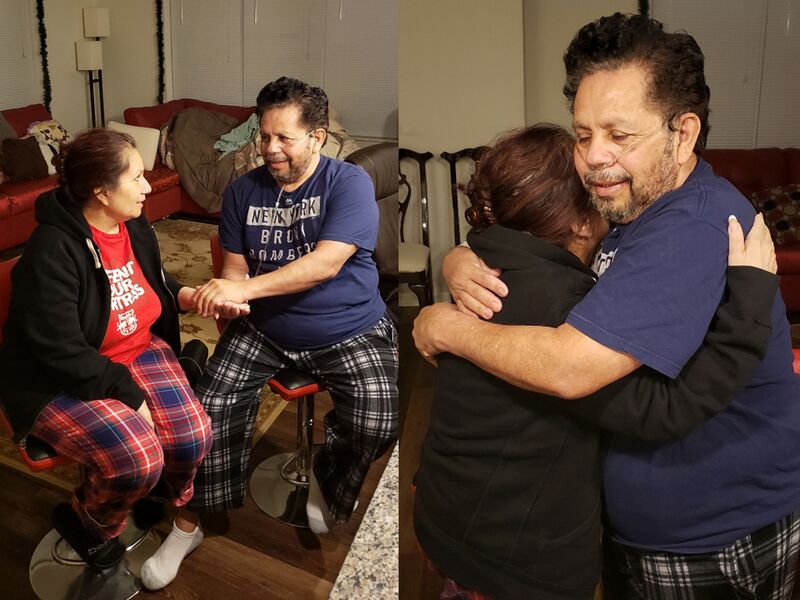
Diana and Carlos Aguilar, married 35 years, are reunited at home after both were infected with Covid-19 and intubated at Somerset hospital.
Source: Carlos Aguilar Jr.
In patients who develop acute respiratory distress — a common condition with Covid-19 marked by dramatic drops in oxygen levels — there is a second stage where scarring in the lungs develops, the University of California Irvine’s Lee says. As inflammatory and other cells invade the space, the architecture of the lungs is permanently changed.

The machines also can cause cognitive impairment, Rodricks says. A patient who worked as an accountant may have a tough time going back to work. An elderly person who was previously independent might struggle to perform daily tasks such as driving or grocery shopping. And a runner might never be able to hit the same pace again.


“Your overall condition may take some time to get back to its pre-Covid, pre-ICU state — if it ever gets back to that pre-ICU state,” he says.

The recovery will be sweeter for Diana Aguilar, now that Carlos has rejoined her after being released from the hospital on April 14. So far, three weeks after her release, it’s been mercilessly slow. Diana still feels weak, with a shortness of breath and vivid nightmares that she’s back in the hospital, tied to the bed, unable to breathe. But she’s thankful.

“There is some miracle that I’m here and he’s here,” she says. “I feel like God gave us another opportunity in this life.”

https://www.bloomberg.com/news/articles/2020-04-24/life-after-ventilators-can-be-hell-for-coronavirus-survivors

Thursday, 16 April 2020

When the ventilator comes off, the delirium comes out for many coronavirus survivors

(CNN)When health care workers finally removed the ventilator tube from Jesse Vanderhoof's throat, he managed to eke out two weak words: "Call Emily."
Updated 2338 GMT (0738 HKT) April 15, 2020

Vanderhoof, a 40-year-old nurse with coronavirus, was emotional and full of relief on the ensuing call with his wife after more than a week on a ventilator in an Idaho hospital's intensive care unit.
But over the next couple days, it became clear that while Jesse's body was on the mend, his mind wasn't right.
    He yanked an IV line out of his arm. He requested an Uber to take him home -- a $200, nearly three-hour trip -- even though he could barely get up. He talked in circles for days about going on a road trip and was obsessed with trying to rent an old-school Ford Bronco to drive himself home. He couldn't grasp what exactly was going on.
    "He didn't understand why the world was at war with (Covid-19), why health care workers were heroes, why he was involved," his wife, Emily Vanderhoof, 34, said. "We had the same conversation for four days straight."
    His experience is just one example of "ICU delirium," an acute brain condition characterized by confusion, inattention and an inability to understand the world around you. This is particularly common in patients who are sedated and on a ventilator for extended periods of time. And patients must be heavily sedated to tolerate a ventilator, which works via a tube snaked down the throat to deliver air to lungs flooded with fluid.
    "My brain wanted to keep on looping over and over and over, and I kept on asking without realizing that I had asked these questions lots of times," Jesse said.
    The effect of coronavirus on the lungs is well known, but its significant impact on the brain has been less widely acknowledged. As more and more patients come off ventilators and recover from coronavirus, many will return home not just with physical changes but with psychological ones, too.
    Two weeks since coming off the ventilator, Vanderhoof remains easily fatigued and is still working to piece together what exactly happened.
    "At this point it's starting to get clear, but for a while there, especially right after I was starting to gain consciousness and especially after ... they took the intubation tube out, it was really, really confusing to me," he said.
    Delirium is fairly common among ICU patients even in normal times. But the coronavirus pandemic is like a "delirium factory," said Dr. Wes Ely, a professor of medicine at Vanderbilt University Medical Center who specializes in ICU delirium.
    "If you had to design an experiment to make delirium as big of a problem as you could in an ICU, Covid is it," he said.

    What happens in delirium

    What it's like to recover from Covid-19 03:00
    Delirium can be caused by infection or inflammation, and it is especially common among ICU patients who are sedated and on a mechanical ventilator for long periods of time.
    Patients with delirium often experience hallucinations or vivid dreams that can sometimes lead them to act in irrational ways. They may pull off their IV line or their breathing apparatus that they believe is hurting them, or they may attack nurses.
    Missy Testerman, 49, a second-grade teacher in Rogersville, Tennessee, said her sweet, gentle father developed delirium when he was intubated in 2018, shortly before he died of leukemia. He became aggressive and paranoid and his arms had to be restrained to the bed to keep him from assaulting nurses.
    "He imagined crazy scenarios, such as that the nurses were trying to rule the world, that we were trying to steal his money, or that he was the only one who could protect the world from evil," Testerman wrote in an email. "He assaulted nurses while in these rages and said words I had never heard him say in my life. One night, he told the room full of people that I had killed his neighbor and taken his body to Mississippi."
    Vanderhoof said that he remembered dreaming that he was passing out and falling onto his face in slow motion. He said he watched his own death as well as his funeral.
    "I swear still, to this day, I saw my own funeral multiple times," he said Tuesday, 10 days after his release from the hospital. "It's just so realistic and so scary as a person to see. That's your brain knowing you're in trouble and knowing you're close (to death)."
    Delirium can last anywhere from days to weeks or months, and it waxes and wanes over time. For Vanderhoof, the delirium suddenly returned one night after he was back home with his wife in Hailey, Idaho. Emily said she found him at 2 a.m. in the bathroom talking in repetitive loops, unable to orient to where he was, counting on his hands and trying to use sign language.
    Delirium can have serious long-term consequences. Patients who experience longer periods of delirium are at higher risk for mental health issues like anxiety, depression and post-traumatic stress disorder. In addition, longer periods of delirium are associated with long-term cognitive impairment, according to a 2013 study in the New England Journal of Medicine.
    Delirium is one part of what's broadly known as Post-intensive care syndrome, or PICS, a collection of issues that patients experience after spending time in the ICU. Dr. Daniela J. Lamas, a pulmonary and critical care doctor at Boston's Brigham & Women's Hospital, said these types of patients often describe being psychologically changed by their stay in the ICU.
    "The family is overjoyed they made it through, but they feel different. They don't feel like they are the same person who went into the unit," she said. "They feel ashamed of even talking about that."

    Why delirium is so common during coronavirus

    Patients who are put on a ventilator for longer periods of time have a higher risk of delirium, Dr. Wes Ely explained.
    The impact of coronavirus on the brain remains largely unclear, but Ely, Lamas and Dr. Sharon Inouye, the director of the Aging Brain Center and a delirium expert, said that delirium is and will be a common issue with coronavirus patients.
    In some cases, the virus may cause brain inflammation, which contributes to delirium, Inouye said. In a case series of 214 Covid-19 patients in Wuhan, China, neurological symptoms were found in 36% of patients, according to research published in JAMA Neurology last week.
    In addition, coronavirus treatment requires longer periods of sedation and ventilator use.
    "A lot of aspects of coronavirus have made it very hard for us to do these practices that we know are the best practices to prevent delirium," Lamas said.
    In normal times, health care workers often wake these patients to test their alertness and breathing and try to wean them off the ventilator, which can decrease the likelihood of delirium. But in the pandemic, health care workers are stretched thin and have less time to spend with individual patients.
    "I think the providers are so taxed that you're trying to keep the patient alive," Inouye said. "During these times of crisis, you're just trying to keep the patient alive. Things like delirium prevention are just like extra credit assignments."
    Further, one way to help prevent delirium is to have family nearby. They can hold the patient's hand or talk to them, which can help orient them, even if they appear unconscious on a ventilator. But now, hospitals are keeping patients isolated and away from family to contain the spread of coronavirus.
    "Patients who are sedated will (later) tell us, 'I remember the family member talking, I remember something they said.' But now the families are not there," Lamas said.
      These ICU treatment strategies may change going forward as doctors learn more about the virus and the best way to treat it, Lamas said. Still, she worried there will be many coronavirus survivors facing difficult recoveries in the months to come.
      "I think we're going to be seeing with Covid a range of recoveries and a range of abilities to return to the world," she said. "As a medical system, it's going to be a very large population."
      https://edition.cnn.com/2020/04/15/us/coronavirus-icu-delirium/index.html