Pages

Showing posts with label Fruit juice. Show all posts

Sunday, 31 May 2020

A soda a day ups heart risk

ANOTHER study concludes that just one sugary drink a day can increase your risk of developing cardiovascular, or heart, disease.

  • The Star Malaysia
  • By NANCY CLANTON
  • A father and daughter check the ingredients label on a fruit drink at the supermarket. drinking sugary beverages daily, including fruit drinks with added sugar, can increase a person’s risk of heart disease. — Positive Parenting

    ANOTHER study concludes that just one sugary drink a day can increase your risk of developing cardiovascular, or heart, disease.

    Last year, researchers in France found that even one small glass of soft drink or sugary juice can increase your chances of getting cancer or having heart problems.

    Now, in a study recently published in the Journal of the American Heart Association, California researchers in the United States have found that one serving daily of a sugary soft drink is associated with a higher risk of cardiovascular disease.

    Sugar-sweetened beverages were defined as “caloric soft drinks, sweetened bottled waters or teas, and fruit drinks.”

    For their study, the scientists questioned 106.178 women free from cardiovascular disease and diabetes mellitus in the California Teachers Study, a cohort of female teachers and administrators who have been followed since 1995.

    The women were questioned for 20 years to determine beverage consumption and whether they had been diagnosed with heart disease, stroke or diabetes.

    During those two decades, many of the women began showing signs of those conditions.

    The study found that women who consumed fruit drinks with added sugar daily – “fruit drink” excluded fruit juices and included only flavoured fruity drinks with added sugar – were 42% more likely to develop cardiovascular disease, compared with those who drank no sugary beverages.

    Frequent (but not daily) soft drinkers had less risk, with a 23% greater likelihood for cardiovascular disease overall.

    The American Heart Association advises no added sugar for children younger than two years of age, no more than 100 calories from added sugar a day for children older than two years and most women, and no more than 150 calories from added sugar a day for most men.

    That’s about six teaspoons or 24g of sugar for children older than two years and women, and nine teaspoons or 36g of sugar for men.

    According to the Mayo Clinic in the US, one teaspoon of sugar (which equals about 4g) has about 16 calories.

    A 12oz (355ml) can of regular soft drink has about 160 calories – about 10 teaspoons or 40g of sugar.

    “We hypothesise that sugar may increase the risk of cardiovascular diseases in several ways,” said lead author Cheryl Anderson, a professor of family and public health at the University of California, San Diego.

    “It raises glucose levels and insulin concentrations in the blood, which may increase appetite and lead to obesity – a major risk factor for cardiovascular disease.”

    In addition, she said, excessive sugar is associated with inflammation, insulin resistance and type 2 diabetes.

    To avoid consuming too much added sugar, the American Heart Association recommends reading labels.

    Many foods – not just beverages – have sugar added, so checking labels can help keep amounts in check. – The Atlanta JournalConstitution/Tribune News Service

    https://www.pressreader.com/malaysia/the-star-malaysia/20200531/282368336860766

    Thursday, 11 July 2019

    Are sugary drinks causing cancer?

    Sugary drinks - including fruit juice and fizzy pop - may increase the risk of cancer, French scientists say.
    Fizzy drinkImage copyrightGETTY IMAGES
    The link was suggested by a study, published in the British Medical Journal, that followed more than 100,000 people for five years.
    The team at Université Sorbonne Paris Cité speculate that the impact of blood sugar levels may be to blame.
    However, the research is far from definitive proof and experts have called for more research.

    What counts as a sugary drink?

    The researchers defined it as a drink with more than 5% sugar.
    That included fruit juice (even with no added sugar), soft drinks, sweetened milkshakes, energy drinks and tea or coffee with sugar stirred in.
    The team also looked at diet drinks using zero-calorie artificial sweeteners instead of sugar but found no link with cancer.

    How big is the cancer risk?

    The study concluded that drinking an extra 100ml of sugary drinks a day - about two cans a week - would increase the risk of developing cancer by 18%.
    For every 1,000 people in the study, there were 22 cancers.
    So, if they all drank an extra 100ml a day, it would result in four more cancers - taking the total to 26 per 1,000 per five years, according to the researchers.
    "However, this assumes that there is a genuine causal link between sugary drink intake and developing cancer and this still needs further research," said Dr Graham Wheeler, a senior statistician at Cancer Research UK.
    Of the 2,193 cancers found during the study, 693 were breast cancers, 291 were prostate cancers and 166 were colorectal cancers.
    Drinking OJImage copyrightGETTY IMAGES

    Is this definitive proof?

    No - the way the study was designed means it can spot patterns in the data but cannot explain them.
    So, it did show that the people who drank the most (about 185ml a day) had more cancer cases than those who drank the least (less than 30ml a day).
    And one possible explanation is that sugary drinks are increasing cancer risk.
    But, alternatively, people who drink the most sugary drinks could have other unhealthy behaviours (eating more salt and calories than then rest, for example) that raise their cancer risk and the sugary drinks themselves could be irrelevant.
    So, the study cannot say that sugary drinks cause cancer.
    "While this study doesn't offer a definitive causative answer about sugar and cancer, it does add to the overall picture of the importance of the current drive to reduce our sugar intake," said Dr Amelia Lake, from Teesside University.
    She added: "Reducing the amount of sugar in our diet is extremely important."

    Is this just about obesity?

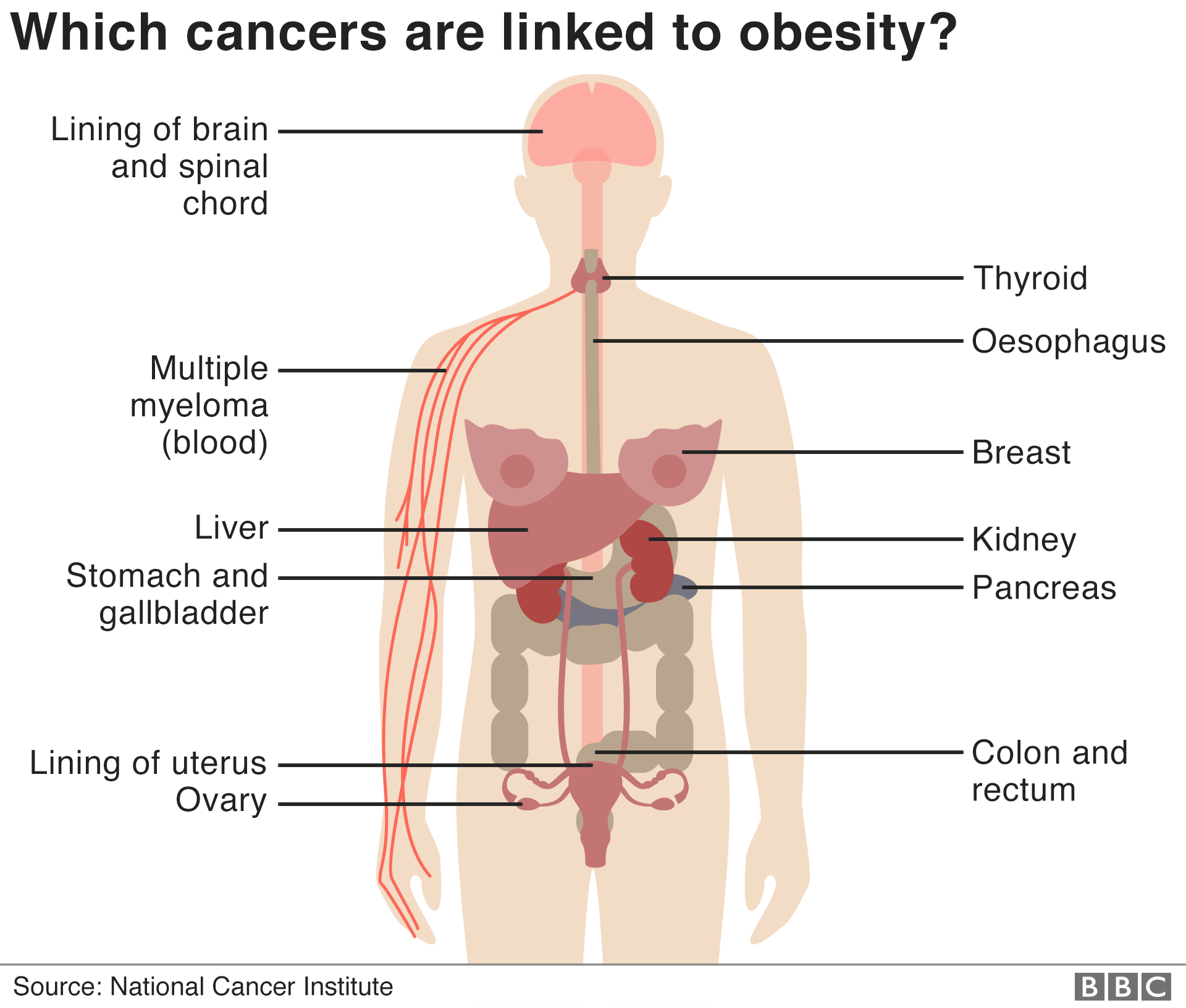
    Obesity is a major cause of some cancers - and excessive consumption of sugary drinks would increase the odds of putting on weight.
    However, the study said it was not the whole story.
    "Obesity and weight gain caused by sugary-drink excessive consumption certainly played a role in the association but they did not explain the whole association," Dr Mathilde Touvier, one of the researchers, told BBC News.
    Infographic shows female human body and indicates parts of the body where obesity is linked to cancer

    So what might be going on?

    The French researchers say the link "was strongly driven by sugar content" and they blame blood sugar levels.
    They also suggest some chemicals in the beverages, such as those that give an appealing colour, may be to blame.
    However, their study does not attempt to answer this question.
    "I find the biological plausibility of this difficult, given there was no significant difference between groups in relation to body weight or incidence of diabetes, which is often cited as an associated risk," Catherine Collins, an NHS dietitian, said.

    What do the researchers say?

    The team at Université Sorbonne Paris Cité say more large scale studies are needed to corroborate the findings.
    "Sugary drinks are known to be associated with an increased risk of cardiovascular diseases, overweight, obesity and diabetes," said Dr Touvier.
    "But what we show is they are also associated, maybe, with cancer risk."
    They say their research is further evidence that taxing sugary drinks is a good idea.
    "These data support the relevance of existing nutritional recommendations to limit sugary drink consumption, including 100% fruit juice, as well as policy actions, such as taxation and marketing restrictions targeting sugary drinks," their report says.
    The UK introduced a sugar tax in 2018, with manufacturers having to pay a levy on high-sugar drinks they produce.

    What do drinks companies have to say?

    The British Soft Drinks Association said the study "does not provide evidence of cause, as the authors readily admit".
    Its director general, Gavin Partington, added: "Soft drinks are safe to consume as part of a balanced diet.
    "The soft drinks industry recognises it has a role to play in helping to tackle obesity, which is why we have led the way in calorie and sugar reduction."

    https://www.bbc.com/news/health-48939671

    Monday, 30 January 2017

    How much fruit is REALLY in your soft drink?

    The shockingly small amounts in famous brands revealed (and there is more in a fizzy J20 than in a whole carton of cranberry juice) 


    • Graphic by Ship It Appliances reveals how much juice is in 65 popular drinks
    • Appletiser contains the most with 100 per cent real fruit juice
    • J20 fizzy drinks have 32 per cent juice compared to 27 per cent in Ocean Spray
    • Bottom of the list is Tizer, Gatorade Fruit Punch and Mountain Dew 


    We all know that fizzy drinks aren't exactly good for us - but if they're fruit-flavoured, we might expect them to contain at least some real fruit juice.
    But a new graphic reveals the shockingly small amounts of real fruit in some of the most popular soft drink brands, from Oasis drinks to Ribena.
    Others on the other hand may surprise you for containing much more fruit than you may realise, including Appletiser and J20 drinks. 
    This is the ultimate guide to how much fruit juice is in your favourite soft drinks. 
    A new graphic reveals how much real fruit juice is really in your favourite soft drinks, from Appletiser to Ribena
    A new graphic reveals how much real fruit juice is really in your favourite soft drinks, from Appletiser to Ribena
    These 10 soft drinks contain the least amount of real fruit juice of the 65 bottles compared in the graphic, including Mountain Dew and Vimto
    These 10 soft drinks contain the least amount of real fruit juice of the 65 bottles compared in the graphic, including Mountain Dew and Vimto
    The graphic by Ship It Appliances compares the fruit content in 65 of the UK's most popular fruity soft drinks, ranking them from top to bottom based on how much real fruit they contain.
    Shockingly, only two drinks are made up of at least 50 per cent fruit, with only 11 containing more than 20 per cent fruit. 
    The fruit content in some drinks will surprise you more than others.
    Surprisingly, J20 fizzy drinks contain more fruit juice than a whole carton of cranberry juice
    Surprisingly, J20 fizzy drinks contain more fruit juice than a whole carton of cranberry juice
    Rubicon's Still Guava contains 18 per cent real fruit juice - more than Orangina or a Capri Sun, which only contain 13 or 12 per cent real fruit juice
    Rubicon's Still Guava contains 18 per cent real fruit juice - more than Orangina or a Capri Sun, which only contain 13 or 12 per cent real fruit juice
    Topping the list is Appletiser, which proudly states on its label that it is simply 100 per cent carbonated apple juice. 
    But the second place may be a pleasant surprise to many. The graphic reveals that the 'posh' Fentimans Mandarin & Seville Orange fizzy drink contains 58 per cent real fruit juice.
    Other pleasant surprises include Rubicon's Still Pomegranate, which contains 36 per cent real fruit juice, and J20 drinks, which contain 32 per cent real fruit.
    Oasis juice drinks only contain five per cent real fruit juice - the same as in a fizzy Fanta or Lilt
    Oasis juice drinks only contain five per cent real fruit juice - the same as in a fizzy Fanta or Lilt
    Many drinks contain as little as five per cent real fruit juice, including Tango and Oasis
    Many drinks contain as little as five per cent real fruit juice, including Tango and Oasis
    But shockingly, they rank above a cranberry juice drink by popular brand Ocean Spray. Its juice only contains 27 per cent real fruit.
    Ribena Blackcurrant only contains six per cent real fruit juice. 
    Many of the drinks on the list contain as little as five per cent fruit juice - or none at all.
    Oasis juice drinks only contain five per cent fruit juice, while Vimto 's fizzy drink only contains 3 per cent. 
    And if you think cloudy lemonade might contain a high percentage of lemon juice, you'd be wrong as Ben Shaws Cloudy Lemonade only contains 2 per cent real fruit juice.
    At the bottom of the list with no real fruit juice at all is Tizer, Coca-Cola Cherry, KA Karnival Krush, Gatorade Fruit Punch and Mountain Dew.  
    Brands have been contacted for comment by MailOnline. 
    Cancer council warns 10 teaspoons of sugar in soft drink can
    Loaded: 0%
    Progress: 0%
    0:00
    Previous
    Play
    Skip
    Mute
    Current Time0:00
    /
    Duration Time0:34
    Fullscreen
    Need Text