Pages

Showing posts with label COVAX. Show all posts

Tuesday, 13 July 2021

Covid: China's coronavirus vaccines - What do we know about them?

Chinese vaccine producers Sinovac and Sinopharm have signed on to global vaccine sharing scheme Covax, which aims to distribute vaccines to poorer countries.

13 July 2021
Various medical syringes seen with Sinovac Biotech company logo displayed on a screen in the background.IMAGE COPYRIGHTGETTY IMAGES
image captionSinovac is a Beijing-based pharmaceutical company

The Global Alliance for Vaccines and Immunization (Gavi) said it would make 110 million doses of the vaccines available as part of the scheme.

Covax has agreements with the manufacturers of 11 vaccines and plans to provide 2 billion doses across the world by early 2022.

Both Sinopharm and Sinovac, which have been approved by the World Health Organization (WHO) for emergency use, are already being used in China and dozens of countries around the world.

But what do we know about China's vaccines and how do they compare to those being developed elsewhere?

media captionHow will the new Pfizer vaccine work?

How does the Sinovac vaccine work?

The Beijing-based biopharmaceutical company Sinovac is behind the CoronaVac, an inactivated vaccine.

It works by using killed viral particles to expose the body's immune system to the virus without risking a serious disease response.

By comparison the Moderna and Pfizer vaccines are mRNA vaccines. This means part of the coronavirus' genetic code is injected into the body, triggering the body to begin making viral proteins, but not the whole virus, which is enough to train the immune system to attack.

"CoronaVac is a more traditional method [of vaccine] that is successfully used in many well known vaccines like rabies," Associate Prof Luo Dahai of the Nanyang Technological University told the BBC.

On paper, one of Sinovac's main advantages is that it can be stored in a standard refrigerator at 2-8 degrees Celsius, like the Oxford vaccine, which is made from a genetically engineered virus that causes the common cold in chimpanzees.

In contrast Moderna's vaccine needs to be stored at -20C and Pfizer's vaccine at -70C.

It means that both Sinovac and the Oxford-AstraZeneca vaccine are a lot more useful to developing countries which may not have the facilities to store large amounts of vaccine at such low temperatures.
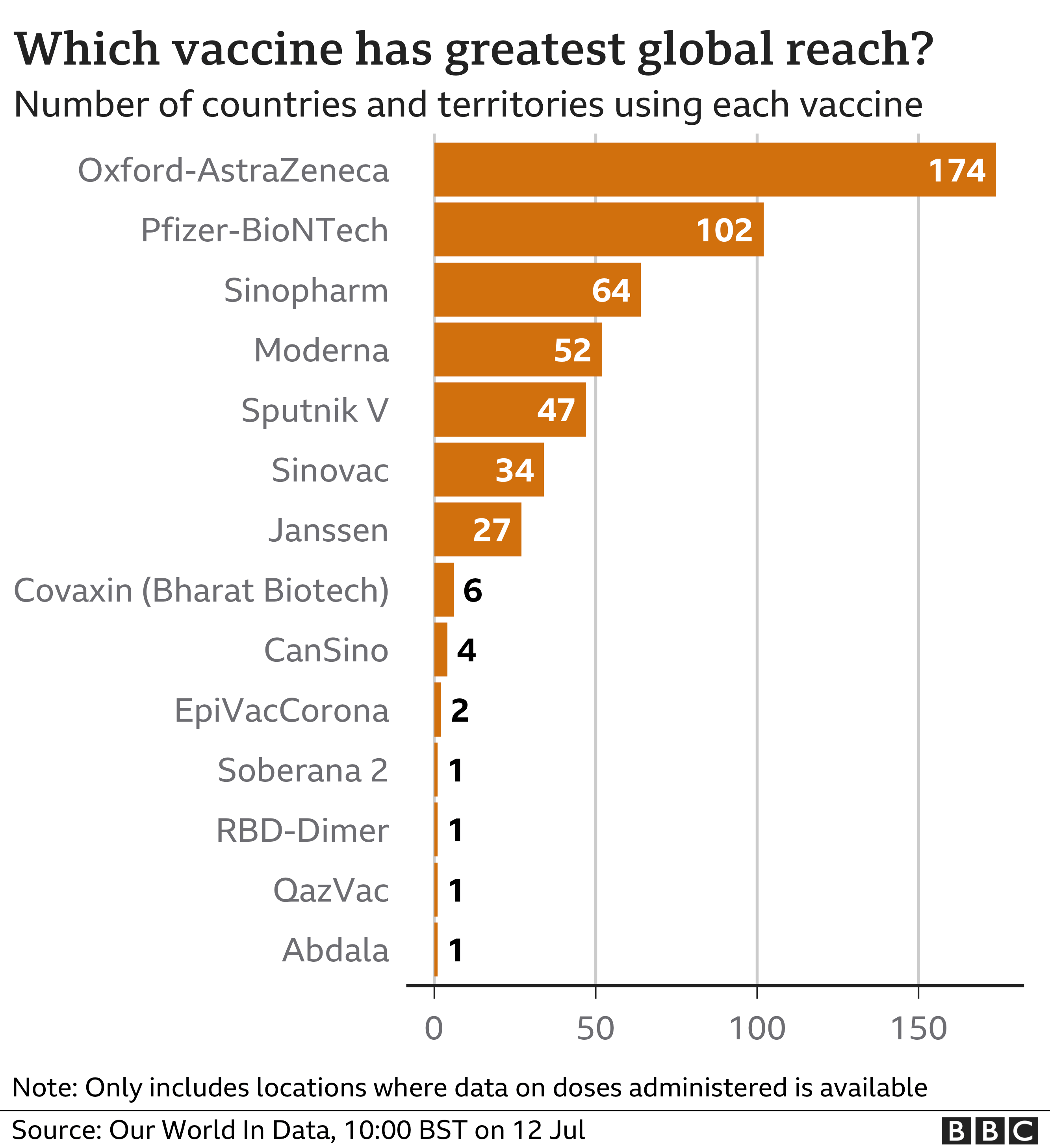
Chart showing which vaccines are being used the most: Oxford-AstraZeneca top, followed by Pfizer-BioNTech

How effective is it?

The WHO said studies showed the Sinovac vaccine "prevented symptomatic disease in 51% of those vaccinated and prevented severe Covid-19 and hospitalization in 100% of the studied population" for adults aged 18 and older, when it approved the jab in June.

It added that only a few adults over the age of 60 were enrolled in clinical trials, so efficacy could not be estimated for that age group.

According to a study published in the New England Journal of Medicine showing results from Chile, Sinovac has an efficacy rate of 65.9% against Covid-19, is 87.5% effective at preventing hospitalisation and 86.3% effective at preventing death.

However, there is little data about its effectiveness against the Delta variant.

What about the Sinopharm vaccine?

The WHO approved the Sinopharm vaccine which is produced by a Chinese state-owned company.

Like Sinovac, it is an inactivated vaccine which triggers the production of antibodies that fight the coronavirus.

The virus is killed before being injected into people's bodies, so it can't transmit Covid-19.

At the time, the WHO said: "Vaccine efficacy for symptomatic and hospitalized disease was estimated to be 79%, all age groups combined."

However, it added once again that there wasn't enough over 60s enrolled in clinical trials to estimate the efficacy for the age group. It still recommends the vaccine for older people though.
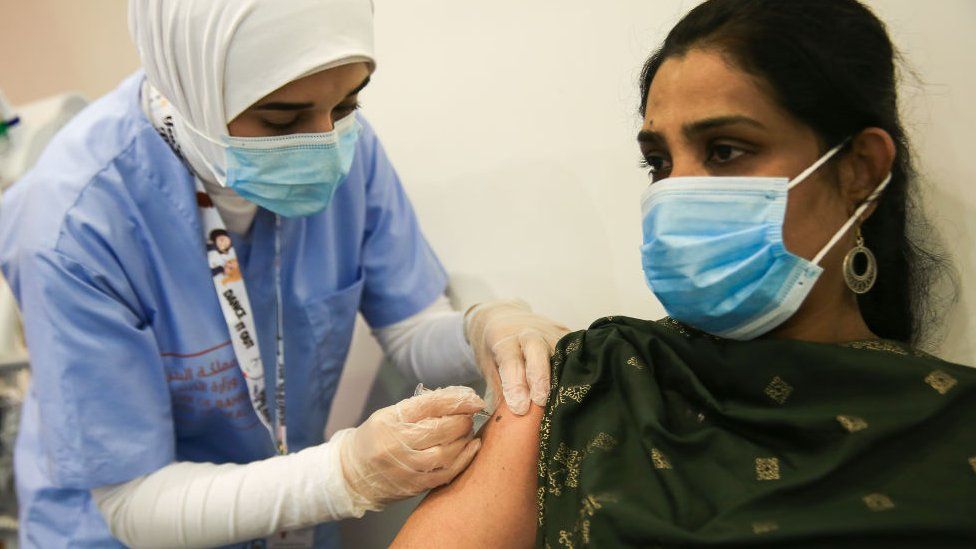
A woman is vaccinated with a syringe of a Chinese COVID-19 vaccine, developed by medicine company SinopharmIMAGE COPYRIGHTGETTY IMAGES
image captionBoth the UAE and Bahrain are using Chinese vaccines

China has administered more than a billion doses of its vaccines to its residents, according to China's National Health Commission.

The spread of the coronavirus within China has for the most part been contained - and the country has largely opened up.

Which countries are administering China's vaccines?

More than 80 countries are using China's Covid vaccines, including many in Asia, among them Indonesia, Thailand, Malaysia, Vietnam and the Philippines.

However, some countries that opted for the Chinese jabs have high vaccination rates, and are still seeing a surge in infection numbers.

For instance, Chile re-imposed a curfew and brought back restrictions on travelling in response to the Delta variant, which is more transmissible than previous variants.

More than 70% of Chileans are fully vaccinated, most with the Sinovac vaccine.

The Seychelles and Mongolia, meanwhile, have recently recorded some of the highest increase in cases per capita, despite their small populations.

Both are relying heavily on Sinopharm and their vaccination programmes are advanced: 68% of adults are fully vaccinated in the Seychelles and 55% in Mongolia.

Thailand has changed its vaccine policy to mix China's Sinovac with the AstraZeneca vaccine in a bid to boost protection after hundreds of medical workers caught Covid despite being fully vaccinated with Sinovac.

Meanwhile in Indonesia, the main doctors and nurses' association said at least 30 healthcare workers died despite receiving two doses of the Sinovac vaccine.

The country is now planning to switch to different Covid-19 vaccines for second doses or administer booster shots to increase efficacy.

So are the vaccines failing?

Vaccines are not the only factor to explain what's going on in these countries.

One reason could be that the efficacy of vaccines might be waning or they are not as effective against new variants.

Pfizer has said recently that it will seek authorisation for a booster shot in the United States to improve immunity.
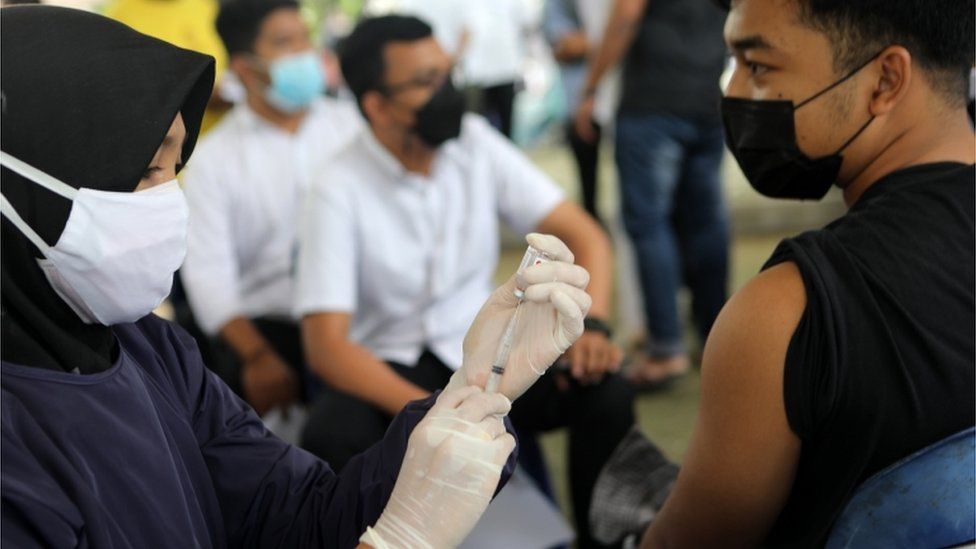
Indonesia man gets the Sinovac jabIMAGE COPYRIGHTEPA
image captionIndonesia has very low vaccination rates despite having access to the Chinese vaccines

In Indonesia, the main doctors' association said comorbidities may have played some part in the death of healthcare workers.

The country also has extremely low vaccination rates - with just over 5% of its population receiving both doses.

In Chile, some experts have blamed the spike in cases on people mingling too soon after getting the first dose of the vaccine.

Prof Ben Cowling, head of epidemiology and biostatics at University of Hong Kong, said despite having a "modest efficacy" against symptomatic Covid, both Sinovac and Sinopharm give "very high level of protection" against severe disease.

"That means that these inactivated vaccines would have already saved a lot of lives," he told the BBC.

How do variants affect vaccines?

The Sinovac and Sinopharm studies, however, tested the efficacy of vaccines against the virus that was first found in the Chinese city of Wuhan. No new data has been published on how they fare against variants.

Based on studies trying to model immune protection from the virus, Prof Cowling estimates the protection offered by inactivated virus vaccines against the Delta variant could be as much as 20% lower compared to the original strain.

His calculations suggest an even larger reduction against the Beta variant first found in South Africa, which is the one that most differs from the original virus.

Professor Jin Dong-yan, a virologist also from the University of Hong Kong, told the BBC it's "expected" that the efficacy of the Chinese vaccines will go down against the variants, including Delta.

But he said "Sinovac and Sinopharm are good vaccines" and people who do not have access to vaccines with higher efficacy should still receive their injections.

However, he said, they should continue to follow social distancing rules and other measures to curb infections.

Reporting by Pablo Uchoa and Yvette Tan

You may also be interested in:

media captionHundreds of people queued in Yiwu, China to get an experimental Covid-19 vaccine

More on this story

https://www.bbc.com/news/world-asia-china-57817591

Tuesday, 22 June 2021

14 Jun 21 Novavax vaccine shows 90% efficacy

Powerful new COVID-19 vaccine shows 90% efficacy, could boost world’s supply

A participant in Plano, Texas, is injected during Novavax’s North American COVID-19 vaccine trial this spring. The company reported its results today.

 
NOVAVAX


The dark horse vaccine company Novavax announced strong results today from a pivotal, 30,000-person trial of its pandemic coronavirus vaccine in the United States and Mexico. The vaccine uses a protein of SARS-CoV-2, a different technology from the COVID-19 vaccines authorized so far, and delivered 90.4% overall efficacy against symptomatic COVID-19 infections, and 100% protection against moderate and severe disease. Against eight viral variants of interest and concern, its efficacy was 93.2%. And the vaccine appeared safe and well-tolerated.

“This vaccine looks phenomenal. I am thrilled about these results,” says Monica Gandhi, an infectious disease physician and epidemiologist at the University of California, San Francisco. She notes that the clinical trial was highly diverse, with 44% nonwhite participants, and that the vaccine’s straightforward storage requirements could speed access to it in remote communities around the globe.

The difference of a few percentage points between Novavax’s 90% efficacy and the 95% and 94% efficacy of the Pfizer-BioNTech and Moderna vaccines is explained in part by Novavax’s later trial, which pitted the vaccine against viral variants, says John Moore, an immunologist at Weill Cornell Medicine and a participant in the Novavax trial. The trials of those other companies’ vaccines, composed of messenger RNA (mRNA), were completed before such variants were widely circulating.

“This is a vaccine whose efficacy is at least on a par with Pfizer and Moderna,” Moore says. “It’s essentially 100% protective against disease.”

One expert is less impressed, however. “The data they have [are] nothing spectacular,” says Vijay Samant, CEO of Xiconic Pharmaceuticals and former chief operating officer of Merck’s vaccine division. “The efficacy overall is couple of notches below the Pfizer and Moderna studies. … It’s a me-too vaccine at best.”

Novavax plans to apply to the U.S. Food and Drug Administration and other regulators for an emergency use authorization in the third quarter, once the company completes regulatory requirements aimed at ensuring its product consistently matches the vaccine used in the clinical trials, said President and CEO Stanley Erck.

Today’s announcement marks the end of a very long beginning for the once-moribund Gaithersburg, Maryland, company, which began to develop a vaccine in January 2020 and that July won $1.6 billion from the U.S. government’s Operation Warp Speed. But the company encountered production problems that delayed the launch of its North American clinical trial until late December 2020.

In the trial, two-thirds of participants at 113 sites in the United States and six sites in Mexico initially received two doses of the vaccine separated by 21 days. One-third of participants received a placebo. Between 25 January and 30 April, participants experienced 77 cases of COVID-19, 63 of them in the placebo group. All 14 cases in vaccinated participants were mild.

These results are similar to those Novavax reported in January from a late-stage trial of more than 15,000 people in the United Kingdom. That trial showed the vaccine efficacy was 89% overall, 86% against the Alpha variant that was first identified in the United Kingdom, and 96% against the original virus strain. But in a separate trial involving 4400 participants in South Africa, where the worrisome Beta variant arose and was circulating widely, the vaccine’s overall efficacy sank to 49%.

In the new trial, Novavax sequenced 70% of all the coronaviruses that caused illness. In more than half of the sequenced cases, they found the culprit was the Alpha variant, which accounted for 70% of U.S. infections by late April. But the company did not provide specific efficacy data against Alpha or any other variant. (Only two cases of the Beta variant were reported in the trial.)

“It doesn’t really address the lingering questions about how well the vaccine would work against ‘escape’ variants” such as Beta, says Natalie Dean, a biostatistician at the University of Florida.

The COVID-19 vaccines so far authorized by major Western regulatory agencies deliver genetic material that directs a recipient’s cells to make spike, a surface protein from SARS-CoV-2, that then trains the immune system to respond to the virus. Novavax’s vaccine instead delivers the spike protein itself, carried on soaplike particles and given extra punch by an immune-boosting substance called an adjuvant. Protein technology has been used for decades in vaccines against diseases including hepatitis B.

In clinical trials so far, Novavax’s vaccine has produced somewhat fewer powerful, though transient systemwide side effects such as headache, muscle pain, and fatigue, which many recipients of the Pfizer-BioNTech and Moderna vaccines experienced. For instance, 54% of participants who received Moderna’s vaccine as part of a 30,000-person trial reported at least one such effect; in Novavax’s 15,000-person trial in the United Kingdom, that number was 38%.

After a second dose of vaccine in the North American Novavax trial, about 40% of participants who received the active vaccine reported experiencing some degree of headache, muscle pain, or fatigue. But serious reactions were rare.

Having relatively mild side effects is a plus, says Mayank Mamtani, a biotechnology analyst who follows Novavax for B. Riley Securities. “This Novavax vaccine is going to be less reactogenic. You don’t have to cancel all your meetings” afterward, he says. He adds that the Novavax jab may find a niche as a booster vaccine in the United States, where he says such boosters may be needed by October or November. “We in this country love choice,” he adds.

Under its 2020 contract with Operation Warp Speed, Novavax committed to deliver 110 million doses to the U.S. government, although the country does not need them for initial vaccinations. Novavax expects to reach manufacturing capacity of 100 million doses per month by the end of the third quarter and 150 million doses per month by the fourth quarter of this year, Erck said.

The company has advance-purchase orders for about 200 million doses from another five Western governments and last month signed a deal to supply Gavi, the Vaccine Alliance, with 350 million doses for the COVID-19 Vaccines Global Access (COVAX) Facility, a global vaccine-sharing partnership. The Serum Institute of India, which is also making the Novavax vaccine, is slated to deliver another 750 million doses to COVAX, Novavax says. Serum plans to start delivering the Novavax vaccine by September, provided regulatory agencies have authorized it, officials there told Science.

Novavax’s production projections are substantially dialed back from earlier company predictions that it would ship 2 billion doses this year. That reflects the company’s struggle to scale up its manufacturing both at its own facilities and those of contractors and partner companies in 11 nations. “Novavax has been particularly challenged with executing on production scale-up efforts and manufacturing,” Mamtani wrote in a note to investment clients last month.

Unlike mRNA vaccines, which need to be stored frozen, Novavax’s protein vaccine can be stored in a refrigerator for up to 6 months, and, once removed, remains viable for 24 hours. Novavax has created a new version of its vaccine, adapted to the Beta variant, that could be used as a 1-year booster, the company says. On Friday, it announced positive results for the adapted vaccine in mice and baboons. Novavax says it is also working to customize its vaccine to other SARS-CoV-2 variants.

But Samant cautions that Novavax’s manufacturing struggles and the entrenched advantages of companies whose vaccines were approved months ago may make the small company’s climb to market share and profitability a tough one.

https://www.sciencemag.org/news/2021/06/powerful-new-covid-19-vaccine-shows-90-efficacy-could-boost-worlds-supply