Pages

Showing posts with label Exercise. Show all posts

Tuesday, 16 August 2022

5 Ways to Lower Your Cholesterol Naturally

 Learn how to get your cholesterol under control naturally.

High cholesterol doesn't make the headlines that other health concerns do, but it's a hidden danger that affects millions of Americans. According to the Centers for Disease Control and Prevention, "Nearly 94 million U.S. adults age 20 or older have total cholesterol levels higher than 200 mg/dL. Twenty-eight million adults in the United States have total cholesterol levels higher than 240 mg/dL." High cholesterol often doesn't show signs, but a blood test can indicate if your levels are too high. If left untreated high cholesterol can lead to serious health issues like heart disease, stroke, diabetes and more. Eat This, Not That! Health spoke with  Sean Marchese, MS, RN, a registered nurse at The Mesothelioma Center with a background in oncology clinical trials and over 15 years of direct patient care experience who shares five ways to help naturally lower your cholesterol. As always, please consult with your physician for medical advice. Read on—and to ensure your health and the health of others, don't miss these Sure Signs You've Already Had COVID.

1

Improve Your Diet

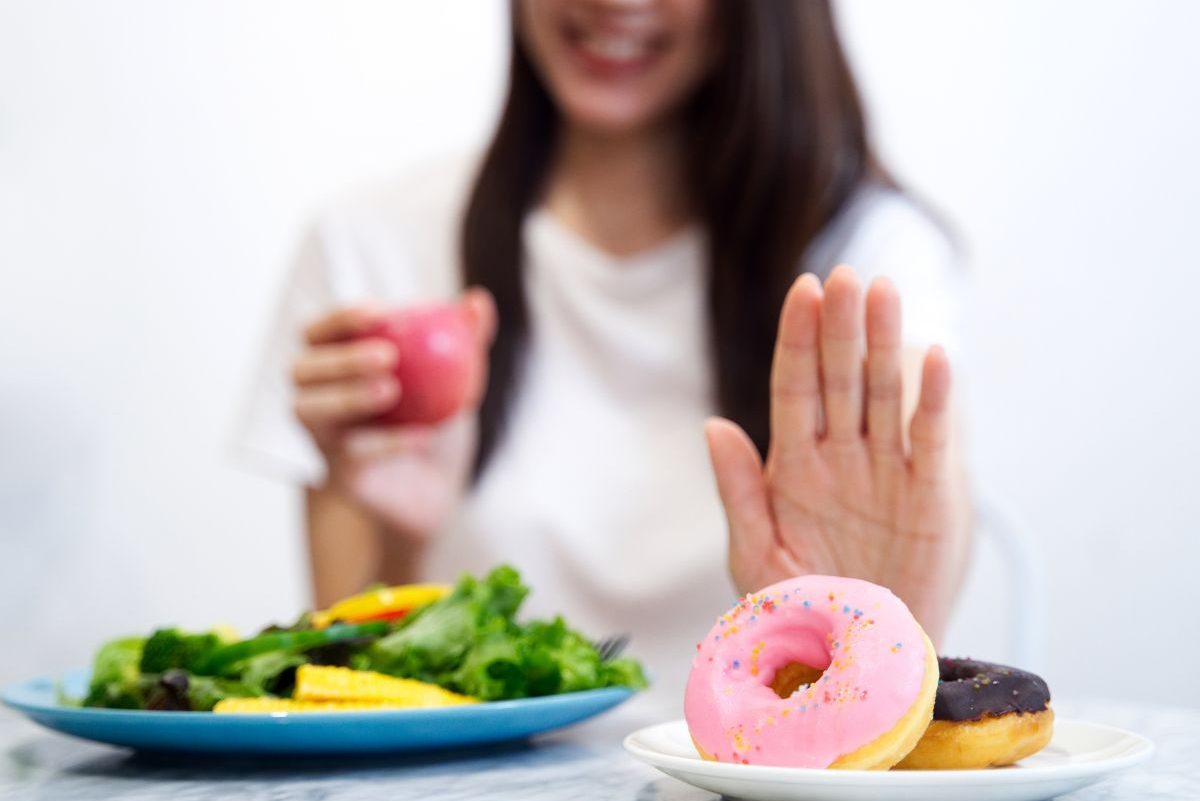
woman choosing healthy apple instead of junk dessert as a food swap to cut calories
Shutterstock

Marchese tells us, "Many foods naturally lower cholesterol levels, and you can take steps to remove sources of cholesterol from your diet. Avoid saturated fats, such as red meats and full-fat dairy, and trans fats from oil, crackers, cookies and cakes. Soluble fiber reduces cholesterol absorption in the blood and is found in oatmeal, kidney beans, apples, and Brussels sprouts. Whey protein from dairy products has been shown to lower LDL and total cholesterol and may improve blood pressure. Food rich in omega-3 fatty acids, such as salmon, walnuts and flaxseed, don't directly affect cholesterol levels. Still, they contribute to healthy heart tissue and blood vessels." 


2

Reduce Alcohol Consumption

Sad woman drinking wine at kitchen.
Shutterstock

Marchese says, "Moderate alcohol use can contribute to higher HDL levels or "bad" cholesterol. Healthy adults should avoid alcohol as much as possible or aim for no more than one to two daily drinks. In addition to high cholesterol, recurrent alcohol use can lead to hypertension, heart failure and stroke." 


3

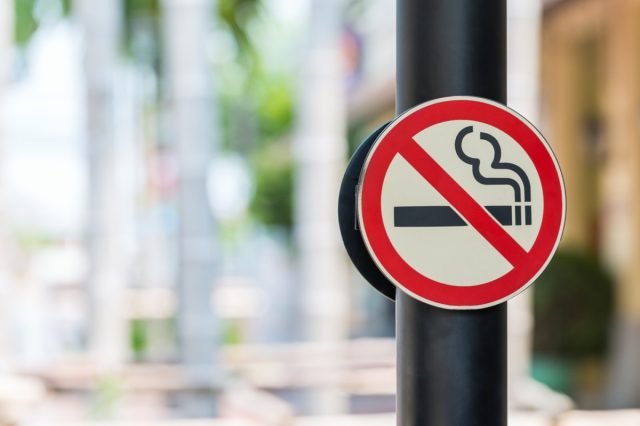
Quit Smoking

no smoking sign
Shutterstock

"Tobacco use can increase heart pressure and heart rate, compounding the adverse effects of atherosclerosis from high cholesterol levels," Marchese explains. "Quitting tobacco improved HDL cholesterol levels by improving blood circulation and lung function. A year after quitting, heart disease risk is cut in half for most ex-smokers." 


4

Lose Weight

weight fluctuates
Shutterstock

According to Marchese, "People who carry weight around their abdomen tend to have a higher ratio of visceral fat, which can adversely affect sensitive organs like the liver. Extra weight contributes to high cholesterol and increases the workload on arteries and blood vessels. Reducing sugary foods, incorporating healthy snacks, and finding ways to increase activity throughout the day are all great ways to improve weight loss." 


5

Increase Activity and Exercise

weight loss progress
Shutterstock

Marchese shares, "Physical activity raises the production of HDL in your bloodstream, which helps clear LDL and reduces atherosclerosis. The recommendation for healthy adults is about 30 minutes of moderate exercise five times per week or vigorous aerobics for 20 minutes three times per week. Try finding ways to incorporate more activity throughout your days, such as a walk during the afternoon, evening bike rides, sports or an active hobby like hiking or swimming."


5 Ways to Lower Your Cholesterol Naturally — Eat This Not That

Wednesday, 1 September 2021

5 Things That Will Help Your Dog Live a Longer, Healthier Life

Animal Expert Shares 5 Things That Will Help Your Dog Live a Longer, Healthier Life

JACQUELINE BOYD, THE CONVERSATION
30 AUGUST 2021


As anyone who has ever lived with a dog will know, it often feels like we don't get enough time with our furry friends. Most dogs only live around ten to 14 years on average – though some may naturally live longer, while others may be predisposed to certain diseases that can limit their lifespan.

But what many people don't know is that humans and dogs share many genetic similarities – including a predisposition to age-related cancer. This means that many of the things humans can do to be healthier and longer lived may also work for dogs.

Here are just a few ways that you might help your dog live a longer, healthier life.

1. Watch their waistline

One factor that's repeatedly linked with longevity across a range of species is maintaining a healthy bodyweight. That means ensuring dogs aren't carrying excess weight, and managing their calorie intake carefully.

Not only will a lean, healthy bodyweight be better for your dog in the long term, it can also help to limit the impact of certain health conditions, such as osteoarthritis.

Carefully monitor and manage your dog's bodyweight through regular weighing or body condition scoring – where you look at your dog's physical shape and "score" them on a scale to check whether they're overweight, or at a healthy weight. Using both of these methods together will allow you to identify weight changes and alter their diet as needed.

Use feeding guidelines as a starting point for how much to feed your dog, but you might need to change food type or the amount you feed to maintain a healthy weight as your dog gets older, or depending on how much activity they get.

Knowing exactly how much you are feeding your dog is also a crucial weight-management tool – so weigh their food rather than scooping it in by eye.

More generally, good nutrition can be linked to a healthy ageing process, suggesting that what you feed can be as important as how much you feed. "Good" nutrition will vary for each dog, but be sure to look for foods that are safe, tasty and provide all the nutrients your dog needs.

2. Plenty of walks

Exercise has many physiological and psychological benefits, both for our dogs (and us). Physical activity can help to manage a dog's bodyweight, and is also associated with anti-ageing effects in other genetically similar species.

While exercise alone won't increase your dog's lifespan, it might help protect you both from carrying excess bodyweight. And indeed, research suggests that "happy" dog walks lead to both happy dogs and people.

3. Teach them new tricks

Ageing isn't just physical. Keeping your dog's mind active is also helpful. Contrary to the popular adage, you can teach old dogs new tricks – and you might just keep their brain and body younger as a result.

Even when physical activity might be limited, explore alternative low-impact games and pursuits, such as scentwork that you and your dog can do together. Using their nose is an inherently rewarding and fun thing for dogs to do, so training dogs to find items by scent will exercise them both mentally and physically.

Other exercise such as hydrotherapy – a type of swimming exercise – might be a good option – especially for dogs who have conditions which affect their ability to exercise as normal.

4. Bonding

Like many companion animals, dogs develop a clear attachment to their caregivers. The human-dog bond likely provides companionship – and often, dog lovers describe them as a family member.

A stable caregiver-dog bond can help maintain a happy and mutually beneficial partnership between you and your dog. It can also help you recognize subtle changes in your dog's behavior or movement that might signal potential concerns.

Where there is compatibility between caregiver and dog, this leads to a better relationship – and even benefits for owners, too, including stress relief and exercise. Sharing positive, fun experiences with your dog, including playing with them, are great for cementing your bond.

5. Don't skip vet visits

Modern veterinary medicine has seen substantial improvements in preventing and managing health concerns in dogs. Successful vaccination and parasite management programs have effectively reduced the incidence of disease in both dogs and humans – including toxocariasis, which can be transmitted from dog feces to humans, and rabies, which can be transmitted dog-to-dog or dog-to-human.

Having a good relationship with your vet will allow you to tailor treatments and discuss your dog's needs. Regular health checks can also be useful in identifying any potential problems at a treatable stage – such as dental issues or osteoarthritis – which can cause pain and negatively impact the dog's wellbeing.

At the end of the day, it's a combination of our dog's genetics and the environment they live in that impacts their longevity. So while we can't change their genetics, there are many things we can do to improve their health that may just help them live a longer, healthier life. The Conversation

Jacqueline Boyd, Senior Lecturer in Animal Science, Nottingham Trent University.

This article is republished from The Conversation under a Creative Commons license. Read the original article.


https://www.sciencealert.com/animal-expert-shares-5-things-that-will-help-your-dog-live-a-longer-healthier-life

How Much Exercise You Need to 'Offset' a Day of Sitting

Scientists Figured Out How Much Exercise You Need to 'Offset' a Day of Sitting

30 AUGUST 2021


We know that spending hour after hour sitting down isn't good for us, but just how much exercise is needed to counteract the negative health impact of a day at a desk? A 2020 study suggests about 30-40 minutes per day of building up a sweat should do it.

Up to 40 minutes of "moderate to vigorous intensity physical activity" every day is about the right amount to balance out 10 hours of sitting still, the research says – although any amount of exercise or even just standing up helps to some extent.

That's based on a meta-analysis across nine previous studies, involving a total of 44,370 people in four different countries who were wearing some form of fitness tracker.

The analysis found the risk of death among those with a more sedentary lifestyle went up as time spent engaging in moderate-to-vigorous intensity physical activity went down.

"In active individuals doing about 30-40 minutes of moderate to vigorous intensity physical activity, the association between high sedentary time and risk of death is not significantly different from those with low amounts of sedentary time," the researchers wrote in the British Journal of Sports Medicine (BJSM) in 2020.

In other words, putting in some reasonably intensive activities – cycling, brisk walking, gardening – can lower your risk of an earlier death right back down to what it would be if you weren't doing all that sitting around, to the extent that this link can be seen in the amassed data of many thousands of people.

While meta-analyses like this one always require some elaborate dot-joining across separate studies with different volunteers, timescales, and conditions, the benefit of this particular piece of research is that it relied on relatively objective data from wearables – not data self-reported by the participants.

The study was published alongside the release of the World Health Organization 2020 Global Guidelines on Physical Activity and Sedentary Behavior, put together by 40 scientists across six continents. In fact, in November 2020 BJSM put out a special edition to carry both the new study and the new guidelines.

"These guidelines are very timely, given that we are in the middle of a global pandemic, which has confined people indoors for long periods and encouraged an increase in sedentary behavior," said physical activity and population health researcher Emmanuel Stamatakis from the University of Sydney in Australia.

"People can still protect their health and offset the harmful effects of physical inactivity," says Stamatakis, who wasn't involved in the meta-analysis but is the co-editor of the BJSM. "As these guidelines emphasize, all physical activity counts and any amount of it is better than none."

The research based on fitness trackers is broadly in line with the new WHO guidelines, which recommend 150-300 mins of moderate intensity or 75-150 mins of vigorous-intensity physical activity every week to counter sedentary behavior.

Walking up the stairs instead of taking the lift, playing with children and pets, taking part in yoga or dancing, doing household chores, walking, and cycling are all put forward as ways in which people can be more active – and if you can't manage the 30-40 minutes right away, the researchers say, start off small.

Making recommendations across all ages and body types is tricky, though the 40 minute time frame for activity fits in with previous research. As more data are published, we should learn more about how to stay healthy even if we have to spend extended periods of time at a desk.

"Although the new guidelines reflect the best available science, there are still some gaps in our knowledge," said Stamatakis.

"We are still not clear, for example, where exactly the bar for 'too much sitting' is. But this is a fast-paced field of research, and we will hopefully have answers in a few years' time."

The research was published here, and the WHO guidelines here, in the British Journal of Sports Medicine.

A version of this article was originally published in November 2020.

https://www.sciencealert.com/scientists-figured-out-how-much-exercise-you-need-to-offset-a-day-of-inactivity

Wednesday, 22 July 2020

Coronavirus: 'Deadly masks' claims debunked

This week, face masks became mandatory on public transport in England, and changes to the use of face coverings in hospitals were introduced.
  • 20 June 2020
The BBC's anti-disinformation team has been investigating misleading claims about the health risks of face masks.
Here is a look at some of the most widely seen examples on social media.

No evidence of harmful carbon dioxide exposure

Most people won't find masks very comfortable, but this article is looking at claims that wearing them is actually dangerous.
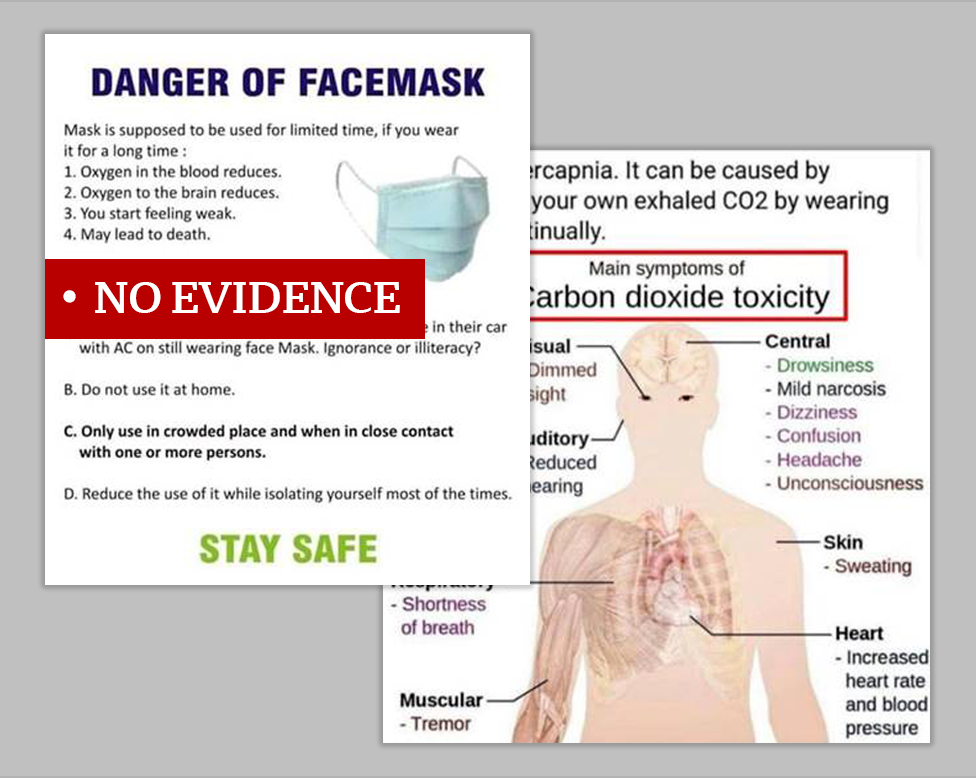
A diagram taken from Wikipedia showing the "symptoms of carbon dioxide toxicity" has been re-edited and shared thousands of times on Facebook.
Two misleading graphics claiming face masks are dangerous
The modified version claims that wearing a mask leads to "re-breathing your exhaled CO2".
People have attached the image to comments under BBC News articles about the new rules.
We've seen lots of posts alerting people to this potentially harmful side-effect - called hypercapnia - where there's too much carbon dioxide in the blood.
But it's highly unlikely you'll suffer it wearing a cloth or gauze face mask.
"This simply won't happen unless there is an air-tight fit and you rebreathe your air," says Prof Keith Neal, an infectious disease expert.
Carbon dioxide molecules are tiny - far smaller than droplets containing coronavirus which the masks are designed to stop - and won't be trapped by a breathable material, particularly during relatively short periods like a bus journey.
When you breathe out, the carbon dioxide will go through and round the mask.
Surgeons regularly wear much heavier-duty face coverings all day without coming to harm.
"There have been reports of some medics developing headaches linked to wearing personal protective equipment for long periods of time, but it's still highly unlikely they would suffer from some of the more extreme effects of carbon dioxide toxicity," says Rachel Schraer, BBC Health reporter.
The World Health Organization (WHO) says masks could provide "a barrier for potentially infectious droplets" in areas where "physical distancing of at least one metre is not possible".
Home-made cloth face coverings can help reduce the spread from people who are contagious but have no symptoms or are yet to develop symptoms. Read more from the BBC's Michelle Roberts on why we're asked to wear masks in some settings.

"I would rather die of coronavirus than wear a mask"

The question of whether or not to wear a mask has been polarising opinion in the United States for weeks.
Some states and local governments have legislated to make wearing face coverings in public places compulsory, and some stores have introduced their own policies requiring shoppers to wear masks. This has led to a debate online about civil liberties.
Plandemic, a viral conspiracy video full of false claims about coronavirus, included an assertion that wearing a mask "literally activates your own virus", when there is no evidence to support this claim. This led to Facebook removing the video from its platform when it went viral in May.
Aubrey Huff video in which he criticises the use of face masks
Former professional baseball player Aubrey Huff this week vented his anger about being required to wear a mask, in a video on Twitter, which was viewed 1.6 million times. In it, he claims: "It's not healthy to breathe in your own CO2 all the time", but as we've seen there's no evidence that wearing a face covering causes you to breathe in more CO2.
He concludes: "I would rather die from coronavirus than to live the rest of my life in fear and wearing a damn mask".
Opponents of mandatory mask legislation are protesting against lawmakers' decisions. Last week, the LA Times reported that a public health official resigned from her role after mandating masks in public places in Orange County, California. Protesters created posters of her with a Hitler moustache and swastikas, and she was on the receiving end of what was interpreted as a death threat.
Some people who dispute the need for masks claim the pandemic is either a hoax or exaggerated, despite the hundreds of thousands of deaths worldwide.
Anti-mask meme posted by a conservative Latino Facebook page
A meme that has been widely shared on US Facebook groups since mid-May asks why we are distancing, if masks work. The easy answer is that neither method gives the population full protection, but having both can help limit the spread of the virus.
The meme then goes on to conclude; "Because it's not about the virus. It never was." However, new requirements to wear masks are certainly related to the coronavirus pandemic and efforts to stop the spread of the virus. One example of the meme from a conservative Latino Facebook page has been shared 26,000 times.

Masks won't deprive body of oxygen

Another theme in misleading posts surrounding the use of masks is that they limit the amount of oxygen getting into the body.
One graphic titled "danger of a face mask" says this "may lead to death".
But the breathable materials recommended for face masks worn properly won't inhibit your breathing.
Breathlessness is a sign that your body is deprived of oxygen - known as hypoxia.
"Thin paper or cloth masks will not lead to hypoxia. Surgeons operate for hours wearing them. They don't get these problems," says Prof Neal.
The WHO says: "The prolonged use of medical masks when properly worn, does not cause CO2 intoxication nor oxygen deficiency.
"While wearing a medical mask, make sure it fits properly and that it is tight enough to allow you to breathe normally. Do not re-use a disposable mask and always change it as soon as it gets damp."
These oxygen-depleting claims have appeared in many different languages: English, German, Serbian and Hebrew Facebook posts alongside the same stock image of a toddler in a mask.
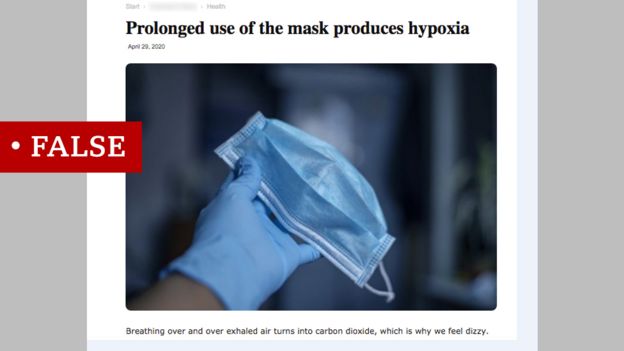
Image of face mask labelled false
An article on a Nigerian news site, originally translated from Spanish, carried the claim back in April and has been shared 100,000 times.
There are some situations in which face masks might not be advised:
  • children under two whose lungs haven't fully developed
  • people with respiratory conditions who may struggle to breathe
  • people should not wear masks when exercising
Additional reporting by Alistair Coleman, Peter Mwai, Olga Robinson, Shayan Sardarizadeh and Rachel Schraer.

https://www.bbc.com/news/53108405