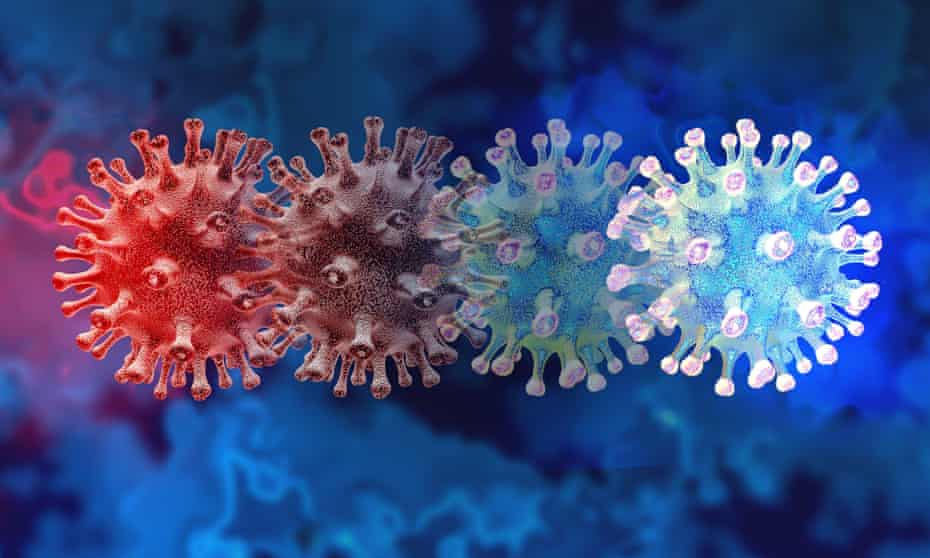
Dr Tom Peacock of Imperial College London said the variant ‘could be of real concern’ but may just be an ‘odd cluster’.Photograph: Brain Light/Alamy
Scientists have said a new Covid variant that carries an “extremely high number” of mutations may drive further waves of disease by evading the body’s defences.
Only 10 cases in three countries have been confirmed by genomic sequencing, but the variant has sparked serious concern among some researchers because a number of the mutations may help the virus evade immunity.
The B.1.1.529 variant has 32 mutations in the spike protein, the part of the virus that most vaccines use to prime the immune system against Covid. Mutations in the spike protein can affect the virus’s ability to infect cells and spread, but also make it harder for immune cells to attack the pathogen.
The variant was first spotted in Botswana, where three cases have now been sequenced. Six more have been confirmed in South Africa, and one in Hong Kong in a traveller returning from South Africa.
Dr Tom Peacock, a virologist at Imperial College London, posted details of the new variant on a genome-sharing website, noting that the “incredibly high amount of spike mutations suggest this could be of real concern”.
In a series of tweets, Peacock said it “very, very much should be monitored due to that horrific spike profile”, but added that it may turn out to be an “odd cluster” that is not very transmissible. “I hope that’s the case,” he wrote.
Dr Meera Chand, the Covid-19 incident director at the UK Health Security Agency, saidthat in partnership with scientific bodies around the globe, the agency was constantly monitoring the status of Sars-CoV-2 variants as they emerge and develop worldwide.
“As it is in the nature of viruses to mutate often and at random, it is not unusual for small numbers of cases to arise featuring new sets of mutations. Any variants showing evidence of spread are rapidly assessed,” she said.
The first cases of the variant were collected in Botswana on 11 November, and the earliest in South Africa was recorded three days later. The case found in Hong Kong was a 36-year-old man who had a negative PCR test before flying from Hong Kong to South Africa, where he stayed from 22 October to 11 November. He tested negative on his return to Hong Kong, but tested positive on 13 November while in quarantine.
England no longer has a red list to impose restrictions on travellers arriving from abroad. People who are not fully vaccinated must test negative before flying and arrange two PCR tests on arrival. Those who are fully vaccinated need to have a Covid test within two days of landing.
Scientists will be watching the new variant for any sign that it is gaining momentum and spreading more widely. Some virologists in South Africa are already concerned, particularly given the recent rise in cases in Gauteng, an urban area containing Pretoria and Johannesburg, where B.1.1.529 cases have been detected.
Ravi Gupta, a professor of clinical microbiology at Cambridge University, said work in his lab found that two of the mutations on B.1.1.529 increased infectivity and reduced antibody recognition. “It does certainly look a significant concern based on the mutations present,” he said. “However, a key property of the virus that is unknown is its infectiousness, as that is what appears to have primarily driven the Delta variant. Immune escape is only part of the picture of what may happen.”
Prof Francois Balloux, the director of the UCL Genetics Institute, said the large number of mutations in the variant apparently accumulated in a “single burst”, suggesting it may have evolved during a chronic infection in a person with a weakened immune system, possibly an untreated HIV/Aids patient.
“I would definitely expect it to be poorly recognised by neutralising antibodies relative to Alpha or Delta,” he said. “It is difficult to predict how transmissible it may be at this stage. For the time being it should be closely monitored and analysed, but there is no reason to get overly concerned unless it starts going up in frequency in the near future.”
Health minister Greg Hunt says officials were assessing the threat but had advised there was ‘no basis for change’ to border arrangements at this stage
Scientists have shown how a fatty acid found in palm oil can encourage the spread of cancer, in work that could pave the way for new treatments.
The study, on mice, found that palmitic acid promoted metastasis in mouth and skin cancers. In future, this process could be targeted with drugs or carefully designed eating plans, but the team behind the work cautioned against patients putting themselves on diets in the absence of clinical trials.
“There is something very special about palmitic acid that makes it an extremely potent promoter of metastasis,” said Prof Salvador Aznar-Benitah, of the Institute for Research in Biomedicine (IRB), Barcelona. “I think it is too early to determine which type of diet could be consumed by patients with metastatic cancer that would slow down the metastatic process.”
Chocolate spread – The team behind the work cautioned against patients putting themselves on diets in the absence of clinical trials.Photograph: MarianVejcik/Getty Images/iStockphoto
The study adds to emerging evidence that diet can be used to enhance existing cancer treatments because certain nutrients are disproportionately relied on by tumour cells, or are required at critical stages such as metastasis.
The study built on previous work by the same team showing that, within a tumour, just a small subset of cells have the capacity to spread by travelling out of the tumour, reaching other organs and colonising them. These specialised cancer cells appeared to rely particularly heavily on fatty acids and the latest work narrowed this down to palmitic acid, which is found in palm oil – but also in a wide variety of foods such as butter and olive oil.
The study, published in Nature, found that when palmitic acid was supplemented into the diet of mice, mouth and skin cancers were more likely to spread. Other fatty acids called oleic acid and linoleic acid – omega-9 and omega-6 fats found in foods such as olive oil and flaxseeds – did not show the same effect. Neither of the fatty acids tested increased the risk of developing cancer in the first place.
The study suggested that exposure to palmitic acid caused changes to the function of genes in cancer cells that allowed them to sense fatty acids and consume them more efficiently. The presence of palmitic acid also appeared to send cancer cells into a “regenerative state” allowing them to form signalling networks beyond the tumour, which is known to be a crucial step towards spreading.
Metastasis of cancer remains the main cause of death in cancer patients and the vast majority of people with metastatic cancer can only be treated, but not cured.
By understanding what cancer cells need to make this leap, the scientists also identified ways to block the process and are planning a clinical trial of proteins that interfere with the tumour response to palmitic acid.
“That is a much more realistic approach in terms of a real therapy, that doesn’t depend on whether a patient likes Nutella or pizza,” said Aznar-Benitah. “Playing with diets is so complicated.”
Prof Greg Hannon, director of the Cancer Research UK Cambridge Institute, said: “This is a rigorous and comprehensive study that suggests that exposure to a major constituent of palm oil durably changes the behaviour of cancer cells, making them more prone to progress from local to potentially lethal metastatic disease. Given the prevalence of palm oil as an ingredient in processed foods, this study provides strong motivation for further study on how dietary choices influence the risk of tumour progression.”
Helen Rippon, chief executive at Worldwide Cancer Research, said: “This discovery is a huge breakthrough in our understanding of how diet and cancer are linked and, perhaps more importantly, how we can use this knowledge to start new cures for cancer. Metastasis is estimated to be responsible for 90% of all cancer deaths – that’s around 9 million deaths a year globally. Learning more about what makes cancer spread and – importantly – how to stop it is the way forward to reduce these numbers.”