These products come from trees in the tropical areas of South and North America. Paw Paw is claimed to work by blocking ATP production and thus reduce the voltage of the cancer cell to the point it falls apart (apoptosis or programmed cell death). Because Paw Paw and graviola are cousins, it is assumed that they work utilized the same mechanism. They are also claimed to build the immune system.
Scientists with the Tepic Institute of Technology (Instituto Tecnológico de Tepic – ITT) in Mexico discovered acetogenins, a compound in the fruit with incredible chemotherapeutic properties.
The researchers with ITT are studying soursop in an effort to find more anti-cancer foods that are readily available in Mexico due to the steadily rising cases of cancer among their population.
Team leader, Montalvo González, explained, “We focus on acetogenins compounds because in Mexico, cancer is a disease that is increasing among the population and scientific research shows that the compounds found in this fruit can encapsulate tumors, but this depends on the [ how much is] amount consumed.” (1)
In an assessment of Graviola, published in the December 2008 issue of the “Journal of Dietary Supplements” by U.S. researchers Lana Dvorkin-Camiel and Julia S. Whelan, multiple in-vitro studies determined that Graviola is effective against various microbial and parasitic agents. Graviola displayed specific effectiveness on parasites Leishmania braziliensis, Leishmania panamensis, Nippostrongylus braziliensis, Artemia salina and Trichomonas vaginalis, as well as against the Herpes simplex virus.
As it relates directly to cancer, cell and animal research demonstrates that Graviola may be an anti-cancer agent. However, no human clinical trials have been performed as of yet. According to the Memorial Sloan-Kettering Cancer Center, MSKCC, Graviola extract proved to be effective against liver cancer and breast cancer cells. Naturopath Leslie Taylor, author of “The Healing Power of Rainforest Herbs,” notes that studies show Graviola has an inhibitory effect on enzyme processes in some cancer cell membranes. Graviola only affected cancer cell membranes and not those of healthy cells. This research may lend support to the herb’s traditional use against cancer. (2)
Theory: This protocol claims to kill the microbes inside the cancer cells, they allow more of the glucose to be converted to pyruvate and thus more ATP energy is created inside the cancer cells.
Graviola Tree and Paw Paw Tree Theory
This is one of those treatments for cancer that is fairly new, meaning it has only recently found its way onto the internet. Nevertheless, there have been a lot of scientific studies on these two products. (3) At the current time most of the articles for Graviola and cancer come from a single source – the Health Sciences Institute (see the links below), though there are a growing number of independent articles.
Graviola is sometimes called “Brazilian Paw Paw,” which can cause some confusion. (4)
Paw Paw is reported to be more powerful than graviola when treating cancer, (5, 6) if the quality of the processing is comparable. Graviola only has single ring compounds, while the Paw Paw's acetogenins have several double ring compounds (e.g. bullatacin) which makes Paw Paw much more powerful.
Paw Paw works (and this seems to apply to graviola as well) by slowing down or stopping the production of ATP. This in turn lowers the voltage of the cell. For normal cells, there is plenty of ATP, thus lowering the level of ATP has no effect on the cell. However, with cancer cells, due to the way they create energy (by fermentation), ATP is far more critical. (5, 6)
When the ATP level, and the energy of the cell level, drops to a critical level the cell falls apart. The residual pieces of the dead cancer cell are called “lysing” and I assume are similar to other apoptosis (programmed cell death) killed cells. If that is the case, then part of the lysing is literally “eaten” by other cells (called: phagocytosis).
Technical Information
Graviola, like its cousin Paw Paw, is claimed to greatly enhance the effectiveness of another alternative cancer treatment – Protocel. However, generally it is recommended that Protocel not be taken with graviola or Paw Paw.
Paw Paw has been reported to kill multiple-drug resistant (MDR) cells, which can result from someone taking chemotherapy.
Paw Paw gravitates towards cells that use a lot of energy and then cuts off their energy supply. Since cancer cells use 10-17 times as much energy as a normal cell, Paw Paw it is theorized to act on cancer cells.
You wouldn’t normally think of my state of Virginia as the breeding grounds for a rare and forgotten fruit—a tropical fruit, no less. But for a few weeks a year, in the thick of our beautiful woods, you’ll find this tasty treat growing high among the glossy leaves of the pawpaw tree. And within those trees are reliable, proven anti-cancer compounds. By Lee Euler / March 23, 2016 Pawpaw used to be more common. It’s believed the American Indian helped propagate the trees across the east coast and as far as Kansas and Texas. Thomas Jefferson had it growing in his backyard. Lewis and Clark relied on pawpaws when the rest of their provisions ran low during their famous 1806 expedition. It’s the largest native edible fruit in North America. From my childhood, I remember a song called “Way Down Yonder in the Pawpaw Patch.” But nobody I knew ate the stuff. . . Apparently we were missing something Along with its sweet-tasting fruit, the pawpaw species Asimina triloba has powerful bioactive compounds called annonaceous acetogenins. These compounds have been proven to fight insects, parasites, and most importantly, cancer cells. But here’s a surprise: The pawpaw’s cancer-fighting power is not found in the fruit, but in the twig – the source of the plant’s most potent acetogenins. In the early 1990’s, a Purdue University researcher named Jerry McLaughlin discovered acetogenin compounds in the bark of the pawpaw tree. Those compounds fight certain drug-resistant cancers. Through a series of experiments, the acetogenins were found to be competent in killing off tumors that had previously resisted other anti-cancer agents. Acetogenins even prefer cancer stem cells (the other name for multidrug-resistant cancer cells or MDRs). The pawpaw compounds don’t appear to have an effect on healthy cells. Researchers believe this is because cancer cells, and tumor cells in particular, are more metabolically active than healthy cells. You may be aware that ATP, or adenosine triphosphate, is basically the “fuel” for cancer cells. By prompting the production of DNA and RNA, ATP helps cancer cells multiply. It makes sense, then, to eliminate ATP wherever cancer is found. And that’s exactly what acetogenins do. As fatty acid derivatives, they kill cancer by cutting off its fuel source. By blocking the production of ATP, acetogenins from pawpaw cause cancer cells to starve and die. In the competition for nutrients, tumor cells beat out healthy cells, but this works to their disadvantage when the available food happens to be fatal pawpaw acetogenins. Cancer cells snap them up before other cells can claim them. Pawpaw extract is one of only a few known treatments for fighting MDR or stem cells. (We wrote about another one, PNC proteins, in our last issue.) Another plant, called the graviola, has a similar function, but the pawpaw is more potent, with approximately 50 acetogenins, compared to graviola’s 30 acetogenins. Here’s what happens to a tumor on pawpaw When pawpaw extract is taken by someone who has cancer, it travels through the bloodstream to the cancerous tissue, where the operative compounds are absorbed into the cancer cells. Once there, they connect with the cells’ mitochondria – often called the cell’s “batteries” or “energy factories.” Mitochondria produce the energy a cancer cell needs to grow and divide—that’s where the ATP comes from. ATP molecules are like little packages of energy that cells use to get their work done. When a cancer cell is multi-drug-resistant or MDR –i.e. highly resistant to chemotherapy—it’s usually because it has a pump within its membrane that pushes those drugs out of the cell if it’s ever infiltrated. But this pump requires ATP energy. So when pawpaw blocks the production of ATP, the drugs stay in the cancer cells for longer—they don’t get pumped out. This is why pawpaw is a good adjunct therapy for anybody taking chemotherapy or any other form of cancer-killing treatment. Blocking the production of ATP basically starves the cancer cell and prompts cell death. ATP is also necessary for the production of the specialized blood vessels that cancer cells generate to feed themselves (the process called angiogenesis). But again, without ATP, the cancer cell’s blood supply gets cut off. This contributes to more cell death and tumor shrinkage Pawpaw, coming to a market near you Despite promising beginnings with the likes of Jefferson and Lewis and Clark, the little pawpaw fruit is only recently being tested as a commercial item. For a while, sales were limited to farmer’s markets frequented by a pawpaw enthusiast and plant scientist named Neal Peterson. Mr. Peterson grows six varieties of pawpaw in the West Virginia area. In an interview with NPR, he said the pawpaw is as good as a peach or a pear. That’s part of the reason he spent 30 years breeding pawpaws, working to increase the amount of flesh per fruit. The lag in coming to market is almost shocking, considering the sweet flavor and health properties of this novel fruit. Besides being delicious and unique, pawpaws are nutrient-dense. Ohio University food scientist Rob Brannan published a study that found the antioxidant count of the pawpaw to be exceptionally high—about the same as a cranberry or a cherry. It’s loaded with proteins, beneficial fats, and complex carbohydrates. And if you’re interested in tasting the pawpaw fruit, I have good news. Fresh, raw pawpaws are becoming more available, however slowly. Pawpaws made it to the Whole Foods chain in 2013 and have been sighted in more and more grocery stores ever since. In 2015, Neal Peterson launched a Kickstarter campaign to raise funds to make pawpaw fruit more widely available. He collected $22,357 and plans to popularize pawpaws in Europe and Japan. But, while the fruit is healthy, it’s the extract of the pawpaw’s wood that has been therapeutically effective against cancer. Currently, several companies offer pawpaw twig extract as an herbal supplement. But as always, I caution you to consult a medical practitioner before adopting it into your cancer treatment regimen. It’s not a magic bullet; if you decided to use pawpaw it should be just one of a range of a treatments in your protocol. And it’s not universally effective – it helped out roughly half of the people who used it in conjunction with another treatment. I wish I could tell you of a practitioner who includes pawpaw among his treatments and has some experience with it, but we haven’t come across one, in more than ten years of interviewing dozens of cancer doctors.
This is a case where a very promising discovery has largely been ignored, and more study is needed. Meanwhile, the fruit does sound like a treat, and I plan to hunt some up and try it this summer. Lee Euler, Publisher
(From No 1 above) How It Works: Non-Member:$89.25 Member: ?$59.50
The active compounds in Paw Paw are a mixture of over 50 acetogenins. Acetogenins are active compounds that affect the production of ATP (Adenosine Triphosphate) in the mitochondria (the powerhouse) of the cell. ATP is the cells’ major source of energy. Acetogenins selectively modulate the production of ATP in specific cells. Modulating the production of ATP affects the viability of specific cells and may help modulate the blood supply to them. Acetogenins also support and enhance the effectiveness of conventional medical regimens.
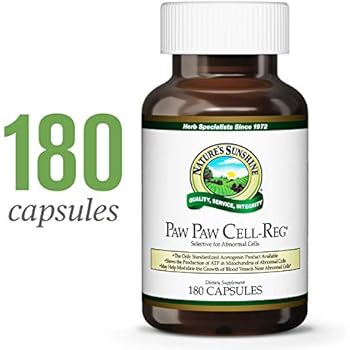
A clinical study with over 100 participants showed that the paw paw extract, containing a mixture of acetogenins, supports the body’s normal cells during times of cellular stress. Paw Paw Cell-Reg is the only standardized acetogenin product available to regulate specific cells. Nature’s Sunshine uses an extract of the twigs of the North American paw paw tree, which contain the most concentrated amount of acetogenins. These twigs are harvested when they are most biologically active, and the extract is standardized biologically using an invertebrate bioassay. This is a renewable resource since the tree is not harmed during the harvest.
(From No 2 above) Q: Why should I avoid supplementing with Co-Q10 or products that support the thyroid while taking Paw Paw Cell-Reg? Our Price: $59.50
A: Taking Co-Q10 or thyroid products may decrease the effectiveness of Paw Paw Cell-Reg. Co-Q10 and thyroid stimulating-products increase the mitochondrial ATP energy production. Compounds called acetogenins, found in the Paw Paw Cell-Reg, act by decreasing this energy production. Taking both products would have a counteractive effect. It is not dangerous to take the products together, but they are both less effective.
(From No 3 above)
This item Nature's Sunshine Paw Paw Cell-Reg, 180 Capsules | Contains Over 50 Acetogenins to Modulate ATP Production and Blood Supply
IMMUNE SYSTEM BOOSTER - Acetogenins are active compounds that affect the production of ATP (Adenosine Triphosphate) in the mitochondria (the powerhouse) of the cell.
SUPPORTS MEDICAL REGIMENTS - Paw paw extract, containing a mixture of 5 acetogenins, supports the body’s normal cells during times of cellular stress.
MODULATES ATP AND BLOOD SUPPLY - Acetogenins selectively modulate the production of ATP in specific cells, and by doing so affects their viability and may help modulate the blood supply.
SIMILAR TO GRAVIOLA - Paw Paw Cell-Reg is the only standardized acetogenin product available to regulate specific cells.
SUSTAINABLE SOURCE - Twigs of the North American Paw Paw tree are harvested when they are most biologically active and the extract is standardized biologically using an invertebrate bioassay.
Paw Paw Cell Reg has killed off my lung cancer not just once, but 3 different times now. First time, I took it for 10 days (6/day) and the CT-scan showed it was completely gone afterwards. All my symptoms had disappeared as well--cough, extreme drowsiness, weakness. Second time--about 2 years later--I took it for the 7 days after the CT-scan showed it had returned and the biopsy date I had scheduled. Three pulmonology doctors were absolutely agreed these were cancer cells in my lung upon seeing the scan. When they did the biopsy, there were no cancer cells in my lung samples (18 different samples taken).
It is important to know that you have to take it after eating something substantial, otherwise you will certainly get nausea. And, importantly, to take a good strong probiotic at least 2x/day as it can lead either to a loose stool or stool blockage. I have had no side effects whatsoever doing that. My doctors are now so convinced (after overcoming their initial total puzzlement and skepticism) after they have seen my lung cancer disappear repeatedly after a Paw Paw regimen of 7-10 days, that they are quietly suggesting to their new lung patients to try it for a short period up to 2 weeks and then get re-tested, as I did. I now take PP for one week every month, just to keep any cancer at bay.
Nature's Sunshine Paw Paw Cell-Reg is the best to brake up tumor's in your lungs I truly like this product...it worked for me.
Milagros Garcia
5.0 out of 5 starsHope!
October 18, 2013
Size: 1 PackVerified Purchase
Better than chemo and far less toxic and damaging to body if you use do so with knowledge and under Doctors care
I love this herb and try real hard to make sure my parent keeps a supply. It seems to fluctuate in price and is no longer 35.00 However I hope that it gets the nod for black friday and goes down in price a few dollars more.
Having said that this is far superior to graviola which also works but nowhere near or half as great as Paw Paw. We also give our parent essiac tea, green tea and a good veggie based diet..Now our parent is 85 and was diag at 76, still thriving working out driving and even after taking chemo in nthe beginning would now never consider it..I have seen the videos by Dr Jerry McLaughlin and we have been very impressed.. I am myself a PHN with a Masters who worked along side an oncologist for years who has since retired..He has always told me that the best medicine is common sense..The fact is that chemo radiation or anything else will help if one is unwilling to change diet...exercise and believe that they can defeat Cancer.
Graviola is Inferior to Paw Paw for the Purpose of Fighting Cancer. Here is Why.
Introduction
Some unscrupulous (as well as some well-meaning--but uninformed) companies and their vendors attempt to pass off a graviola supplement product as equivalent to paw paw. In fact, some companies go so far as to call their product "Paw Paw"--attempting to capitalize on the good name of paw paw--even at times justifying their deception by saying that graviola is sometimes called "Brazilian paw paw." Graviola is also known by other names, such as "guanabana" and "soursop".
The reported use of graviola as an anti-carcinoma treatment has gone back for decades. While some people have no doubt seen some success with graviola, it is important to note the differences and understand why it is not even close to equivalent with paw paw when used for this purpose.
Tests were done under the direction of Dr. Jerry McLaughlin on two leading graviola products on the market. The first one had a cyto-toxic potency level of about 4% of the potency of paw paw--in other words, paw paw had about 24 times the potency of this product. The second leading graviola product had a potency level of 2% that of paw paw; so paw paw was about 50 times as potent as that product. These results should be unacceptable to those serious about using a product of this nature to fight cancer.
As will be further explained below, there are two big differences between graviola products and paw paw. First, and probably most important, is the chemistry structure. The chemistry structure of the graviola compounds does not allow it to be as potent as that of the paw paw acetogenins. Second, the manufacturing process of graviola products is inferior in that it is generally consists of grinding powder from leaves, twigs, or other parts of the plant. With this type of very unsophisticated manufacturing process, the amount of active acetogenins will vary widely by batch, and the amount in any selected bottle is unknown to the consumer.
Dr. McLaughlin, while known for his work with paw paw, also did testing of graviola during his long research career. He not only isolated the acetogenin compounds in paw paw that have been seen to fight cancer, but he also found the compounds in graviola and is an expert on the differences. He did two separate research projects on graviola leaves, twigs, and seeds, and isolated 28 acetogenin compounds from that plant.
He has written about these compounds in many papers (over 300 total!) that he published, most of them published in prestigious publications such as the Journal of Natural Products, Heterocycles, Journal of the American Chemistry Society, Phytotherapy Research, Journal of Organic Chemistry, Journal of Medicinal Chemistry, and others. Several of these papers note the chemical differences between the acetogenins found in the two species, and discuss what makes those in paw paw much more powerful.
The Scientific and Physical Distinction
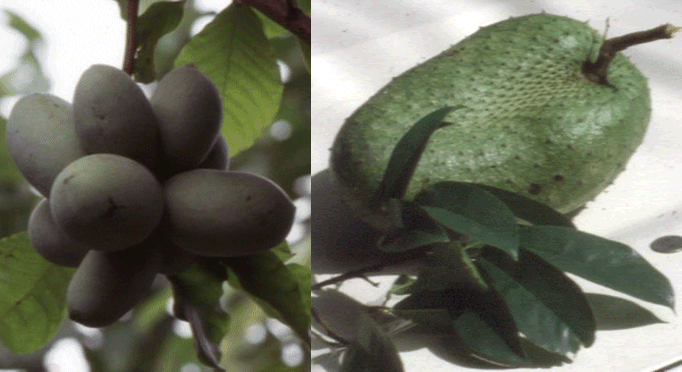
The scientific name of the paw paw used by Dr. McLaughlin in his research is Asimina triloba. It is a North American species of paw paw. Although botanically, the paw paw and graviola are related (both are of the Annonaceae family), they are not the same--any more than an apple and a pear are the same. The scientific name of the graviola is Annona muricata. If one looks at the photographs of the two below, the physical difference is obvious. Paw paw is on the left, and graviola is on the right.
Brief History
In the 1970's, the National Cancer Institute started funding Dr. Jerry McLaughlin at Purdue University to find botanical substances that had anti-cancer potential. He tested and screened over 3500 species of plants, and found that the acetogenin compounds of the Annonaceae family had the most potential. He--along with 13 of his Ph.D. students and others--worked with the various species of this family, including the paw paw and graviola. They found and isolated over 400 acetogenins in this family, and used some very sophisticated chemical modeling techniques to determine and show the differences. About 50 acetogenins were found in the paw paw, and about 30 in the graviola.
Chemistry Differences
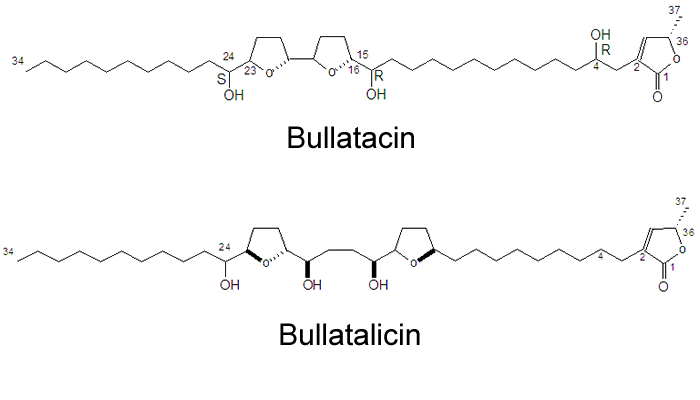
Of more importance than the number of acetogenins found in each plant are the potency of these compounds. Dr. McLaughlin and his students did chemical structure analysis on many of these compounds, and without exception found that those acetogenins with a "double ring" chemical structure were many, many times more powerful than those with only single ring structures. In fact, Dr. McLaughlin went further to isolate "triple" ring structured compounds--only to find that they also were inferior to double ring. The pictures below show 2 different acetogenin chemical structures--both of which are found in paw paw but NOT in graviola.
These acetogenins (bullatalicin and bullatacin) have double ring structures. Note the proximity of the two ring structures to each other. All of the acetogenins in graviola do NOT have a double ring structure--only single ring--and this chemical structure causes them to have only a fraction of the potency of paw paw. For reference, it is Bullatacin that was tested by Upjohn Company (now Pfizer) to be 300 times the potency of Taxol, a chemotherapy drug.
Manufacturing Differences
The graviola products on the market typically advertise themselves as "freshly ground powder" of twigs, leaves, etc. This type of manufacturing process has two main advantages for the manufacturer--but not the customer. First, it is cheap to produce. Second, it is easy enough that just about anyone can do it.
However, there are problems--and big ones. Dr. McLaughlin found in his research that the level and potency of the acetogenins--even in paw paw itself--varies according to time of year. In fact, it varies drastically! If the twigs are not harvested during the month of May, they are essentially worthless. Also, the acetogenin potency varies even from tree to tree in the same grove! Again...drastically! The problem remains then, how does the manufacturer guarantee that the customer gets the required acetogenin level in each and every capsule of product?
The answer is standardization. A process must be developed or used by the manufacturer to test every single batch of product produced and determine whether or not the potency level is present. Furthermore, the manufacturing process must be able to allow and compensate for different levels of acetogenins in order to get the proper level in each and every capsule. If the product is made (as are the typical graviola products) simply by grinding up the raw ingredients and putting them into capsules, there is not much way to make any adjustments--after all, you can only fit so much material into the capsule, whether or not it has any acetogenins or not. Thus, graviola manufacturers generally do not standardize their products. This process is not easy, since every single batch of material must be tested and adjustments made.
However, the process for that that Dr. McLaughlin developed for the paw paw uses an extraction of the acetogenins from the paw paw twigs. This process allows the manufacturer to adjust the acetogenin level somewhat to be able to guarantee a set amount in each capsule. Thus, the customer is assured of proper potency.
Much can be said about the differences. If you would like to hear Dr. McLaughlin speak on this directly, check out the Video Q&A page as well as his Powerpoint Presentation elsewhere on this site.