Pages

Showing posts with label RNA Vaccine. Show all posts

Tuesday, 24 May 2022

China's bet on homegrown mRNA vaccines holds back nation


 TAIPEI, Taiwan (AP) — China is trying to navigate its biggest coronavirus outbreak without a tool it could have adopted many months ago, the kind of vaccines that have proven to offer the best protection against the worst outcomes from COVID-19.

24 May 2022

By HUIZHONG WU and ANIRUDDHA GHOSAL   AP

© Provided by Associated Press China's first SARS-CoV-2 mRNA vaccine AWcorna, developed by Abogen Biosciences, Walvax Biotechnology, and the Academy of Military Medical Sciences' Institute of Biotechnology, is displayed at the National 13th Five-Year Scientific and Technological Innovation Achievement Exhibition in Beijing, China on Oct. 27, 2021. More than two years into the pandemic, China has not approved the more effective mRNA vaccines, instead choosing to pursue its own route on COVID-19 vaccines. (Chinatopix via AP)

As early as the spring of 2020 a Chinese pharmaceutical company, Fosun Pharma, reached an agreement to distribute — and eventually manufacture — the mRNA vaccine made by Pfizer and BioNTech. It still has not been cleared in mainland China, despite being authorized for use by separate authorities in Hong Kong and Macao.
Now health experts say that delay — a result of putting politics and national pride above public health — could lead to avoidable coronavirus deaths and deeper economic losses because whole cities would be locked down to insulate the country’s unprotected population.

“The biggest issue is about the delay of the reopening,” said Xi Chen, a health economist at Yale University’s School of Public Health. “The consequences will be huge, the supply chain disruption, the disruption to all kinds of service sectors.”

Studies have consistently shown that vaccination with mRNA vaccines made by Pfizer-BioNTech and Moderna offer the best protection against hospitalization and death from COVID-19. Chinese vaccines made with older technology proved fairly effective against the original strain of the virus, but much less so against more recent variants.

As this evidence became clearer, even countries that initially used Chinese vaccines and some other less effective Western-made vaccines have turned to mRNA vaccines for booster shots and new vaccinations.

Not China. Regulators have not publicly said why they have not acted — the mRNA vaccines are authorized in much of the world and have proven safe and effective in hundreds of millions of people. But a Chinese health official and another person directly involved in the negotiations told The Associated Press that authorities have held back because they want to master the technology in China and not depend on foreign suppliers. Both spoke on condition of anonymity, given the sensitive nature of the issue.

© Provided by Associated Press Visitors look at giant replica bottles of COVID-19 vaccine including one produced via mRNA technology by Sinopharm subsidiary CNBG at the China International Fair for Trade in Services (CIFTIS) in Beijing, China on Sept. 5, 2021. More than two years into the pandemic, China has not approved the more effective mRNA vaccines, instead choosing to pursue its own route on COVID-19 vaccines. (AP Photo/Ng Han Guan)

For more than a year, the approach seemed defensible. The country was able to keep the virus at bay better than any other large nation with its strict “zero COVID” approach that isolates infected people and locks down communities when infections pop up.

But now, the highly transmissible omicron variant is testing that strategy, requiring ever wider and longer lockdowns that are taking a greater economic and human toll. While other countries are able to operate close to normal because their people are protected by vaccination or previous infection, China is left with only its lockdown strategy to avoid huge numbers of hospitalizations and deaths.

China may be changing its mind. The Communist Party-owned Global Times newspaper reported last month that Fosun Pharma is still working with health authorities on its approval and Shanghai authorities recently issued new policies that could allow the import of COVID-19 vaccines. Fosun, based in Shanghai, did not respond to questions about the announcement.

© Provided by Associated Press Visitors look at giant replica bottles of COVID-19 vaccine including ones produced via mRNA technology by Sinopharm subsidiary CNBG at the China International Fair for Trade in Services (CIFTIS) in Beijing, China on Sept. 5, 2021. More than two years into the pandemic, China has not approved the more effective mRNA vaccines, instead choosing to pursue its own route on COVID-19 vaccines. (AP Photo/Ng Han Guan)

China’s National Health Commission directed questions to the country’s drug regulator, the National Medical Products Administration. That agency did not respond to a faxed request for comment.

In the meantime, hopes for a Chinese-developed mRNA vaccine center on Abogen Biosciences, a startup founded in 2019 by Bo Ying, an American-trained scientist who once worked for Moderna.

The company has partnered with more established companies in the country such as Walvax, a private company founded in 2001, and the Academy of Military Medical Sciences, the military’s medical research facility. Abogen has raised more than $1.7 billion since 2020.

The company’s vaccine candidate succeeded in eliciting an immune response in a small, preliminary test in humans designed to evaluate safety, according to a study published in the journal Lancet Microbe.

The results were “promising,” said Dr. Vineeta Bal, who studies immune systems at the Indian Institute of Science Education and Research in Pune, India, although she said that a direct comparison of the immune response the shot triggered with the Pfizer and Moderna vaccines would have helped scientists better evaluate its performance.

But large studies that are needed to show whether the shot works to prevent infections or symptoms have not been completed. Abogen did not respond to requests for an interview.

Even if the studies can be completed and the vaccine proves effective, manufacturing the millions of doses required will be a challenge, experts say. Abogen built a manufacturing facility in December 2020 with a projected capacity of up to 120 million doses a year.

Manufacturing that vaccine and ensuring quality at scale will be a difficult hurdle to clear because mRNA is still a new technology, said Scott Wheelwright, chief operating officer at BioInno Bioscience, a Chinese biopharmaceutical contract manufacturer who has held conversations with Abogen.

In the meantime, Chen, the Yale health policy expert, said the Chinese government should better protect its elderly population by both approving the Pfizer vaccine and encouraging booster shots.

Using a Chinese phrase that means “giving up completely,” Chen said the change from “zero COVID” does not have to be all or nothing. “It doesn’t have to be tang ping or sticking to zero COVID,” Chen said. “I don’t think there are only two solutions, and we can stick to a middle ground.”

ALSO:

https://healthticket.blogspot.com/2022/05/chinas-bet-on-homegrown-mrna-vaccines.html

https://healthticket.blogspot.com/2022/04/chinas-biggest-covid-failure-is-not.html

https://arisechina.blogspot.com/2022/01/china-has-rejected-worlds-top-mrna.html

https://arisechina.blogspot.com/2022/01/china-rushes-to-develop-mrna-covid-19.html

https://healthticket.blogspot.com/2021/05/15-apr-21-how-china-passed-up-vaccine.html

https://healthticket.blogspot.com/2021/05/top-chinese-official-admits-vaccines.html


Monday, 3 May 2021

15 Apr 21 How China passed up a vaccine opportunity and fell behind - Bloomberg

  • Moderna, Pfizer cornered the mRNA technology for their shots
  •  
    China’s leading shots are less effective; use older techniques
 Updated on 

The call came early in the Covid-19 pandemic. Drew Weissman, an infectious diseases professor at the University of Pennsylvania and an expert in messenger RNA, received a query from a Chinese company interested in using the new technology to make a vaccine against the coronavirus.

mRNA, which effectively turns the body’s cells into tiny vaccine-making factories, has since become the breakout star of the Covid era, underpinning shots made by Moderna Inc. and the Pfizer Inc./BioNTech SE partnership which have been among the most effective in fighting the disease. Before Covid hit, though, the experimental science had yet to receive regulatory approval for use against any illness -- let alone against the mysterious respiratory infection.

“They wanted to develop my technology in their company in China,” said Weissman, a leader in the field because of his work with research partner Katalin Karikó on discovering mRNA’s disease-fighting potential. “I told them I was interested.”

Then, nothing happened.

“I never heard from them again,” Weissman said.

It was one of the missed opportunities that have disadvantaged the country’s Covid vaccine push and left Chinese companies playing catch-up on a technology set to revolutionize everything from flu shots to oncology drugs.

As the coronavirus spread globally last year, New York-based Pfizer raced to partner with Germany’s BioNTech, an mRNA frontrunner that had hired Kariko as a senior vice president. Massachusetts-based Moderna, meanwhile, had $2.5 billion in funding from the U.S. government.

China Setback

By contrast, several Chinese companies focused on older technologies that have proved far less potent. At a conference on April 10, the head of the Chinese Center for Disease Control and Prevention, George Fu Gao, said Chinese vaccines “don’t have very high protection rates,” local media reported.

As the comments caused a stir on social media, Gao backtracked, telling Communist Party-backed newspaper Global Times that he was just referring to ways to improve vaccine efficiency. But no amount of damage control can obscure the fact that no Made-in-China mRNA vaccines have been approved yet.

For more, read: Are China’s Covid Shots Less Effective? Experts Size Up Sinovac

That’s a setback for President Xi Jinping’s ambition to make the country a healthcare innovation powerhouse. mRNA’s effectiveness with Covid vaccines is opening up a new frontier for the technology, with researchers looking at ways to use it to fight cancer, tuberculosis and many other diseases, according to Surbhi Gupta, a healthcare and life sciences analyst with consultancy Frost & Sullivan.

“mRNA technology has the potential to be a game changer,” she said.

For decades, vaccines have been made using inactive versions of viruses, but mRNA shots use genetic material to instruct the body to create the spike protein the coronavirus uses to enter cells. That in turn trains the body to fight potential infection.


Inside the packaging plant of the Beijing Biological Products Institute Co. in Beijing in December 2020.

Photographer: Zhang Yuwei/Xinhua News Agency/Getty Images

Old-school Chinese-made Covid vaccines now in use from Sinovac Biotech Ltd. and China National Biotec Group Co. rely on particles from inactivated viruses and have protection rates much lower than the mRNA vaccines’ more than 90% effectiveness in preventing infections.

Sinovac’s vaccine has an efficacy rate of a little over 50% in protecting against symptomatic Covid-19, according to studies conducted in Brazil, just meeting the minimum threshold required by global drug regulators.

State-owned China National Biotec, a unit of Sinopharm Group Co., has said its two inactivated vaccines are 73% and 79% effective in preventing symptomatic Covid but has not published data to support that assertion. Sinopharm’s Hong Kong-listed shares jumped on Thursday, a day after the company said that there had been no severe side effects related to its inactivated-virus vaccines.

Meanwhile, China’s CanSino Biologics Inc. has produced a viral-vector vaccine which, like those made by AstraZeneca Plc’s and Johnson & Johnson, uses a genetically modified virus to fight off infection. The Tianjin-based company has reported 66% efficacy in preventing symptomatic Covid-19 in its final stage trial.

A New Generation of Vaccines Is Coming, Some With No Needles

China’s government has pushed aggressively to close the gap with the West and become an alternative pharmaceutical and biotech power. It allowed controversial treatments with stem cells and gene therapy, despite concerns elsewhere about safety and efficacy. Yet China didn’t make mRNA vaccines a priority.

“Before Covid, a lot of people still had reservations” about the technology, said Lusong Luo, senior vice president at BeiGene Ltd., a Beijing-based biotech pioneer and leading producer of oncology drugs. “It’s new, it’s at the cutting edge.”

When Sinovac began working on a vaccine, it focused on a familiar method in order to develop a shot quickly, after efforts at exploring other alternatives didn’t yield promising results.

“For us the strategy is really to use the more mature platform and technology to solve the problem,” CEO Yin Weidong told Bloomberg News in an interview last May.

Now, with the success seen by Pfizer and Moderna, Chinese companies are jumping into the fray -- but their efforts will take time to pay off. China may not have mRNA vaccines until the end of 2021, according to Feng Duojia, president of the China Association of Vaccines, China Global Television Network reported on April 11.

Residents Get Vaccinated In Shanghai As WHO Says China’s Covid Shots Are Safe But Need More Data


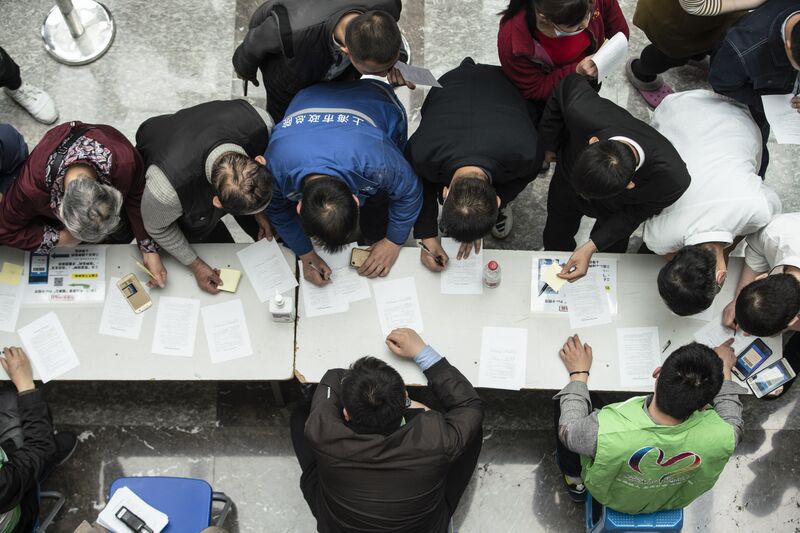
People fill out consent forms at a Covid-19 vaccination center in Shanghai on April 3.

Photographer: Qilai Shen/Bloomberg

For more, read: China’s Bid to Ramp Up Vaccinations Hindered by Supply Shortages

BeiGene in January announced an agreement to cooperate with Strand Therapeutics Inc. of Cambridge, Massachusetts on an mRNA treatment for tumors. “Now people realize that mRNA vaccines really work, it will be a lot easier,” Luo said.

China’s Walvax Biotechnology Co. began construction in December on a facility to make mRNA vaccines, while CanSino struck a deal in May last year with Vancouver-based Precision NanoSystems Inc. to develop an mRNA vaccine. Contract manufacturer WuXi Biologics Cayman Inc. has said it is devoting over $100 million to mRNA-related vaccines, biologics discovery, development and manufacturing.

While China has largely contained the spread of the coronavirus within its borders, more effective vaccinations and a wider take-up among its population would enable the country to reopen sooner, reducing the need for quarantines and lockdowns. China risks losing the edge gained by stamping out the virus if its inoculation drive is less effective than places where mRNA shots are the backbone of rollouts.

In Israel, where nearly 60% of the population has received the Pfizer/BioNTech vaccine, Covid cases, hospitalizations and deaths are plunging. As more adults get their shots in the U.S., which also relies largely on mRNA vaccines, President Joe Biden has predicted Americans will be celebrating July 4th with backyard barbecues once again.

The Best and Worst Places to Be as Global Vaccinations Take Off

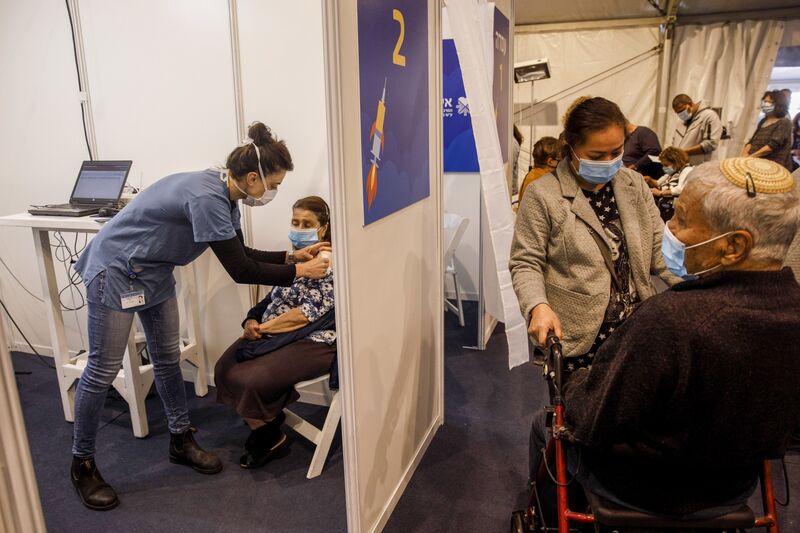
Vaccination Center as Israel Forges Nationwide Covid Effort


A nurse administers a dose of the Pfizer-BioNTech Covid-19 vaccine at a mass vaccination center at Rabin Square in Tel Aviv earlier in January.

Photographer: Kobi Wolf/Bloomberg

China isn’t the only country that missed the boat with mRNA. While companies in Japan, India and Australia are significant players in fighting diseases like flu and polio, no company in the Asia-Pacific region now makes mRNA shots. “Basically, mRNA was put in the ‘too-hard’ basket for many years,” said Nigel McMillan, Program Director for Infectious Diseases & Immunology at Griffith University in Southport, Australia.

In March this year, Takeda Pharmaceutical Co., Moderna’s local partner for Japanese trials of its Covid vaccine, signed a deal with New Jersey-based Anima Biotech on mRNA treatments for Huntington’s and other neurological diseases. Another big Japanese drug maker, Daiichi Sankyo Co., announced on March 22 the start of an early-stage trial of its own mRNA Covid vaccine.

In Thailand, Bangkok-based Chulalongkorn University has enlisted Penn’s mRNA pioneer Weissman to help it develop mRNA capability.

As they try to catch up, Chinese developers and others in Asia can take advantage of the lower barriers to entry for mRNA vaccine and drug development. In addition to the market leaders Moderna and BioNTech, there are other Western startups that invested in mRNA and are ready to license their technology.

Making mRNA vaccines and drugs also doesn’t require large capital expenditures on expensive bioreactors and other equipment, said Archa Fox, an associate Professor at the University of Western Australia’s School of Human Sciences and School of Molecular Sciences.

That bodes well for China’s ability to recover from not focusing on mRNA sooner, according to Weissman.

“They are going to hire the best scientists they can find,” he said. “Anybody can get in the game if they’ve got good people and money.”

— With assistance by Dong Lyu

(Updates with added details)
Source:

Other reads:

https://healthticket.blogspot.com/2022/05/chinas-bet-on-homegrown-mrna-vaccines.html

https://healthticket.blogspot.com/2022/04/chinas-biggest-covid-failure-is-not.html

https://arisechina.blogspot.com/2022/01/china-has-rejected-worlds-top-mrna.html

https://arisechina.blogspot.com/2022/01/china-rushes-to-develop-mrna-covid-19.html

https://healthticket.blogspot.com/2021/05/15-apr-21-how-china-passed-up-vaccine.html

https://healthticket.blogspot.com/2021/05/top-chinese-official-admits-vaccines.html


Sunday, 2 May 2021

26 Apr 21 UK Covid vaccines and ones in the works

What Covid vaccines does the UK have and which are in the works?

As Valneva recruits volunteers for final stage trials of its vaccine, here is the current state of play in Britain

 Science editor
Mon 26 Apr 2021 00.01 BST
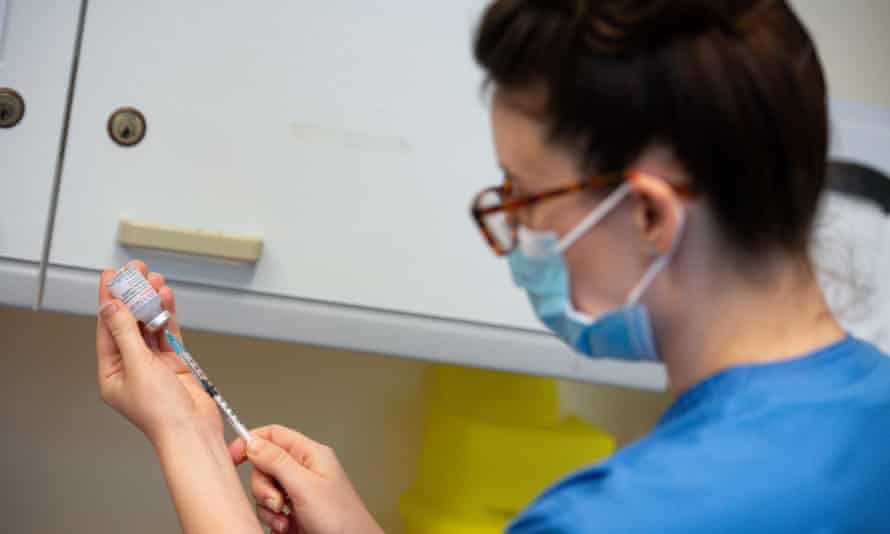
A nurse prepares a dose of the Moderna Covid-19 vaccine at West Wales general hospital in Carmarthen

A nurse prepares a dose of the Moderna Covid-19 vaccine at West Wales general hospital in Carmarthen. Photograph: WPA/Getty Images

Vaccines to protect against the coronavirus were designed, tested and manufactured in record time, and several have been approved for use in the UK vaccination programme, with a number of others under consideration.

Pfizer/BioNTech

The vaccines taskforce secured 40m doses of the Pfizer/BioNTech vaccine, the first coronavirus shot to be approved by the medicines regulator. The NHS vaccine rollout began on 8 December 2020 when 90-year-old Margaret Keenan became the first person in the world to receive the jab as part of a mass vaccination programme. This is one of the cutting-edge mRNA vaccines that smuggles the genetic instructions for making the coronavirus spike protein into muscle cells. Coronavirus is covered in spike proteins, so making human cells manufacture it primes the immune system to attack the virus should it invade.

Oxford/AstraZeneca

With 100m doses on order, the Oxford/AstraZeneca vaccine is a major pillar of the national immunisation programme. The first shot outside trials was given on 4 January 2021. The vaccine is based on a virus that causes common colds in chimps. The virus is engineered to ensure it cannot replicate in humans and modified further to include the genetic instructions to make the coronavirus spike protein.

NIH/Moderna

The second mRNA vaccine to reach the market joined the country’s vaccination programme less than three weeks ago, on 7 April. The government has ordered 17m doses of the Moderna jab. In response to the very rare blood clots seen in some people who receive the Oxford/AstraZeneca vaccine, people under 30 in the UK are offered Moderna or Pfizer shots instead.

Novavax

The UK medicines regulator is expected to approve the Novavax vaccine imminently. It is known as a protein subunit vaccine and incorporates a lab-made coronavirus spike protein and an ingredient called an adjuvant that makes the body’s immune response stronger. The UK has ordered 60m doses. While Novavax is a US company, supplies for the mass vaccination programme will be made in Stockton-on-Tees with the final “fill and finish” step at GlaxoSmithKline’s plant in Barnard Castle, County Durham.

Covid-19 in the UK
Mar
Daily cases
1,907
-154  vs last week
Daily deaths
7
Total deaths
127,524
Vaccination rollout
Dec
Daily vaccinations
535,113
-65,688  vs last week
Received 1st dose
51.4%
Received 2nd dose
22.4%
Cases and deaths as published 1 May 2021, vaccinations as published 30 Apr 2021. Daily vaccinations includes both doses, % is of total population. Weekly change shows difference from 7 days ago. Source: data.gov.uk.

Janssen/Johnson & Johnson

The UK medicines regulator is conducting a rolling review of the Janssen vaccine, which is based on similar “viral vector” technology to the Oxford/AstraZeneca shot. US health officials lifted a short pause in administering the Janssen vaccine on Saturday after deciding that the benefits outweighed the low risk of blood clots that resemble those seen in small numbers of people who received the Oxford/AstraZeneca shot. A major advantage of the Janssen vaccine is that it requires only one dose while the others need two. The UK vaccines taskforce has ordered 30m doses.

Others

If it performs well in final stage trials, Valneva’s vaccine, which uses an inactivated whole virus and an adjuvant to strengthen the immune response, could be approved for use as a booster this autumn. The government has secured up to 100m doses. Further orders are in for 60m doses of a GSK/Sanofi vaccine and 50m doses of another mRNA vaccine from the German company CureVac. Both are still in trials.

https://www.theguardian.com/society/2021/apr/26/what-covid-vaccines-does-uk-have-valneva