Pages

Showing posts with label France. Show all posts

Monday, 2 August 2021

Wrong claims about Oxford vaccine helping to fuel COVID spread, says scientist

Experts say vaccines remain key to fighting COVID despite concerns over variant protection

 on July 27, 2021 at 11:00 AM

use

Current Time 0:56
Loaded: 100.00%
Duration 1:05

Misleading reports

Misinformation about the effectiveness of the Oxford-AstraZeneca jab has helped fuel the spread of COVID-19 – and still risks undermining the fight against rising infections, one of the scientists behind the vaccine has warned.

French president Emmanuel Macron wrongly claimed the jab was 'quasi-ineffective' for over-65s earlier this year, while misleading reports from Germany said it was only 8 per cent effective in this age group.

Professor Sir Andrew Pollard, director of the Oxford Vaccine Group, said that 'confused messaging' about the vaccine in protecting against Beta and other variants threatens to erode confidence in the jab, at a time when millions of people around the world remain unvaccinated.

He pointed to the example of South Africa, which rejected the Oxford vaccine back in February due to concerns about its effectiveness before later suffering an intense third wave of infections caused by the highly transmissible Delta variant.

Fears have returned surrounding the jab’s ability to protect against Beta, which has been shown to be effective in partially evading the immune response triggered by the vaccines and causing symptomatic infection.

Rising spread

It's rising spread in France prompted ministers to impose new travel restrictions on the country, which are set to be reversed, due to fears that the variant could take off in the UK and disrupt the national rollout.

However, Sir Andrew said that worries over Beta were unfounded, insisting that the Oxford vaccine remained highly effective in preventing hospitalisation and death from the variant.

Writing for The Independent, alongside Shabir Madhi, a professor of vaccinology at the University of Witwatersrand in South Africa, Sir Andrew suggested the lessons from South Africa needed to be learned across the globe.

South Africa was one of the first African countries to procure the Oxford-AstraZeneca vaccine from Serum Institute of India,

they wrote.

Unfortunately, these doses were never deployed because of misguided fears over efficacy, allowing the present third wave to occur in a largely unvaccinated population.
https://www.gentside.co.uk/news/wrong-claims-about-oxford-vaccine-helping-to-fuel-covid-spread-says-scientist_art7838.html


Monday, 3 May 2021

26.03.21 France accuses Russia and China of using COVID jabs as 'means of propaganda'

Russia and China are using their home-grown COVID-19 vaccines as a "means of propaganda", France's Foreign Minister said on Friday.

By Alice Tidey

A man receives a COVID-19 vaccine at a vaccination center in Belgrade, Serbia, Sunday, March 21, 2021.
A man receives a COVID-19 vaccine at a vaccination center in Belgrade, Serbia, Sunday, March 21, 2021. 


Speaking to FranceInfo radio, Jean-Yves Le Drian rebuffed Russian claims that the European Union is "clearly biased" against the Sputnik V vaccine, stressing that it must first "be validated by the European Union, by the European Medicines Agency (EMA), because in Europe we only take vaccines that are credible and safe, otherwise it would not be serious."

"Regarding Sputnik, we told the Russian authorities, come and test it here, but they only submitted the application a few days ago," he said.

European authorities have been criticised domestically for the slow pace of vaccination which lags behind countries including the US, the UK and Israel.

The EMA has so far approved four vaccines for use across the EU: Pfizer/BioNTech, Moderna, AstraZeneca/OxfordUniversity and Janssen (Johnson & Johnson). Sputnik V submitted an application for emergency use across the bloc earlier this month and a decision will be released by mid-April.

The Russian-made vaccine has been delivered to 55 countries worldwide including EU member state Hungary.

"In my opinion, the way it is managed, it is more a means of propaganda and aggressive diplomacy, in a way, than a means of solidarity and health aid," Le Drian continued.

"China, Russia are conducting a policy of influence through the vaccine even before vaccinating their own population," he went on.

"In Tunisia, Russia announced with a lot of media coverage that they were going to give 30,000 doses to the Tunisians. Very good. But at the same time, COVAX that I was talking about has already delivered 100,000 doses and will deliver 400,000 by May. And there is a total of 4 million doses planned for this year to Tunisia. This is a real work of solidarity, this is real health cooperation.

"I have the same example for Senegal where China announced it will deliver 200,000 doses of Sinopharm to Dakar. Very good. But at the same time, the COVAX mechanism will deliver in the same year 1 million doses and has already delivered nearly 400,000 doses," he continued.

Russian rebuttal

The Kremlin rejected Le Drian's claim. Dmitry Peskov, spokesman for the Russian presidency, said on Friday: "We absolutely do not agree (with the accusations) that Russia and China use the coronavirus pandemic and the issue of vaccines as tools of influence."

The EU has contributed about €2.2 billion to COVAX making it the second biggest contributor after the US. The vaccine-sharing programme, led by the World Health Organisation (WHO), has so far delivered 32 million doses to 60 countries.

The WHO aims for vaccination to have started in every country by mid-April and for 20 per cent of the population of every country to have been immunised by the end of the year.

The organisation has repeatedly called for more solidarity in the distribution of vaccines worldwide.

Last week, WHO chief Dr. Tedros Ghebreyesus Adhanom warned that "the gap between the number of vaccines administered in rich countries, and the number of vaccines administered through COVAX is growing every single day, and becoming more grotesque every day."

Over 508 million doses of vaccines had been administered globally by Thursday, according to Our World in Data.

More than half of these doses have been used in high-income countries with the EU/EEA, UK and US accounting for a combined 222.5 million doses.


https://www.euronews.com/2021/03/26/france-accuses-russia-and-china-of-using-covid-jabs-as-means-of-propaganda

Thursday, 29 April 2021

4 Mar 21: Covid: Germany approves Astra for over-65s

 Covid: Germany approves AstraZeneca vaccine for over-65s

Published
comments
 2021Comments
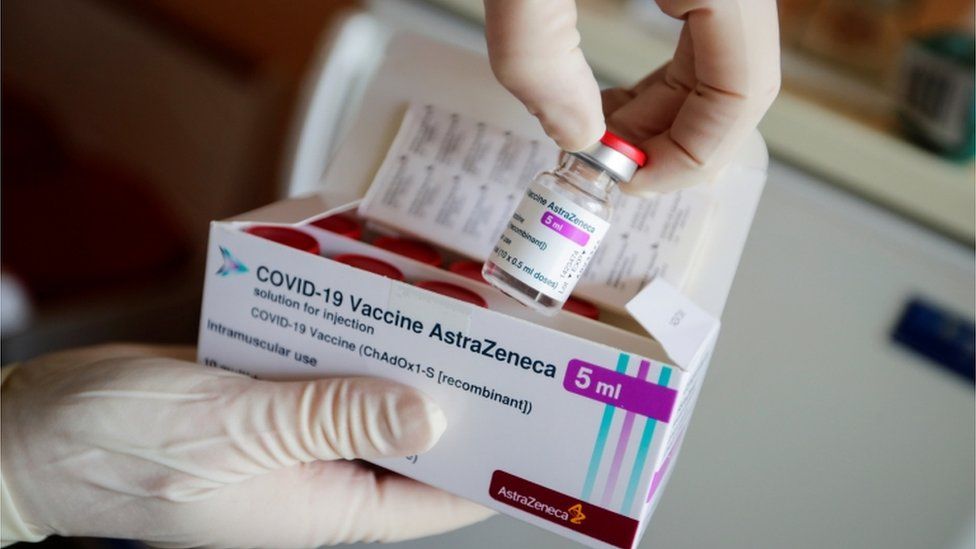
AstraZeneca Covid vaccine shown in Germany, 3 MarchIMAGE COPYRIGHTREUTERS

Germany's vaccine commission has approved the use of the Oxford-AstraZeneca jab in people aged over 65.

The country previously approved it for under-65s only, citing insufficient data on its effects on older people.

That led to public scepticism about its effectiveness, with some Germans spurning it and leaving many doses unused.

But German Chancellor Angela Merkel said recent studies had now provided enough data to approve it for all ages.

Announcing the commission's decision on Thursday, Health Minister Jens Spahn said the move was "good news for older people who are waiting for an injection".

"The new data also shows that the vaccine is even more effective when the first and second jabs are administered 12 weeks apart," the minister said, adding that the law would be updated to incorporate the new recommendations.

Mrs Merkel said on Wednesday that Germany would follow the UK example of stretching the interval between vaccine doses in order to offer as many people as possible an initial shot.

Various studies have shown the AstraZeneca vaccine is highly effective among the elderly.

Belgium says it will also approve the vaccine for older people, following France earlier this week.

About 5% of Germans have so far received a first vaccine shot.

What led to scepticism about the AstraZeneca jab?

The EU's medical regulator approved the use of the Oxford-AstraZeneca vaccine for all age groups in January.

But the rollout was met by some public scepticism after regulators in countries including France, Belgium and Italy recommended that it should not be used for people over 65. Like Germany, they citied insufficient data on its efficacy for older people.

In January French President Emmanuel Macron said the jab was "quasi-ineffective" for older age groups - a suggestion strongly refuted by the UK government and British medical regulators.

The debate came amid an acrimonious dispute between AstraZeneca and the EU over vaccine supplies to member states.

Since then, stocks of the Oxford-AstraZeneca jab have gone unused in several European countries, slowing vaccination efforts.


Meanwhile the UK - which approved the Oxford-AstraZeneca jab for all age groups - has offered a first dose of a vaccine to 20.7 million people, almost a third of its population.

Last week Carsten Watzl, head of the German Society for Immunology, urged his country to change its mind on the Oxford-AstraZeneca vaccine.

In an interview with the BBC, he predicted regulators would have to reverse their decision to not recommend the jab for older people and suggested Mrs Merkel should take the vaccine live on TV to prove it is safe.

How is Germany planning to ease restrictions?

Separately, Mrs Merkel said she had agreed to a phased easing of restrictions with leaders of Germany's federal states but added that there was the option of an "emergency brake" if case numbers got out of control.

"We are at the threshold of a new phase of the pandemic that we can go into not carelessly but still with justified hope," Mrs Merkel said.

From Monday up to five people from two households will be allowed to meet, with children under 14 exempt.

Some shops will reopen provided that regional case numbers are below 50 per 100,00 people. If cases rise over 50 per 100,000 then customers will have to book slots to visit shops. If cases rise to over 100 per 100,000 over three days in a row then restrictions will be reimposed.

What do we know about the AstraZeneca vaccine?

The UK has been using the vaccine made by AstraZeneca, a UK-Swedish pharmaceutical firm, in its mass immunisation programme since December.

UK health officials say it provides "high levels of protection" for all ages.

No one who received the vaccine in trials was admitted to hospital or became seriously ill with Covid-19.

The vaccine is given via two injections to the arm, the second between four and 12 weeks after the first.

line
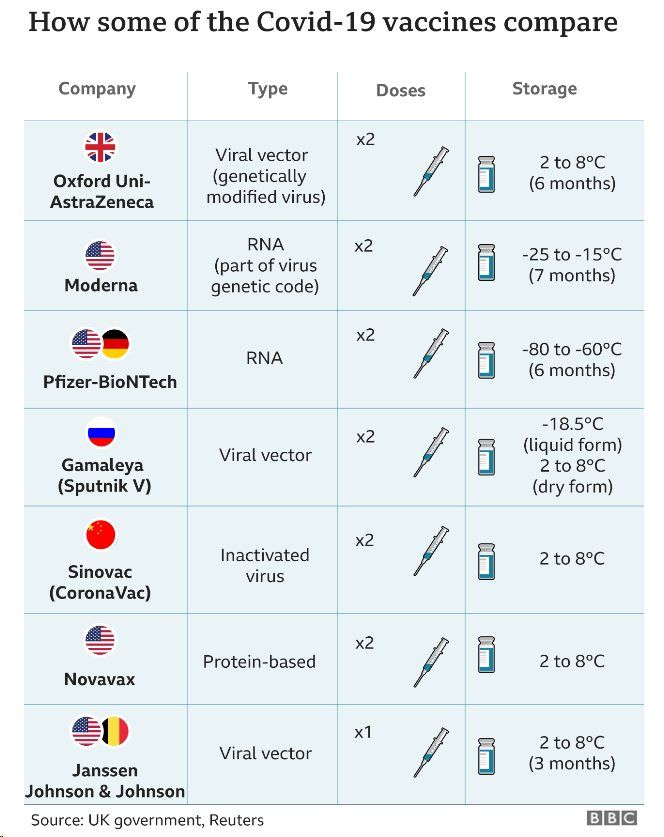
Covid vaccines graphic
1px transparent line

More on this story

https://www.bbc.com/news/world-europe-56275342