Pages

Showing posts with label Milk Powder. Show all posts

Thursday, 14 July 2022

The surprising science of breast milk - BBC

Scientists are discovering the extraordinary power of human milk and the benefits it brings to infants, but there are also some hidden contaminants that can lurk in breast and formula milks.

By Anna Turns23rd June 2022


(Image credit: Wikimedia Commons)

Throughout the first year of their lives, I breastfed my two children without the use of infant formula. Breast milk has been shown to be an ideal source of nutrition for babies, with many benefits for their developing brains, immune systems and digestive tracts, and I was glad to be able to offer them that boost. But when I had my blood tested for persistent toxic chemicals while researching a book on pollution, I discovered that some pesticides banned more than 40 years ago could still be detected in my body. There is also evidence that low levels of some chemical contaminants can be passed from a mother into her breast milk. Yet formula milk is also prone to contamination with toxic chemicals or potentially harmful bacteria, which have led to high-profile food scares and recalls in recent years.

It made me wonder what's really in the first foods our children consume – from the most beneficial ingredients, to hidden, undesirable or even toxic ones. And given what we know about some of the dangers, what can be done to improve all the available options for babies, be they breast- or formula-fed, and offer them the best possible start in life?

The milk that changes every day

Breast milk is considered the top choice for a baby's first food (the World Health Organization recommends that infants should be exclusively breastfed for the first six month of life). It mainly consists of water, fat, protein, as well as vitamins, minerals, digestive enzymes and hormones. It is rich in maternal antibodies, and has anti-infective properties. Breast milk is also a dynamic, adaptable food – it is fattier in the afternoon and evening than in the morning, for example. It also varies during a feed. When the baby latches onto the breast, the first gush of milk, or foremilk, is thin and high in lactose, making it thirst-quenching and easy to drink. The so-called hindmilk that follows is creamier and fattier, making it more filling. This dynamic aspect is one reason why breast milk is hard to replicate, despite considerable advances in the quality of infant formula.

"Human milk varies over the course of lactation, over the course of a day, from the start to the end of the feed, and to some extent on maternal factors such as her diet," says Mary Fewtrell, a professor of paediatric nutrition at University College London, who published a peer-reviewed study of lactation. "That all makes it difficult to decide on a precise amount that should be included in a formula whose composition doesn't change with the baby's age."

Fewtrell highlights non-nutrient ingredients in breast milk such as hormones, cells (including stem cells), microRNAs (small strands of genetic material), which give it unique properties. "We still don't fully understand the role of all these components but… quite probably they allow the mother to transmit information to the infant about her own experiences and the environment, which is why breastfeeding is sometimes described as 'personalised nutrition'."


A Yanomami mother breastfeeds her baby as she waits at a health care centre in Brazil (Credit: Andressa Anholete / Getty Images)

However, while more than 80% of babies in the US are breastfed at the start of their life, according to the Centers for Disease Control and Prevention, that rate falls to 58% at six months. Health authorities have tried to increase that rate, for example by offering more breastfeeding support to mothers. Diagnosing and treating conditions such as tongue-tie in babies can also help. But in the meantime, parents who do use formula may also wish to understand more about it, including what might be done to improve it.

"Whilst human milk is the biological norm for human infants and provides benefits for both mother and infant, some women may be unable to breast-feed or choose not to do so, and some choose to partly breast-feed," says Fewtrell. "For young infants, the only safe alternative if an infant is not breast-fed (or not fully breast-fed) is an infant formula which is designed to meet the nutritional needs of infants and support normal growth and development." Flexibility is expected – there's no "one size fits all" approach to infant nutrition, she says.

Towards better formula

The manufacture of infant formula has come a long way over recent decades. Throughout the 19th and early 20th centuries, bottle-feeding was not a safe option. In orphanages during the early 1900s, as many as 80% of bottle-fed babies died during the first year of life due to infections from unsterilised bottles, or malnourishment. Since infant formula was first commercially produced in 1865 using just four key ingredients (cows' milk, wheat and malt flour, and potassium bicarbonate), its nutritional contents have been refined in remarkable ways.

So what's in formula today?

Multiple fat sources are often used in formula, including cows' or goats' milk (often skimmed, which isn't as fatty as breast milk) and vegetable oils such as palm, sunflower or rapeseed, plus fatty acids. One fatty acid called DHA (docosahexaenoic acid, a type of omega-3 fat), which plays an important role in infant development, is now a mandatory ingredient in the European Union.

In breast milk, the main carbohydrate is lactose. In formula, this is usually added into the skimmed dairy milk powder base. Maltodextrin (a carbohydtrate derived from maize or potatoes) is also added. In the UK, glucose (a sugar) isn't routinely added but in the US, glucose sugars such as corn syrup are more commonly used. One problem is that this can increase the risk of dental decay in infants when their teeth come through.

The major breast milk proteins are whey and casein, which change in proportion as the baby grows, plus lactoferrin which is found at higher concentrations in colostrum, the first milk a mother produces after birth. The protein quantity and composition differs in formulas based on cows' and goats' milk, which have a higher casein to whey ratio than human milk. Plant-based ones are often made with soya protein. Formula also contains a mix of vitamins (including A, D, B and K), minerals such as calcium, magnesium, iron, zinc and many other trace elements.

Breast milk is a dynamic, adaptable food, and varies over the course of a day and even from the start to the end of a feed (Credit: Getty Images)

Unfortunately, formula can also contain lurking, unwelcome ingredients: just like I discovered pollutants in my own body, toxic substances can make their way into infant formula, too. 

Heavy metal mix

In 2017, the Clean Label Project, a US-based not-for-profit that tests products for toxic substances such as pesticides and heavy metals, found that almost 80% of 86 infant formula samples tested positive for arsenic. It also discovered that soy-based formulas had seven times more cadmium, a carcinogenic metal found in batteries, than other formulas.

Two years later, researchers from the Clean Label Project and the department of neurology at the University of Miami published a study into the heavy metal content of 91 infant formulas. They found that 22% of infant formula samples tested exceeded the lead exposure limit set by Californian state law, while 23% exceeded the state's limit for cadmium. The study concluded that "low-level heavy metal contamination is widespread" in baby foods and formulas and that "further research is needed to understand the long-term health effects of this chronic daily low-level heavy metal exposure in babies". Another study of baby foods in Sweden found that the dietary cadmium exposure of children fed infant formula was up to 12 times higher than those who are breast fed, although the levels were still within weekly tolerable limits set by the WHO and FAO.

Food safety regulators insist they are actively trying to tackle the issue of heavy metals in baby foods

Jackie Bowen, an environmental biologist and executive director of Clean Label Project, co-authored the study. She campaigns for greater transparency about the hidden contaminants that end up in our food, including infant formula. According to Bowen, food safety regulation can miss those contaminants since it focuses primarily on microbial pathogens such as E. coli that cause acute, short-term food poisoning.

Food safety regulators, however, insist they are actively trying to tackle the issue of heavy metals in baby foods. The US Food and Drug Administration (FDA), for example, insists it routinely monitors baby foods for toxic elements and takes action if they present a health concern. It says it is working with food companies and other stakeholders in an attempt to reduce the levels of heavy metals and other toxic substances in baby foods to as low as possible. But a recent report by the Committee on Oversight and Reform at the US House of Representatives criticised the FDA and food companies for not doing enough.

The FDA, however, says it is continuing to issue guidance to industry that will help lead to "meaningful and lasting reductions in exposure to toxic elements from foods", alongside its sampling and enforcement work.

"As parents and caregivers ourselves, we recognise and understand concerns about toxic elements and how they could impact the health of children," a spokesperson told the BBC.

"Consumers are increasingly concerned about how the foods they eat are linked to long-term chronic diseases like cancer or infertility that can take decades to manifest," explains Bowen who adds that, in the US, this food safety regulation is 'silent' when it comes to heavy metal contamination. "There's a growing divide between the court of law and the court of public opinion of what it means for food to be safe.".

Heavy metals like cadmium and lead naturally occur in the Earth's crust, so it's impossible to totally eliminate them. But human activities such as mining, fracking, industrial agriculture and the use of waste water for irrigation, exacerbate the presence of heavy metals in air, water and soil in the form of pollution, Bowen argues. Unlike microbial pathogens which can be destroyed by high heat and other methods, there's no way to get rid of such contaminants once they are in a product, she says. Instead, the problem has to be addressed at the start of the process, by beginning with clean, uncontaminated soil. After all, formula starts with farming, since key ingredients come from dairy livestock or crops.

"If you want a high-quality finished product, that comes from high-quality ingredients. That comes from healthy nutritious soils and that comes from good environmental policy that isn't going to allow for that level of pollution that contributed to the problem," says Bowen who explains that certain formula ingredients are at higher risk of heavy metal contamination. Soy, a mainstream plant-based substitute for cows' milk, tends to bioaccumulate heavy metals, as does hemp, whereas pea protein doesn't have that same tendency.

A dad bottle-feeds his son in a pre-school class in Beijing (Credit: Gou Yige/AFP via Getty Images)

Hidden formula contaminants are only one part of the problem. Powdered formula gets mixed with tap water to create infant milk. That poses a health risk in areas where that water is contaminated by old, flaking lead pipes, which happened in Flint, Michigan, for example (lead exposure can also affect breastfeeding mothers). While lead piping is gradually being replaced, water testing typically focuses on microbes, rather than high levels of heavy metals, Bowen says.

"It's one thing to solve the problem for infant formula, but unless you solve heavy metal contamination of the drinking water that gets mixed with powdered milk to give to baby, you're only fixing half the problem," she says. "What are we doing to prevent these problems in the first place?"

The US Food and Drug Administration's Closer to Zero action plan, which aims to reduce exposure to arsenic, lead, cadmium and mercury from foods eaten by babies and young children, could be one step towards cleaner food.

Common formula ingredients such as palm and soy have also raised wider environmental concerns, because their production often involves destruction of native forest habitat. For some, the solution is to use organic formula ingredients and source them as locally as possible. In Australia, for example, formula maker Bubs sources milk from local goat farms and cattle, which they say helps them ensure the traceability of the ingredients they use.

Feeding the microbiome

In recent years, there has been growing awareness of the important role of the human microbiome, the ecosystem of microorganisms that thrive inside and on our bodies, including in our digestive system. Emily Bloxam, a paediatric dietitian at City Dietitians in London who specialises in neonatal nutrition and allergies, explains that while the nutritional composition of formula is now closer to breast milk than ever before, breast milk is "a key driver" for the development of the baby's gut microbiome. Breast milk components that facilitate this development, such as maternal antibodies and healthy gut bacteria, cannot be artificially manufactured yet. 

"Bifidobacteria is a key probiotic (friendly bacteria) found in breastmilk which colonises an infant's gut during the first 1,000 days of life and aids immune function, while reducing the risk of asthma, eczema and gastrointestinal symptoms," says Bloxam. "Breast milk also contains prebiotics called human milk oligosaccharides (HMOs) which feed the Bifidobacteria allowing their growth."

A mother breastfeeds her child during the "all for breastfeeding" festival in Bogota, Colombia (Credit: Daniel Garzon Herazo/NurPhoto via Getty Images)

Over 150 types of HMOs have been found in breast milk. In fact, the gut microbiomes of breastfed infants have been found to be distinctly different to those of formula-fed babies.

Some hypoallergenic formulas now include prebiotic and probiotic additions which are designed to bring the gut microbiome of milk-allergic infants closer to that of breastfed infants. Newly developed probiotic Bifidobacteria supplements can be mixed with formula or breast milk for babies who have been delivered by C-section and therefore not exposed to some of their mother's gut bacteria during a vaginal delivery. Some HMOs have been chemically engineered for addition to infant formula as well.

However, any added ingredients in formula still lack one distinctive feature of breast milk: the ability to constantly change and adapt. As Bloxam explains, breast milk is in a complex constant state of flux: "The amounts and composition of these beneficial substances vary among women according to a number of factors such as genetics, geographical regions, stages of lactation and diet. Even within one individual, breast milk composition changes daily to meet the infant's needs."

Lab-grown milk?

One way to potentially mimic some of those properties may be to grow breast-milk-producing cells in a laboratory, something scientists are beginning to explore.

BioMilq, a North Carolina-based start-up, was set up by cell biologist Leila Strickland after she struggled to produce enough breast milk for her first child. Her team take cells from human breast tissue and breast milk before growing them in flasks in the lab. They are fed a mix of nutrients and vitamins, then incubated inside a bioreactor, where the cells start secreting the milk components that are found in natural human milk. However, BioMilq is still a few years at least away from market. Also, lab-grown milk would still not be as individually tailored to a baby's fluctuating needs as their own mother's milk.

Other biotech companies are also working on lab-grown milk projects that could change how we think of manufactured infant formula in the future. In Singapore, Turtle Tree Labs is culturing cells from various different mammals, including cows, sheep, goats, camels and now humans, to create milk components. In New York, researchers at Helaina, a start-up, are using fermentation processes that programme yeast cells to manufacture functional human milk proteins, which could eventually be added to infant formula and other food products.

We can quite successfully produce formulas to provide adequate and safe nutrition so the baby grows and develops as expected. However I think it would be impossible to ever mimic the 'non-nutrient' components – Mary Fewtrell

However, breast milk is a constantly changing fluid so in a way it's a moving target, with some components still not fully understood, says Fewtrell, the professor of paediatric nutrition at University College London.   

"We can quite successfully produce formulas to provide adequate and safe nutrition so the baby grows and develops as expected," she says. "Indeed, there have been improvements to the composition of formulas in recent years so that they can more closely reproduce the growth patterns and some outcomes seen in breast-fed infants. However I think it would be impossible to ever mimic the 'non-nutrient' components in this complex fluid."

As for my investigation into my own body's toxic load, and the harmful chemicals that were perhaps present in my breastmilk, Bloxam, the dietician, reassures me:  "I'd encourage breastfeeding wherever possible as the benefits for mother and baby would far outweigh any risks [from contamination]." 

Still it appears I'm not the only one wondering about the ingredients in my own milk. Stephanie Canale, previously a family medical doctor, is the founder of Lactation Lab in California, a private company that analyses breast milk for nutritional content as well as environmental toxics. Mothers send in frozen samples of their breast milk to check the levels of various ingredients including minerals and vitamins. The idea is that they can then adapt their diet accordingly.

Canale says that when we look at a baby's nutrition, we need to include everything from prenatal vitamins to the food a breastfeeding mother consumes and the meals a weaning baby eats. Formula may be one part of that mosaic, in families where it is used. 

"It's this holistic approach," says Canale who would like to see stricter regulations in the US about the contents of formula. "I'm from Canada and it still surprises how much high-fructose corn syrup is present in US products, including formula. Moms are going to drive this change by saying we need to be better aware of what is going into these products, especially formula because that child is eating the same thing every single day – there's no variation [like there is naturally with breast milk]."

In the case of the toxic chemicals – whether they find their way into breast milk or into formula – the question is clearly not just about how we can provide our children with safe nutrition. It is also about how we can provide them and future generations with a safe, liveable environment, and reduce pollution along the entire food chain. One answer, surely, is to start by using fewer harmful chemicals in the first place.

* Listen to My Toxic Cocktail, Anna Turns's investigation for BBC Radio 4's Costing the Earth series on BBC Sounds. Go Toxic Free: Easy and Sustainable Ways to Reduce Chemical Pollution by Anna Turns is out now

--

This article was updated on 27 June to include a quote from the FDA.

FAMILY TREE

This article is part of Family Tree, a series of features that explore the issues and opportunities that families face all over the world. You might also be interested in other stories about a baby's first months:

You can also climb new branches of the Family Tree on BBC Worklife.


https://www.bbc.com/future/article/20220622-whats-really-inside-babies-first-foods

Thursday, 7 March 2019

Nestlé under fire for marketing claims on baby milk formulas

Exclusive: Report finds Swiss multinational is violating advertising codes and misleading consumers with nutritional claims


Thu 1 Feb 2018 
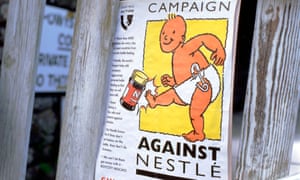
A boycott campaign poster against Nestlé baby milk products at the Hay festiva, 2002.
A boycott campaign poster against Nestlé baby milk products at the Hay festiva, 2002. Photograph: Kathy deWitt/Alamy Stock Photo
The Swiss multinational Nestlé has been accused of violating ethical marketing codes and manipulating customers with misleading nutritional claims about its baby milk formulas.

A new report by the Changing Markets Foundation has found that Nestlé marketed its infant milk formulas as “closest to”, “inspired by” and “following the example of” human breastmilk in several countries, despite a prohibition by the UN’s World Health Organisation (WHO).
The study, which analysed over 70 Nestlé baby milk products in 40 countries, also found that Nestlé often ignored its own nutritional advice in its advertising.
In South Africa, the firm used sucrose in infant milk formulas, while marketing its Brazilian and Hong Kong formulas as being free of sucrose “for baby’s good health”.
In Hong Kong, it promoted its baby milk powders as healthier – because they were free from vanilla flavourings – even as it sold other vanilla-flavoured formulas elsewhere in the territory.

Nusa Urbancic, campaigns director for the Changing Markets Foundation told the Guardian: “We have come to understand that companies manipulate consumers’ emotional responses to sell a variety of products, but this behaviour is especially unethical when it comes to the health of vulnerable babies.
“If the science is clear that an ingredient is safe and beneficial for babies then such ingredients should be in all products. If an ingredient is not healthy, such as sucrose, then it should be in no products. Nestlé’s inconsistency on this point calls into serious question whether it is committed to science, as it professes to be.”
Nestlé is the global market leader for infant milk products with a market share of close to a quarter. It has been dogged by the advertising issue since a 1974 report called The Baby sparked a worldwide boycott.
In 1981, the WHO adopted a strict code of advertising banning the promotion of baby milk products as being in any way comparable to breastmilk. Nestle insists that it follows the code “as implemented by national governments”.
But the new report finds that it touted products in the US such as Gerber Good Start Gentle powder as “our closest to breastmilk”, and sold its Beba Optipro 1 powder in Switzerland as “following the example of breastmilk”.
Similar Nestlé products in Hong Kong and Spain were advertised as being “inspired by human milk”, and having “an identical structure” to breastmilk.
The company did not respond to specific questions about the new study but a Nestlé spokesperson told the Guardian it supported WHO recommendations and believed that breastmilk was, wherever possible, “the ideal source of nutrition for babies.”
However, not all infants could be breastfed as recommended and “where needed or chosen by parents, we offer high quality, innovative, science-based nutritional products for mothers and infants from conception to two years of age,” the employee said. “We market these products in a responsible way at all times, and the claims made on our products are based on sound scientific evidence.”
Some academics, though, have highlighted the way that language used by corporates to promote infant milk formulas can sometimes mislead consumers about this.
Last year, Prof George Kent of the University of Hawaii wrote that describing a product as “closer to breastmilk … is not the same as saying it is close to breastmilk. New York is closer than New Jersey to Paris, but that does not mean New York is close to Paris.”
Breastmilk is a “personalised” and continuously changing nutrition between mother and child that contains live substances – such as antibodies and immune-system related compounds – which cannot yet be replicated in a lab.

Thursday, 5 September 2013

The Truth About Organic Foods from China


There are articles all over the Internet right now about “fake organic” food from China. Wanting to keep you informed, I read through many of them. The problem was, they all seemed to quote other sources and reading on, I found that these sources quoted other sources and so on. There didn’t seem to be any credible first-hand sources for this information. Was this all just rumor run rampant, as Whole Foods claims?

Whole Foods has been accused of selling these “fake organic” foods from China but they claim that “any product sold as organic in the US, regardless of where it’s grown, must be certified to the USDA’s National Organic Program standard by a USDA-accredited certifier.”

Well, I wanted to know more about this USDA certification of imported organics. It took quite a bit of digging but what I eventually found was more disturbing than any of those copycat articles.

I found frightening information about all food from China, frightening lack of regulation concerning organic food from China, and, worst of all, shocking information about our National Organic Program (NOP).


Before I go on, I want to reassure you about your options. You don’t have to break the bank buying all of your foods organic. Read which foods are commonly pesticide-ridden and those that usually aren’t in How to Buy Organic. I’ll tell you about the “beyond organic” movement that has arisen in response to NOP problems. Check out this source here to learn more, What is Beyond Organic?


Chinese Food Safety Issues


First of all, I was surprised to learn how much food the US imports from China: China is the third-largest source of food imports according to a 2009 report by the Economic Research Service (ERS). For example, 60 percent of our apple juice and over half of the garlic we use in the US is from China. The ERS claims that food safety is a critical issue with Chinese imports but that “there are no simple solutions to addressing the safety hazards since they appear to occur in many different types of foods at all links in the supply chain.”

Reading through the USDA article “Imports From China and Food Safety Issues” is alarming. The FDA regularly refuses shipments from China because of filth, unsafe additives, veterinary drug residues and mislabeling. Filth violations and unsafe additives are the most common violations in Chinese imports and reading what constitutes “filth” is only recommended to those with strong stomachs.

What this report did make evident is that pollution in China is so prevalent that even more stringent regulation is unlikely to make great improvements in food quality there. The ERS reports that banned agricultural chemicals are still used and even when they’re not–they still exist in the soil and water.

Many farms are in industrial regions where air, water and soil pollution is concentrated, especially in terms of cadmium and lead levels. Animal and human waste spoil the water, many workers don’t have hygiene awareness and fraudulent record-keeping is common.


More information about pollution in China can be found in the Stanford Journal of Internation Law ”Is ‘USDA Organic’ a Seal of Deceit?” by Chenglin Liu (print).

Is “USDA Organic” a Seal of Deceit? covers the pitfalls of USDA Certified Organics Produced in the United States, China and Beyond. This article was originally published in the summer 2011 issue of Stanford Journal of International Law and is available for a fee on many scholarly studies websites. To avoid subscription prices, you can read this article via your local or statewide library. Based upon court cases and the evidence presented in them, this white paper was my most disturbing find.

In terms of pollution, author and law professor Chenglin Liu reports that only five percent of household sewage and 17 percent of industrial sewage in China is properly treated.  A Chinese government study found that 90 percent of Chinese groundwater is polluted. China is the world’s biggest user of chemical fertilizers and one of the largest producers and users of pesticides. Worse of all, Chinese farmers traditionally did use organic methods. When farmlands were socialized in the 1960′s, they were forced to use new farming techniques, fertilizers and pesticides by the Chinese government. After decades of such heavy use of agricultural chemicals, soil quality has decreased to the point that USDA economist Fred Gales claims that it is “almost impossible to grow truly organic food in China.”


Organic Certification in China


I also took a look at the 2010 USDA Foreign Agriculture Report, an organic report on China. The authors of this report surmise that because of increasing demand within China and worldwide, within 10 years, China may “become the fourth largest organic market in the world.” They report that food safety issues in China make organics a profitable market. Consumers are willing to pay 300 percent more for organic asparagus, 10 times more for organic beef, and generally, five to 10 times more for all organic vegetables. This kind of profit drives unscrupulous practices.

Organic certification in China is wildly diversified. The Chinese Organic Food Certification Center (COFCC) is supposedly in charge but only certifies about 30 percent of organic products. The rest are certified through third parties, private firms, individual inspectors and international firms. As of 2010, the authors report that there is no agreement between China and the US as what constitutes organic. They also report that organic standards are poorly enforced in China, that no clear authority exists, that mislabeling is common and that many producers use expired organic labels. Some organic companies don’t even produce their own food but subcontract to others. Some companies label their goods as organic when only a tiny portion of their produce is grown organically.


Importing Practices


Professor Liu reports that there are three ways that imported foods can be sold as organic in the US. 1) Foods can be certified by a USDA-accredited certifying agent, either US-based or foreign-based; 2) foods may be stamped with the USDA seal if the US has a recognition agreement with that country, an agreement that the country’s own certifying agents can use this seal because they follow US organic regulations; 3) equivalency agreements exist through which the US and other countries agree that their organic standards are equivalent.

We don’t have an equivalency agreement or a recognition agreement with China so technically, Whole Foods is right: organic food from China must be certified by a USDA-accredited certifier. But here’s the rub. There aren’t enough US certifiers to go around, only about 94 exist. The USDA certifies agents in China to certify farms and other producers. In 2007, an audit of two farms and four certifiers in China found many issues of noncompliance. For example, the certifiers had little experience with organic certification stipulations, often didn’t even understand them, and in once case, a German-based certifying company in China didn’t even provide the NOP organic standards to applying agents.

Also in 2007, the USDA realized that the Organic Crop Improvement Association (OCIA) had been using employees from the Chinese Ministry of Environmental Protection. It would be in their best interest to push organic certification no matter what actual practices were taking place. The OCIA certifies 1800 organic operations in 11 countries, 233 in China. It took three years for the USDA to take action and suspend OCIA for one year, and they didn’t tell the American public until 2010.

Professor Liu finds Whole Food’s rebuttal ridiculous because it claims equivalency in organic standards and certification whether the food is from US or beyond. Liu points out that in one instance, the USDA granted conditional accreditations to certifiers based only on paperwork and didn’t check to see that they complied with conditions set forth for seven years.  NOP regulations only stipulate a once-yearly check on farms and Liu reports that China’s government agencies can’t even enforce their own laws, never mind that of the US.


Corruption in China


Why did China keep having problems with tainted milk and products made with this milk? Because local governments cover up such scandals as a matter of course. These local governments are closely tied to food manufacturers and it is in their best interest economically to boost manufacturing any way they can. The court system also has ties with food manufacturers reports Liu, and the news media is controlled by the Chinese government. Bribes for licenses are common and ethics aren’t very strong in the food industry in China. The use of additives to enhance look and taste, for instance, rule over health concerns.

Farmers in China don’t voluntarily choose to grow organic: they’re ordered to. Village leaders are in charge of farm cooperatives and are the gatekeepers for USDA certifying agents. An agent might be shown a sampling of organic farming rather than all the practices within the cooperative and many farmers reported that that didn’t know what organic meant or what they were supposed to do. Local officials commonly disrupt, delay or circumvent certifier’s tours of these farms.

Fraudulent labeling is very common in Chinese food manufacturing and because so many departments and agencies are involved in this chain, there are plenty of ways to duck under the radar. For two years, Jiahe products were carried on Carrefour, Wal-Mart and other grocery chain shelves even though they weren’t verified to be free of pesticides.

In terms of corruption, Argentina, Ecuador, Guatemala, Honduras, Mexico, the Philippines and Thailand all rank worse than China. Yet these countries are the top ten suppliers of fruits and vegetables to the US reports Liu.  Growing demand for organic food drives imports. Liu reports that 40 percent of the organic food consumed in the US is imported from over 100 other countries.


Fake Organic in the US?


Then there’s the National Organic Program. The US certainly isn’t immune to corruption. The NOP was instituted because small farmers thought regulation would protect them. Instead, as the organic industry has been co-opted by mega-corporations, loopholes in organic standards and regulations become cavernous.

Those small farms? They’ve been gobbled up by big business and organic practices become industrial organic practices. Kellogg now owns Bear Naked and Kashi, Heinz and Hein own 19 organic brands. Coca-Cola, Con-Agra, General Mills, Kraft, and Mars M&M own most of the market. Michael Pollan reports that “five giant farms control fully one-half of the $400 million organic produce market in California.” To see who owns your favorite organic brand, check out this info graphic,  Organic Sells Out to Mega Corporations.

The truth is, there is no perfect standard.  But in general, organic foods are typically of higher quality than conventional.  Even then, I would recommend not buying foods from China whether it’s organic or not.  Support companies who are willing to show you there production methods and be completely transparent like Beyond Organic.  I also recommend shopping at your local farmers market and asking them how they produce their foods.  Buying local or from a single owned organic company is your safest bet when buying any foods including organic.


Lessons Learned

  • Chinese imports are a common part of US food supply.
  • Environmental pollution in China makes any food grown there hazardous or nutrient-deplete.
  • Organic regulation of Chinese foods is a joke.
  • Corruption is common in many of the countries that contribute to US food sources, organic and otherwise.
  • Organic regulation in the US has been severely compromised by corporate interests.
  • It’s better to know the person that provides your food than rely on organic certifications.
 Sources

Peoples Republic of China: Organics Report, October 26, 2010

“Is “USDA Organic” a Seal of deceit? The Pitfalls of USDA Certified Organics Produced in the United States, China and Beyond.

USDA.gov – Imports From China and Food Safety Issues
The Organic Watergate—White Paper: Connecting the Dots: Corporate Influence at the USDA’s National Organic Program
www.nytimes.com Michael Pollan: Behind the Organic-Industrial Complex

http://www.draxe.com/organic-foods-china-shocking-and-exposed/

Monday, 12 August 2013

NZ dairy giant issues global botulism alert

Posted on 3 August 2013 - 04:12pm
Last updated on 4 August 2013 - 10:36am

WELLINGTON (Aug 3, 2013): New Zealand warned international health authorities Saturday of exported dairy products, including infant formula, containing a bacteria that could lead to botulism -- a potentially fatal illness.

The government said the contaminated whey protein concentrate, or products using this ingredient, had been exported to Australia, China, Malaysia, Saudi Arabia, Thailand and Vietnam.

Dairy giant Fonterra, which manufactured the product more than a year ago, said eight customers had been advised and were investigating whether any of the affected product was in their supply chains.

If necessary, contaminated consumer products would be recalled, the company said in a statement.

There have been no reports of any illness linked to consumption of the affected whey protein.

New Zealand Trade Minister Tim Groser said health authorities around the world, including the World Health Organization, had also been alerted to the contamination.

"As soon as New Zealand authorities were notified of this risk, we immediately acted to inform relevant authorities around the world," Groser said.

"This has included formally notifying Infosan, the World Health Organization's international food safety regulators network. As more information on this issue is confirmed we will provide our trading partners with further updates.

"We understand that the markets to which contaminated whey protein concentrate, or products using this ingredient, has been exported are Australia, China, Malaysia, Saudi Arabia, Thailand and Vietnam."

Fonterra said the affected product was used in a range of drinks including infant formula and sports drinks.

"We are doing everything we can to assist our customers in ensuring any product containing this ingredient is removed from the marketplace and that the public is made aware," Fonterra chief executive Theo Spierings said.

Three batches of whey protein concentrate manufactured in May last year recently tested positive for Clostridium botulinum.

The batches have been used to form 870 tonnes of products sold in a variety of markets, the Ministry for Primary Industries' Acting Director General Scott Gallacher said.

The symptoms of botulism include nausea, vomiting and diarrhoea, followed by paralysis, and it can be fatal if not treated.

Fonterra said the potential impact on someone consuming a contaminated product would depend on their age and the amount they consumed.

For an adult, a small amount of contaminated whey protein "would probably pass through unnoticed", Fonterra's managing director of New Zealand milk products, Gary Romano, told reporters.

Dairy exports are New Zealand's major earner and its products are particularly popular in Asia, where they are considered the gold standard.

According to government data the dairy industry contributes 2.8 percent to New Zealand's GDP and about 25 percent of its exports. It is worth NZ$10.4 billion (US$8.1 billion) annually.

New Zealand accounts for one-third of the world's cross-border trade in dairy products.

Fonterra, the world's largest dairy exporter, reported revenues of NZ$19.8 billion ($15.5 billion) in the 2012 financial year. – AFP

http://www.thesundaily.my/news/788025

NZ struggling to complete tainted milk recall

Posted on 7 August 2013 - 09:40am
Last updated on 7 August 2013 - 10:43am

WELLINGTON (Aug 7, 2013): New Zealand was struggling to meet a self-imposed deadline to remove tainted baby formula from shelves worldwide Wednesday and end a botulism scare that has triggered global recalls.

Both the government and dairy giant Fonterra said earlier this week they hoped to ensure the last of the contaminated formula was out of circulation by late Wednesday, but ministers have since warned they can offer no guarantees.

About 90 percent of the product, which was distributed from China to Saudi Arabia, has been collected and Trade Minister Tim Groser said officials were combing Fonterra's records to find the rest.

"It's a question of working through by a process of elimination to find where the last remaining can is... it's really unfortunate, it's just taking time," he told TV3 on Wednesday.

Economic Development Minister Stephen Joyce said the formula had been cleared from New Zealand stores but "internationally there's still some that's being verified, exactly where it is".

"There will be some that's been effectively sold to end users and may or may not be returned," he said on Radio New Zealand.

Joyce acknowledged the botulism scare has dented New Zealand's "clean, green" reputation, particularly in China, where Fonterra has used the country's premium reputation to create a multi-billion dollar dairy market.

"I've read some interesting comments in the last 24 hours, people saying it's not as big as you think, well I beg to differ, it's very significant," he said.

In an editorial that was reportedly widely published in Chinese media, state news agency Xinhua blamed lax regulations in New Zealand for allowing the product to be exported.

It also raised concerns the problems were systemic, pointing to Fonterra's involvement with a Chinese company it part-owned that in 2008 illegally laced milk with the chemical melamine, resulting in six children dying and 300,000 falling sick.

There have been no reports of illness in the latest scare but Groser said such sentiments in one of New Zealand's major export markets were "not pretty".

"I have a very firm view that this is not going to be won by a slick PR campaign," he said.

"The number one thing is to fix the immediate problem. That will determine our real ability to recover our position." – AFP

http://www.thesundaily.my/news/791164

NZ milk powder contaminated with bacteria

Posted on 5 August 2013 - 09:55am
Last updated on 5 August 2013 - 12:25pm

WELLINGTON (Aug 5, 2013): New Zealand Prime Minister John Key on Monday accused dairy giant Fonterra of delaying in sounding the alarm over products tainted with a potentially fatal bug, as investors sent the company's shares tumbling.

Fonterra revealed on Saturday that a whey product used to make infant formula and sports drinks had been contaminated with a bacteria that can cause botulism, prompting immediate action from China, a major market for New Zealand's dairy products.

Key said he was concerned at the impact on farm-reliant New Zealand's reputation as a supplier of "clean, green" dairy products, particularly in Asia where its infant formula has long been regarded as gold standard.

He said it was difficult to understand why Fonterra did not act immediately when tests last year showed there were problems with three batches of whey.

"I'm a bit staggered that in May of 2012, when this whey was produced, that it (Fonterra) did show something in its testing, but clearly not something that was of concern to the company because they allowed it to go out," he told Radio New Zealand.

"You would have thought that for a business where its top business is essentially based around consumer confidence, food safety and the quality of its products, that they are risks that you wouldn't take."

He said the government had a team of more than 60 personnel working to contain the fallout from the contamination and would eventually seek a "forensic" examination of how Fonterra had handled the crisis.

The Fonterra Shareholders' Fund fell 8.7 percent at the open on the New Zealand stock exchange as investors had their first chance to react to the scare, later recovering slightly to be down 5.9 percent at NZ$6.70 around midday.

The countries that the contaminated whey was exported to include Australia, China, Malaysia, Saudi Arabia, Thailand and Vietnam.

New Zealand officials say China has blocked all imports of its milk powder, while there are also reports that Russia has recalled Fonterra products and advised customers not to buy them.

Fonterra said there had been no reports of illness linked to consumption of the tainted product, which contains the bacteria Clostridium bolulinium, which can cause botulism, an infection that can lead to paralysis and death if left untreated.

The company has blamed the contamination on a dirty pipe at a North Island processing plant.

The New Zealand Infant Formula Exporters Association said none of the products made by its members were affected but it had been caught in a global backlash due to the poor quality of information being released by Fonterra.

"There wasn't full and frank disclosure right at the beginning and this has led to a lot of rumours spreading in the marketplace, which is what we're seeking to counter now," spokesman Chris Claridge told TVNZ.

New Zealand is the world's largest dairy exporter and the NZ$10.4 billion ($8.1 billion) sector accounts for about 25 percent of its exports. – AFP

http://www.thesundaily.my/news/788944

Tainted milk powder recalled

Posted on 4 August 2013 - 10:08pm
Last updated on 5 August 2013 - 08:05am

Wednesday, 7 December 2011

Cesium found in milk powder made by Japan's Meiji


TOKYO (Reuters) - Japan's Meiji Holdings said on Tuesday that radioactive cesium was found in infant milk powder made by the food and dairy firm, in the latest food scare to grip the country nearly nine months after the Fukushima nuclear disaster.

Meiji said it was recalling 400,000 cans of the infant formula, which is sold only in Japan.

Worries over the safety of food supplies have shaken the public after the March 11 earthquake and tsunami crippled the Fukushima Daiichi plant in the worst nuclear accident in 25 years, spreading radiation over a large swathe of northern and eastern Japan.

Cases of excessive radiation in vegetables, tea, milk, seafood and water have stoked anxiety despite assurance from public officials that the levels detected are not dangerous.

Meiji said it is unsure exactly how the cesium got into the powdered milk, but it suspects radioactive substances emitted from the Fukushima accident may have been the source. A company spokesman told Reuters hot air used in the drying process may have contained cesium.

Tests by Meiji showed that up to 30.8 becquerels (a unit of radioactivity) of cesium was found per kilogram of the powdered milk. That is below the government-set permissible limit, but the firm will nevertheless conduct a voluntary recall of the product, called "Meiji Step."

The limit set by Japan's health ministry is 200 becquerels per kilogram for powdered milk, an official at the ministry's department of food safety said.

Tokyo Electric Power (Tepco), the operator of the Fukushima plant, has made slow but steady progress in bringing the facility under control, curbing the amount of radiation emitted from its reactors and reducing temperatures of the water, cooling them to levels considered stable.

It is on track to declare a "cold shutdown" -- when water used to cool the reactors is stable below boiling point -- before the end of the year.

Tepco said this week about 45 tons of contaminated water had leaked from a system that cleans radiated water, of which the utility said 300 liters escaped outside. But trade and energy minister Yukio Edano told reporters on Tuesday that the leak would not affect the goal of achieving a cold shutdown before the year's end.

http://news.yahoo.com/cesium-found-milk-powder-made-japans-meiji-201606002.html
.