George Gao, now former head of the Chinese Center for Disease Control and Prevention, attending a forum in Beijing last year.
A version of this story appeared in CNN's Meanwhile in China newsletter, a three-times-a-week update exploring what you need to know about the country's rise and how it impacts the world. Sign up here.
(CNN)George Gao, head of the Chinese Center for Disease Control and Prevention, has stepped down after five years at the helm of the health body, ending a tenure that placed him at the fore of early investigations into the first outbreak of Covid-19 in central China and the country's rapid development of Covid-19 vaccines.
The leadership change, announced by the agency on Tuesday, comes amid a restructuring that has seen the China CDC moved from its position directly under the monolithic centrallycontrolled National Health Commission and placed within a new nominally streamlined bureau, borne of pandemic-era calls for reform.
It also comes as China continues to grapple with fresh outbreaks of Covid-19 across the country, despite a stringent zero-Covid policy that has seen it maintain tight border controls and implement frequent mass testing and lockdowns.
Oxford University-educated and internationally connected Gao, 60, known also by his Chinese name Gao Fu, would no longer serve as director "due to his age," according to the China CDC readout of a meeting announcing the changes. Sixty is a standard retirement age for male civil servants, though many do not adhere to this.
He would be succeeded by former president of the Nanjing Medical University Shen Hongbing, currently vice-director of the National Administration of Disease Prevention and Control, the new bureau established in 2021.
The shift brings to an end the tenure of an internationally respected virologist who observers say grappled with the limitations of an agency with little sway over policy-making -- a key distinction between China's CDC and the US agency it was modeled after.
Legacy of an overseas-educated virologist
Gao also oversaw the agency at a time of increasing acrimony between China and the United States, made worse by questions over the origins of the coronavirus and accusations that China had suppressed its investigation.
Gao, who gave presentations at international scientific forums in English and had professional relationships with Western scientists, including top American epidemiologist Anthony Fauci, was widely respected among the international scientific community and seen as a rare point of contact with China.
"He will be remembered for being more open-minded and willing to reach out to his counterparts in Western countries," said Yanzhong Huang, a senior fellow for global health at the Council on Foreign Relations in New York.
"Under him the China CDC became a more prominent actor in China's response to the pandemic, especially in the early stages of the outbreak, and also an important window for the outside world to learn about China's Covid response," Huang said.
Prior to the pandemic, Gao was known for his work in Sierra Leone countering a 2014 Ebola outbreak, when he was stilldeputy director of the China CDC. He took up the director role in 2017.
Gao was among a group of top-level health officials who traveled to Wuhan, the epicenter of the first known outbreak of Covid-19, before the disease became a global crisis in January, 2020. China has been criticized for its actions during that period, due to the three-week lag between local officials' announcement of the outbreak and confirmation the virus could pass between people.
Gao played a key role in early scientific papers documenting the outbreak in Wuhan, and went on to develop one of the seven Covid-19 vaccines authorized for use in China.
He has also been involved in research into the origins of the virus, suggesting, contrary to recently published studies, that a Wuhan market linked to early cases was not where the new virus emerged, but rather a place where it was able to spread rapidly between people.
But he has sparked controversy within China and is considered by some in China's public health community as a "loose cannon," according to Huang.
In one instance last year, Gao appeared to suggest during a presentation that China's homegrown vaccines offered a low protection rate -- comments he later walked back in an interview with state media in which he called this a "misunderstanding" of his point.
He was also criticized after an interview last fall with the editor of Caijing magazine, in which he discussed the conditions under which China might relax its zero-Covid policy -- a sensitive subject in China, where the policy is viewed as the personal directive of leader Xi Jinping.
On Tuesday, Gao, who remains vice-president of China's grant-giving National Natural Science Foundation, said he supported the changes and that he would "continue contributing to developing disease control and public health."
Virus flare-ups
Gao's departure was announced as China continues to grapple with flare-ups of the virus, relying on frequent mass testing and snap lockdowns to handle outbreaks, while most of the rest of the world has moved into some mode of living with the virus.
As of Wednesday, China has identified 776 high-risk areas in 24 cities across the country, where residents are subject to partial or full lockdowns, according to information from the country's State Council.
Authorities in Wuhan, which was locked down for more than two months in early 2020, announced Wednesday they would be implementing control measures for three days in the main urban area of Jiangxia district, banning its roughly 1 million residents from leaving the area and shuttering a number of businesses and public transportation. Four cases had been identified in the district the previous day, according to official reports.
But as the head of China CDC, Gao himself had a limited role in forming policy to respond to and control the virus, observers say, as such matters are dictated by the cabinet-level National Health Commission, while the CDC has played a more technical, advisory role.
"Though restricted, (Gao) still tried his best to fulfill CDC's role as a public health and scientific adviser," said Xi Chen, an associate professor at the Yale School of Public Health.
"His scientific publications in the early stage of the pandemic helped inform the world about the virus. He also championed the publication of a scientific journal in English -- China CDC Weekly -- that aimed to make communications with the global public health arena more timely and transparent."
It remains unclear exactly what role the agency will play now that it is under the National Administration of Disease Prevention and Control. That body was set up following calls to strengthen China's disease prevention and control systems in the wake of the Covid-19 outbreak.
In Tuesday's meeting, Wang Hesheng, head of the National Administration of Disease Prevention and Control, praised Gao's contributions and laid out several goals regarding "reform" of the CDC and its operations under the new leadership. These included taking a "clear stand on politics" and to "faithfully implement General Secretary Xi Jinping's important directives and instructions."
And as a result of the new structure, it is possible that Gao's successor could be given more power, according to Chen. "Hopefully, the empowerment of China CDC under Shen may achieve something George Gao was unable to," he said.
Why nations relying on China's Covid vaccines are at risk of the disease resurging: Experts warn Beijing-made jabs being rolled out in 53 countries 'will not be enough to stop the virus circulating'
At least 53 countries worldwide have ordered doses of Chinese jabs, many of which are in developing nations
China over the weekend conceded that the efficacy of its vaccines were not ideal, in a rare public admission
Chile has seen its infection rate more than double since mid-February despite vaccinating 40% of population
Countries relying on China's Covid vaccines may be vulnerable to future waves of the disease, scientists warned today.
Experts told MailOnline the spiralling crisis in Chile should send a warning to the rest of the world that Chinese-made jabs are too weak to halt the spread of the virus, even with a successful immunisation programme.
At least 53 countries have ordered doses of the Chinese vaccines, many of which are developing nations in South America, Africa and South East Asia. The fact they are cheap and easy to store has made them ideal for countries which do not have the special equipment to keep other jabs at ultra-cold temperatures.
China's top health official conceded the efficacy of its vaccines were not ideal, in a rare public admission over the weekend. Gao Fu, director of the Chinese Center for Disease Control and Prevention admitted 'protection rates of existing vaccines are not high'.
Professor Ian Jones, a virologist at the University of Reading, told MailOnline the figures from Chile suggest the Chinese vaccines 'will not be enough to stop the virus circulating'.
Despite fully vaccinating a quarter of its population and getting a single dose to 40 per cent, Chile has seen its infection rate double since mid-February, rising from 177 daily cases per million to 372. More than 80 per cent of the country has been forced to retreat back into lockdown, which was used by No10's scientists as proof the UK is not out of the woods.
However, the South American nation is primarily using the CoronaVac vaccine, made by Chinese pharma giant Sinovac, which a University of Chile study found was only 3 per cent effective after the first dose, rising to 56.5 per cent two weeks after the second. Another study in Brazil found efficacy could be as low as 50 per cent, which just meets the World Health Organization's threshold for an acceptable vaccine.
For comparison, the Pfizer and Moderna vaccines have efficacy rates of 95 per cent and 94 per cent, respectively, while AstraZeneca's is about 79 per cent. Trials of tens of thousands of patients given the US and British jabs found they stopped up to 100 per cent of hospitalisations and deaths, compared to CoronaVac's 84 per cent.
Another Chinese-made vaccine made by state-owned pharmaceutical firm Sinopharm appears slightly better than the CoronaVac, 73 per cent efficacy against symptomatic illness. However, because China has refused to publish robust data in a medical journal means experts cannot be sure how effective the jab really is. But Mr Gao's remarks over the weekend suggest even Chinese officials are not confident in the vaccine.
Scientists fear the Chinese jabs allow too many people to slip through the cracks of immunity, leaving a significant proportion of the population vulnerable to falling severely ill with the disease. But they admitted a jab above 50 per cent efficacy is better than none.
How do the Chinese vaccines compare to other approved jabs? CoronaVac, made by
Chinese pharma company Sinovac, was found to be just 3 per cent effective at stopping
symptomatic illness after the first dose, rising to 56.5 per cent two weeks after the second.
Another Chinese-made vaccine made by state-owned pharmaceutical firm Sinopharm
appears slightly better than the CoronaVac, 73 per cent efficacy against symptomatic illness
Both Sinovac and Sinopharm's jabs are made from inactivated versions
of the SARS-CoV-2virus which have been genetically modified so
they do not cause illness.
Professor Jones said his guess was that the technology was behind the low efficacy, adding: 'I assume it's the whole inactivated virus vaccine.
'They are quick to make but they contain virus proteins which are irrelevant as far as protection goes so, in effect, a good proportion of what you receive is wasted.'
However, Professor Jones said these types of vaccines are unspecific, causing the immune system to release lots of antibodies that do not actually help fight the real coronavirus.
Moderna and Pfizer's vaccines, on the other hand, use mRNA technology which use a synthetic piece of genetic material to carry instructions directly to the cells, telling them how to recognise and defend against the disease.
AstraZeneca's vaccine is known as a 'viral vector'. It also carries genetic coding to the cell to prepare it for Covid infection, but it uses a weakened version of the virus that causes the code to transport it to the cells.
Professor Gabriel Scally, a public health expert at the University of Bristol, told MailOnline the crisis in Chile 'was not a great tribute to the Chinese vaccines'.
He added: 'They haven't been approved by any of the major medical regulators and there is very limited research evidence, they certainly don't appear to have a high level of effectiveness in the real world. And in the absence of data it's very difficult to know [how effective they really are]. The only benefit of them is the fact they're cheap.'
On whether countries rolling out Chinese vaccines should fear a resurgence of the virus, he said: 'I think they would have a right to be worried.'
But he admitted that a vaccine that's partially effective is better than none at all.
He told MailOnline: 'That 50 per cent mark is the line in the sand that's drawn by the WHO, which is great. But I think it's beginning to dawn on people these [Chinese] vaccines aren't going to solve the problem completely.'
Professor Scally said the UK was 'in a different place' because it has highly effective vaccines in its arsenal, adding: 'As long as we take it easy [coming out of lockdown] we should be fine.'
It has been suggested that China's attempt to supply the developing world with Covid jabs is the country's attempt at diplomacy. Professor Scally told MailOnline: 'Whether it's diplomacy or not, I don't know, I happen to think it's just China being China.
The director of the Chinese Centre for Disease Control and Prevention, Gao Fu, (pictured) said
the vaccines made in China ¿don¿t have very high protection rates¿ against covid symptoms
WHICH COUNTRIES ARE USING CHINESE-MADE VACCINES?
China has said it is giving 'vaccine aid' to around 50 countries.
There are about a dozen Chinese vaccine candidates for Covid-19, but only five frontrunners have received approval from medical regulators.
EUROPE (% vaccinated in total - not just using China's jab)
Belarus (0.43%)*
Hungary (29.36%)
Montenegro (5.62%)
Serbia (25.23%)
Turkey (12.88%)
ASIA
Azerbaijan (7.29%)
Brunei (0.08%)*
Cambodia (5.81%)
Indonesia (3.66%)
Kyrgyzstan (0.01%)
Laos (0.56%)*
Mongolia (No data)
Malaysia (1.75%)*
Pakistan (0.50%)*
The Philippines (0.80%)*
Thailand (0.70%)
SOUTH AMERICA
Argentina (9.91%)
Brazil (9.65%)
Bolivia (2.42%)*
Chile (38.47%)*
Colombia (4.33%)*
Dominica (24.69%)*
Dominican Republic (9.22%)*
Guyana (5.14%)*
Mexico (7.16%)
Peru (1.94%)*
Uruguay (23.77%)
MIDDLE EAST
Bahrain (33.04%)
Jordan (3.97%)*
United Arab Emirates (35.19%)*
AFRICA
Algeria (No data)
Benin (No data)
Cameroon (No data)
Congo (No data)
Comoros (No data)
Djibouti (No data)
Egypt (No data)
Equatorial Guinea (0.79%)*
Gabon (0.11%)*
Guinea (No data)
Morocco (12.12%)
Mozambique (0.18%)*
Namibia (0.10%)*
Niger (No data)
Senegal (2.05%)
Seychelles (65.60%)*
Sierra Leone (0.40%)*
Zimbabwe (1.30%)
* denotes old data, with all of the above jab figures compiled by the Oxford University-led OurWorldInData statistics tracker
'China has a very strong economic outreach, that's their modus operandi - whether it's buying farmland in New Zealand or investing in companies in the UK, that's just China being China.'
Since Mr Gao's comments over the weekend, Beijing has put out an interview with the official claiming that his comments were 'a complete misunderstanding', in a bid to save face.
Global Times, a state-run nationalist tabloid, quoted Mr Fu as saying: 'The protection rates of all vaccines in the world are sometimes high, and sometimes low. How to improve their efficacy is a question that needs to be considered by scientists around the world.'
Many of the orders for China's vaccines have been placed by developing nations such as Zimbabwe, the Congo and Brunei, but a number of European countries have also started using them.
Hungary and Serbia, which have raced ahead of the rest of the EU in terms of vaccines administered, have both been scorned by the bloc for deviating from the its official rollout schedule.
But only 10 countries to have placed orders of the Chinese vaccines have immunised more than 10 per cent of their populations, making it difficult to discern how well the jabs are working in the real world.
Those countries are: Uruguay, Bahrain, Turkey, Chile, Seychelles, the United Arab Emirates, Morocco, Dominica, Serbia and Hungary.
The nations are also using a mixture of vaccines, for example Chile is vaccinating a smaller number with Pfizer's jab and Serbia and Hungary are also using the Russian Sputnik V jab, making it even more difficult to see the effect of the Chinese vaccines.
Professor Jones told MailOnline: 'The trends could be the result of anything, better social distancing measures, age structure etc.
'And at only 10 per cent or less for usage, the numbers of immune people will not influence the spread yet so I don't think you can say much about the vaccine effect (or lack of it) in those countries.
'However, the 3 per cent, 56 per cent figures (for CoronaVac) coupled with the CDC (Chinese health institute) statement do suggest it will not be enough to stop the virus circulating, particularly if it's a variant that also dodges some of the response.
'Whether it's enough to stop serious Covid and so address the hospitals clogging up and the CFR I guess remains to be seen.'
However, during his press conference on Saturday, Mr Gao revealed China, which has vaccinated around 160million people, was now considering using different jabs. He said: 'It's now under formal consideration whether we should use different vaccines from different technical lines for the immunisation process.'
His remarks are the biggest clue yet that the Chinese vaccines are not performing as well as hoped in the real world.
But Chilean science minister Andres Couve leapt to the defence of the vaccines yesterday following the backlash. He revealed Chile's health ministry will shortly publish a real world study on the efficacy of the CoronaVac vaccine.
He said it was important to focus on the data and the vaccine's effectiveness in reducing illness that required medical treatment or being hospitalised or dying, which he suggested it was doing.
Heriberto Garcia, head of Chile's Public Health Institute which approved CoronaVac's emergency roll-out, said people should not pay attention to headlines.
'The University of Chile study and the study the health ministry will release say the same thing: the number of people who fall ill and are hospitalized has decreased,' he told local newspaper La Tercera. 'We are going down the right path.'
About 8million people have been given at least one vaccine in Chile, most of whom received the Chinese-made jab.
Yet some experts have still pointed to Chile as a warning that easing restrictions in the UK too soon could lead to another nasty virus surge.
Sir David King, former chief scientific adviser to the Government, told Sky News today: 'From the point of view of the population itself, we're all dying to get out of lockdown.
'From the point of view of the epidemic, I think it's all a little bit more worrying.'
He added: 'Chile is a country where the rate of vaccination amongst the population was third highest in the world – they were ahead of us in terms of the number of people who have had the vaccine – and they're suddenly now into a third wave.
'They now have 7,600 cases a day and the total number of people in Chile now who have Covid is over a million.
'So what has happened in Chile is very, very surprising – a high percentage of people have been vaccinated, but here's a variant of the disease coming through the country.'
England's chief medical officer Chris Whitty told a Downing Street press conference last week: 'We want to do things in a steady way because the assumption that just because you vaccinate lots of people, then the problem goes away, I think Chile is quite a good corrective to that.'
Chile’s foresight led to early access to Covid-19 vaccines and the country having the fastest vaccination rate in the Americas.
Vaccination of Chile’s health care workers commenced on Christmas Eve 2020 with the Pfizer vaccine and the population with the Sinovac vaccine at the end of January 2021.
Chile, together with Israel and the United Arab Emirates, has one of the best vaccination rates in the world, and was on track to be amongst the first in the world to reach herd immunity.
The impressive vaccination rate contributed to policies and behaviours which led to a surge in March 2021.
Chile opened its borders, eased restrictions on business, and created a permit system for Chileans to go on summer vacation, with more than four million who travelled around the country.
The number of new daily cases of 3,000 in February doubled to more than 6,000 daily in March 2021. There was a surge in deaths, leading to the health care system being close to breaking point with an occupancy rate of 95 per cent of intensive care unit beds and the establishment of overflow mortuaries.
As the cumulative number of cases exceeded one million, Chile has closed its borders again and tightened an already strict lockdown, which included an evening curfew and a rule which only allows citizens to leave their homes twice a week.
The surge was attributed to the variants from Brazil and the UK, an inefficient contact tracing system, and a false sense of security due to the hype and fanfare about the vaccination programme which lulled the public into dropping their guard. In addition, about a quarter of medical professionals had gone on leave because of exhaustion, mental health problems, and even suicidal ideation.
Claudia Cortés, vice president of the Chilean Society of Infectious Diseases, reportedly stated: “The government was overoptimistic, and there was a mishandling of information around the good initial rollout of vaccines. It seems people got the impression everything is fine now, but there needs to be a clear message that the vaccines are just one part of combatting the pandemic. It does not mean that we can forget the basics like social distancing and wearing masks.”
Health Minister Enrique Paris admitted the government’s mistakes and acknowledged that it should have been more emphatic about conveying that the virus remained a big threat as Chileans became lax about non-pharmaceutical interventions.
China's top disease control official has said the efficacy of the country's Covid vaccines is low, in a rare admission of weakness.
12 April 2021
IMAGE COPYRIGHTGETTY IMAGES
image captionIf you want a visa to China, it'll be easier with a Chinese jab
In a press conference, Gao Fu added that China was considering mixing vaccines as a way of boosting efficacy.
China has developed four different vaccines approved for public use, though some trials abroad had suggested efficacy as low as 50%.
Mr Gao later said his comments had been misinterpreted.
More than 100 million people in China have received at least one shot of the vaccine.
Beijing has insisted the jabs are effective and said in March that obtaining visas would be easier for foreigners who have received a Chinese vaccine.
What did Mr Gao say?
Gao Fu, head of the Chinese Centres for Disease Control and Prevention, on Saturday said at a conference the current vaccines "don't have very high rates of protection".
He suggested that the China was considering mixing Covid-19 vaccines, as a way of boosting efficacy.
Mr Gao explained that steps to "optimise" the vaccine process could include changing the number of doses and the length of time. He also suggested combining different vaccines for the immunisation process.
But he later appeared to backtrack on his comments, telling state media Global Times that "protection rates of all vaccines in the world are sometimes high, and sometimes low".
"How to improve their efficacy is a question that needs to be considered by scientists around the world," he told the paper.
He added that his earlier admission that Chinese vaccines had a low protection rate were a "complete misunderstanding".
Mr Gao's original and later comments have been largely unreported by Chinese media.
His original comments however, attracted some criticism on social media site Weibo, with commenters suggesting that he should "stop talking".
What do we know about Chinese vaccines?
With little data released internationally, the effectiveness of the various Chinese vaccines has long been uncertain.
Brazilian trials of the Sinovac vaccine CoronaVac for instance, showed an efficacy rate of around 50.4%, which is barely over the 50% threshold needed for regulatory approval by the World Health Organization (WHO).
IMAGE COPYRIGHTGETTY IMAGES
image captionChina has vaccinated millions of its people with the local jabs
Interim results from late-stage trials in Turkey and Indonesia however, had suggested the efficacy rate of the Sinovac shot to be between 91% and 65%.
Western vaccines like the ones by BioNTech/Pfizer, Moderna have an efficacy rate of around 90% or higher while the UK's AstraZeneca jab is thought to be around 76%.
Which countries are using it?
So far, Sinovac's CoronaVac jab has only been fully authorised for use by China.
But Beijing is also offering its vaccines around the world and has already shipped millions of doses to a number of countries.
In Asia, the biggest takers are Indonesia, Malaysia, the Philippines, Thailand and Pakistan, while in the Americas, Brazil, Mexico, Chile, Colombia and Ecuador have also ordered millions of shot.
In Europe, Turkey and Ukraine have signed large contracts for CoronaVac.
The vaccine is thought to be particularly important for African countries where so far Zimbabwe, Somalia, Djibouti, Benin and Tunisia have received vaccines from China.
How are they different from other vaccines?
China's vaccines though differ significantly from some vaccines, especially those developed by Pfizer and Moderna.
Developed in a more traditional way, they are so-called inactivated vaccines which means they use killed viral particles to expose the immune system to the virus without risking a serious disease response.
By comparison, the BioNtech/Pfizer and Moderna vaccines are mRNA vaccines. This means part of the coronavirus' genetic code is injected into the body, training the immune system how to respond.
The UK's AstraZeneca vaccine is yet another type of vaccine where a version of a common cold virus from chimpanzees is modified to contain genetic material shared by the coronavirus. Once injected, it teaches the immune system how to fight the real virus.
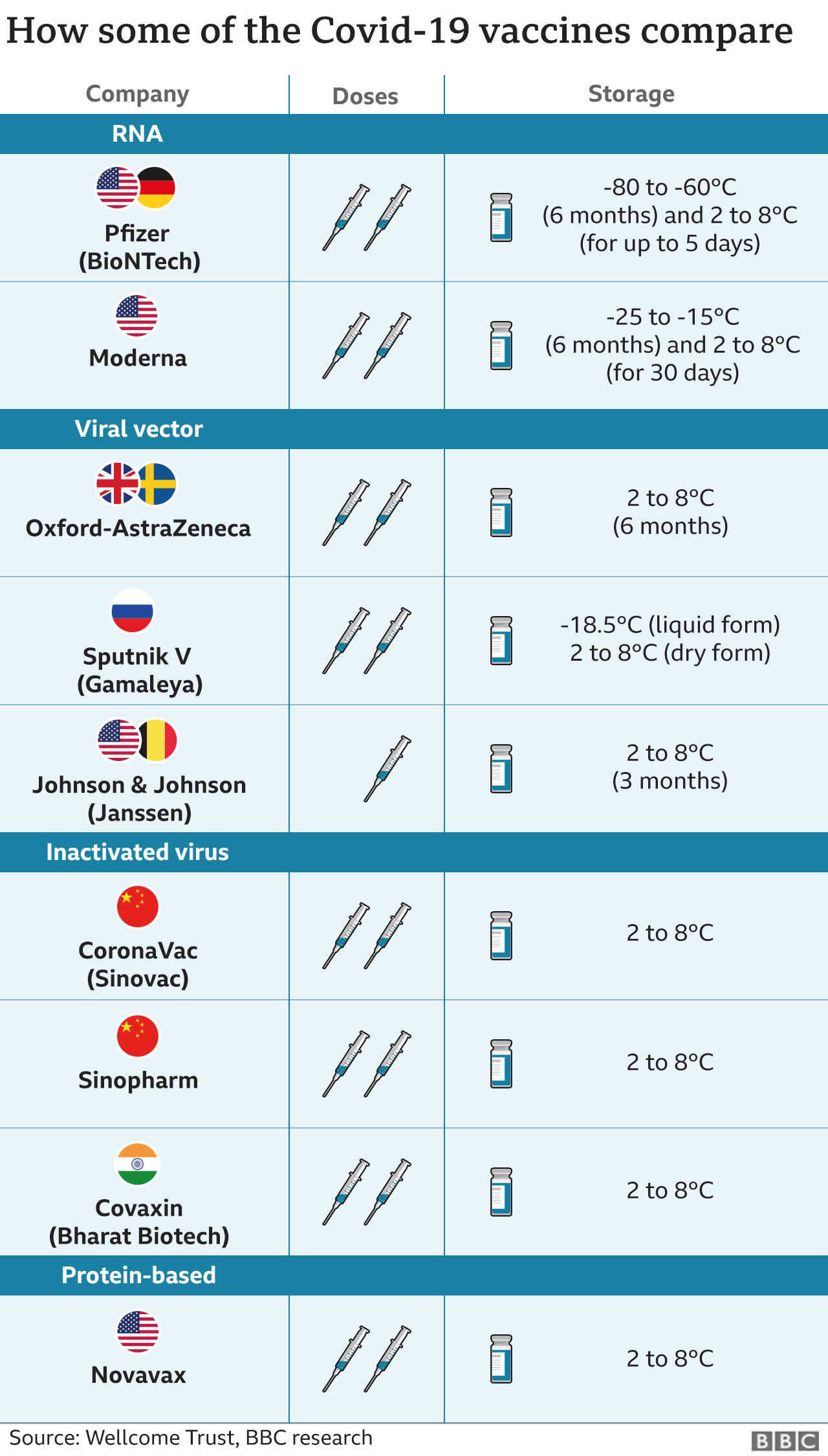
One significant advantage of the Chinese vaccines is that they can be stored in standard refrigerators at 2-8 degrees Celsius. Moderna's vaccine needs to be stored at -20C and Pfizer's vaccine at -70C.
The AstraZeneca vaccine though can also be stored at normal refrigerator temperatures.