The first drugs that do make a difference are now being identified.
What work is being done to find treatments?
More than 150 different drugs are being researched in different countries. Most are existing drugs that are being trialled against the virus.
- The UK is running the the world's largest clinical trial, called Recovery, with more than 12,000 patients taking part - it is one of the few trials to have given a definitive view on which drugs do and do not work
- The World Health Organization (WHO) is running the the Solidarity trial to assess promising treatments in countries around the world
- Multiple pharmaceutical companies are running trials of their own drugs
There are three broad approaches being investigated:
- Antiviral drugs that directly affect the coronavirus's ability to thrive inside the body
- Drugs that calm the immune system (severe Covid-19 is caused by patients' immune systems overreacting and damaging the body)
- Antibodies that can target the virus, taken from either survivors' blood plasma or made in a lab
It is possible that different drugs will work better at different stages - such as anti-virals at the beginning and immune drugs in late-stage diseases. Combinations of therapies will also be investigated.
The only life-saving drugs
Of all the drugs being trialled, only steroids have been proven to save lives and the discovery has been a a significant breakthrough in the fight against coronavirus.
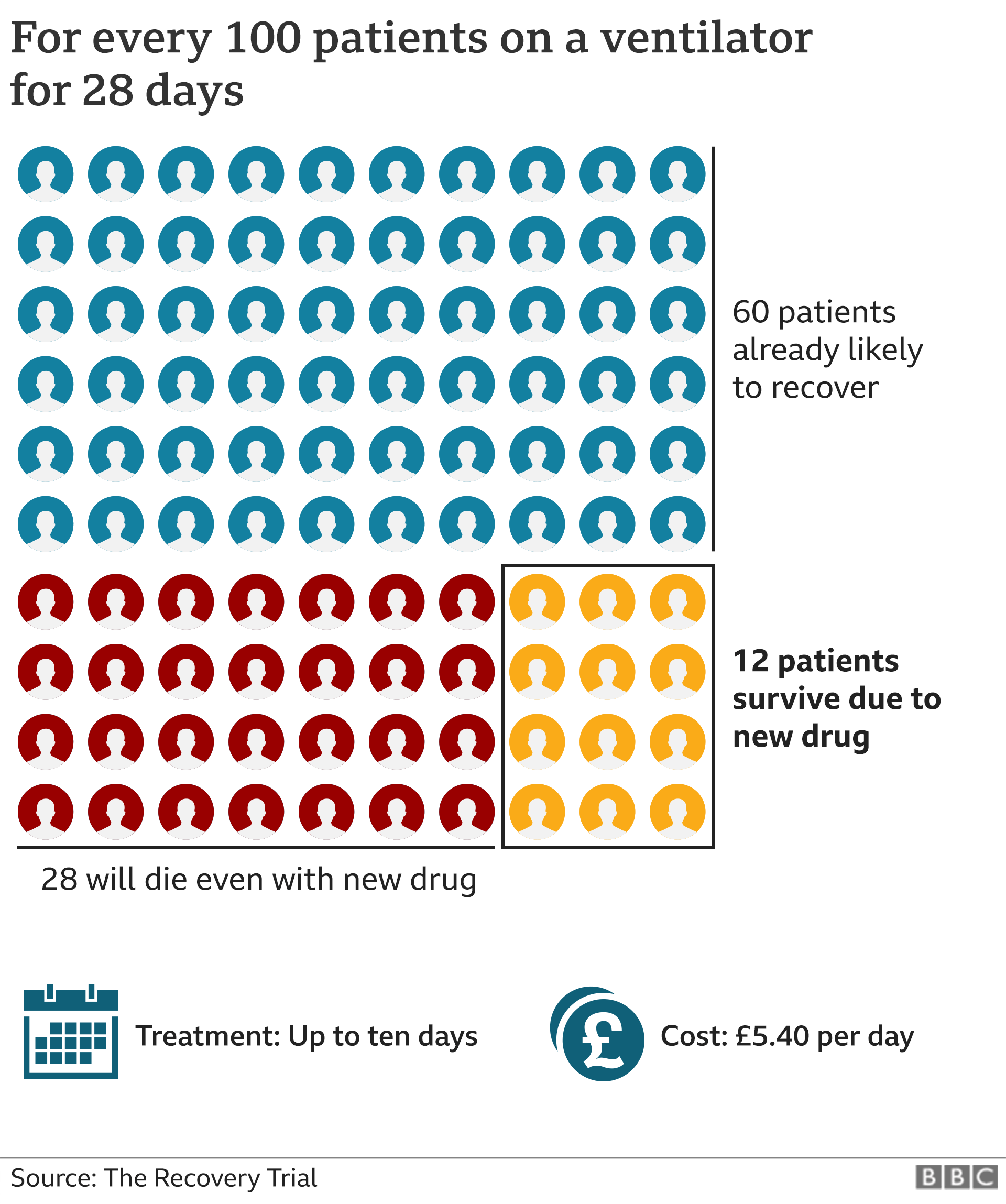
The UK's Recovery trial showed the steroid dexamethasone cut the risk of death by a third for patients on ventilators and by a fifth for those on oxygen.
And further data suggests another steroid, hydrocortisone, is equally effective too.
Both calm down inflammation (part of the immune response) in the body, which can become damaging in severe cases.
Crucially it is also cheap which means it could be used all around the world.
However, the drug does not work on people with milder symptoms.
What other drugs look promising?
Remdesivir is an antiviral drug that was originally developed to treat Ebola.
Clinical trials of more than 1,000 people found it cut the duration of symptoms from 15 days to 11. It has not been shown to save lives, although studies are still continuing.
However, the US has bought almost all of the supply, with the manufacturer Gilead also donating some to South Korea.
Interferon beta is a protein that the body normally makes to dampen down inflammation. It is used as a treatment for multiple sclerosis.
The UK company Synairgen is delivering the drug directly to Covid-19 patients' lungs using a nebuliser.
Initial findings suggest the treatment cut the odds of a patient in hospital developing severe disease, but larger clinical trials are now needed.

What do I need to know about the coronavirus?
- SOCIAL DISTANCING: What are the rules now?
- SUPPORT BUBBLES: What are they and who can be in yours?
- FACE MASKS: When do I need to wear one?
- SCHOOLS: What will happen if children catch coronavirus?
- TESTING: What tests are available?

Can HIV drugs treat coronavirus?
No.
A pair of drugs called lopinavir and ritonavir are antiviral drugs that stop HIV from replicating.
There has been much talk and even early laboratory studies hinting they could be effective against coronavirus too.
However, the UK's Recovery trial showed they were ineffective and the WHO has also pulled the drugs from their Solidarity trial.
Can malaria drugs stop coronavirus?
It's another no.
Chloroquine, and the related drug, hydroxychloroquine, may have antiviral and immune-calming properties.
The drugs were thrust into the spotlight as potential coronavirus therapies, largely because of claims made by President Trump, and because early laboratory tests showed they could inhibit the coronavirus.
However, the UK's Recovery trial found that hydroxychloroquine does not work as a treatment for Covid-19 and the WHO has stopped trialling the drug.
Can survivors' blood treat coronavirus?
People who survive an infection should have antibodies in their blood that can attack the virus.
Blood plasma (the part which contains the antibodies) can be extracted from those who have recovered and then given to sick patients as "convalescent plasma".
It is hoped transfusing seriously-ill patients with the plasma can give struggling immune systems a helping hand.
This therapy is now being tested in people in the UK and the US, among other countries. Two separate UK trials are currently running.
The US Food and Drug Administration (FDA) has given emergency authorisation for the use of plasma to treat coronavirus patients based on promising results from early trials - although some experts say it's too soon to know how effective the treatment is.
How long until we have a cure?
We may never get a "cure" for coronavirus. We don't have one for flu or the common cold or other similar infections.
However, there is now one treatment that works and others that look promising.
Doctors are testing drugs that have already been developed and are known to be safe enough to use, so more trial results can be expected relatively soon.
This contrasts with trials for vaccines (which protect against infection rather than treating it) where researchers are starting from scratch.
Some completely new experimental coronavirus drugs are also being tested in the laboratory, but are not yet ready for human tests.
Why do we need a treatment?
The most obvious reason for wanting a treatment is it will save lives, but it could also allow the lifting of restrictions such as lockdowns and social distancing.
Having an effective treatment would, in essence, make coronavirus a milder disease.
If it stopped people who were admitted to hospital from needing ventilation, then there would be less risk of intensive care units being overwhelmed, so controls on people's lives would not need to be as strict.
Follow James on Twitter
https://www.bbc.com/news/health-52354520
Treatment drugs recommended so far:
- FDA approves remdesivir despite doubts about effectiveness (23 Oct 2020)
- Covid: Remdesivir 'has little or no effect' on survival, says WHO (16 Oct 2020)
- Coronavirus cure: What progress are we making on treatments? (this article)
- Important Updates of COVID19 Treatment - MUST READ
- Coronavirus: what-drug-treatment-works
- Dexamethasone proves first life-saving drug - Coronavirus
- UK authorises anti-viral drug remdesivir - Coronavirus (see also articles above of 23 Oct and 16 Oct 2020)
- Ibuprofen tested as a treatment - Coronavirus
- Coronavirus: Protein treatment trial 'a breakthrough'
- Convalescent plasma therapy for severe SARS-CoV-2 - Graphic News
SEE ALSO: