The FDA Extends The Expiration Date On Johnson & Johnson's COVID Vaccine To 6 Months
July 28, 20218:06 PM ET
THE ASSOCIATED PRESS
Federal regulators have approved a longer shelf life for the Johnson & Johnson
COVID-19 vaccine. Damian Dovarganes/AP
WASHINGTON — Federal health regulators on Wednesday again extended the
expiration dates on Johnson & Johnson's COVID-19 vaccine, providing health
workers with six more weeks to use millions of doses of the shot.
The Food and Drug Administration said in a letter to J&J that the shots remain
safe and effective for at least six months when properly stored and refrigerated.
It's the second time the FDA has extended the shelf life on the vaccines since
June, when the agency said they could be used for up to 4 1/2 months. When
first authorized in February, the FDA said the vaccines could be stored for three
months at normal refrigeration levels.
Health authorities in many states had recently warned that they could be forced
to throw out thousands of doses of the one-shot vaccine without an extension.
The change gives health providers more time to use remaining shots sitting at
pharmacies, hospitals and clinics. After plateauing earlier this summer, vaccination
rates have begun climbing again as the contagious delta variant surges across
many parts of the country.
Vaccine expiration dates are based on information from drugmakers on how long
the shots stay at the right strength. J&J previously stated that it continues to
conduct stability testing with the aim of further extending the shelf life of the shots.
The FDA has been reviewing expiration dates on all three U.S.-authorized vaccines as companies have continued to test batches in the months since the shots first rolled out. Vaccines from Pfizer and Moderna, authorized in December, have a six-month shelf life.
J&J's vaccine was highly anticipated because of its one-and-done formulation and easy-to-ship refrigeration.
But rival drugmakers Pfizer and Moderna, which started shipping shots months earlier, have already supplied more than enough doses to vaccinate all eligible Americans. More than 150 million Americans have been fully vaccinated with the companies' two-dose shots. By comparison, just 13 million Americans have been vaccinated with the J&J shot.
That followed a pause in the use of the shot in April after it was linked to a rare blood clot disorder. In both cases, government health advisers said the overall benefits of the shot still greatly outweigh the risks.
Approval comes as cases surge around the world, putting pressure on governments to accelerate vaccination programmes.
1 May 2021
The WHO has given emergency use approval to Moderna's COVID-19 vaccine [File: Carlos Osorio/Reuters]
The World Health Organization has listed Moderna’s COVID-19 vaccine for emergency use, the agency said on Friday, the fifth jab to be given the status meant to expedite countries’ own approval of shots.
“The objective is to make medicines, vaccines and diagnostics available as rapidly as possible to address the emergency,” the WHO said in a statement.
WHO Assistant Director-General Mariangela Simao said on Friday it was important to have more vaccines available because of supply problems for other shots, including from India, a main source of vaccines for the global COVAX vaccine sharing programme.
India has restricted exports because of a crisis of infections at home that has overwhelmed the country’s health system.
Moderna announced this week an expansion plan for its production network to boost its capacity to up to three billion doses in 2022.
The WHO’s Strategic Advisory Group of Experts on Immunization (SAGE) had in January already recommended Moderna’s vaccine for all age groups 18 and above.
Pfizer and its German partner BionTech’s shot, an mRNA vaccine like Moderna’s, was the first vaccine to get a WHO emergency use listing in the final hours of 2020.
Since then, the WHO has added vaccines from AstraZeneca-SK Bio, Serum Institute of India and Johnson & Johnson vaccines to the list.
The UN health agency is still considering COVID-19 vaccines developed by Chinese manufacturers Sinopharm and Sinovac following an extended review, with decisions due by the end of next week.
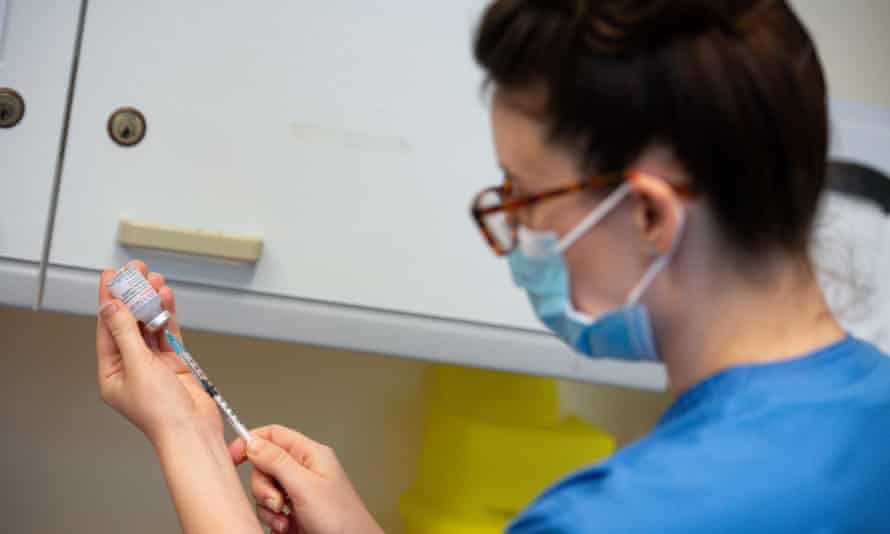
A nurse prepares a dose of the Moderna Covid-19 vaccine at West Wales general hospital in Carmarthen.Photograph: WPA/Getty Images
Vaccines to protect against the coronavirus were designed, tested and manufactured in record time, and several have been approved for use in the UK vaccination programme, with a number of others under consideration.
Pfizer/BioNTech
The vaccines taskforce secured 40m doses of the Pfizer/BioNTech vaccine, the first coronavirus shot to be approved by the medicines regulator. The NHS vaccine rollout began on 8 December 2020 when 90-year-old Margaret Keenan became the first person in the world to receive the jab as part of a mass vaccination programme. This is one of the cutting-edge mRNA vaccines that smuggles the genetic instructions for making the coronavirus spike protein into muscle cells. Coronavirus is covered in spike proteins, so making human cells manufacture it primes the immune system to attack the virus should it invade.
Oxford/AstraZeneca
With 100m doses on order, the Oxford/AstraZeneca vaccine is a major pillar of the national immunisation programme. The first shot outside trials was given on 4 January 2021. The vaccine is based on a virus that causes common colds in chimps. The virus is engineered to ensure it cannot replicate in humans and modified further to include the genetic instructions to make the coronavirus spike protein.
NIH/Moderna
The second mRNA vaccine to reach the market joined the country’s vaccination programme less than three weeks ago, on 7 April. The government has ordered 17m doses of the Moderna jab. In response to the very rare blood clots seen in some people who receive the Oxford/AstraZeneca vaccine, people under 30 in the UK are offered Moderna or Pfizer shots instead.
Novavax
The UK medicines regulator is expected to approve the Novavax vaccine imminently. It is known as a protein subunit vaccine and incorporates a lab-made coronavirus spike protein and an ingredient called an adjuvant that makes the body’s immune response stronger. The UK has ordered 60m doses. While Novavax is a US company, supplies for the mass vaccination programme will be made in Stockton-on-Tees with the final “fill and finish” step at GlaxoSmithKline’s plant in Barnard Castle, County Durham.
Covid-19 in the UK
Mar
Daily cases
1,907
-154 vs last week
Daily deaths
7
Total deaths
127,524
Vaccination rollout
Dec
Daily vaccinations
535,113
-65,688 vs last week
Received 1st dose
51.4%
Received 2nd dose
22.4%
Cases and deaths as published 1 May 2021, vaccinations as published 30 Apr 2021. Daily vaccinations includes both doses, % is of total population. Weekly change shows difference from 7 days ago. Source: data.gov.uk.
Janssen/Johnson & Johnson
The UK medicines regulator is conducting a rolling review of the Janssen vaccine, which is based on similar “viral vector” technology to the Oxford/AstraZeneca shot. US health officials lifted a short pause in administering the Janssen vaccine on Saturday after deciding that the benefits outweighed the low risk of blood clots that resemble those seen in small numbers of people who received the Oxford/AstraZeneca shot. A major advantage of the Janssen vaccine is that it requires only one dose while the others need two. The UK vaccines taskforce has ordered 30m doses.
Others
If it performs well in final stage trials, Valneva’s vaccine, which uses an inactivated whole virus and an adjuvant to strengthen the immune response, could be approved for use as a booster this autumn. The government has secured up to 100m doses. Further orders are in for 60m doses of a GSK/Sanofi vaccine and 50m doses of another mRNA vaccine from the German company CureVac. Both are still in trials.