Pages

Showing posts with label CureVac. Show all posts

Sunday, 19 December 2021

The mRNA Vaccines Are Extraordinary, but Novavax Is Even Better

 Persistent hype around mRNA vaccine technology is now distracting us from other ways to end the pandemic.

At the end of January, reports that yet another COVID-19 vaccine had succeeded in its clinical trials—this one offering about 70 percent protection—were front-page news in the United States, and occasioned push alerts on millions of phones. But when the Maryland-based biotech firm Novavax announced its latest stunning trial results last week, and an efficacy rate of more than 90 percent even against coronavirus variants, the response from the same media outlets was muted in comparison. The difference, of course, was the timing: With three vaccines already authorized for emergency use by the U.S. Food and Drug Administration, the nation is “awash in other shots” already, as the The New York Times put it.

Practically speaking, this is true. If the FDA sees no urgency, the Novavax vaccine might not be available in the U.S. for months, and in the meantime the national supply of other doses exceeds demand. But the asymmetry in coverage also hints at how the hype around the early-bird vaccines from Pfizer and Moderna has distorted perception. Their rapid arrival has been described in this magazine as “the triumph of mRNA”—a brand-new vaccine technology whose “potential stretches far beyond this pandemic.” Other outlets gushed about “a turning point in the long history of vaccines,” one that “changed biotech forever.” It was easy to assume, based on all this reporting, that mRNA vaccines had already proved to be the most effective ones you could get—that they were better, sleeker, even cooler than any other vaccines could ever be.

But the fascination with the newest, shiniest options obscured some basic facts. These two particular mRNA vaccines may have been the first to get results from Phase 3 clinical trials, but that’s because of superior trial management, not secret vaccine sauce. For now, they are harder and more expensive to manufacture and distribute than traditional types of vaccines, and their side effects are more common and more severe. The latest Novavax data confirm that it’s possible to achieve the same efficacy against COVID-19 with a more familiar technology that more people may be inclined to trust. (The mRNA vaccines delivered efficacy rates of 95 and 94 percent against the original coronavirus strain in Phase 3 trials, as compared with 96 percent for Novavax in its first trial, and now 90 percent against a mixture of variants.

Pandemic-vaccine success, as I wrote last year, was never just about the technology. You needed a good vaccine, sure—but to get it out the door quickly, you also had to have a massive clinical-trial operation going, and it had to be situated in places where the virus would be spreading widely at just the right time. Even if your candidate worked amazingly well, if you weren’t testing it in the middle of a huge outbreak, you’d have to wait a very long time for the evidence to build.

The precise timing of these studies mattered a great deal in practice. The Phase 3 clinical trials for Pfizer and Moderna, for example, were up and running in the U.S. by late summer 2020, and so they caught the nation’s giant wave of infections in the fall. By the time Novavax had finished recruiting in the U.S. and Mexico, in February, case rates had been dropping precipitously. This fact alone, independent of any aspect of vaccine technology, did a lot to shape the outcome.

Corporate strategy was another crucial factor. To “win” the vaccine race, a company would need to be able to produce high-quality vaccine doses reliably and quickly, and in vast numbers. It would also need to field the challenges of working with multiple regulatory agencies around the world. And it would need to do all of this at the same time.

BioNTech, the German company that developed the Pfizer mRNA vaccine, could not have accomplished so much, so quickly by itself. Last October, the company’s CEO, Uğur Şahin, told German interviewers that BioNTech had sought out Pfizer for help because of the scale of the clinical-trial program necessary for drug approvals. That strategic partnership, and not simply the “triumph of mRNA,” was what propelled them past the post. (Moderna had the advantage of its partnership with the National Institutes of Health.) Consider this: The BioNTech-Pfizer first-in-human vaccine study appeared on the U.S. government’s registry of clinical trials on April 30, 2020—the same day as the first-in-human vaccine study for Novavax, which would be going it alone. In a parallel universe where Novavax had paired up with, say, Merck, this story could have come out very differently.

In the meantime, the early success of two mRNA vaccines pulled attention away from the slower progress of other candidates based on the same technology. Just two days after last week’s Novavax announcement came the news that an mRNA vaccine developed by the German company CureVac had delivered a weak early efficacy rate in a Phase 3 trial, landing below even the 50 percent minimum level set by the World Health Organization and the FDA. “The results caught scientists by surprise,” The New York Times reported. CureVac is the company that President Donald Trump reportedly tried to lure to the U.S. early in the pandemic, and the one that Elon Musk said he would supply with automated “RNA microfactories” for vaccine production. In the end, none of this mattered. CureVac’s mRNA vaccine just doesn’t seem to be good enough.

The “sobering” struggles of CureVac perfectly illustrate what epidemiologists call “survivor bias”—a tendency to look only at positive examples and draw sweeping conclusions on their basis. When the Pfizer and Moderna vaccines triumphed, The Washington Post suggested that a bet on “speedy but risky” mRNA technology had paid off with a paradigm-shifting breakthrough. Anthony Fauci called the gamble “a spectacular success.” Such analyses usually had less to say about the non-mRNA vaccines that had gotten into clinical trials just as quickly—and about the other mRNA vaccines that were hitting snags along the way.

Now we’ve seen what happened to CureVac, and that some mRNA formulations clearly work much better than others. By one count, nine groups were testing mRNA COVID-19 vaccines in animal studies as of May 2020, and six were expected to be in clinical trials a few months later. By the end of the year, only BioNTech-Pfizer, Moderna, and CureVac had reached Phase 3 testing, compared with 13 non-mRNA vaccines. Of the nine mRNA-vaccine candidates that were already testing in animals in mid-2020, just two have proved efficacy at this point, while no fewer than nine vaccines based on more traditional technologies have reached the same mark.

These other, non-mRNA vaccines have been widely used throughout the world—and some could still make an important difference in the U.S. Although the U.S. has plenty of doses of the Pfizer and Moderna vaccines available right now, demand for them has cratered. The Washington Post reports that in 10 states, fewer than 35 percent of American adults have been vaccinated. An international study of COVID-19 vaccine misinformation, published in May, found that among the most common online rumors were those alleging particular dangers of mRNA technology—that it leads, for example, to the creation of “genetically modified human beings.” The CDC has also made a point of debunking the circulating falsehood that COVID-19 vaccines can change your DNA. For a time, it looked as though the Johnson & Johnson vaccine would help address this worry. It’s based on a fairly new technology, but not as new as mRNA. However, concerns about tainted doses made at a Baltimore factory and the emergence of a very rare but serious side effect have pretty much dashed that hope. The Johnson & Johnson single-dose vaccine has reportedly accounted for fewer than 4 percent of doses administered in the country.

In this context, the success of the Novavax vaccine should be A1 news. The recent results confirm that it has roughly the same efficacy as the two authorized mRNA vaccines, with the added benefit of being based on an older, more familiar science. The protein-subunit approach used by Novavax was first implemented for the hepatitis B vaccine, which has been used in the U.S. since 1986. The pertussis vaccine, which is required for almost all children in U.S. public schools, is also made this way. Some of those people who have been wary of getting the mRNA vaccines may find Novavax more appealing.

The Novavax vaccine also has a substantially lower rate of side effects than the authorized mRNA vaccines. Last week’s data showed that about 40 percent of people who receive Novavax report fatigue after the second dose, as compared with 65 percent for Moderna and more than 55 percent for Pfizer. Based on the results of Novavax’s first efficacy trial in the U.K., side effects (including but not limited to fatigue) aren’t just less frequent; they’re milder too. That’s a very big deal for people on hourly wages, who already bear a disproportionate risk of getting COVID-19, and who have been less likely to get vaccinated in part because of the risk of losing days of work to post-vaccine fever, pain, or malaise. Side effects are a big barrier for COVID-vaccine acceptance. The CDC reported on Monday that, according to a survey conducted in the spring, only about half of adults under the age of 40 have gotten the vaccine or definitely intend to do so, and that, among the rest, 56 percent say they are concerned about side effects. Lower rates of adverse events are likely to be a bigger issue still for parents, when considering vaccination for their children.

Don’t get me wrong—the Pfizer and Moderna vaccines have been extraordinary lifesavers in this pandemic, and we may well be heading into a new golden age of vaccine development. (This week, BioNTech started injections in an early trial for an mRNA vaccine for melanoma.) But even the best experts at predicting which drugs are going to be important get things wrong quite a bit, overestimating some treatments and underestimating others. Pharmaceuticals are generally a gamble.

But here’s what we know today, based on information that we have right now:  Among several wonderful options, the more old-school vaccine from Novavax combines ease of manufacture with high efficacy and lower side effects. For the moment, it’s the best COVID-19 vaccine we have.

The Atlantic’s COVID-19 coverage is supported by grants from the Chan Zuckerberg Initiative and the Robert Wood Johnson Foundation.

Hilda Bastian is a scientist, writer, and founding member of the Cochrane Collaboration. She was formerly the editor of the PubMed Health project at the National Library of Medicine.

Source

Tuesday, 22 June 2021

What went wrong with CureVac’s highly anticipated new mRNA vaccine for COVID-19?

 The startlingly poor performance revealed this week for a COVID-19 vaccine made by the German company CureVac isn’t just a disappointment, it’s a scientific puzzle. The company blames the rapidly changing pandemic virus. But several outside researchers suspect the vaccine’s design is at fault.

By Jon Cohen

Peter Kremsner of University Hospital Tübingen injects a participant in CureVacs efficacy study with the companys COVID-19 vaccine candidate or a placebo.

 
KAI PFAFFENBACH/REUTERS


Many scientists and investors alike had expected CureVac’s candidate, which uses messenger RNA (mRNA) to code for the spike surface protein of SARS-CoV-2, had a good chance of becoming one of the most powerful new weapons against the pandemic. It relies on essentially the same novel mRNA technology as vaccines from the Pfizer-BioNTech collaboration and Moderna, which had more than 90% efficacy in their trials, and it holds some practical transportation and storage advantages over those rival shots.

But preliminary data released Wednesday evening and discussed on a call with investors yesterday suggest the efficacy of the CureVac vaccine is a lackluster 47%—low enough that, if further data are equally disappointing, health regulators likely won’t authorize it for emergency use.

The efficacy trial enrolled some 40,000 people, about 75% in Latin America and 25% in Europe. The topline finding came from an interim analysis evaluating 134 participants who developed at least one COVID-19 symptom. Although the company did not give a breakdown, the reported 47% efficacy translates to roughly 88 cases in the placebo group and 46 among the vaccinated. “The results are sobering,” said Franz-Werner Haas, CureVac’s CEO.

He stressed that the many SARS-CoV-2 variants now in circulation may explain the disappointing results. The vaccine’s mRNA was designed for a version of spike that was dominant among viruses early in the pandemic but has evolved through multiple mutations. “We are virtually fighting a different virus, different pandemic over the last 6 months,” Haas said.

The trial scientists sequenced the virus in 124 participants who got sick and found 13 different variants. Only 1% of the infected people had a SARS-CoV-2 whose spike matched the mRNA used in the vaccine. “Demonstrating high efficacy in this unprecedented broad diversity of variants is quite challenging,” Haas said.

Other efficacy trials have found that certain mutant strains of the coronavirus can compromise the ability of COVID-19 vaccines to protect against mild disease, but the variant that has most powerfully undermined other vaccines, Beta, was not seen in the CureVac study. In contrast, Alpha, first seen in the United Kingdom and one of the earliest variants of concern, caused 41% of the 124 cases overall and 91% of the 44 cases that occurred in Europe.

Kathleen Neuzil of the University of Maryland School of Medicine doubts variants fully explain the poor performance of CureVac’s vaccine. Unlike CureVac’s mRNA shot, she says, the Pfizer-BioNTech and Moderna vaccines “work very well against Alpha.” She cautions that it’s difficult to compare trials of different vaccines, but says, “It’s just hard for me to believe that the variants could have this degree of effect.”

CureVac did not provide any data about how many of the infected in its efficacy trial developed severe disease. Other vaccines continue to prevent most hospitalizations and deaths even when variants reduce their protection against mild COVID-19.

Some scientists trying to make sense of the CureVac result point to an earlier, phase 1 study of the vaccine. It showed that serum levels of so-called neutralizing antibodies, which prevent the virus from binding to cells, were relatively low in vaccine recipients compared with people who naturally became infected with the coronavirus. “It’s certainly a good possibility that the vaccine is just not immunogenic enough,” says John Moore, an immunologist at Weill Cornell Medicine who specializes in analyzing neutralizing antibodies.

The type of mRNA used by CureVac may undermine antibody formation, contends Drew Weissman of the University of Pennsylvania’s Perelman School of Medicine, who helped pioneer certain mRNA modifications used in the Pfizer-BioNTech and Moderna vaccines. (Those companies license the technology, which may financially benefit the university and Weissman.) CureVac’s vaccine used an unmodified form of mRNA. When natural mRNA is injected into the body, it triggers the production of interferons, signaling molecules that can rev up the immune system. CureVac touted that as an advantage of its formulation. But Weissman notes interferons can also block the generation of T helper cells that, in turn, direct B cells to make antibodies.

Pfizer and BioNTech and Moderna, in contrast, chemically altered the uracils, one of the four nucleotides that make up RNA, in their spike-encoding sequences. Weissman’s group had shown in 2018 that uracil-modified mRNA triggered potent neutralizing antibodies and other protective immune responses in animal models. He notes that a BioNTech study comparing modified and natural mRNA vaccines also found that the modifications boosted the antibody response.

Peter Kremsner of University Hospital Tübingen, who helped run the CureVac study, suggests another factor: too low a dose of vaccine. “I am uncertain what it was finally, natural uracil or only dose or both,” he says. Kremsner helped conduct CureVac’s phase 1 study, which compared the safety and immune responses generated by doses between 2 and 20 micrograms. The study revealed the company should not use the higher doses “because of intolerability, perhaps due to natural uracil?” he says. (Kremsner says he hopes to publish his work soon, but a preprint with some of the study’s data has already been posted.) CureVac settled on 12 micrograms, a dose that balanced the best safety profile with the highest level of neutralizing antibodies. (The Pfizer-BioNTech vaccine uses a 30-microgram dose and Moderna’s is 100 micrograms.)

Other data presented at yesterday’s press conference suggest, however, that the design of the vaccine is more important than the dose. CureVac reported data from a monkey study that compared its current vaccine to a next-generation version, which is more stable inside of cells and made in collaboration with the pharmaceutical giant GlaxoSmithKline: The new candidate produced higher levels of the spike protein, triggering a 10-fold higher level of neutralizing antibodies. Dose-ranging studies of the Pfizer and Moderna vaccines have also found that higher mRNA doses offer relatively modest gains in antibody levels.

Still, CureVac says it must wait for the final analysis of the current efficacy trial, expected to include more than 200 COVID-19 cases, before it makes a “strategic shift” to the second-generation vaccine. “For now, we are going full speed exactly where we are,” Haas said. “We are expecting the data to come within the next 3 weeks.”

https://www.sciencemag.org/news/2021/06/what-went-wrong-curevac-s-highly-anticipated-new-mrna-vaccine-covid-19

Sunday, 2 May 2021

26 Apr 21 UK Covid vaccines and ones in the works

What Covid vaccines does the UK have and which are in the works?

As Valneva recruits volunteers for final stage trials of its vaccine, here is the current state of play in Britain

 Science editor
Mon 26 Apr 2021 00.01 BST
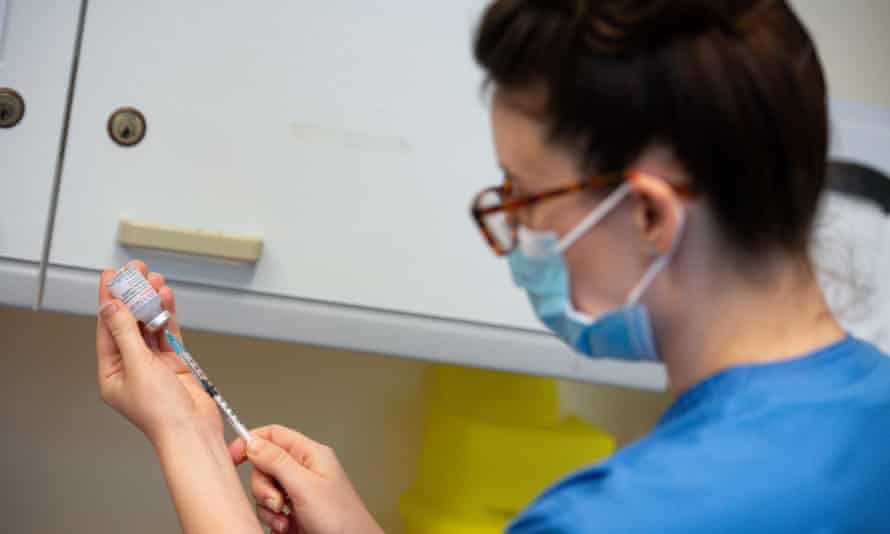
A nurse prepares a dose of the Moderna Covid-19 vaccine at West Wales general hospital in Carmarthen

A nurse prepares a dose of the Moderna Covid-19 vaccine at West Wales general hospital in Carmarthen. Photograph: WPA/Getty Images

Vaccines to protect against the coronavirus were designed, tested and manufactured in record time, and several have been approved for use in the UK vaccination programme, with a number of others under consideration.

Pfizer/BioNTech

The vaccines taskforce secured 40m doses of the Pfizer/BioNTech vaccine, the first coronavirus shot to be approved by the medicines regulator. The NHS vaccine rollout began on 8 December 2020 when 90-year-old Margaret Keenan became the first person in the world to receive the jab as part of a mass vaccination programme. This is one of the cutting-edge mRNA vaccines that smuggles the genetic instructions for making the coronavirus spike protein into muscle cells. Coronavirus is covered in spike proteins, so making human cells manufacture it primes the immune system to attack the virus should it invade.

Oxford/AstraZeneca

With 100m doses on order, the Oxford/AstraZeneca vaccine is a major pillar of the national immunisation programme. The first shot outside trials was given on 4 January 2021. The vaccine is based on a virus that causes common colds in chimps. The virus is engineered to ensure it cannot replicate in humans and modified further to include the genetic instructions to make the coronavirus spike protein.

NIH/Moderna

The second mRNA vaccine to reach the market joined the country’s vaccination programme less than three weeks ago, on 7 April. The government has ordered 17m doses of the Moderna jab. In response to the very rare blood clots seen in some people who receive the Oxford/AstraZeneca vaccine, people under 30 in the UK are offered Moderna or Pfizer shots instead.

Novavax

The UK medicines regulator is expected to approve the Novavax vaccine imminently. It is known as a protein subunit vaccine and incorporates a lab-made coronavirus spike protein and an ingredient called an adjuvant that makes the body’s immune response stronger. The UK has ordered 60m doses. While Novavax is a US company, supplies for the mass vaccination programme will be made in Stockton-on-Tees with the final “fill and finish” step at GlaxoSmithKline’s plant in Barnard Castle, County Durham.

Covid-19 in the UK
Mar
Daily cases
1,907
-154  vs last week
Daily deaths
7
Total deaths
127,524
Vaccination rollout
Dec
Daily vaccinations
535,113
-65,688  vs last week
Received 1st dose
51.4%
Received 2nd dose
22.4%
Cases and deaths as published 1 May 2021, vaccinations as published 30 Apr 2021. Daily vaccinations includes both doses, % is of total population. Weekly change shows difference from 7 days ago. Source: data.gov.uk.

Janssen/Johnson & Johnson

The UK medicines regulator is conducting a rolling review of the Janssen vaccine, which is based on similar “viral vector” technology to the Oxford/AstraZeneca shot. US health officials lifted a short pause in administering the Janssen vaccine on Saturday after deciding that the benefits outweighed the low risk of blood clots that resemble those seen in small numbers of people who received the Oxford/AstraZeneca shot. A major advantage of the Janssen vaccine is that it requires only one dose while the others need two. The UK vaccines taskforce has ordered 30m doses.

Others

If it performs well in final stage trials, Valneva’s vaccine, which uses an inactivated whole virus and an adjuvant to strengthen the immune response, could be approved for use as a booster this autumn. The government has secured up to 100m doses. Further orders are in for 60m doses of a GSK/Sanofi vaccine and 50m doses of another mRNA vaccine from the German company CureVac. Both are still in trials.

https://www.theguardian.com/society/2021/apr/26/what-covid-vaccines-does-uk-have-valneva