Pages

Saturday, 2 June 2018

'Holy grail of cancer research': doctors positive about early detection blood test

Blood tests called liquid biopsies show signs of finding 10 different types of cancer at an early stage


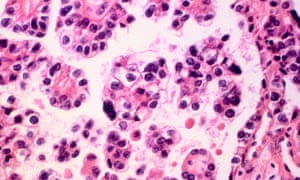
Ovarian cancer cells

 Ovarian cancer cells. Researchers hope the tests for cancer cells will become part of a ‘universal screening’ tool. Photograph: Media for Medical/UIG via Getty Images

A blood test for 10 different types of cancers could one day help doctors screen for the disease before patients show symptoms, researchers at the world’s largest gathering of oncologists have said.
The test, called a liquid biopsy, screens for cancer by detecting tiny bits of DNA released by cancer cells into blood. The test had particularly good results for ovarian and pancreatic cancers, though the number of cancers detected was small.
Researchers hope the test will become part of a “universal screening” tool that doctors can use to detect cancer in patients.
“This is potentially the holy grail of cancer research, to find cancers that are currently hard to cure at an earlier stage when they are easier to cure,” said Dr Eric Klein, lead author of the research from Cleveland Clinic’s Taussig Cancer Institute. “We hope this test could save many lives.”
The study, by a research team that also included scientists from Stanford University, was presented at the annual conference of the American Society of Clinical Oncologists in Chicago.
Simon Stevens, the chief executive of NHS England, said “new techniques” such as cancer blood tests could “unlock enormous survival gains, as well as dramatic productivity benefits in the practice of medicine”.
“Now, as the NHS marks its 70th anniversary, we stand on the cusp of a new era of personalised medicine that will dramatically transform care for cancer and for inherited and rare diseases,” said Stevens.
The research scrutinised the cases of more than 1,600 people, 749 of whom were cancer-free at the time of the study, with no diagnosis, and 878 of whom had been newly diagnosed with a disease.
The test was most accurate for diagnosing pancreatic, ovarian, liver and gallbladder cancers, correctly finding the diseases in at least four out of five patients.
The blood test found lymphoma and myeloma with slightly less accuracy, at 77% and 73%, and bowel cancer in two out of three patients. Lung cancerwas detected in 59% of patients. Head and neck cancer was detected in 56% of patients.
Researchers said their results showed promise in the approach of blood screenings for cancer, but noted further “clinical development” was needed.
The number of patients in whom cancers were detected was small. For example, although the test detected ovarian cancer with 90% accuracy, only 10 ovarian cancers in total were detected.
Nevertheless, researchers aim to develop a tool that could be used by for all people regardless of their family history. “Potentially this test could be used for everybody,” said Klein.
Prof Nicholas Turner from the Institute of Cancer Research in London described the findings as really exciting and as a possible universal screening tool. “Far too many cancers are picked up too late, when it is no longer possible to operate and the chances of survival are slim,” he said. “The goal is to develop a blood test, such as this one, that can accurately identify cancers in their earliest stages.”
Klein added: “It is several steps away and more research is needed, but it could be given to healthy adults of a certain age, such as those over 40, to see if they have early signs of cancer.”

https://www.theguardian.com/society/2018/jun/01/doctors-welcome-possible-holy-grail-of-cancer-research

Friday, 1 June 2018

‘Holy grail’ of blood tests can detect 10 types of cancer

Doctors could soon be able to detect 10 different types of cancer using a simple blood test.
The “holy grail” of cancer tests could pave the way for a universal screening program that could save tens of thousands of lives each year.

‘Holy grail’ of blood tests can detect 10 types of cancer
Experts say the simple check allows early diagnosis when survival chances are higher.
It works by pinpointing DNA that has broken free of a tumor.
The test was administered on 749 cancer-free patients and 878 with newly diagnosed but untreated cancer.
It can currently detect ovarian, pancreatic, liver, lymphoma, multiple myeloma, colorectal, esophageal, lung, head and neck, and breast cancers, but it works best for ovarian and pancreatic forms of the disease.
The “comprehensive” test identified 90 percent of ovarian cancers and 80 percent of pancreatic and liver cancers.
It picked out four in five liver tumors, 58 percent of breast cancers and 59 percent of lung cancers.
Experts say it could be available in hospitals within a few years and is likely to cost between $660 and $1,300 each time.
Study leader Dr. Eric Klein from the Cleveland Clinic, said: “This blood test detected multiple cancers at various stages with high specificity, indicating this approach is promising as a multi-cancer screening test.
“It gives us the opportunity to find cancers months or years before someone would develop symptoms and be diagnosed.
“It is potentially the Holy Grail of cancer research – to find cancers that are currently hard to cure at an earlier stage when they are easier to cure.
“This test could be used for everybody, regardless of their family history.
“More research is needed but it could be given to healthy adults of a certain age, such as those over 40, to see if they have early signs of cancer.”
Professor Nicholas Turner, from the Institute of Cancer Research, London, described the findings as “really exciting.”
“Far too many cancers are picked up too late, when it is no longer possible to operate and the chances of survival and slim,” he said.
“The goal is to develop a blood test, such as this one, that can accurately identify cancers in their earliest stages.
“This particular test is really exciting but it is likely to be a few years before it is ready for clinical use.
“When this test, or another like it, are ready for clinical use, it could be used as part of a universal screening program, with the potential to save many lives.”
Fiona Osgun, from Cancer Research UK, added: “The idea that we could one day offer people a blood test that could find cancer earlier is certainly exciting.
“Detecting cancer early, before it has spread is one of the most powerful ways to ensure more people are offered treatments which give them a better chance of beating the disease.”
Simon Stevens, chief executive of the National Health Service in England, said: “We stand on the cusp of a new era of personalized medicine that will dramatically transform care for cancer and for inherited and rare diseases.
“In particular, new techniques for precision early diagnosis would unlock enormous survival gains, as well as dramatic productivity benefits in the practice of medicine.”
The findings were presented at the annual conference of the American Society of Clinical Oncology in Chicago.

https://nypost.com/2018/06/01/holy-grail-of-blood-tests-can-detect-10-types-of-cancer/

Thursday, 31 May 2018

The rise and fall of Elizabeth Holmes ...

The rise and fall of Elizabeth Holmes, who started Theranos when she was 19 and became the world's youngest female billionaire before it all came crashing down


 14/05/2018


Slide 1 of 30:  These days, blood-testing startup Theranos is on its last legs.  But in 2014, the billion-dollar company and its CEO, Elizabeth Holmes, were on top of the world. Back then, Theranos was a revolutionary idea thought up by a woman hailed as a genius who styled herself as a female Steve Jobs. Holmes was the world's youngest female self-made billionaire, and Theranos was one Silicon Valley's unicorn startups.  Then it all came crashing down. The shortcomings and inaccuracies of Theranos's technology were exposed, along with the role Holmes played in covering it all up. Theranos and Holmes were charged with massive fraud, and the company was forced to close its labs and testing centers.  This is how Holmes went from precocious child to ambitious Stanford dropout to embattled startup CEO.

These days, blood-testing startup Theranos is on its last legs.
But in 2014, the billion-dollar company and its CEO, Elizabeth Holmes, were on top of the world. Back then, Theranos was a revolutionary idea thought up by a woman hailed as a genius who styled herself as a female Steve Jobs. Holmes was the world's youngest female self-made billionaire, and Theranos was one Silicon Valley's unicorn startups.
Then it all came crashing down.
The shortcomings and inaccuracies of Theranos's technology were exposed, along with the role Holmes played in covering it all up. Theranos and Holmes were charged with massive fraud, and the company was forced to close its labs and testing centers.
This is how Holmes went from precocious child to ambitious Stanford dropout to embattled startup CEO.


Slide 2 of 30: Source: Elizabeth Holmes/Twitter, CNN, Vanity Fair

Elizabeth Holmes was born on February 3, 1984 in Washington, D.C. Her mom, Noel, was a Congressional committee staffer, and her dad, Christian Holmes, worked for Enron before moving to government agencies like USAID.


Holmes' family moved when she was young, from Washington, D.C. to Houston.

Slide 4 of 30: Source: CBS News

At the age of 9, Holmes wrote a letter to her father: "What I really want out of life is to discover something new, something that mankind didn't know was possible to do."

When she was a teenager, Holmes started her own business: she sold C++ compilers, a type of software that translates computer code, to Chinese schools.

Slide 6 of 30: Source: San Francisco Business Times

Holmes was inspired by her great-great-grandfather Christian Holmes, a surgeon, to go into medicine, but she discovered she was terrified of needles. Later, this would influence her to start Theranos.

Holmes went to Stanford to study chemical engineering. When she was a freshman, she became a "president's scholar," an honor which came with a $3,000 stipend to go toward a research project.

Holmes spent the summer after her freshman year interning at the Genome Institute in Singapore. She got the job partly because she spoke Mandarin, which she learned as a teenager.

Slide 9 of 30: Source: Fortune, Wired

As a sophomore, Holmes went to one of her professors, Channing Robertson, and said: "Let's start a company." With his blessing, she founded Real-Time Cures, later changing the company's name to Theranos.

Holmes soon filed a patent application for "Medical device for analyte monitoring and drug delivery," a wearable device that would administer medication, monitor patients' blood, and adjust the dosage as needed.

Slide 11 of 30: Source: Wall Street Journal

By the next semester, Holmes had dropped out of Stanford altogether, working on Theranos in the basement of a college house.

Slide 12 of 30: Source: Wall Street Journal

Theranos's business model was based around the idea that it ran blood tests using proprietary technology that required only pinprick in your finger and a small amount of blood. Holmes said the tests would be able to detect medical conditions like cancer and high cholesterol.

Slide 13 of 30: Source: SEC, Crunchbase

Holmes started raising venture capital money for Theranos from prominent investors like Draper Fisher Jurvetson and Larry Ellison. To date, Theranos has raised more than $700 million.

Holmes took investors' money on the condition that she wouldn't have to reveal how Theranos' technology worked. Plus, she would have final say over everything having to do with the company.

That obsession with secrecy extended to every aspect of Theranos. For the first decade Holmes spent building her company, Theranos operated in stealth mode. She even took three former Theranos employees to court, claiming they had misused Theranos trade secrets.

Holmes' attitude toward secrecy was borrowed from a Silicon Valley hero of hers: Steve Jobs. Holmes started wearing black turtlenecks like Jobs, decorated her office with his favorite furniture, and like Jobs, never took vacations.

Even Holmes's uncharacteristically deep voice may have been part of a carefully crafted image intended to help her fit in in the male-dominated business world.

Slide 18 of 30: Source: STAT News, Bad Blood: Secrets and Lies in a Silicon Valley Startup

Shortly after Holmes dropped out of Stanford at age 19, she had been dating Theranos president and COO Sunny Balwani, who was 20 years her senior. The pair broke up in spring 2016 when Holmes pushed him out of the company.

Slide 19 of 30: Source: Vanity Fair

As Theranos started to rake in millions of funding, Holmes became the subject of media attention and acclaim in the tech world. She graced the covers of Fortune and Forbes, gave a TED Talk, and spoke on panels with Bill Clinton and Alibaba's Jack Ma.

Slide 20 of 30: Source: Wired,Business Insider

Theranos quickly began securing outside partnerships. Capital Blue Cross and Cleveland Clinic signed on to offer Theranos tests to their patients, and Walgreens made a deal to open Theranos testing centers. Theranos also formed a secret partnership with Safeway worth $350 million.

Slide 21 of 30: Source: Forbes

At one point, Holmes was the world's youngest self-made female billionaire with a net-worth of around $4.5 billion.

Slide 22 of 30: Source: Vanity Fair,Business Insider

Around the same time, questions were being raised about Theranos's technology. Ian Gibbons — chief scientist at Theranos and one of the company's first hires — warned Holmes that the tests weren't ready for the public to take, and that there were inaccuracies in the technology. Outside scientists began voicing their concerns about Theranos, too.

Slide 23 of 30: Source: Vanity Fair

By August 2015, the FDA began investigating Theranos, and regulators from the government body that oversees laboratories found "major inaccuracies" in the testing Theranos was doing on patients.

By October 2015, Wall Street Journal reporter John Carreyrou published his investigation into Theranos's struggles with its technology. Carreyrou's reporting sparked the beginning of the company's downward spiral.

Carreyrou found that Theranos' blood-testing machine, named Edison, couldn't give accurate results, so Theranos was running its samples through the same machines used by traditional blood-testing companies.

Holmes appeared on CNBC's "Mad Money" to defend herself and her company. "This is what happens when you work to change things, and first they think you're crazy, then they fight you, and then all of a sudden you change the world," Holmes said.

By 2016, the FDA, Centers for Medicare & Medicaid Services, and SEC were all looking into Theranos.

Slide 28 of 30: Source: Business Insider


In July 2016, Holmes was banned from the lab-testing industry for two years. By October, Theranos had shut down lab operations and wellness centers.

In March 2018, Theranos, Holmes, and Balwani were charged with "massive fraud" by the SEC. Holmes agreed to give up financial and voting control of the company, pay a $500,000 fine, and return 18.9 million shares of Theranos stock. She also isn't allowed to be the director or officer of a publicly traded company for 10 years.

Slide 30 of 30: Source: Business Insider Maya Kosoff contributed to an earlier version of this story.

Despite the charges, Holmes has been allowed to stay on as CEO of Theranos, as it's a private company, not public. But the company is hanging on by a thread, and Holmes has written to investors asking for more money to save Theranos. "In light of where we are, this is no easy ask," Holmes wrote.

https://www.msn.com/en-gb/money/companies/the-rise-and-fall-of-elizabeth-holmes-who-started-theranos-when-she-was-19-and-became-the-worlds-youngest-female-billionaire-before-it-all-came-crashing-down/


List of Theranos postings on this blog :

  1. Theranos: Scandal hit blood-testing firm to shut
  2. Theranos founder Elizabeth Holmes indicted for alleged fraud, out as CEO
  3. The rise and fall of Elizabeth Holmes ...
  4. Lesson of Theranos: Fact-Checking Alone Isn't Enough
  5. A 31-year-old's fight to disrupt a $75 billion industry
  6. TEDMED: Elizabeth Holmes Lab testing reinvented
  7. Blood, Simpler: One Woman's Drive to Revolutionize Medical Testing


This post is on Healthwise