Pages

Wednesday, 24 November 2021

Scientists warn of new Covid variant with high number of mutations

The B.1.1.529 variant was first spotted in Botswana and six cases have been found in South Africa

 Science editor   Guardian
Dr Tom Peacock of Imperial College London said the variant ‘could be of real concern’ but may just be an ‘odd cluster’

Dr Tom Peacock of Imperial College London said the variant ‘could be of real concern’ but may just be an ‘odd cluster’. Photograph: Brain Light/Alamy

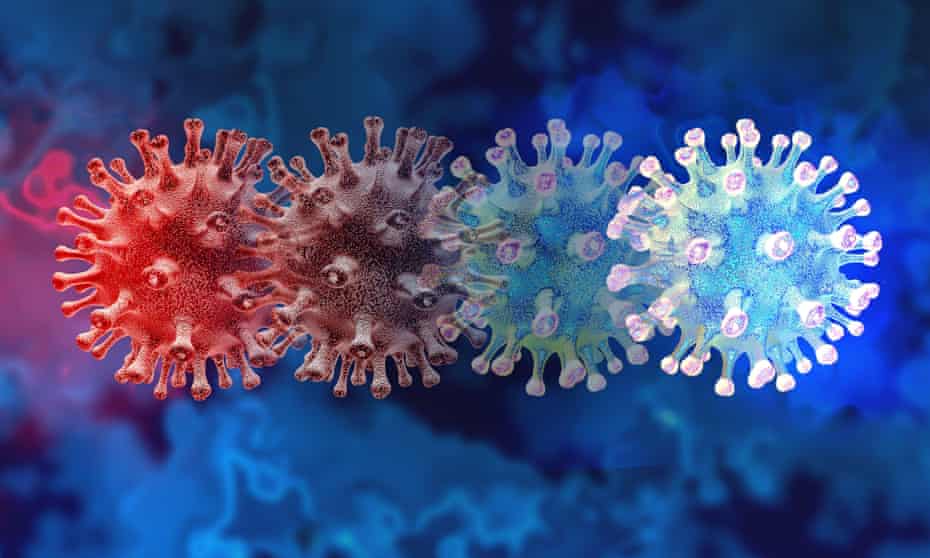
Scientists have said a new Covid variant that carries an “extremely high number” of mutations may drive further waves of disease by evading the body’s defences.

Only 10 cases in three countries have been confirmed by genomic sequencing, but the variant has sparked serious concern among some researchers because a number of the mutations may help the virus evade immunity.

The B.1.1.529 variant has 32 mutations in the spike protein, the part of the virus that most vaccines use to prime the immune system against Covid. Mutations in the spike protein can affect the virus’s ability to infect cells and spread, but also make it harder for immune cells to attack the pathogen.

The variant was first spotted in Botswana, where three cases have now been sequenced. Six more have been confirmed in South Africa, and one in Hong Kong in a traveller returning from South Africa.

Dr Tom Peacock, a virologist at Imperial College London, posted details of the new variant on a genome-sharing website, noting that the “incredibly high amount of spike mutations suggest this could be of real concern”.

In a series of tweets, Peacock said it “very, very much should be monitored due to that horrific spike profile”, but added that it may turn out to be an “odd cluster” that is not very transmissible. “I hope that’s the case,” he wrote.

Dr Meera Chand, the Covid-19 incident director at the UK Health Security Agency, said that in partnership with scientific bodies around the globe, the agency was constantly monitoring the status of Sars-CoV-2 variants as they emerge and develop worldwide.

“As it is in the nature of viruses to mutate often and at random, it is not unusual for small numbers of cases to arise featuring new sets of mutations. Any variants showing evidence of spread are rapidly assessed,” she said.

The first cases of the variant were collected in Botswana on 11 November, and the earliest in South Africa was recorded three days later. The case found in Hong Kong was a 36-year-old man who had a negative PCR test before flying from Hong Kong to South Africa, where he stayed from 22 October to 11 November. He tested negative on his return to Hong Kong, but tested positive on 13 November while in quarantine.

England no longer has a red list to impose restrictions on travellers arriving from abroad. People who are not fully vaccinated must test negative before flying and arrange two PCR tests on arrival. Those who are fully vaccinated need to have a Covid test within two days of landing.

Scientists will be watching the new variant for any sign that it is gaining momentum and spreading more widely. Some virologists in South Africa are already concerned, particularly given the recent rise in cases in Gauteng, an urban area containing Pretoria and Johannesburg, where B.1.1.529 cases have been detected.

Ravi Gupta, a professor of clinical microbiology at Cambridge University, said work in his lab found that two of the mutations on B.1.1.529 increased infectivity and reduced antibody recognition. “It does certainly look a significant concern based on the mutations present,” he said. “However, a key property of the virus that is unknown is its infectiousness, as that is what appears to have primarily driven the Delta variant. Immune escape is only part of the picture of what may happen.”

Prof Francois Balloux, the director of the UCL Genetics Institute, said the large number of mutations in the variant apparently accumulated in a “single burst”, suggesting it may have evolved during a chronic infection in a person with a weakened immune system, possibly an untreated HIV/Aids patient.

“I would definitely expect it to be poorly recognised by neutralising antibodies relative to Alpha or Delta,” he said. “It is difficult to predict how transmissible it may be at this stage. For the time being it should be closely monitored and analysed, but there is no reason to get overly concerned unless it starts going up in frequency in the near future.”

Source


Friday, 19 November 2021

'Life-changing': Revolutionary new HIV drug approved for use in the UK

 A revolutionary HIV drug that reduces the need for a daily cocktail of drugs to half a dozen injections a year has just been approved in the UK.

By Euronews  with AP

For those suffering from the disease, the news of a long-acting treatment is "extraordinary" and "life-changing".

The injectable treatment is a combination of cabotegravir (also called vocabria) with rilpivirine (also called r_ekambys_) and is as effective as oral antiretrovirals at maintaining a low viral load in clinical trials, according to the National Institute for Health and Care Excellence (NICE).

Cabotegravir is the result of the FLAIR trial run by Professor Chloe Orkin at Queen Mary University of London. The results were first published in March 2019.

Now more than two years later, its supply has been scaled up and the drug is being made available freely to HIV patients throughout the UK.

Charities have welcomed the move as it offers an alternative to taking daily antiretroviral drugs to suppress the virus.

An estimated 13,000 people will be eligible for the new treatment via the NHS.

The treatment is already being used in parts of Europe, the US, and Canada, with scientists saying it is highly effective.

Original Source


- - - - - - - - - -  


‘Great step forward’ for HIV treatment as long-acting jabs to replace daily pills


Charities hail ‘incredible’ news as injectable treatment to be offered to 13,000 people on NHS

A new injectable HIV treatment could replace daily pills


The NHS has been given the green light to offer people living with HIV the first "long-acting injectable" to keep the virus at bay.

Charities have hailed the "incredible news" which offers an alternative to adults living with HIV who have to take daily antiretroviral drugs.

Many people living with HIV can keep the virus at very low levels by taking antiretroviral tablets each day.

These drugs keep the number of virus particles in the blood - also known as the viral load - so low that it cannot be detected or transmitted between people.

But now an estimated 13,000 people will be eligible for the injectable treatment in England which means they no longer need daily treatment but will have two injections every two months.

This means they can reduce the days they receive treatment from 365 to six per year.

The National Institute for Health and Care Excellence said that cabotegravir (also called vocabria and made by Viiv Healthcare) with rilpivirine (also called Rekambys and made by Janssen) can be offered to adults who have managed to keep HIV viral load to a low level through daily antiretroviral medicines.

Clinical trial results show that cabotegravir with rilpivirine is as effective as oral antiretrovirals at maintaining a low viral load, Nice said.

Meindert Boysen, deputy chief executive Nice, said: "Despite scientific advances HIV is still incurable, but the virus can be controlled by modern treatment.

"However, for some people, having to take daily multi-tablet regimens can be difficult because of drug-related side effects, toxicity, and other psychosocial issues such as stigma or changes in lifestyle.

"We're pleased therefore to be able to recommend cabotegravir with rilpivirine as a valuable treatment option for people who already have good levels of adherence to daily tablets, but who might prefer an injectable regimen with less frequent dosing."

Commenting on the news, Debbie Laycock, head of policy at Terrence Higgins Trust, said: "It's incredible news for people living with HIV in England and Wales that they will be able to access the first long-acting injectable treatment on the NHS as an additional treatment option.

"We have incredibly effective treatment which means HIV is now a manageable virus, however, it is lifelong so it is important that taking treatment is as easy as possible.

"HIV unfortunately remains a stigmatised condition. Although we're working hard to tackle the stigma surrounding HIV, this new injectable treatment option could help people in house-shares for example who do not wish to share their HIV status and will no longer have to worry about hiding their medication.

"Pill fatigue is also an issue for some people living with HIV who struggle with the idea of taking antiretroviral drugs every day.

"Long-acting injectable treatment is also a better option for those who have difficulty swallowing medication. Therefore, the institute's approval provides a welcome additional treatment option for people living with HIV across England and Wales.

'This is a great step forward as we work towards ending new cases of HIV by 2030. The institute's decision brings great potential for HIV prevention including long-lasting PrEP in the future."

Deborah Gold, chief executive of National Aids Trust, said the charity was "delighted" with the news, adding: "The voice of people living with HIV is clear: they want this technology available as part of a range of treatment options. It won't be right for everyone but, for some, monthly injections are highly preferable to daily pills.

"Innovations that can make it easier for people to stick to their treatment plans both improve the wellbeing of people living with HIV and bring us one step closer to the goal of ending transmissions by 2030."

Dr Jonathan Stoye, from the Francis Crick Institute, said: "Drug treatment of HIV-1 has been one of the great successes of modern medicine.

"While HIV-1 was once a virtual death sentence from Aids, combination therapy now allows an essentially normal life span.

"However, almost all treatments require taking medicines at least once a day. This is inconvenient and brings with it the risk of missing doses essential for virus control.

Original Source

Thursday, 11 November 2021

Cancer: Fatty Acid Found In Palm Oil May Increase Risk Of Skin And Mouth Cancer

 A study has found that when palmitic acid was supplemented into the diet of mice, mouth and skin cancers were more likely to spread. Palmitic acid, or palm oil has remained a controversial substance however this latest study shines a light on how it could be one of the main causes for the increase in cancer diagnosis seen of late.  


Metastasis – or the spread – of cancer remains the main cause of death in cancer patients and the vast majority of people with metastatic cancer can only be treated, but not cured.

As most are aware, food can have a major impact on cancer with fatty acids being the building blocks of fat in the body.

Unfortunately, metastasis is often promoted by fatty acids in one’s diet further warning what you put in your mouth can have a devastating health impact.

Newly published findings, led by researchers at IRB Barcelona, Spain, reveal that one such fatty acid commonly found in palm oil, called palmitic acid, promotes metastasis in oral carcinomas and melanoma skin cancer in mice.

“There is something very special about palmitic acid that makes it an extremely potent promoter of metastasis,” said Prof Salvador Aznar-Benitah, of the Institute for Research in Biomedicine (IRB), Barcelona.

“I think it is too early to determine which type of diet could be consumed by patients with metastatic cancer that would slow down the metastatic process.”

The study suggested that exposure to palmitic acid caused changes to the function of genes in cancer cells that allowed them to sense fatty acids and consume them more efficiently.

The presence of palmitic acid also appeared to send cancer cells into a “regenerative state” allowing them to form signalling networks beyond the tumour, which is known to be a crucial step towards spreading.


Prof Greg Hannon, director of the Cancer Research UK Cambridge Institute, said: “This is a rigorous and comprehensive study that suggests that exposure to a major constituent of palm oil durably changes the behaviour of cancer cells, making them more prone to progress from local to potentially lethal metastatic disease.

“Given the prevalence of palm oil as an ingredient in processed foods, this study provides strong motivation for further study on how dietary choices influence the risk of tumour progression.”

Helen Rippon, chief executive at Worldwide Cancer Research, added: “This discovery is a huge breakthrough in our understanding of how diet and cancer are linked and, perhaps more importantly, how we can use this knowledge to start new cures for cancer.

Metastasis is estimated to be responsible for 90 percent of all cancer deaths – that’s around nine million deaths a year globally.

“Learning more about what makes cancer spread and – importantly – how to stop it is the way forward to reduce these numbers.”

https://vervetimes.com/cancer-fatty-acid-found-in-palm-oil-may-increase-risk-of-skin-and-mouth-cancer-2/