Pages

Thursday, 26 February 2015

Big Feet, Big **** and Other Myths About Sex

Despite our sexually saturated society, Americans are surprisingly naïve about what’s true and what’s not about sex—and some myths just won’t die.


This post is on Healthwise

December 15, 2015 (sic)

5434

Here, the most common myths and the truth…

MEN THINK ABOUT SEX ALL THE TIME

It’s been widely reported—and often repeated in social media—that men think about sex every seven seconds. That would mean that men are having sexual thoughts about every time they take a breath. Impossible!
But men do think about sex more often than women do. In one study, 54% of the men surveyed said that they had sexual thoughts every day or several times a day. Among women, 19% thought about sex with the same frequency.

MEN DOING THE LAUNDRY TURNS WOMEN ON

True or false: A man who really wants sex should simply roll up his sleeves and do a load of laundry. His wife will tear his clothes off.
Answer: True and false. Women report higher levels of marital satisfaction when husbands help out around the house. And marital satisfaction is correlated with sexual desire in some studies, so perhaps housework will lead to satisfaction and satisfaction will lead to more desire.
For more on this topic, see our helpful
Guide to the Best Sex of Your Life

But the laundry itself may be incidental—or, paradoxically, even detrimental. Data from the National Survey of Families and Households showed that couples actually had less sex when men did more of the “core” housework (laundry, dishes, cleaning house, etc.), compared with couples in which the men did more traditional “man-typed” tasks, such as car repairs and yard work.

BIG FEET, BIG ****

No one wants to stare (or get caught staring) at the area beneath a man’s belt. Is sneaking a peek at his feet a less embarrassing way to check his endowment?
It’s not a reliable measure. In one survey (often referred to as “The Definitive Penis Size Survey”), 3,100 men reported information about the size of their penises and their other characteristics. It found no connection between erect penis size and shoe size.
By all means, check out a man’s feet—but only if you’re curious about his taste in shoes.

CHOCOLATE IS AN APHRODISIAC

Throughout history, people have believed that certain foods—such as chocolate, oysters and asparagus—are aphrodisiacs that increase sexual desire and performance.
There might be a kernel of truth to it. Chocolate, for example, contains compounds that dilate blood vessels and can potentially help a man get erections. Other compounds in chocolate stimulate the release of neurotransmitters that improve mood. People who feel good are more likely to want to have sex.
But there’s nothing in chocolate, oysters or other foods that will stimulate desire in people. On the other hand, if you like those foods, there’s no reason not to eat them.

WOMEN ARE TURNED OFF BY SWEATY, STINKY MEN

It seems like common sense that women would be turned off by sweaty, stinky men. Not so!
A group of scientists at University of California, Berkeley, conducted a study of how certain components of male sweat affected women. They found that women who smelled a component of male sweat called androstadienone had improved mood and reported more sexual arousal. They also saw their blood pressure increase, their heart rates go up and their breathing become more rapid.

SEX IS GREAT FOR WEIGHT LOSS

If you have frequent, vigorous sex that lasts as long as a run on the treadmill, you’ll probably lose a bit of weight. Otherwise, forget it.
You do burn calories during sex—anywhere from 85 to 150 calories in 30 minutes. But who has sex for a half-hour? The average duration of a sexual encounter is about five minutes—and the biggest increase in metabolism occurs for only about 15 seconds during orgasm. At that rate, you would have to have a lot of sex to lose weight.

SEX OFTEN CAUSES HEART ATTACKS

As discussed above, sex isn’t nearly as strenuous as people think. The physical exertion that most people put in when having sex is similar to walking up two flights of stairs. If you’re generally healthy, your risk of having a heart attack during sex is about one in a million. (The chance of being hit by lightning in a given year is one in 700,000.)
What if you already have heart disease? You still shouldn’t worry. If you are able to pass a basic stress test, your risk of having a heart attack during sex goes up to only 10 in a million.
Exceptions: Anyone who has recently had a heart attack or stroke or other cardiovascular event should talk to his/her doctor about the types of activities that he should or shouldn’t do. Sex is unlikely to be on the “don’t” list.
http://blp.artilenttechnolo.netdna-cdn.com/big-feet-big-and-other-myths-about-sex/

Go to Healthwise for more articles

Wednesday, 25 February 2015

Alzheimer’s Symptoms Reversed

BREAKTHROUGH RESEARCH SHOWS IT’S POSSIBLE…

Can Alzheimer’s symptoms be reversed? A breakthrough treatment suggests that they can. 

This post is on Healthwise


January 15, 2015

BREAKTHROUGH RESEARCH SHOWS IT’S POSSIBLE…

Alzheimers_reversedCan Alzheimer’s symptoms be reversed? A breakthrough treatment suggests that they can. In a study recently published in the journal Aging, Dale Bredesen, MD, director of the Alzheimer’s Disease Program at UCLA’s David Geffen School of Medicine, presented an all-natural, multicomponent treatment program that reversed memory loss in four people with Alzheimer’s and in five people with eithersubjective cognitive impairment or mild cognitive impairment (the stages of memory loss that typically precede Alzheimer’s).
Bottom Line/Personal interviewed Dr. Bredesen, who explained that his program is based on a new theory about why people get Alzheimer’s. This theory was developed over two decades of cellular and animal research at the Buck Institute for Research on Aging and UCLA…

NEW THINKING

The current, widely accepted theory of Alzheimer’s says that the protein beta-amyloid forms plaques outside neurons in the brain…somehow triggering the production of abnormal tau tangles inside neurons…thereby interfering with synapses, the information-laden connections between neurons that create memory and other mental activity.
New thinking: Normal mental function depends on a balance betweensynaptoblastic (synapse-making) andsynaptoclastic (synapse-destroying) activity. If there is more synaptoclastic activity, memory loss may ensue. If there is chronic synaptoclastic activity, our research suggests that Alzheimer’s occurs.
My colleagues and I have identified 36 unique synapse-affecting factors (including beta-amyloid). Addressing only one or two of these factors—with a drug, for example—will not reverse Alzheimer’s. But addressing many factors—10, 20 or more—can effectively reverse the symptoms.
Here are several key factors in what we call the MEND (Metabolic Enhancement for NeuroDegeneration) program—factors anyone can use to prevent, slow, stop or potentially even reverse memory loss…

RESTORING MEMORY

Synapse-making and synapse-destroying factors function in a “loop” that develops momentum, like a snowball rolling downhill. In the synapse-­destroying momentum of Alzheimer’s, you gradually lose memories, ultimately even basic ones such as the faces of loved ones. But because the synapse-making factors in the MEND program are so effective, they can reverse the momentum of Alzheimer’s. The more of them that you incorporate into your daily life, the more momentum there is to protect and restore memory.
• Optimize diet. Eliminate simple carbohydrates such as anything made from white flour and/or refined sugar. Don’t eat processed foods with either “trans fats” or “partially hydrogenated vegetable oil” on the label. If you’re sensitive to gluten, minimize your consumption of gluten-containing foods, such as wheat and rye (there are simple tests to determine whether you are indeed gluten-sensitive). Emphasize fruits and vegetables. Eat nonfarmed fish for neuron-protecting omega-3 fatty acids.
Why it works: This dietary approach reduces inflammation and high levels of insulin (the hormone that regulates blood sugar), both of which are synapse-destroying. Important: Dietary changes have more impact than any other factor in preventing or reversing memory loss.
Helpful: Four books that have diets consistent with MEND are Eat to Live by Joel Furhman, MD…The Blood Sugar Solution by Mark Hyman, MD…The Spectrum by Dean Ornish, MD…and Grain Brain by David Perlmutter, MD.
• Have a nightly “fast.” Don’t eat three hours before bedtime. Ideally, 12 hours should pass between the last time you eat at night and when you eat breakfast. Example: Dinner ending at 8:00 pm and breakfast starting at 8:00 am.
Why it works: This eating pattern enhances autophagy (the body’s ability to “clean up” dysfunctional cells, such as beta-amyloid) and ketosis (the generation of ketones, molecules that can help protect neurons). It also reduces insulin.
•  Reduce stress. Pick a relaxing, enjoyable activity—walking in the woods, yoga, meditation, playing the piano, etc.—and do it once a day or every other day for at least 20 to 30 minutes.
Why it works: Stress destroys neurons in the hippocampus, the part of the brain that helps create short- and long-term memory. Stress also boosts cortisol, a synapse-damaging hormone. And stress increases corticotropin-releasing factor (CRF), a hormone linked to Alzheimer’s.
• Optimize sleep. Sleep seven to eight hours every night.
Why it works: Anatomical changes during sleep flush the brain of toxic, synapse-damaging compounds. If you have trouble sleeping, we have found that 0.5 mg of melatonin at bedtime is the best dose for restorative sleep.
• Exercise regularly. I recommend 30 to 60 minutes per day, four to six days per week. Combining aerobic exercise (such as brisk walking) with weight-training is ideal.
Why it works: Among its many benefits, exercise produces brain-derived neurotrophic factor(BDNF), a powerfully synaptoblastic compound.
• Stimulate your brain. Brain-­training exercises and games stimulate and ­improve your ability to remember, pay attention, process information quickly and creatively navigate daily life.
Why it works: Just as using muscle builds muscle, using synapses builds synapses. (Scientists call this ability of the brain to change and grow plasticity.)
Helpful: Brain HQ and Lumosity are good, science-based online programs for stimulating your brain.
• Take folate, vitamin B-6 and vitamin B-12. These three nutrients can reduce blood levels of the amino acid homocysteine, which is linked to an increase in tau, increased age-­related shrinkage of the hippocampus and double the risk for Alzheimer’s disease.
However: To work, these supplements must undergo a biochemical process called methylation—and many older people don’t “methylate” well, rendering the supplements nearly useless. To avoid the problem, take a form of the supplements that already is methylated (or activated)—folate as L-methylfolate, B-6 as pyridoxal-5-phosphate and B-12 as methylcobalamin.
• Take other targeted supplements. Along with the three B vitamins, there are many other supplements that target synaptoblastic and synaptoclastic factors. Check with your doctor about the right dosages. The supplements include vitamin D-3 (low levels double the risk for Alzheimer’s)…vitamin K-2…vitamin E (as mixed tocopherols and tocotrienols)…the minerals selenium, magnesium and zinc (zinc, for example, lowers copper, which is linked to Alzheimer’s)…DHA and EPA (anti-inflammatory omega-3 fatty acids)…coenzyme Q10, N-acetyl-cysteine, alpha-lipoic acid (they nourish mitochondria, energy-generating structures within cells)…and probiotics (they improve the microbiome, helping to strengthen the lining of the gut, reducing body-wide inflammation).
Also, certain herbs can be helpful. These include curcumin (1 gram per day), ashwagandha (500 mg once or twice per day) and bacopa monnieri (200 mg to 300 mg per day). These have multiple effects, such as reducing inflammation and amyloid-beta peptide and enhancing neurotransmission.

Go to Healthwise for more articles

Tuesday, 24 February 2015

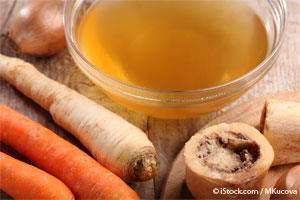
Is Bone Broth the New Super Food?

Move over coconut water and green juice, bone broth is the latest ancient superfood that's making a well-deserved comeback.

This post is on Healthwise


February 23, 2015


Homemade Bone BrothStory at-a-glance


  • Bone broth contains a variety of valuable nutrients, including calcium, collagen, and bone marrow, in a form your body can easily absorb and use
  • Homemade bone broth may help reduce joint pain and inflammation, promote strong bones and boost hair and nail growth

By Dr. Mercola
If you happen to be in New York City, you can stop by Brodo, a trendy new to-go restaurant devoted to selling broth.1 One cup will set you back about $8… or you can make a gallon (that’s 16 cups) of this healing staple food right in your own kitchen for far less than the equivalent $128.
There’s no doubt that bone broth’s popularity as a superfood is growing. More than a few New York City bars are even featuring bone broth shots and cocktails.2 But there’s nothing “new” about it.
Bone broth may quite possibly be one of the oldest meals on record. Hippocrates was known to extol its virtues, and according to Dr. Kaayla Daniel, vice president of the Weston A. Price Foundation and coauthor (with Sally Fallon Morell) of the book Nourishing Broth:
“Bone broth goes way back to the Stone Age, when they were actually cooking broth in turtle shells and in skins over the fire.”3

Why Bone Broth Is Regarded as a Superfood

There’s something inherently soothing about sipping on a warm cup of broth, and it really does have medicinal potential. 

For starters, bone broth is used as the foundation of the GAPs diet, which is based on the Gut and Psychology Syndrome (GAPS) principles developed by Dr. Natasha Campbell-McBride. It forms the foundation because it is so healing to your gut.
The GAPS diet is often used to treat children with autism and other disorders rooted in gut dysfunction, but just about anyone with allergies or less than optimal gut health can benefit from it, as it is designed to heal leaky gut.
If your gut is leaky or permeable, partially undigested food, toxins, viruses, yeast, and bacteria have the opportunity to pass through your intestine and access your bloodstream; this is known as leaky gut.
When your intestinal lining is repeatedly damaged due to reoccurring leaky gut, damaged cells called microvilli become unable to do their job properly. They become unable to process and utilize the nutrients and enzymes that are vital to proper digestion.
Eventually, digestion is impaired and absorption of nutrients is negatively affected. As more exposure occurs, your body initiates an attack on these foreign invaders. It responds with inflammation, allergic reactions, and other symptoms we relate to a variety of diseases.
Leaky gut is the root of many allergies and autoimmune disorders, for example. When combined with toxic overload, you have a perfect storm that can lead to neurological disorders like autism, ADHD, and learning disabilities.
One of the main foods that you use is bone broth, because not only is it very easily digested, it also contains profound immune-optimizing components that are foundational building blocks for the treatment of autoimmune diseases.

Nutrients That Many Americans Are Lacking

Bone broth contains a variety of valuable nutrients of which many Americans are lacking, in a form your body can easily absorb and use. This includes but is not limited to:
Calcium, phosphorus, and other minerals Components of collagen and cartilage
Silicon and other trace mineralsComponents of bone and bone marrow
Glucosamine and chondroitin sulfateThe "conditionally essential" amino acids proline, glycine, and glutamine
These nutrients account for many of the healing benefits of bone broth. As Dr. Daniel told the Washington Post:4
“We have science that supports the use of cartilage, gelatin, and other components found in homemade bone broth to prevent and sometimes even reverse osteoarthritis, osteoporosis, digestive distress, autoimmune disorders, and even cancer.”
Additional benefits of bone broth include the following:
  1. Reduces joint pain and inflammation, courtesy of chondroitin sulfate, glucosamine, and other compounds extracted from the boiled down cartilage and collagen.
  2. Inhibits infection caused by cold and flu viruses etc. Indeed, Dr. Daniel reports chicken soup — known as "Jewish penicillin"—has been revered for its medicinal qualities at least since Moses Maimonides in the 12th century.5
  3. Recent studies on cartilage, which is found abundantly in homemade broth, show it supports the immune system in a variety of ways; it's a potent normalizer, true biological response modifier, activator of macrophages, activator of Natural Killer (NK) cells, rouser of B lymphocytes, and releaser of Colony Stimulating Factor.
  4. Fights inflammation: Amino acids such as glycine, proline, and arginine all have anti-inflammatory effects. Arginine, for example, has been found to be particularly beneficial for the treatment of sepsis (whole-body inflammation).6 Glycine also has calming effects, which may help you sleep better.
  5. Promotes strong, healthy bones: Dr. Daniel reports bone broth contains surprisingly low amounts of calcium, magnesium and other trace minerals, but she says "it plays an important role in healthy bone formation because of its abundant collagen. Collagen fibrils provide the latticework for mineral deposition and are the keys to the building of strong and flexible bones."
  6. Promotes healthy hair and nail growth, thanks to the gelatin in the broth. Dr. Daniel reports that by feeding collagen fibrils, broth can even eliminate cellulite too.

Kobe Bryant Swears By Bone Broth

Bone broth is also getting attention for its use in sports medicine. Genuine bone broth contains components of cartilage that may help your body make cartilage. In addition, Dr. Daniel notes that body builders have long used gelatin supplements to support muscle growth. She describes bone broth as “the raw food version of a gelation supplement.”7
Los Angeles Lakers player Kobe Bryant is among those who swear by bone broth, and he believes it has kept his NBA career sustainable. It’s a foundation of his pre-game meals. As ESPN reported:8
"I've been doing the bone broth for a while now," Bryant said. "It's great - energy, inflammation. It's great."
As Tim DiFrancesco, the Lakers' head strength and conditioning coach, said,"Everybody is looking for a magical elixir or some cure-all… but bone broth is where it's at."9 He told ESPN:10
“You could go into a store and on the shelf you’ve got this carton of vegetable stock or chicken stock, and that’s probably something that’s been flavored with salt and chicken-flavored bouillon cubes or something like that.
But there’s no actual vitamin, mineral nutrient value in there. It just tastes good because there’s enough salt in there. But when you make a bone stock the right way, it’s like liquid gold. And the way you know you have real stock on your hand is if you put it in the refrigerator overnight and it basically turns into Jell-O.”
Indeed, the more gelatinous the broth, the more nourishing it will tend to be. The collagen that leaches out of the bones when slow-cooked is one of the key ingredients that make broth so healing. According to Dr. Daniel, if the broth gets jiggly after being refrigerated, it's a sign that it's a well-made broth.
To make it as gelatinous as possible, she recommends adding chicken feet, pig's feet, and/or joint bones. All of these contain high amounts of collagen and cartilage. Shank or leg bones, on the other hand, will provide lots of bone marrow. Marrow also provides valuable health benefits so ideally you'll want to use a mixture of bones. You can make bone broth using whole organic chicken, whole fish or fish bones (including the fish head), pork, or beef bones. Vary your menu as the many types offer different flavors and nutritional benefits.

Use the Highest Quality Ingredients You Can Find

Perhaps the most important caveat when making broth, whether you're using chicken or beef, is to make sure the bones are from organically raised, pastured or grass-fed animals. As noted by Sally Fallon, chickens raised in concentrated animal feeding operations (CAFOs) tend to produce stock that doesn't gel, so you'll be missing out on some of the most nourishing ingredients if you use non-organic chicken bones.
If you can't find a local source for organic bones, you may need to order them. A great place to start is your local Weston A. Price chapter leader,11 who will be able to guide you to local sources. You can also connect with farmers at local farmers markets. Keep in mind that many small farmers will raise their livestock according to organic principles even if their farm is not USDA certified organic, as the certification is quite costly. So it pays to talk to them. Most will be more than happy to give you the details of how they run their operation.

Homemade Chicken Bone Broth Recipe

The recipe that follows is from Hilary Boynton and Mary Brackett's GAPS cookbook, The Heal Your Gut Cookbook: Nutrient-Dense Recipes for Intestinal Health Using the GAPS Diet. For even more broth recipes, this book is an excellent resource.
Homemade Chicken Broth
Ingredients
  • 1 3- to 4-pound stewing hen, 1-2 chicken carcasses, or 3-4 pounds of chicken necks, backs and wings
  • 4 quarts filtered water
  • 2-4 chicken feet (optional)
  • 1-2 chicken heads (optional)
  • 2 tablespoons apple cider vinegar
  • 3 celery stalks, coarsely chopped
  • 2 carrots, coarsely chopped
  • 1 onion, quartered
  • Handful of fresh parsley
  • Sea salt
Method:
  • Put the chicken or carcasses in a pot with 4 quarts of water; add the chicken feet and heads (if you’re using them) and the vinegar.
  • Let sit for 30 minutes to give the vinegar time to leach the minerals out of the bones.
  • Add the vegetables and turn on the heat.
  • Bring to a boil and skim the scum.
  • Reduce to barely a simmer, cover, and cook for 6 to 24 hours.
  • During the last 10 minutes of cooking, throw in a handful of fresh parsley for added flavor and minerals.
  • Let the broth cool, strain it, and take any remaining meat off the bones to use in future cooking.
  • Add sea salt to taste and drink the broth as is or store it in the fridge (up to 5 to 7 days), or freezer (up to 6 months) for use in soups and stews.

Effortless Healing – One Step at a Time

My newest book, Effortless Healing, is available February 24th! I've organized this book into a guide that will help you avoid the many pitfalls of the conventional approach to health. Rather than relying on expensive and potentially dangerous drugs, I will help you effortlessly make small shifts in what you eat and how you live to achieve your health goals. I promise,Effortless Healing isn't a book that will overwhelm you. On top of that, preordering the book today entitles you to 4 exclusive bonuses:

BONUS #1:

Your chance to see me live and ask me your health questions on Thursday February 26th on Google Hangouts.

BONUS #2:

A sneak peek of my new book! Books will be mailed starting February 24th, but you won’t need to wait until it arrives to get started. Begin reading my new book right away with your free sneak preview!

BONUS #3:

My most popular video interviews, all in one place. I’ve compiled 18 of my BEST expert interviews for you to watch and listen to at your leisure, and in the comfort of your own home or office.

BONUS #4:

Receive 15% off your next Mercola.com order. Depending on your order, your savings from this one bonus alone could more than cover the cost of your book!

All My Profits from This Book Will Be Donated

That's right. When you order a copy of my new book Effortless Healing, you'll be making a much-deserved donation to the key organizations that work quietly and efficiently behind the scenes to make the world a healthier place for you, your family, and your community.
Among them, you'll be benefiting and supporting the actions of:
  • National Vaccine Information Center (NVIC) – A non-profit organization that seeks to prevent vaccine injuries and deaths through public education and defending your right of informed choice.
  • Organic Consumers Association (OCA) – A grassroots public interest organization campaigning for health, justice, and sustainability, and addressing food safety, GMOs, the industrial agricultural complex, children's health, and more. The ONLY U.S. organization focused exclusively on the interests that you and I share!
  • Consumers for Dental Choice – Children, the unborn, and employees in the dental field are particularly vulnerable to mercury. But so is everyone with a mouthful of amalgam fillings (which are 50% mercury) at risk. Consumers for Dental Choice is working to phase out amalgam use and to promote access to mercury-free alternatives.
  • Fluoride Action Network (FAN) – An international coalition aimed at ending water fluoridation and alerting you to fluoride's environmental and health risks. FAN keeps you informed about fluoride toxicity, and monitors government actions that may expose you to fluoride.
Are you ready to get started? The timing has never been better. Order your copy of Effortless Healing today, collect your free gifts, and let your journey begin!

http://articles.mercola.com/sites/articles/archive/2015/02/23/bone-broth-superfood.aspx

Go to Healthwise for more articles