A range of vaccines, designed in completely different ways, are being used to reduce people's chances of getting sick, needing hospital treatment or dying.
And two new vaccines have just been shown to work in large scale clinical trials.
By James Gallagher Health and science correspondent
Published
5 hours ago
IMAGE COPYRIGHTGETTY IMAGES
Why do we need a vaccine?
It is more than a year since the virus first emerged, yet the vast majority of people are still vulnerable to the virus.
The restrictions on our lives are the only thing holding the virus in check as they reduce opportunities for the virus to spread.
Vaccines teach our bodies to fight the infection and are "the" exit strategy from the pandemic.
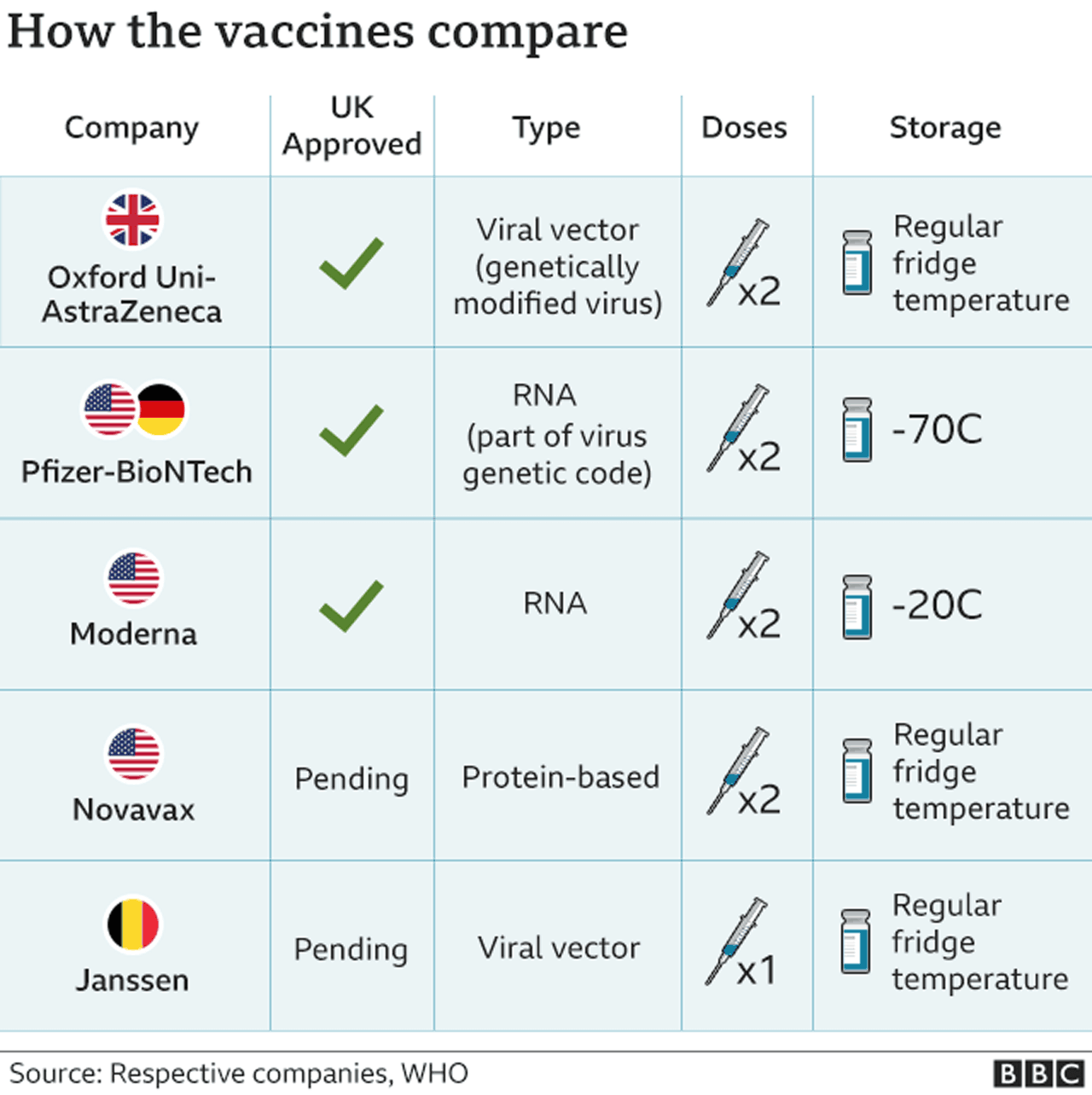
Pfizer and Moderna have both developed RNA vaccines - a new approach that is incredibly quick to design.
They inject a tiny fragment of the virus's genetic code into the body, this starts producing part of the coronavirus and the body to mounts a defence.
These have been approved for use in the UK, Europe and the US.
These have been approved for use in the UK, Europe and the US.
Margaret Keenan became the first person in the world to be given the Pfizer Covid-19 jab as part of a mass vaccination programme.
The Oxford vaccine is subtly different as it uses a harmless virus to carry the same genetic material into the body. This has been approved in the UK and Europe.
It is the easiest of the of the three to use as it can be stored in a fridge rather than needing very cold temperatures.
All are supposed to be given as two doses, but the UK is prioritising giving as many people as possible the first dose and delaying the second.
The two new ones
Data from large-scale trials on two new vaccines have also been presented recently.
The work by Janssen and Novavax will now be reviewed by drugs regulators before they can be join the vaccination effort.
Janssen's vaccine uses the same technique as Oxford, but crucially is given as a single injection, rather than the usual two. This combined with it needing only a fridge to store and a billion doses planned this year means it could make a significant impact around the world.
Novavax are using a different, old-school, approach to vaccines - proteins from the virus and a chemical to prime the immune system are injected into the body.
What is the rest of the world doing?
There are other noteworthy vaccines even if they are not being used in Europe and the US.
The Sinovac, CanSino and Sinopharm vaccines have been developed by scientists in China and deals have signed with other countries in Asia and South America. Around one million people in China are reported to have been given the Sinopharm injection.
The Sputnik V vaccine, developed by Russia's Gamaleya Research Centre, has published early trial data saying it is effective and some people have been immunised.
Are they all equally effective?
It is hard to compare one company's results with another as their trials will have been conducted in slightly different ways and at points in the pandemic.
However, all the main vaccines seem to have a large impact on your chances of needing hospital treatment or dying from Covid.
However, one of the most important questions - do they stop you spreading the virus - remains unknown.
Understanding which method produces the best results will be explored in challenge trials where people are deliberately infected with the virus.
A fourth COVID-19 vaccine could be approved for use in the UK within weeks after late-stage trials suggested it was 89% effective in preventing coronavirus.
Connor Sephton, news reporter 30 January 2021
The prime minister has said the Novavax jab is now going to be assessed by the Medicines and Healthcare products Regulatory Agency (MHRA).
If approved, the vaccine would start to be rolled out in the second half of 2021. The UK has already ordered 60 million doses, which are going to be manufactured in Stockton-on-Tees.
More than 15,000 people aged 18 to 84 took part in the Phase 3 clinical trial in the UK - about a quarter of whom were over the age of 65.
The extensive study also showed that the Novavax jab offered 86% protection against the new British strain of COVID-19, which is up to 70% more transmissible.
A smaller, separate trial also showed that it was about 60% effective against the South African variant, despite concerns that this strain may not respond to vaccines.
Health Secretary Matt Hancock has said the NHS is prepared to start rolling out the vaccine quickly if authorised by the MHRA, adding: "This is positive news and, if approved by the medicines regulator, the Novavax vaccine will be a significant boost to our vaccination programme and another weapon in our arsenal to beat this awful virus."
Vaccines minister Nadhim Zahawi was among those who took part in the Novavax trial, and said he was "particularly thrilled" to see such positive results - thanking fellow volunteers for taking part.
The breakthrough comes as a row deepens between the EU and AstraZeneca over vaccine shortages in the trading bloc.
Despite Brussels calling for doses to be sent over from British plants to compensate for the shortfall, Cabinet Office minister Michael Gove has warned that the government won't allow vaccines intended for Britons to be sent to the EU.
Reports have suggested that the EU could block millions of coronavirus vaccines from being exported to the UK within days.
The latest figures show a further 1,239 people died within 28 days of testing positive for COVID-19, with another 28,680 lab-confirmed cases of coronavirus in the UK.
Gallery: Countries with the most Covid vaccine doses (Lovemoney)
Novavax is currently stockpiling vaccines at six manufacturing locations - and is aiming for eight plants in seven countries to produce two billion doses a year.
The effectiveness of the Novavax jab is not far off the 95% success rate seen with the Pfizer/BioNTech and Moderna vaccines, which have already been approved for use, while the Oxford/AstraZeneca vaccine is up to 90% effective.
Dr Amesh Adalja, an infectious disease expert at the Johns Hopkins Centre for Health Security, said the 60% effectiveness against the South African variant of COVID-19 is still promising - not least because US regulators previously said they were prepared to approve a jab that was just 50% effective.
"We've gotten spoiled because we've seen the Moderna and Pfizer numbers," he said. "I know people are going to be alarmed, but 60% efficacy against the new variant is acceptable."
Like the Oxford/AstraZeneca vaccine, the Novavax jab only needs to be kept at fridge temperature, meaning distribution and supply chain management is easier.
After an initial dose, a second shot is given three weeks later.
At a cost of $16 (£11.66) per vaccination, the Novavax jab is more expensive than AstraZeneca's, but cheaper than Pfizer and Moderna's offerings.