Pages

Saturday, 25 October 2014

MUST WATCH - “The Future of Food” (Part 2)

—GMOs, Gene Patenting, and the Corporatization of Our Food Supply


This post is on Healthwise

October 11, 2014

Story at-a-glance

  • The award winning documentary “The Future of Food” covers the genetic engineering of food, gene patenting, and corporatization of the food supply
  • Genetic engineering is complex and unpredictable, resulting in pieces of DNA interacting with each other in unexpected and potentially dangerous ways
  • Oregon and Colorado have GE food labeling initiatives on this November’s ballot; labeling laws have passed in Vermont, Connecticut, and Maine
  • Between 2012 and mid-2014, Monsanto and GMA spent more than $100 million to successfully block GE labeling legislation in more than 30 states
  • Americans spend more on organic foods with each passing year; polls consistently show about 90 percent support GE food labeling

Part 2

The Revolving Door Between Government and Industry

The genetic engineering of our food system is proceeding essentially unregulated, despite the fact that three federal agencies are responsible for the safety of genetically engineered foods.
  • The US Department of Agriculture (USDA) is responsible for assessing the environmental impacts of GE crops and regulating GE crop field testing. However, in a study of more than 8,000 field test applications, not a single environmental assessment was required by USDA. In fact, new USDA rules actually cut the time in half that it takes GE seed developers to go through a regulatory review.
  • The Environmental Protection Agency (EPA) regulates insecticides. Bt insecticide is engineered into every cell of Bt crops. EPA approved an exemption for residue tolerance levels for Bt toxin in GE soy foods and animal feed, so that Monsanto and other pesticide companies can incorporate as much as they want. The agency also recently raised allowable levels of glyphosate in food by significant amounts.9, 10 Allowable levels in oilseed crops such as soy were doubled, from 20 ppm to 40 ppm just last summer. It also raised the levels of permissible glyphosate contamination in other foods—many of which were raised to 15-25 times previous levels.
  • US Food and Drug Administration (FDA) is responsible for food safety. Every novel substance in food must be tested. However, GE foods (such as soy lecithin and corn syrup) were granted "GRAS status" (generally regarded as safe) using the argument of "substantially equivalent"— which exempts them from testing or labeling. This was done through a former VP of Monsanto Michael Taylor, who was deputy commissioner of the FDA in the early 90s. Despite many studies in the last 20 years disproving the substantially equivalent claim, the FDA has failed to reverse its decision.
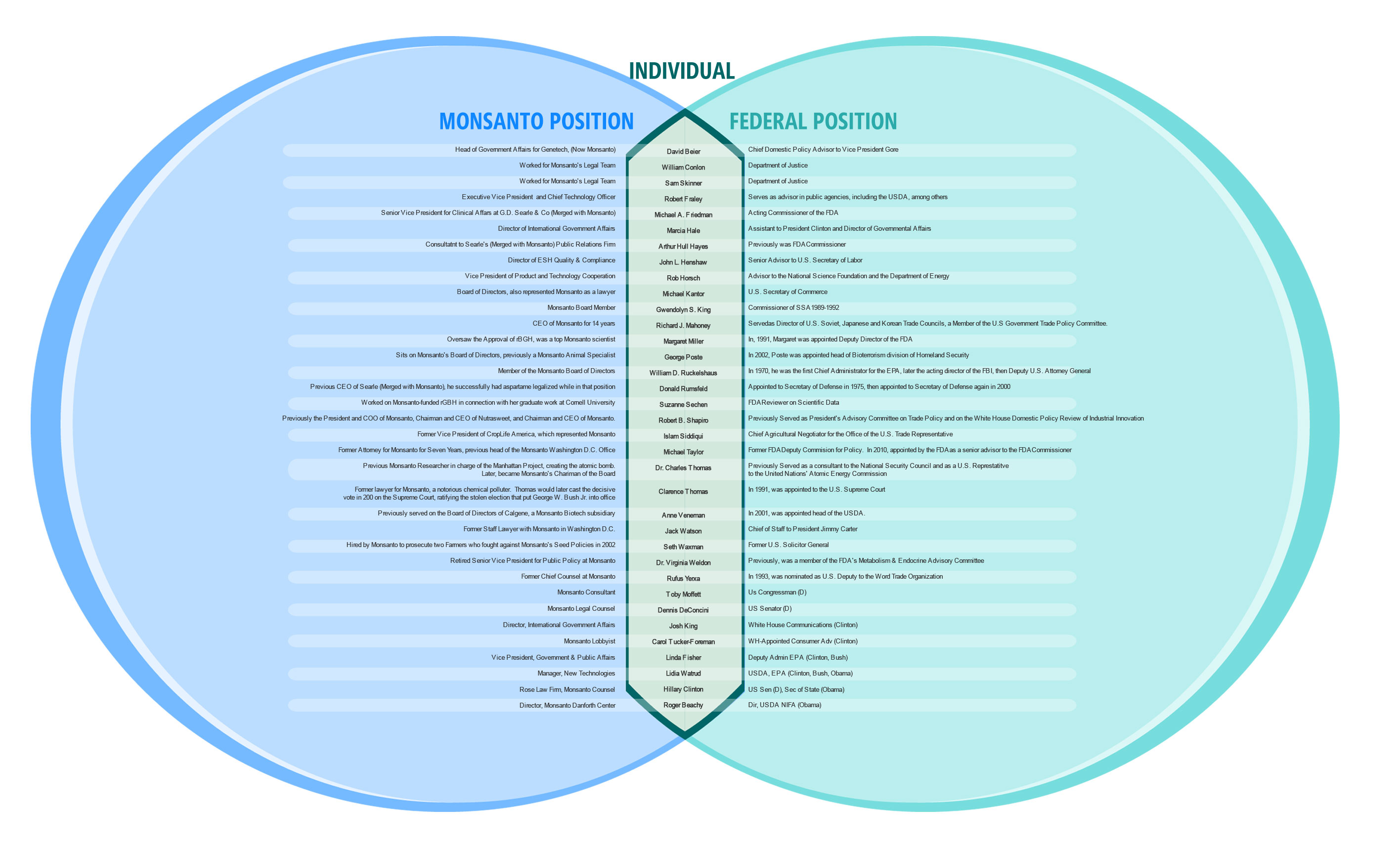
How does the government get away with this? It's fairly simple. It fills its regulatory positions with corporate shills—there's a revolving door for people with industry ties, such as Michael Taylor, Linda Fisher, Donald Rumsfeld, and others. Monsantohas deep roots in Washington, DC. Former Attorney General John Ashcroft received Monsanto's largest contribution to any political candidate in the 2000 election, toward his campaign for senate re-election. Corporate interests explain why the government continues to look the other way.

Subsidizing the Junk Food Industry

While the agrichemical industry rakes in record profits from GE seeds, farmers lose money growing them and can't stay in business without government subsidies. As of the time of this film (2004), the farmer's cost for growing one bushel of GE corn or soy was $3.20, and their return was about $2.20. Obviously, farmers were unable to stay in business with this sort of margin, so agricultural subsidies were created. When wealthy countries subsidize crops, there are global repercussions—the markets of developing countries are undercut, making subsistence farming virtually impossible.
Subsidies support only the most widely grown industrial crops—corn, wheat, and soybeans—ergo, those that go directly to the processed food industry. Far from providing us with nutrition, US agricultural subsidies contribute to the declining health of Americans and fuel the obesity epidemic. It's complete idiocy... junk food is subsidized in one department, while another department across the hall funds an anti-obesity campaign.
Over the past 15 years, taxpayers have paid corn farmers more than $77 billion in subsidies, and more than 75 percent of the funds are paid to a mere 10 percent of America's farmers. Farm subsidies are no longer based on need. Mega-farms receive an annual fixed cash payment based on their acreage, whether they need them or not. Large corporate farms receive the majority of farm subsidies while small farmers receive little to none. You subsidize the junk food industry with your taxes, whether you consume their products or not. As farm subsidies are already in the federal budget, a better approach might be to reallocate them in a way that provides incentives to farmers who grow healthy crops using sustainable farming methods.

A Three-Step Self-Help Plan to Avoid Genetically Engineered Foods

On a brighter note, consumer spending trends reflect America's growing awareness about the shortfalls of the industrial food system. Consider America's growing hunger for organic foods:11, 12
  • In 1990, Americans spent one billion dollars on organic foods
  • In 2003, they spent $13 billion
  • In 2009, they spent $24.8 billion
  • In 2013, they spent $35.1 billion
  • A recent report showed that 65 percent of consumers prefer foods with organic ingredients
In a recent interview, research scientist and internationally recognized sustainability expert Dr. Elaine Ingham suggested the following three-step plan to help you avoid GE foods:
  1. Choose local organic food. This is a must if you want to stop supporting the likes of Monsanto with your hard-earned dollars. Genetically engineered seeds and materials are not allowed in organic farming and food production, so at present it's the only way to ensure you're not accidentally buying something with GE ingredients. Beware that the terms "natural" or "all-natural" on a label has absolutely NO meaning when it comes to GE ingredients—the natural label is in no way interchangeable with the certified organic label.
  2. Improve the soil in your garden and grow your own vegetables. This is my new passion. Please refer to my interview with Paul Gautschi to learn simple strategies you can use to make your home or local garden thrive.
  3. Support GMO labeling campaigns. With elections quickly approaching, this is the time to get the word out to your friends and family about the importance of passing labeling laws. Forward this article as widely as you can to increase awareness about this important issue.


I recently named the GMA “the most evil corporation on the planet,” considering the fact that it consists primarily of pesticide producers and junk food manufacturers who are going to great lengths to violate some of your most basic rights—just to ensure that subsidized, genetically engineered and chemical-dependent, highly processed junk food remains the status quo.
The insanity has gone far enough. It’s time to unite and fight back, which is why I encourage you to boycott every single product owned by members of the GMA, including natural and organic brands. To learn more about this boycott, and the traitor brands that are included, please visit TheBoycottList.org. I also encourage you to donate to the Organic Consumers Fund. Your donation will help fight the GMA lawsuit in Vermont, and also help win the GMO labeling ballot initiative in Oregon in November.
Donate Today!
Voting with your pocketbook, at every meal, matters. It makes a huge difference. By boycotting GMA Member Traitor Brands, you can help level the playing field, and help take back control of our food supply. And as always, continue educating yourself about genetically engineered foods, and share what you’ve learned with family and friends.
[+] Sources and References

http://articles.mercola.com/sites/articles/archive/2014/10/11/gmo-food-labeling.aspx

Go to Healthwise for more articles

MUST WATCH - “The Future of Food” (Part 1)

—GMOs, Gene Patenting, and the Corporatization of Our 

Food Supply


This post is on Healthwise

October 11, 2014

Story at-a-glance

  • The award winning documentary “The Future of Food” covers the genetic engineering of food, gene patenting, and corporatization of the food supply
  • Genetic engineering is complex and unpredictable, resulting in pieces of DNA interacting with each other in unexpected and potentially dangerous ways
  • Oregon and Colorado have GE food labeling initiatives on this November’s ballot; labeling laws have passed in Vermont, Connecticut, and Maine
  • Between 2012 and mid-2014, Monsanto and GMA spent more than $100 million to successfully block GE labeling legislation in more than 30 states
  • Americans spend more on organic foods with each passing year; polls consistently show about 90 percent support GE food labeling

I am unable to show the video panel on this page.
Please click on this link to view the film <"The Future of Food" > on Vimeo


By Dr. Mercola
The GMO food labeling movement has gained momentum over the past several years, passing labeling laws in three states. America's awareness of the risks of genetically engineered (GE) foods and genetically modified organisms (GMOs) to their health and the environment continues to expand.
The Future of Food is not a new film, but still does an excellent job of covering contemporary issues that continue to threaten your health, including genetic engineering, gene patenting, and the corporatization of the food supply.
The film has received multiple awards, including Best Documentary at the dead CENTER Film Festival in 2004, as well as an Oscar nomination for the same.1 Of special importance to me, it was the movie that catalyzed my interest in the GMO problem and after watching it, I committed to doing everything I could to stop this danger.
I recently had the opportunity to interview Deborah Garcia about her new film Symphony of the Soil when I was lecturing in Santa Rosa California at the Heirloom Seed Conference.


The US has no laws requiring the labeling of GE foods, yet polls consistently show that the overwhelming majority of Americans—over 90 percent in most polls—believe these foods should be labeled. Sixty-four countries already require the labeling of GE foods, including European Union states, Japan, and China.2
More than 80 percent of all processed foods sold in the US now contain GE ingredients. With elections around the corner and labeling initiatives making the ballot in two states, it's important to know what's at stake.

As GE Labeling Initiatives Grow, Industry's War Against Labeling Rages On

Genetically engineered food labeling laws have passed in Vermont, Connecticut, and Maine, and more than 20 other states are presently considering them. California and Washington saw very narrow losses in 2012 and 2013, by three percent and one percent, respectively.3
GE labeling initiatives will be on this November's ballot in Oregon and Colorado. It's just a matter of time before the scales really begin tipping in our favor. But industry won't give up without a fight.
The Grocery Manufacturers Association of America (GMA), whom I recently named "the most evil corporation on the planet," is suing Vermont in an effort to overturn their recently passed labeling law.
GMA is also pushing a Congressional bill, the "Safe and Accurate Food Labeling Act of 2014, dubbed the "DARK" (Denying Americans the Right to Know) Act, which would bar states from passing GE labeling laws altogether.
Industry's latest tactic is launching a coordinated attack against Vandana Shiva, one of the world's most vocal and well-respected environmentalists and anti-GE activists.
Oregonians are more determined than ever, with this year's initiative being their second attempt to pass a labeling measure—their first back in 2002. Measure 27 failed (20 percent to 80 percent).
This was due to the pressure of a massive smear campaign promulgated by industry groups like DuPont, General Mills, and of course GMA. Reflecting upon the past decade, we've gone from losing by 80 percent 12 years ago to losing by just one percent last year—so the tides are definitely turning.
Nevertheless, industry will continue its war on labeling at any cost—there seems to be no limit to the lies money can buy. Between 2012 and mid-2014, Monsanto and GMA successfully blocked GE labeling legislation in more than 30 states, with a price tag exceeding $100 million.

'The Largest Biological Experiment Humanity Has Ever Seen'


With genetic engineering, in order for a gene to be inserted into a cell, you need something good at invading cells, which is why bacteria and viruses are typically used to "smuggle" desirable DNA from one organism into another... a complicated and unpredictable process.
What could possible go wrong? Well, any number of things—take suicide genes, for example. "Suicide genes" are inserted into the DNA of GE plants in order to prevent their seeds from being viable for future use. This forces a farmer to purchase seeds from the seed company every season.
Imagine the ramifications on our food supply if these suicide genes were to transfer to other seeds around the world, where farmers collect their seed for next year's crops, or raise rare heirloom varieties.
Another issue is the insertion of antibiotic marker genes, which is concerning due to its potential for worsening the widespread problem of antibiotic resistance. And then there is the issue of viral DNA appearing in unexpected places. The European Food Safety Authority discovered a hidden viral gene in 54 of 84 commercially approved GE crops. Plant pathologists spoke out about the potential dangers of this viral gene fragment, stating it may confer "significant potential for harm," and called for a total recall of affected crops.
Plants expressing the viral gene fragment exhibit gene expression abnormalities, which indicates that the protein produced by the gene functions as a toxin. The known targets of its activity are also found in human cells, so there is potential for this plant toxin to produce toxic effects in humans. These are just three possible consequences of genetically manipulating our food supply—but there are many more frightening scenarios that are less than far-fetched. A single gene can express or influence a variety of traits. According to Dr. Ignacio Chapela, Microbial Ecologist, University of California Berkeley:
"As we move on into the biotech revolution and we're producing more and more transgenic manipulations, we will start seeing pieces of DNA interacting with each other in ways that are totally unpredictable. This is probably the largest biological experiment humanity has ever entered into."

Today's Food System Kills Bees, Decimates Soil, and Squelches Diversity

Genetic engineering has created a food system rooted in monoculture and heavy agrichemical use, such as synthetic fertilizers, pesticides, and herbicides. Ten thousand agricultural chemicals have been registered for use. More than 1.1 billion pounds of toxic pesticides, including glyphosate and atrazine, are used annually, costing $25 billion.
While nearly one billion pounds of glyphosate is doused on both conventional and GE crops worldwide each year, GE crops receive the heaviest amounts. The majority ends up in our soil and waterways, destroying soil's beneficial organisms while allowing pathogens to flourish. These toxic agricultural chemicals are also killing off our bees and butterflies.
In addition to decimating soils, industrialized agriculture wastes energy, water, and other precious natural resources, as well as trapping farmers in a vicious cycle of using more and more chemicals. For example, those planting Monsanto's Bt cornincur severe damage from the resistant corn rootworm, so they are forced to apply increasing amounts of pesticide to try and rescue their failing Bt crops. Furthermore, GE crops and monoculture result in "erosion of diversity."
When you insert one single genotype that preferentially passes its genes to the progeny, it crowds out genetic diversity, and in the long-term this presents a serious threat to the food supply. Genetic uniformity increases vulnerability to pests and disease.4 This is why dozens of countries have banned GE crops. Ninety-seven percent of vegetable varieties grown at the beginning of the 20th Century are now extinct.

Glyphosate Linked to Birth Defects and Hormone-Dependent Cancers

Residues of glyphosate, the active ingredient in Monsanto's popular herbicide Roundup, are found in most commonly consumed foods in the Western diet, courtesy of GE sugar, corn, and soy, as well as conventionally-grown desiccated wheat.Atrazine and nitrates form a deadly combination, as nitrates shut off your body's defenses against these chemicals. Research suggests glyphosate may "enhance the damaging effects of other food-borne chemical residues and toxins in the environment to disrupt normal body functions (including gut bacteria) and promote disease." Glyphosate also appears to stimulate hormone-dependent cancers even at extremely low concentrations.
Studies show that even tiny exposures to common agricultural chemicals can induce abortions and resorption of fetuses in pregnant women. In fact, the greatest effects appear to be from the lowest doses. Very small exposures can alter developmental trajectories, resulting in birth defects, irregularities in genitalia, and learning impairments. Babies conceived during the months of highest lawn chemical use are known to have greater risks for these birth defects and developmental abnormalities. When children are overexposed to glyphosate, especially through consumption of GE foods, their likelihood of having an adverse vaccine reaction also increases.

Monsanto Attacks Farmers for Patent Infringement

For 200 years, the patenting of life was prohibited, especially with respect to foods. But all of that changed in 1978 with the first patent of a living organism, an oil-eating microbe, which opened the proverbial floodgates. Patenting of life forms was never approved by Congress or the American public. But as far the GE industry is concerned, they own a gene, wherever it ends up. According to OCA, as of August 2013, Monsanto owned 1,676 seed, plant, and other similar patents.5
Unlike GE drugs that are produced under controlled conditions in secured labs, once GE plants are released into the environment, they cannot be controlled. Uncontrolled spreading of GE seed is commonplace. This benefits only the patent holder—which raises the question, "Was this their plan all along?"
Monsanto has been suing farmers for patent infringement if GE plants are found in their fields, regardless of how they got there. Sometimes canola seeds blow off trucks into nearby fields or pollen is transported by the wind. Monsanto claims to own any plant that bears its patented genes, which is devastating to small farmers. It doesn't help that there are thousands of secret GE crop test sites across the US... you could be living right next to one and not even know it.6 Monsanto has filed over 140 lawsuits against farmers for intentionally planting its seeds without paying royalties, and settled another 700 cases. Most farmers agree to pay a fine in order to avoid a costly lawsuit.
In 2014, the US Supreme Court struck down a case that would have protected farmers if their fields became inadvertently contaminated with patented seeds, giving Monsanto the legal rights to continue suing farmers for patent infringement.7, 8Making farmers responsible for Monsanto's genes is like having your neighbor hold YOU responsible for erecting a fence to keep HIS dog out of your yard. Unfortunately, there is no fence high enough to keep GE seeds out of neighboring land.
See the next article for the continuation, or
Go to Healthwise for other articles

Friday, 24 October 2014

Juicing—One of the Best Tools for Improving Your Health

This post is on Healthwise

October 12, 2014 

View All Health Topics

Story at-a-glance

  • There are three basic types of juicers: centrifugal type juicers, auger or masticating types of juicers, and grind-and-press juicers
  • Masticating juicers tend to give you more juice than a centrifugal juicer and can therefore end up being a less expensive choice over time. They also tend to be easier to clean and reassemble
  • Juicing reduces large amounts of vegetables into a small manageable glass. It also makes the nutrients more bioavailable for quick absorption
  • Using organic produce is very important when juicing. One inexpensive alternative is to grow your own
  • Even if you choose not to juice every day, doing a juice fast once a month, where you drink nothing but vegetable juices for three to seven days, is a great way to detox and maintain health
  • Vegetable juice also qualifies as water, and it is some of the absolute best water you can get as it is structured—essentially high-quality living water


By Dr. Mercola
Vegetable juice is an enormously helpful tool for improving your health. Dr. Andrew Saul, who's been a guest here many times before, is a lifelong juicer.
His book, Vegetable Juicing for Everyone: How to Get Your Family Healthier and Happier, Faster!, is a fantastic resource, offering lots of practical tips for integrating juicing into your life, and having fun doing it.
"My father juiced and my children were raised on juice. By the way, that's what the book is about. The whole sordid story of what it's like to raise your kids with juicing when the neighbors think you're crazy and your relatives are sure," Dr. Saul says.
"In the 39 years that I've been working with folks and teaching in the natural health arena, the one thing that's helped more people more consistently is vegetable juicing."
Dr. Max Gerson was one of the pioneers of juicing. He suffered terrible migraine headaches, which he eventually resolved by drinking vegetable juice.
Once word spread, patients started coming in to be relieved of their migraines and ended up improving their health in other ways as well. Eventually, Dr. Gerson realized that vegetable juice is a metabolic therapy, capable of combating virtually any disease.
"The advantage of the juicer is, first of all, it reduces [large amounts of] vegetables into a few manageable glasses. That means you get a nice, easy-to-take, and quick food concentrate," Dr. Saul says.
"It has zero cholesterol, practically zero fat, lots of fiber, lots of minerals, and lots of vitamins...
The juicer also does a good job of making the nutrients available. [W]hen you juice, you break down the cell walls and you release these nutrients and liquid solution. When you drink that, you absorb it."
Juicing really is for everyone. Even people with irritable bowel syndrome, Crohn’s disease, and other kinds of gastrointestinal problems can usually handle vegetable juice, whereas they may not be able to eat a lot of raw food.

The Importance of High-Quality Produce

Using organic produce is very important when juicing. The price of organic produce can be a challenge for some. One alternative is to grow your own, making sure not to use synthetic pesticides and optimizing your soil by adding mulch or wood chips, which will promote beneficial soil microbes.
"Just say no to GMOs. Make sure that you grow as much as you can. If you really want to make an impact on this world, the answer is self-reliant production of your own food," Dr. Saul notes.
If the juice doesn't taste good, you're not going to want to drink it. Children are even more finicky than adults. But organic vegetables have a lot of flavor, and when picked straight from your own garden and juiced within minutes, the flavor is going to be at its peak. This is also true for the nutrient content.
Interestingly, one of the things I found in my own juicing experience is that some of the healthiest vegetables to juice are also some of the most bitter. This includes collards and mustard greens.
When using those, you'll want to add them in smaller quantities and balance the bitterness with other ingredients. My favorite is lime, but you can also use cranberries or occasionally an apple. 
"People say to me, 'What should I juice?' My answer is anything you can eat raw. Play around with it. Have some fun. Just try everything," Dr. Saul suggests.
"I have a Facebook site called The Megavitamin Man. People go on there, and they talk about the different things that they're juicing. I find it extremely entertaining because they're so creative...
Cabbage juice is fantastic for the gastrointestinal tract, and beet juice is a good blood builder. [B]eet juice... is remarkably sweet. Now, it looks awful but it tastes great." 

Juice Fasting for General Health 

Even if you don't juice every day, Dr. Saul recommends getting into the habit of doing a juice fast about once a month, where you drink nothing but vegetable juices for three to seven days. It's a great detox. Others have found new life by juicing every single day.  
Experts typically recommend drinking eight to 10 glasses of water each day. I believe the key is to drink enough fluids so that your urine is light yellow. If it's dark, you're not drinking enough. But when it comes to water, purity is really important. This is yet another benefit of vegetable juice.
It actually qualifies as water, and it is some of the absolute best water you can get. The reason is because it's structured water—essentially high-quality living water. It's actually different from regular water. It's not H₂O; it's H3O2. And vegetables make magnificent structured water; far better than drinking filtered tap water.

Different Types of Juicers

There are three basic types of juicers:
  • Centrifugal type juicers that separate the juice from the fiber through a spinning process. These are the least expensive and the most common
  • Auger or masticating types of juicers that chew up the vegetables and push them through a strainer. They work very well and tend to give you more juice than a centrifugal juicer. Dr. Saul estimates you could get 20-25 percent more juice from a masticating juicer, which makes it a sensible choice even if you're paying a little bit more for it. Over time, it'll save you money as you can get by with fewer vegetables. They're also quieter than other models, and tend to be easy to clean and assemble
  • Grind-and-press juicers that work like an apple cider mill. These are quite expensive and therefore generally not as popular  
There are also blenders, which are different from juicers. A powerful blender will give you juice along with all the fibrous material from the vegetables. This can work well for the elderly, or people who have trouble chewing for whatever reason. But it also has drawbacks. The “juice” doesn’t taste as good and remember if it doesn’t taste good you won’t drink it. The other downside of blending is that it limits the amount of vegetables you can eat. And while fiber is certainly good, the nutrients in the juice are more important.
"There's much to be said for that because nothing is lost, nothing is thrown away. And there is every value in having the complete food and just pulverizing it. The problem with that is not everybody likes it that way. It's kind of a thick, baby food-like consistency," Dr. Saul says.

Time Saving Tips, and a Warning About Storage

Provided you're using organic veggies, a great way to save time when juicing is to clean them with a brush rather than peeling them. One exception is beets, which have a rather foul tasting skin. If you're using non-organic vegetables, your best bet is to peel them, to avoid juicing pesticide residues. This is particularly important for fruits and vegetables that have been waxed, as this seals in pesticides.
Be aware that it can be difficult to discern if a vegetable has been waxed or not, because it can be applied in a very thin non-glossy layer. According to Dr. Saul, eggplant, turnips, cucumbers, and tomatoes are almost always waxed. Zucchini and squash are usually waxed but not always. Carrots are never waxed. Ideally, you'll want to drink the juice right away. The longer it sits, the more nutrients are destroyed through the contact with air, which oxidizes them. You also lose taste.
"Can you do all your juicing in the morning, take it with you to work, and drink juice all day? The answer is you can. But you will lose quality and you will lose taste. That's the number one reason I think people should have all their juice at once. But if you don't want to do that, you can certainly juice in advance. Generally speaking, the masticating juicer will introduce less air into the juice than the centrifugal. People have told me that they get longer storage when they use a masticating or chewing juicer and not the centrifugal type.
The next trick is to fill the container all the way to the top. Don't leave any airspace. My little trick is to add vitamin C as ascorbic acid at the top because it's an antioxidant. You cap it up, and you're good to go for a number of hours. You can take this with you."
A helpful device that can prolong the life of your juice is called the FoodSaver. It vacuums out air from plastic bags that you then seal. But it also has an attachment that will suck out the air from the top of a Ball jar, essentially creating a vacuum seal to further limits the problem of oxidation, which is what destroys nutrients. You still need to keep the juice refrigerated, and you'll want to drink it all that day. As noted by Dr. Saul:
"Whenever you have an oxygen low or oxygen-free atmosphere like that, there is a risk of botulism. We don't want that. The way to avoid that is to simply drink the juice that day. Don't think you can put it in your fridge all sealed up and leave it for two weeks. That's not going to work."
Storage of fresh juice also allows methanol to dissociate and increase over time, which is another reason to drink it as soon as possible. The human body is not adapted to detoxify methanol, which is why it can cause so many problems. For example, it can convert into formaldehyde that can then wind its way into your brain.
Methanol toxicity, which is primarily associated with the artificial sweetener aspartame, has been linked to Alzheimer's and other health problems. Methanol is not a problem in fresh produce because the methanol is bound to pectin, which allows it to safely pass through your system, but the processing and storing of it could allow it to build up. So make sure you discard any left-over juice the next day.

More Information

As stated by Dr. Saul, in order to get and stay healthy, we need to get back to basics. It's not very complicated when it really comes down to it, but if you listen to the pharmaceutical industry and the medical profession, they all seem to make their living complicating things.
"We have been taught that the simple is not scientific. It's not effective. It's really not a viable alternative," Dr. Saul says, "Yes, it is! The simple solution is usually the best one. When we're looking at our health, it's just amazing how many people ask me, 'What vitamin should I take?' They are eating a lousy diet, are overweight, don't exercise, and they eat a lot of junk. Now, it's good if they take the vitamins, but you still have to eat right. That means it's got to come out of the dirt. It's got to be good dirt, good seed, and you need a good quantity of it.
We need to get back to the land. It sounds kind of hippie-like, but the fact is, truth is truth. It's always been a good idea to follow nature. We're way off that. We need to turn around, look at the animal kingdom, and take the knowledge that we see in healthy animals. What can we do to improve our life? It's very simple... 'No junk.'"
If you’re looking for an entertaining book to get you juicing, whether you’re ready to try it out for the first time, or want to pick the habit back up, I highly recommend Dr. Saul’s book, Vegetable Juicing for Everyone, which he co-wrote with his daughter Helen Saul Case.

Go to Healthwise for more articles