Pages

Monday, 6 November 2017

Tell me about… the different types of kidney transplants

Living donor kidney transplants offer better survival rates, and the kidneys start working immediately in the recipient’s body after transplantation compared to deceased donor kidneys. — 123rf.com

OCTOBER 26, 2017

Tell me about… the different types of kidney transplants


I was told that there are different types of kidney transplants. What types are there?

There’s one where the kidney comes from a donor who is already deceased. Usually, it is someone who has just recently died and has signed up for an organ donation programme. If this person has signed up, he or she will usually have an organ donor card. Alternatively, the family can also consent to it.

But the kidney is dead? What use is it to me then?

Actually, the kidney is not dead yet – even if the donor is medically dead. It still can be used and harvested. It is then stored on ice or connected to a machine that provides it oxygen and nutrition until it can be transplanted to a recipient. It is preferable that the donor and recipient be in the same area to ensure that the kidney does not spend too much time outside a living human body.

Is this type of transplant common?

Kidneys from deceased donors account for about two-thirds of kidney transplants. There is a very long waiting list for donor kidneys worldwide. Many patients with end-stage kidney failure have been on dialysis, waiting for a donor kidney. Many have died after a futile wait. And you can’t just accept any kidney from any deceased donor. It is like receiving donated blood. You have to have compatible blood types between the donor and the recipient.
Selena Gomez, kidney transplant, organ donation, Star2.com
Gomez had a kidney transplant donated from her friend. The important thing is not being related, but having compatible blood and tissue typing. — AFP

Selena Gomez received a kidney from her best friend. I assume this is a living donor kidney transplant?

Yes. You only need one kidney to survive. The body has two because the other one is a backup. Based on this concept, a healthy person with two kidneys can donate a kidney to someone else. One-third of all kidney transplants are living donor transplants.

Is this a better option than a deceased donor transplant?

There are certain things that make live donor kidneys better. For example, you don’t have to wait months, or even years, waiting for a donor to die before you get your kidney. That way, your kidney function does not have to deteriorate further. You can then save a lot of money on months or years of dialysis fees. Living donor kidney transplants offer better survival rates. And living donor kidneys start working immediately in the recipient’s body after transplantation compared to deceased donor kidneys, which sometimes can have delayed function because they have been put on ice for a while.

Does the living donor have to be a sibling or a relative? Gomez got one from her friend, and they are not related, right?

Just as a deceased donor does not have to be related to you, a living donor does not have to be related to you either. The living donor can be your friend, neighbour, colleague or anyone you know from your circle of acquantainces. However, if you are genetically related – such as family members are – there is a higher chance of success. The important thing once again, is that you share compatible blood and tissue typing.
Dialysis, kidney transplant, organ donation, Star2.com
Many patients with end-stage kidney failure have to go on dialysis, as seen in this filepic, while waiting for a donor kidney and many often die without getting a new kidney.

My sister wants to undergo a kidney transplant, and I am willing to donate. However, my blood type is not compatible with hers. She can’t find anyone else to donate, and she was told that the waiting list for deceased donors is several years. What can I do?

Even if the donor is not a complete match, there are ways to ensure success with additional medical suppression of the recipient’s immune system before and after the transplant surgery. This is to reduce the risk of rejection. There is such a thing as a paired donor programme. If your living donor is not compatible with you, your transplant centre can alert your donor to give to someone else compatible to his kidney, and you in turn will receive a compatible kidney from that recipient’s donor. It should be noted that a kidney transplant is not a cure to whatever disease you are having.

Is a kidney transplant a dangerous and very complicated procedure?

It is considered a major surgery, and like all surgeries, it has risks. But the benefits may far outweigh the risks, and that is the way you have to look at all surgeries and procedures. For example, during the surgery itself, you can get blood clots like deep vein thrombosis, bleeding, infections, leakages from tubes and rejection of the donated kidney. You can also get infections, or even cancer, from your new donated kidney if it has not been screened properly. In very rare cases, surgeries can be fatal. But like I said, all these are risks with any surgery. Later on, you have to go on lifelong immunosuppressive drugs to prevent your body from rejecting the new kidney. These come with a variety of side effects as well.
http://www.star2.com/health/2017/10/26/i-want-your-kidney

Saturday, 4 November 2017

Hunt for Ming dynasty admiral Zheng He’s lost treasure ship heats up in Indian Ocean

Study off coast of Sri Lanka, where massive vessel that was part of Chinese adventurer’s fleet sank 600 years ago, has delivered ‘positive results’
PUBLISHED : Saturday, 04 November, 2017, 7:03pm


During an epic naval battle between Chinese and local forces off the coast of Sri Lanka more than 600 years ago, a massive treasure ship laden with gold, precious gems and religious artefacts was scuppered and sank to the bottom of the Indian Ocean.

According to the history books, the vessel (or vessels – no one knows for sure exactly how many ships might have sunk) was part of the fleet of Chinese admiral Zheng He, one of the greatest maritime adventurers of all time. But while stories of his exploits abound in Chinese texts, no hard evidence has ever been found to prove the existence of his ships.
That, however, could be about to change, as researchers are set to embark on an archaeological expedition that they believe could not only settle a centuries-old debate, but also yield a hoard of lost Ming dynasty (1368-1644) treasure.

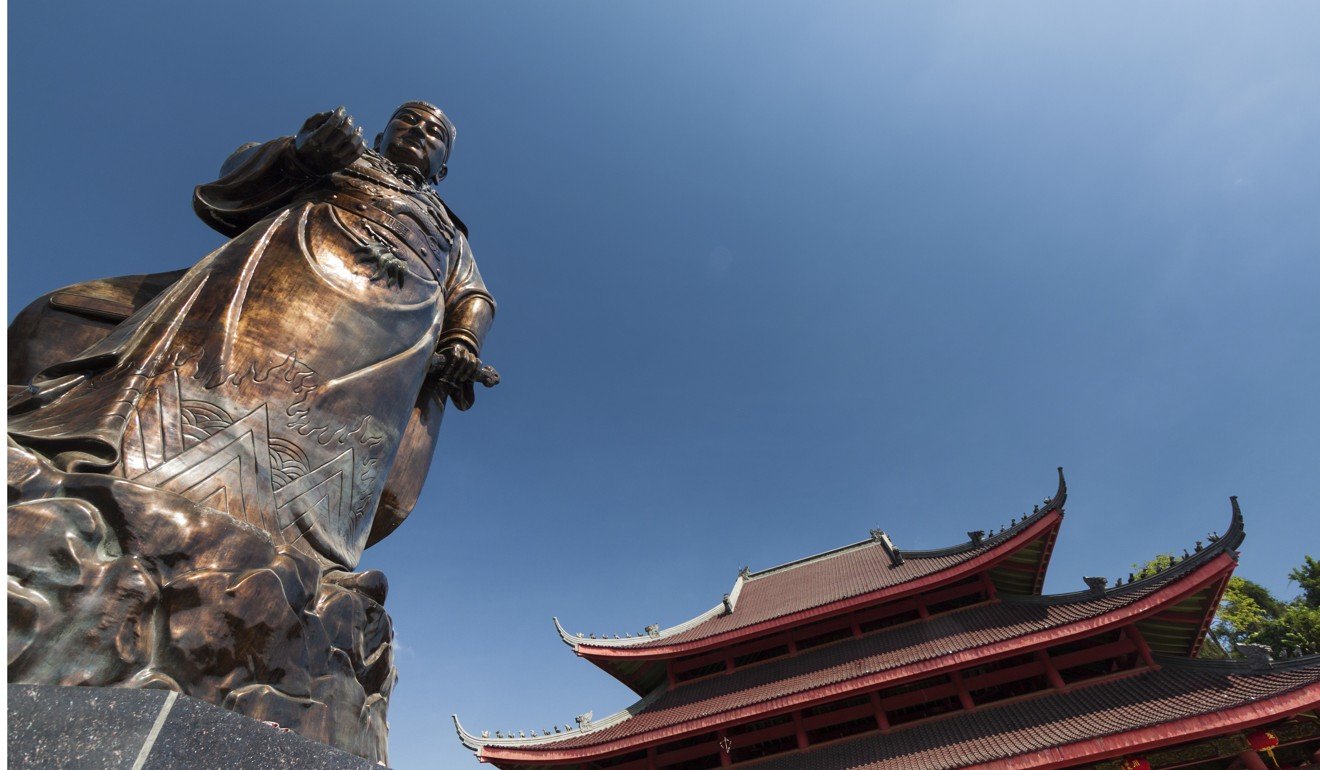
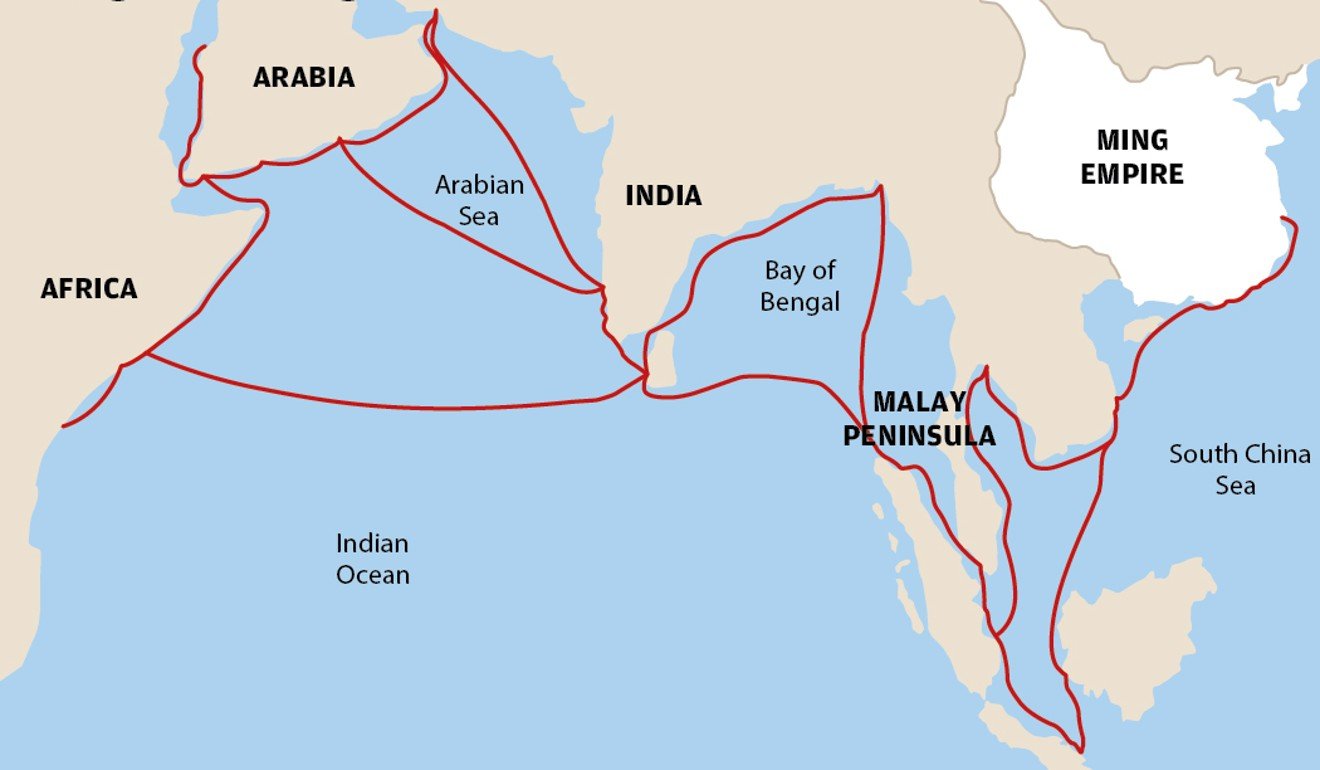
Zheng was born into a Muslim family in 1371. Castrated in his youth, he served as a eunuch in the imperial court before becoming a mariner and explorer. Between 1405 and 1433, he led seven expeditions, spreading Chinese influence across half the globe, from Southeast Asia to east Africa.
Sometime between 1410 and 1411, Zheng launched an attack on the island of Ceylon, the former name of Sri Lanka.
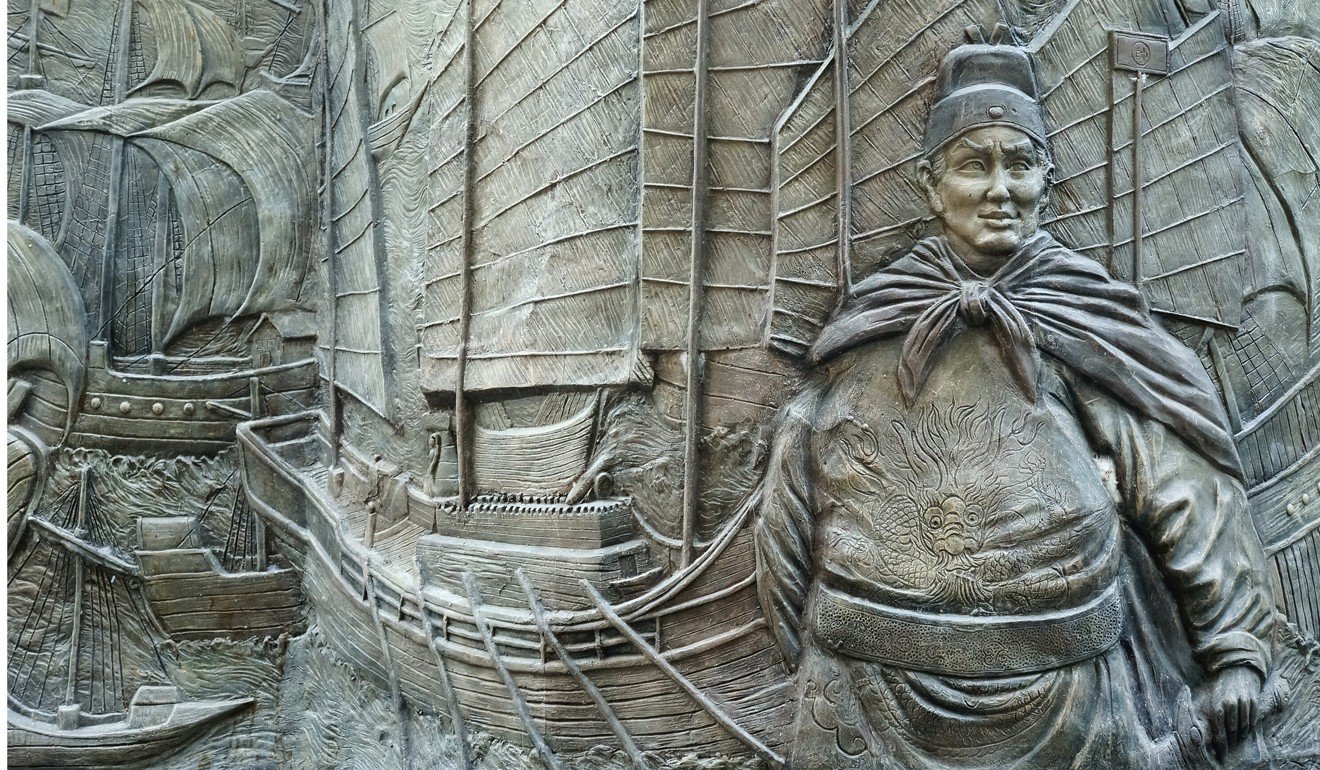
At the time, China had the world’s most powerful naval force. Zheng’s fleet comprised more than 300 vessels, of which about a fifth were “treasure ships”. Such vessels traditionally set sail laden with gold, silver, porcelain and silk as gifts to foreign leaders from the emperor, and returned to China with precious stones, ivory and other exotic valuables given in return.

According to Chinese historical records, the massive ships measured up to 127 metres in length and had nine giant masts. Some critics, however, have questioned such claims, arguing that even with 21st century design techniques, building a vessel of such dimensions entirely out of wood would be almost impossible.
Since 2015, a team of scientists and archaeologists funded by the Chinese government and using advanced military-grade sensing equipment, has conducted multiple surveys of the sea floor along the Sri Lankan coastline in the hope of locating the sunken treasure ship. The hope now is that the traces of evidence they have found can finally lead them to their goal.
In an article posted on the website of the Institute of Acoustics under the Chinese Academy of Sciences in October, the researchers said their latest investigations had produced “positive results”, which could mean they have located possible shipwreck sites or even discovered relevant artefacts.

Encouraged by those findings, Chinese government scientists and archaeologists from Sri Lanka would launch a new round of investigations later this month, a member of the team told the South China Morning Post.
“The investigation is still at a primitive stage,” said Professor Prishanta Gunawardhana from the department of archaeology at the University of Kelaniya and the lead researcher on the Sri Lankan side.
“A new study will take place in two weeks,” he said on Wednesday.
“We will use some advanced equipment brought over by our Chinese partners”, including a synthesised aperture sonar system capable of producing extremely high resolution images of underwater targets, he said.
The mission will be led by Professor Hu Changqing, director of the Shanghai Acoustics Laboratory at the Chinese Academy of Sciences. Hu has been involved in military projects and developed many new technologies for the Chinese navy, including a passive sonar system that allows submarines to avoid dangerous suboceanic currents. He could not be reached for comment.
To prevent it being compromised by treasure hunters, the precise details of the research project have been kept a closely guarded secret, according to the scientists involved.
Zhu Min, a researcher at the Institute of Acoustics in Beijing who has close knowledge of the project but is not directly involved, said China would provide a host of cutting-edge equipment for use in the mission, including Jiaolong, or Sea Dragon, a submersible capable of operating at depths of more than 7km.
“If the water allows for the operation of an optical observation device, we can send the Jiaolong [which can carry up to three people] down for a close-up look at the wreckage and retrieve samples for laboratory analysis,” he said.
If visibility was poor or currents made it too risky for a manned mission, the researchers could send down specialist deep sea robots to survey the site, Zhu said.
“If the temperature and salinity are right, it’s possible the ship’s wooden structures could have survived for six centuries,” he said.
“The biggest challenge is to separate those from fake targets such as rocks or other man-made debris … [that have] outlines extremely similar to the remnants of a ship.”
Since 2010, the Chinese government has funded numerous research expeditions along the possible routes taken by Zheng’s fleet – across the Middle East and east Africa – in a bid to provide concrete evidence of China’s maritime glory. The project in Sri Lanka is the only one still ongoing.
Niu Jianqiang, a professor of Ming dynasty history at Henan University in central China, said an archaeological breakthrough would help to settle some major questions.
Earlier finds, such as the discovery in Nanjing of the remnants of a dry dock matching the dimensions of one of Zheng’s ships, and a giant vessel’s rudder found in Zhejiang, were not in themselves indubitable evidence of the existence of the legendary fleet, he said.
Though accounts vary, the sea battle in which Zheng’s ship (or ships) were lost did not start well for the adventurer. Despite the size and power of his fleet, he was met with huge resistance from a force of about 50,000 people summoned by Ceylon’s King Alakeshvara.
According to one account, Zheng tactically deserted the naval battle and managed to land with 2,000 elite soldiers. They then cut through dense forest and launched a surprise attack on the king’s palace and took him hostage.
A century later, Chinese writer Yang Rong reflected on Zheng’s victory in a poem:
“Straight-away, their dens and hideouts we ravaged, and made captive that entire country, bringing back to our august capital, their women, children, families and retainers, leaving no one.”
As Yang wrote, Zheng returned to Beijing with the “disobedient” King Alakeshvara and his family and presented them to Ming emperor Yong Le. The emperor showed mercy and allowed them to return to Ceylon, but a new king had already been installed in his former kingdom.
While the Chinese researchers are optimistic about the upcoming search, their efforts to date have not been entirely trouble-free.
Earlier studies off the coast of Sri Lanka, which is close to several major shipping lanes, had been closely monitored by Indian officials, a researcher said on condition of anonymity.
“India treats the Indian Ocean as its home water. Any activity undertaken by China here is going to put nerves on edge, but we have got used to it,” the researcher said.
India’s foreign ministry did not respond to the Post’s request for comment.

Wednesday, 1 November 2017

The Rich Built Heritage Of Century-old St Andrew’s Presbyterian Church

As St Andrew's Presbyterian Church in Kuala Lumpur celebrates its 100th anniversary, we look at how its architecture and design has stood the test of time.

OCTOBER 26, 2017
The Rich Built Heritage Of Century-old St Andrew’s Presbyterian Church
The interior of the St Andrew's Presbyterian Church retains the building's original cengal rafters and pointed arch doorways. Photos: The Star/Art Chen
A long dark chain hangs down from a beam, stopping in mid-air, in front of the church. Its inconspicuous nature is largely due to the beautiful arched stained glass that forms the chain’s backdrop.
“I’ve been here for five years and this is the first time I’ve noticed it!” remarks resident minister Reverend Dr Robert Weniger with a laugh.
Luckily, the most senior parishioner of the Kuala Lumpur St Andrew’s Presbyterian church is present at our recent tour to shed some light on its existence.
St Andrew's Presbyterian Church KL
Keep has been attending church services for 30 years and is among the oldest parishioners there.
“Back in those days, we used to hang a huge round wheel with decorations on it during Christmas,” recalls Joyce Keep, 84, who has been a parishioner at St Andrew’s for almost 30 years.
Keep first set foot in Malaysia in 1958 to teach at the British Army School. In 1962, she was posted to Sabah, after which she left the country to teach in a few different places, including West Africa and Jordan. In 1977, she returned to Malaysia, got married, and settled down.
However, the church’s history dates back even further, much more than three decades. In fact, it celebrates 100 years of the laying of the building’s foundation stone this month.
Construction of the main sanctuary started on Oct 3, 1917. The initial design was created by John McNeill of Penang-based architecture firm Stark and McNeill.
But records from 1918 state that due to the long distance involved, a Mr Russell from the Singapore firm Swan and MacLaren took over the final plans and supervised the building work.
St Andrew's Presbyterian Church KL
An old photo of the church believed to have been circa 1922. Photo: St Andrew’s Presbyterian Church KL
On April 17, 1918, the church welcomed its first parishioners.
However, during World War II, the premises were taken over by the Japanese army and used as a store. The pipe organ’s steel pipes, milled in Britain, were looted, as were memorial brass tablets.
“We also had information that the manse (completed in 1921) next door was converted into a Japanese naval intelligence base,” says Kenneth Tan, who sits on St Andrew’s board of managers.
St Andrew's Presbyterian Church KL
A photo of the manse believed to be taken circa 1923.  Photo: St Andrew’s Presbyterian Church KL
Later, members of the KL Wesley Methodist Church came in and prevented further damage to the building.
Surprisingly, the Japanese Army agreed to allow the building to be re-used as a church by the Methodist congregation.
Nestled within less than a hectare (2 acres) of land, the unassuming building sports a toned-down Gothic style of architecture (no, there are no gargoyles anywhere).
St Andrew's Presbyterian Church KL
The flying buttresses on the exterior feature cast concrete panels.
Its design is characterised by pointed arches, ribbed vaults and gentle flying buttresses on the exterior walls, while the facade features a pebble dash and cast concrete look.
Over the century, the main sanctuary has undergone minimal changes.
The interior, which seats up to 200 people, is still protected by original cengal rafters overhead while 100-year-old porcelain tiles line the floor. However, due to the carpeting, the tiles are hidden.
Pointed arch doorways are seen on both side walls, while above them are square air vents that have since been sealed with frosted glass panels due to the air-conditioning.
“It used to be all opened up and naturally ventilated but with traffic getting busier (along Jalan Raja Chulan), it got to be so noisy that we could not hear the sermon! That’s when we decided to close up the main sanctuary and put in air-conditioning,” says church elder C.J. Lim.
“When the church was first built, it was like a ‘country church’ in the middle of nowhere. But now we are located right in the heart of the city,” Tan adds with a smile.
The sanctuary’s appeal is also heightened by its stained glass and pipe organ.
St Andrew's Presbyterian Church KL
The arched stained glass window, pipe organ and nyatoh cross are among the key features of the church.
“The primary stained glass in front is to commemorate those who died in both world wars. The one at the back is to remember those who fell during the Emergency,” explains Tan referring to the Malayan Emergency action against the communists from 1948 to 1960.
The pipe organ was purchased in 1939. Designed by KL-based organ builder James A. Riddell, it was the first complete new pipe organ to be installed in any church in Selangor.
With the exception of the 29 pipes milled in Britain, the organ was made using local labour within six months.
The organ’s casing consists of solid teak wood, the same material used for the pulpit panelling.
In 1992, an organ cross was added. Handcrafted by local Chinese carpenters from nyatoh, the cross is a replica of an 18th century brass altar cross found in the ancient church of Llandyfrydog, a western British isle. With a rather unconventional look, the design is a variation of the crux immissa (Latin cross).
A new bell tower and modern portico in glass and steel are in the works as part of St Andrew’s centenary celebrations next year marking when the church began services.
“We are quite excited about the bell tower, which we hope will be ready in time for next year’s celebration in April, because that’s when the doors of the church actually opened 100 years ago,” says Tan.
The current church bell, which was acquired in conjunction with the church’s 90th anniversary, will be placed within the tower.
Designed by local firm Veritas Architects, the contemporary-style tower will also house a new time capsule that will be opened in another 100 years.
St Andrew's Presbyterian Church KL
The century-old church is a little gem in the midst of busy Kuala Lumpur.
A previous capsule, buried behind the foundation stone, was opened recently; its contents form part of a small collection of historic items displayed at the church.
http://www.star2.com/culture/2017/10/26/the-architectural-heritage-of-century-old-st-andrews-presbyterian-church-continues-to-inspire/