ANOTHER study concludes that just one sugary drink a day can increase your risk of developing cardiovascular, or heart, disease.
The Star Malaysia
By NANCY CLANTON
A father and daughter check the ingredients label on a fruit drink at the supermarket. drinking sugary beverages daily, including fruit drinks with added sugar, can increase a person’s risk of heart disease. — Positive Parenting
ANOTHER study concludes that just one sugary drink a day can increase your risk of developing cardiovascular, or heart, disease.
Last year, researchers in France found that even one small glass of soft drink or sugary juice can increase your chances of getting cancer or having heart problems.
Now, in a study recently published in the Journal of the American Heart Association, California researchers in the United States have found that one serving daily of a sugary soft drink is associated with a higher risk of cardiovascular disease.
Sugar-sweetened beverages were defined as “caloric soft drinks, sweetened bottled waters or teas, and fruit drinks.”
For their study, the scientists questioned 106.178 women free from cardiovascular disease and diabetes mellitus in the California Teachers Study, a cohort of female teachers and administrators who have been followed since 1995.
The women were questioned for 20 years to determine beverage consumption and whether they had been diagnosed with heart disease, stroke or diabetes.
During those two decades, many of the women began showing signs of those conditions.
The study found that women who consumed fruit drinks with added sugar daily – “fruit drink” excluded fruit juices and included only flavoured fruity drinks with added sugar – were 42% more likely to develop cardiovascular disease, compared with those who drank no sugary beverages.
Frequent (but not daily) soft drinkers had less risk, with a 23% greater likelihood for cardiovascular disease overall.
The American Heart Association advises no added sugar for children younger than two years of age, no more than 100 calories from added sugar a day for children older than two years and most women, and no more than 150 calories from added sugar a day for most men.
That’s about six teaspoons or 24g of sugar for children older than two years and women, and nine teaspoons or 36g of sugar for men.
According to the Mayo Clinic in the US, one teaspoon of sugar (which equals about 4g) has about 16 calories.
A 12oz (355ml) can of regular soft drink has about 160 calories – about 10 teaspoons or 40g of sugar.
“We hypothesise that sugar may increase the risk of cardiovascular diseases in several ways,” said lead author Cheryl Anderson, a professor of family and public health at the University of California, San Diego.
“It raises glucose levels and insulin concentrations in the blood, which may increase appetite and lead to obesity – a major risk factor for cardiovascular disease.”
In addition, she said, excessive sugar is associated with inflammation, insulin resistance and type 2 diabetes.
To avoid consuming too much added sugar, the American Heart Association recommends reading labels.
Many foods – not just beverages – have sugar added, so checking labels can help keep amounts in check. – The Atlanta JournalConstitution/Tribune News Service
Speculation about a future coronavirus vaccine is ramping up and social-media posts from anti-vaccination campaigners are gaining more traction online.
We've been debunking a few recent claims.
By Jack Goodman and Flora CarmichaelBBC Reality Check 30 May 2020
Image copyrightTOBIAS SCHWARZ
Image captionConspiracy theorists around the world have put Bill Gates at the heart of their storiesWhy the microchip rumours don't stack up
First up, a conspiracy theory about vaccines that has spanned the globe.
It claims that the coronavirus pandemic is a cover for a plan to implant trackable microchips and that the Microsoft co-founder Bill Gates is behind it.
We've found no evidence to support these claims.
The Bill and Melinda Gates Foundation told the BBC the claim was "false".
The head of the Russian Communist party this week said that so-called "globalists" supported "a covert mass chip implantation which they may in time resort to under the pretext of a mandatory vaccination against coronavirus".
He didn't mention Mr Gates by name but in the US, Roger Stone, a former adviser to Donald Trump, said Bill Gates and others were using the virus for "microchipping people so we can tell 'whether you've been tested'."
A new YouGov poll of 1,640 people suggests that 28% of Americans believe that Bill Gates wants to use vaccines to implant microchips in people - with the figure rising to 44% among Republicans.
Rumours took hold in March when Mr Gates said in an interview that eventually "we will have some digital certificates" which would be used to show who'd recovered, been tested and ultimately who received a vaccine. He made no mention of microchips.
That response led to one widely shared article, under the headline: "Bill Gates will use microchip implants to fight coronavirus".
The article makes reference to a study, funded by The Gates Foundation, into a technology that could store someone's vaccine records in a special ink administered at the same time as an injection.
However, the technology is not a microchip and is more like an invisible tattoo. It has not been rolled out yet, would not allow people to be tracked and personal information would not be entered into a database, says Ana Jaklenec, a scientist involved in the study.
The Bill and Melinda Gates Foundation says: "The reference to 'digital certificates' relates to efforts to create an open-source digital platform with the goal of expanding access to safe, home-based testing."
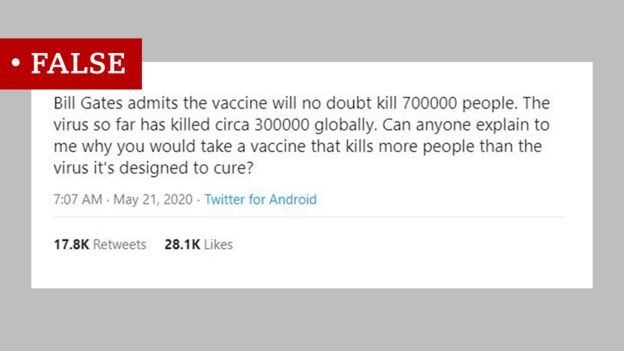
A recent post on a UK-based Twitter account said: "Bill Gates admits the vaccine will no doubt kill 700,000 people" and links to a video featuring right-wing conspiracy theorist Alex Jones.
The claim in the tweet, which has had more than 45,000 retweets and likes, is false and misrepresents Gates' words.
In the video, Mr Gates is talking about the efficacy of vaccines in older people and cautions about the risk of side-effects.
He sets out a hypothetical situation about the potential harm of side-effects, saying: "If we have one in 10,000 side-effects, that's way more... 700,000 people who will suffer from that."
He does not "admit" 700,000 will die from a vaccine.
Conspiracy theories about Bill Gates have reached the Italian Parliament, where an independent MP called for Bill Gates to be referred to the International Criminal Court for crimes against humanity.
One popular Italian video, which has been viewed more than 700,000 times on Facebook, has a caption claiming that the pandemic has been "invented".
The narrator of the clip is Stefano Montanari, an Italian researcher with a degree in pharmacology, who claims the end goal is to get everyone vaccinated.
He argues that the epidemic "will continue to be totally made-up" until there is a vaccine that "will bring money and corruption into the already full pockets of some".
He concludes: "This is a sensational hoax, but a very successful one."
There is no evidence whatsoever to support his theory that the pandemic is a hoax. It is true that whichever pharmaceutical company develops a vaccine could potentially profit from the success, but the idea that this potential profit would be a motive to invent a pandemic is far-fetched.
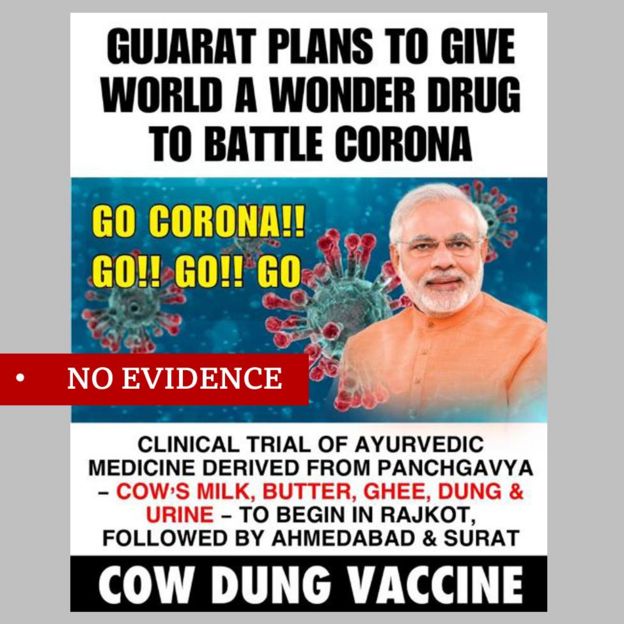
Image captionThe meme features an image of Indian Prime Minister Narendra Modi.
Cow-dung vaccine?
A Facebook meme announcing a "wonder drug to battle corona" and a "cow-dung vaccine" has been shared widely on Facebook in India.
Some of the posts, including one shared more than 1,000 times, link to a front-page story from the Ahmedabad Mirror, which reports that a trial of medicine derived from cow's milk, butter, ghee, dung and urine is under way.
The cow is considered sacred in Hinduism and some Hindu groups have claimed that drinking cow urine could boost immunity against the virus - a claim we've looked at before.
However, there is no scientific evidence to support this theory, and the trial described in the Ahmedabad Mirror does not mention testing cow dung as a vaccine or prophylactic treatment.
The article quotes a doctor as saying: "Cow urine is known to have medicinal components that can cure Covid-19." In fact there is no known cure for coronavirus.
We asked Dr Rajni Kant, a biologist and head of research at the Indian Council for Medical Research, about the use of cow urine or dung as a treatment.
He said: "We don't have any significant evidence or study to quote that these have any efficacy against Covid-19. We don't have significant evidence or study to quote anything."
The Rashtriya Kamdhenu Aayog, part of India's Ministry of Agriculture, confirmed there will be trials for a Covid treatment combining cow urine, dung, butter, ghee and milk - but not a vaccine.
A secondary school student gets vaccinated against TB as her younger sister looks on in this filepic. The BCG vaccine that protects against TB is a live-attenuated vaccine.
Antibodies are proteins produced by our immune system to help defend our body against foreign invaders such as bacteria or viruses.
According to the World Health Organization (WHO), vaccination is one of the most effective methods to prevent diseases such as measles, polio, tetanus, diphtheria, meningitis, influenza, typhoid and cervical cancer.
These are diseases that are mainly caused by infections and spread from person to person.
Vaccines are like a training course for the immune system to recognise and combat pathogens.
They prepare the body by building immunity against specific diseases without actually causing the illness.
They do so by introducing antigens from the pathogens that cause these diseases into the body.
Antigens are molecules or molecular structures made up of proteins, carbohydrates or other polymers, which are found on the surface of pathogens and can trigger the immune response.
The immune system reacts to these foreign antigens by producing antibodies that will specifically target them for destruction.
If similar pathogens attack the body in the future, the immune system will be capable of recognising these antigens immediately for faster antibody production before the pathogens can cause an illness.
Types of vaccines
There are various types of vaccines designed to teach our immune system to fight against different kinds of bacteria or viruses.
They are categorised according to the antigen used in their preparation, as follows:
Live-attenuated vaccines
This vaccine uses a weakened (or attenuated) form of the bacteria or virus that causes the disease.
The virulence (harmfulness) of the pathogen is reduced, but it is still viable (alive).
Live-attenuated vaccines stimulate excellent and long-lasting immune responses because they are relatively similar to the natural infection.
However, due the minute amount of weakened live bacteria or virus in the vaccine, people with weakened immune systems, chronic diseases or organ transplants should seek advice from a doctor before getting vaccinated with this type of vaccine.
Live vaccines are commonly used to protect against:
Chickenpox
Measles, mumps and rubella (via the combined MMR vaccine)
Rotavirus
Smallpox
Tuberculosis (via the BCG vaccine)
Yellow fever
Inactivated vaccines
This vaccine is made from the whole bacteria or virus, which has been killed and cannot cause disease.
However, this vaccine is unable to provide as long-lasting an immune response as compared to a live-attenuated vaccine, and usually requires repeated doses and/or booster shots.
Inactivated vaccines are commonly used to protect against:
Cholera
Hepatitis A
Japanese encephalitis (JE)
Influenza (Flu)
Rabies
Subunit, recombinant, polysaccharide and conjugate vaccines
These vaccines use specific pieces of the bacteria or virus, like proteins or polysaccharides (sugars) from the surface of the bacteria or virus.
Although the vaccine may only consist of a few, yet specific, proteins out of the thousands in bacteria, for example, it is sufficient to trigger the immune response to protect against the disease.
This type of vaccine may also require booster shots for continued protection against a disease.
These vaccines are commonly used to protect against:
Hepatitis B
HPV (Human papillomavirus)
Pneumococcal disease
Meningococcal disease
Shingles
Toxoid vaccines
This vaccine is made with an inactivated version of the toxin (known as a toxoid) produced by certain bacteria when they attack the human body.
Our immune system is able to recognise these toxoids just like how they recognise the proteins or polysaccharides from the surfaces of bacteria or viruses.
Thus, this vaccine triggers a strong immune response.
Toxoid vaccines are used to protect against:
Diphtheria
Tetanus
A new type of vaccine
Using DNA as an integral part of a vaccine is the next step in vaccine technology. — TNS
With current advancements in the field of immunology, genetic immunisation, also known as a deoxyribonucleic acid (DNA) vaccine, is a rapidly developing technology in disease prevention.
In such a vaccine, the DNA or genetic sequence that codes for the antigen of interest, against which an immune response is sought, is introduced into the body.
DNA vaccines against influenza have been in development since the 1990s.
Such vaccines for various viral and bacterial infections such as tuberculosis, anthrax, malaria, dengue and typhoid, and even some cancers, have been undergoing clinical trials.
DNA vaccine technology is gaining in popularity as several veterinary DNA vaccines have already been licensed, such as the first commercial DNA vaccine against H5N1 in chickens.
A DNA vaccine is simpler to produce compared to a live-attenuated vaccine, and potentially cheaper to produce than recombinant vaccines.
Importantly, the immune response is focused only on the antigen of interest and provides long-term immunity.
A DNA vaccine that is heat-stable and easy to store and ship will have a positive impact on vaccine availability, especially in areas where there is a limited access to resources and electricity.
Despite its promise, there are challenges, constraints and limitations facing a DNA vaccine, like:
Safety issues concerning the system, which may activate oncogenes (genes that have the potential to cause cancer) as a result of genomic incorporation of immunising DNA
Inducing antibody production against DNA, and
Reduced levels of immunity.
Nevertheless, DNA vaccines hold future promise for the field of immunisation.
Numerous ongoing studies on the strategies for construction and delivery of DNA vaccines offer valuable insights that can be applied to further refine current DNA vaccine platforms.
Dr Wendy Yeo Wai Yeng is a lecturer in biochemistry and medical biotechnology at the Perdana University Graduate School of Medicine. This article is courtesy of Perdana University. For more information, email starhealth@thestar.com.my. The information provided is for educational and communication purposes only and it should not be construed as personal medical advice. Information published in this article is not intended to replace, supplant or augment a consultation with a health professional regarding the reader’s own medical care. The Star disclaims all responsibility for any losses, damage to property or personal injury suffered directly or indirectly from reliance on such information.