The study was the first to examine the impact of LEDs in a real-world setting. Photograph: Douglas Boyes/Science Advances
“Eco-friendly” LED streetlights produce even worse light pollution for insects than the traditional sodium bulbs they are replacing, a study has found.
The abundance of moth caterpillars in hedgerows by rural roads in England was 52% lower under LED lights and 41% lower under sodium lights when compared with nearby unlit areas.
In grass margins, moth caterpillar numbers near LEDs were a third lower than in unlit areas, whereas sodium lights had little effect on abundance. The white LED lights are more energy efficient but produce more blue light, say scientists, which is the colour predominantly seen by insects.
Moths are important pollinators and provide essential food for birds and animals, but the total abundance of moths in Britain has dropped by a third over the past 50 years.
The study is the first to examine the impact of LEDs in a real-world setting and the first to show the direct impact of light pollution on caterpillars. The caterpillars are less mobile than adult moths, and therefore show more precisely the local losses caused by light pollution.
The researchers said flying moths were attracted by light but may then be more vulnerable to predators, meaning they lay fewer eggs. They said the wide range of moth species they studied suggested their results would apply to other nocturnal insects.
“It’s a really striking result,” said Douglas Boyes, of the UK Centre for Ecology and Hydrology, who led the new research. “We found numbers that you’re not really used to ecology. You usually find maybe 5-10% changes here and there, but we found up to 50% drops in the number of caterpillars in the areas lit by streetlights.
“LEDs are the baddies in our story, if you like, because they’re worse in terms of their effect at the moment, but they also have the potential to be much better than sodium lighting.”
LEDs are dimmable, can be linked to motion sensors and can have cheap filters fitted to screen out blue light. LEDs are energy efficient, leading to reduced climate-warming emissions. They are often brighter than sodium lamps, although not at the locations in the study.
Prof Darren Evans, of Newcastle University, who was part of the study, said: “Light pollution is one of the few causes of biodiversity loss that has easy [and immediate] solutions. We need a balance between protecting both public safety and wildlife, by ensuring that lighting is well designed, away from important habitats and switched on for limited times.” Bat-friendly red lighting was installed on a road in Worcestershire in 2019.
Matt Shardlow, of the insect charity Buglife, said: “This new evidence demonstrates the massive impact that light pollution is having on local populations of insects, contributing to the terrible decline in insect abundance we have all observed.
Insect populations are suffering “death by a thousand cuts”, with many falling at “frightening” rates that are “tearing apart the tapestry of life”, according to scientists behind a volume of studies published earlier in 2021.
The latest research, published in the journal Science Advances, studied 26 pairs of roadside sites in Oxfordshire, Buckinghamshire and Berkshire, where lit and unlit sections were on average 100 metres apart. Boyes spent more than 400 hours sampling more than 2,000 caterpillars.
The scientists are using DNA analysis to see whether parasitic wasps lay their eggs more frequently in caterpillars in lit areas, which could be an additional explanation for the lower populations.
Boyes said better protecting moths was essential. “We’ve got 2,500 species in the UK. They’re really important as prey for birds, bats, hedgehogs and other predatory invertebrates. But they’re also really important pollinators. They do the night shift after the daytime pollinators have gone to bed.”
A spokesperson for the Department for Environment, Food and Rural Affairs said: “Insects are a vital part of our natural environment and protecting them is a priority. We have set a legally binding target for species abundance for 2030, which will drive the right mix of actions to address the loss of wildlife, including insects, and address the interacting pressures on biodiversity such as light pollution.”
The light-emitting diode (LED) is rapidly replacing earlier lighting technology, including incandescent bulbs and compact fluorescent lamps (CFLs). There’s good reason for this, as LEDs are far more energy efficient, longer-lasting and produce excellent light quality compared to other types of lighting.
July 16, 2016
Story at-a-glance
The American Medical Association (AMA) issued new guidance for communities on how to “reduce the harmful human and environmental effects of high-intensity [LED] street lighting”
LED streetlights operate at a wavelength that adversely suppresses melatonin at night — five times more so than other types of light
Discomfort and disability caused by the intense LED lighting may “decrease visual acuity and safety, resulting in concerns and creating a road hazard”
Migrating birds and other wildlife may be disoriented by LED lighting at night
By Dr. Mercola
The light-emitting diode (LED) is rapidly replacing earlier lighting technology, including incandescent bulbs and compact fluorescent lamps (CFLs). There’s good reason for this, as LEDs are far more energy efficient, longer-lasting and produce excellent light quality compared to other types of lighting.
For instance, according to the U.S. Department of Energy (DOE), LED lights use at least 75 percent less energy, while lasting 25 times longer than incandescent lighting.1
It’s estimated that compared to no LED use, widespread LED use in the U.S. by 2027 could save the equivalent electrical output of 44 large electric power plants each year, which would add up to a total of at least $30 billion in savings, according to DOE.2
LEDs are different from incandescent bulbs in three key ways. One, they emit very little heat compared to incandescent bulbs and CFLs, which release 90 percent and 80 percent of their energy as heat, respectively.
Two, LEDs emit light in a specific direction, which make them very efficient and reduces the need for reflectors and diffusers.
Finally, LEDs contain a mix of red, green and blue light, which is usually combined to make white light.3 The light is brighter, whiter and bluer than incandescent bulbs, which contain far more yellow and red light.
The “white” LED light is so bright and energy efficient that about 10 percent of U.S. municipalities are now using it for their streetlights, with more expected to follow suit.4 Unfortunately, in making this change a new set of potential problems has emerged.
American Medical Association Gives Warning About LED Streetlights
At the 2016 Annual Meeting of the American Medical Association (AMA), the AMA issued new guidance for communities on how to “reduce the harmful human and environmental effects of high-intensity [LED] street lighting.”
AMA Board Member Dr. Maya A. Babu said in a news release, "Despite the energy efficiency benefits, some LED lights are harmful when used as street lighting.”5
The guidance focused on high-intensity LED lighting, which emits a large amount of blue light and appears white to the naked eye. Risks noted by the AMA include risks to nighttime drivers, including:
Worse nighttime glare than conventional lighting
Discomfort and disability caused by the intense lighting may “decrease visual acuity and safety, resulting in concerns and creating a road hazard”
The AMA also pointed out that blue-rich LED streetlights operate at a wavelength that adversely suppresses melatonin at night — far more so even than other types of light. The AMA noted white LED lights “have five times greater impact” on circadian sleep rhythms than conventional street lamps.
This in turn, may lead to problems with sleep and related conditions. They cited “recent large surveys” that found brighter nighttime light in communities is linked with:
Reduced sleep times
Dissatisfaction with sleep quality
Excessive sleepiness
Impaired daytime functioning
Obesity
Residents Demand Removal of Harsh LED Lighting
Residents living in communities that have made the switch to LED have gone so far as to demand the harsh lighting be removed. Such was the case in Davis, California, where new LED streetlights were installed in January 2014.
By May that year, negative public reactions caused the city council to put the light replacement project on hold. According to the Smart Outdoor Lighting Alliance (SOLA), which promotes ecologically responsible outdoor lighting:6
“The city received 40 comments by residents of which 36 or 90 percent were negative.
The complaints were focused on the new fixtures being too bright, producing too much glare and light trespass, increasing skyglow and light pollution, and resulting in potential negative impact on human health and wildlife.
… [T]he City of Davis should be commended for listening to the residents once the installation was started and for having the courage to remedy the problems that were communicated.”
Ultimately, the new LED fixtures (some 1,400 that had already been installed) were replaced with lower-intensity bulbs.
A similar scenario occurred in New York City, where hundreds of people launched a petition in protest of LED streetlights, comparing them to “an emergency construction zone,” “a zombie picnic” and “the ‘Close Encounters’ mothership.”7
In response, the city has swapped out some of the lights with lower wattage LED bulbs.
Why LED Lights’ Significant Impact on Melatonin Is a Big Deal
The fact that LED lights suppress the hormone melatonin significantly more so than other lighting is a serious issue — and here’s why. Your brain typically starts secreting melatonin around 9 or 10 p.m., which makes you sleepy.
These regularly occurring secretions help regulate your sleep cycle as well as provide other important health benefits, including helping to prevent cancer.
Melatonin acts as a marker of your circadian phase or biological timing. In a nutshell, this hormone influences what time of day or night your body thinks it is, regardless of what time the clock on the wall displays.
Melatonin is produced by a pea-sized gland in the middle of your brain called the pineal gland. In a normal night's sleep, your melatonin levels stay elevated for about 12 hours.
Then, as the sun rises, your pineal gland reduces your production of melatonin, and the levels in your blood decrease until they're hardly measurable at all. When your circadian rhythms are disrupted, such as from shift work, jet lag or nighttime light exposure, your body produces less melatonin.
Melatonin deficiency may come with some profound biological disadvantages, such as higher levels of inflammation, a weakened immune system and an increased risk of cancer.
If you’re exposed to LED lighting often at night (such as if LED streetlights shine in your bedroom window), it could have a profoundly negative influence on your health.
AMA: Light Pollution Via LED Streetlights Poses Environmental Risks
It’s not only humans that may be harmed by widespread adoption of LED streetlights. Wildlife is also adversely affected. Hundreds of bird species migrate at night, for instance, and bright LED lighting may disorient the birds and draw them toward the light.
Some birds die from colliding with buildings lit up with LED lights while others circle the buildings, seemingly unable to break away from the LED trance. Many die of exhaustion as a result.8 Other species that depend on dark nighttime environments are also harmed by the bright LED lights. AMA explained:
“ … [P]oorly designed LED lighting disorients some bird, insect, turtle and fish species, and U.S. national parks have adopted optimal lighting designs and practices that minimize the effects of light pollution on the environment.”
AMA Recommends Minimizing Use of Blue-Rich Light at Night
Red and amber lights will not suppress melatonin, while blue, green and white lights will. The reason for this is because these are the wavelengths that are the most common outdoors during daytime hours. To protect your melatonin production, it’s important to avoid the blue light wavelength after sunset.
This includes the light emitted by electronics such as your TV, computer and other electronic screens. AMA also recognized the importance of minimizing blue-light exposures, stating:9
“Recognizing the detrimental effects of poorly-designed, high-intensity LED lighting, the AMA encourages communities to minimize and control blue-rich environmental lighting by using the lowest emission of blue light possible to reduce glare. The AMA recommends an intensity threshold for optimal LED lighting that minimizes blue-rich light.
The AMA also recommends all LED lighting should be properly shielded to minimize glare and detrimental human health and environmental effects, and consideration should be given to utilize the ability of LED lighting to be dimmed for off-peak time periods.”
Do This at Sundown to Protect Your Health
In the evening (around 8 p.m.), you’ll want to dim your lights (whether they’re LED, incandescent or CFLs) and turn off electronic devices to reduce your exposure to light that may stifle your melatonin production. After sundown, shift to a low-wattage bulb with yellow, orange or red light if you need illumination. A salt lamp illuminated by a 5-watt bulb is an ideal solution that will not interfere with your melatonin production.
If using a computer or smartphone, install blue light-blocking software like f.lux, which automatically alters the color temperature of your screen as the day goes on, pulling out the blue wavelengths as it gets late. The easiest solution, which I recently started using myself, however, is to simply use amber-colored glasses that block blue light.
I found a Uvex model (S1933X) on Amazon that costs less than $10 and works like a charm to eliminate virtually all blue light. This way you don't have to worry about installing programs on all your devices or buying special light bulbs for evening use.
Once you have your glasses on, it doesn't matter what light sources you have on in your house. You can even wear these glasses outdoors at night if you’ll be traveling in an area with LED streetlights. When you’re ready to climb into bed, make sure your bedroom is pitch black. The slightest bit of light in your bedroom can disrupt your body’s clock and your pineal gland's melatonin production.
It’s a good idea to cover your windows with drapes or blackout shades to achieve this — especially if you have LED streetlights outside your bedroom window. If this isn’t possible, wear an eye mask.
Can light affect your health? In this interview, Dr. Alexander Wunsch, a world class expert on photobiology, shares the hidden dangers of light-emitting diode (LED) lighting that most people are completely unaware of.
October 23, 2016|245,158views
Story at-a-glance
Near-infrared is important as it primes the cells in your retina for repair and regeneration, which explains why LEDs — which is devoid of infrared — are so harmful for your eyes and health
One-third of the energy your body consumes comes from the food you eat. The vast majority of the energy your body needs to maintain the systemic equilibrium comes from environmental infrared light exposure
LEDs sabotage health and promote blindness. Limit your exposure to blue light during the daytime and at night. Swap out LEDs for incandescents or low-voltage incandescent halogen lights
By Dr. Mercola
Can light affect your health? In this interview, Dr. Alexander Wunsch, a world class expert on photobiology, shares the hidden dangers of light-emitting diode (LED) lighting that most people are completely unaware of.
In fact, this could potentially be one of the most important video interviews I've done, as it has enormous impacts — not only on preventing blindness as you age but it is also a pervasive hidden risk factor for sabotaging your health.
Largely as a result of energy efficiency, there's been a major transition to using LED as a primary indoor light source. In this regard, it worked like a charm, reducing energy requirements by as much as 95 percent compared to incandescent thermal analog sources of lighting.
However, the heat generated by incandescent light bulbs, which is infrared radiation, is actually beneficial to your health, and hence worth the extra cost.
There are major downsides to LEDs that are not fully appreciated. LED lighting may actually be one of the most important, non-native EMF radiation exposures you're exposed to on a daily basis.
If you chose to ignore these new insights, it can have very serious long-term ramifications. It could lead to age-related macular degeneration (AMD), which is the leading cause of blindness in the United States and elsewhere.
Other health problems rooted in mitochondrial dysfunction may also be exacerbated, and these run the gamut from metabolic disorder to cancer.
What Is Light?
The definition of light, as applied to artificial light sources, is rather distinct. Visible light is only between 400 nanometers (nm) and 780 nm, but "light" is actually more than just what your eye can perceive. As explained by Wunsch:
"When we look at sunlight, we have a much broader spectral range, from somewhere around 300 nm up to 2,000 nm or so. For our energy efficiency calculation, it makes a big difference if we are talking about this broad natural range or if we are only talking about … vision performance
[T]he definition that we are only looking at the visible part of the spectrum [given in the 1930s] … led to the development of energy-efficient light sources like the fluorescent lamps or what we have nowadays, the LED light sources, because they are only energy efficient as long as you take the visible part of the spectrum [into account] …
[F]or example, [lamps providing] phototherapy with red light can be used in medical therapy to increase blood circulation, and this is a part we are taking away as long as we only look at the visible part.
Physicists think that infrared radiation is just thermal waste. But from the viewpoint of a physician, this is absolutely not true; in the last 30 years there have been hundreds of scientific papers published on the beneficial aspects of a certain part in the spectrum, which is called near-infrared or infrared-A."
What Makes Near-Infrared so Special?
You cannot feel near-infrared as heat, and you cannot see it, but it has a major beneficial impact in terms of health. Near-infrared is what's missing in non-thermal artificial light sources like LED.
There's also a difference between analog and digital forms of light sources, and this difference is another part of the complexity. In essence, there are two separate but related issues: the analog versus digital light source problem, and the spectral wavelength differences.
Starting with the latter, when you look at the rainbow spectrum, the visible part of light ends in red. Infrared-A or near-infrared is the beginning of the invisible light spectrum following red. This in turn is followed by infrared-B (mid-infrared) and infrared-C (far-infrared).
While they cannot be seen, the mid- and far-infrared range can be felt as heat. This does not apply to infrared-A, however, which has a wavelength between 700 and 1,500 nm.
"Here you have only very low absorption by water molecules, and this is the reason why radiation has a very high transmittance," Wunsch says.
"In other words, it penetrates very deeply into your tissue, so the energy distributes in a large tissue volume. This near-infrared A is not heating up the tissue so you will not feel directly any effect of heat.
This significantly changes when we increase the wavelength, let's say, to 2,000 nm. Here we are in the infrared-B range and this already is felt as heat. And from 3,000 nm on to the longer wavelength, we have almost full absorption, mainly by the water molecule, and this is [felt as] heating."
Near-Infrared Is Critical for Mitochondrial and Eye Health
The near-infrared range affects your health in a number of important ways. For example, it helps prime the cells in your retina for repair and regenerate.
Since LEDs have virtually no infrared and an excess of blue light that generates reactive oxygen species (ROS), this explains why LEDs are so harmful for your eyes and overall health.
Chromophores are molecules that absorb light. There's an optical tissue window that ranges from 600 to 1,400 nm, which means it is almost completely covered by the infrared-A part of the spectrum. This optical tissue window allows the radiation to penetrate several centimeters or at least an inch or more into the tissue.
Chromophores are found in your mitochondria and in activated water molecules. In your mitochondria, there's also a specific molecule called cytochrome c oxidase, which is involved in the energy production within the mitochondria. Adenosine triphosphate (ATP) — cellular energy — is the end product.
ATP is the fuel your cells need for all of their varied functions, including ion transport, synthesizing and metabolism. Remarkably, your body produces your body weight in ATP every day. And, while you can survive for several minutes without oxygen, were all ATP production to suddenly stop, you'd die within 15 seconds.
Lighting Plays an Important Role in Biological Energy Production
This is why this issue of lighting is so important. Light is a sorely misunderstood and overlooked part of the equation for biological energy production, specifically at themitochondrial ATP level. As further explained by Wunsch:
"The cytochrome c oxidase, which is this [light] absorbing molecule, is the last step before the ATP is finally produced in the mitochondria. Here we have this tipping point where light in a wavelength range between 570 nm and 850 nm is able to boost energy production, especially in cells when energy production is depleted …
We know today that many signs of aging, for example, are the consequence of hampered mitochondrial functioning, and so we have a very interesting … tool to enhance the energy status in our cells, in the mitochondria in our cells, and not only on the surface but also in the depths … of the tissue. This is one important aspect and there are hundreds of papers published on these positive effects …
Infrared saunas are another magnificent way to nourish your body with near-infrared light. But not just ANY infrared sauna. Most offer only FAR-infrared and are not full spectrum. Most also emit dangerous non-native EMFs. So you need one that emits low or no non-native EMFs.
After searching for a long time I finally found a near perfect one and hope to have it made to my customized specs in a few months. And it should be significantly less than $1,000. So stay tuned for this exciting development.
Wound Healing and Anti-Aging Procedures Make Use of Near-Infrared
These beneficial effects can be seen in wound healing and anti-aging procedures where near-infrared is employed. Since the cytochrome c oxidase is responsible for an increased production of ATP, the cell has a better supply of energy, which allows it to perform better, and this is true no matter where the cell resides.
This means liver cells with more ATP will be able to detoxify your body more efficiently; fibroblasts in your skin will be able to synthesize more collagen fibers and so on, because ATP is crucial for all cellular functions. Wunsch expands on this even more in the lecture above.
According to Wunsch, as little as one-third of the energy your body requires for maintaining the thermal equilibrium comes from the food you eat. The electrons transferred from the food, primarily the fats and the carbohydrates, are ultimately transferred to oxygen and generate ATP. The more near infrared you get, the less nutritional energy is required for maintaining thermal homeostasis.
That said, a differentiation is in order. Most of the METABOLICALLY USED energy does come from food. But there is a thermodynamic aspect to it as well. Maintaining a normal body temperature (37 degrees C or 98.6 degrees F) involves two mechanisms: Energy production in your mitochondria from food, and photonic energy (near-infrared radiation from sunlight and incandescent light bulbs) that is able to penetrate deeply into your tissue, even through clothing.
"The radiation can enter your body and then be transformed into longer wavelengths in the infrared part. They are very important for supporting the temperature level, the thermal energy level, of our body which is … a very crucial aspect. A lot of energy comes in the form of radiation and this is supporting our thermal balance," Wunsch explains.
The key take-home message here is that your body's energy production involves not just food intake. You also need exposure to certain wavelengths of light in order for your metabolism to function optimally. This is yet another reason why sun exposure is so vitally important for optimal health.
Analog Versus Digital Lighting
LED lamps are a form of digital non-thermal lighting whereas incandescent light bulbs and halogens are analog thermal light sources.
"For a color changing system you have three different LEDs, a red, a green and a blue LED, and the intensity of these three colored channels has to be changed in order to achieve different color use, which is perceived by the eye in the end. The control of the intensity output of an LED is realized in a digital manner because it's very difficult to have a low intensity in many different steps.
The dimming of LEDs is realized by a so-called pulse-width modulation, which means the LEDs switch on to the full intensity and then they fully switch off, and then they switch on again. So we have the constant on and off in frequencies, which are higher than our eyes are able to discriminate. But on the cellular level, it is still perceivable for the cells …
[T]his causes a flicker, which is not perceivable for let's say 90 percent of the population. But it's still biologically active. And flicker is something that is very harmful to your [biology]."
You've likely experienced this if you're old enough to recall the older TVs that had a very visible and intense flicker. Modern flat screens do not have this perceptible flicker, but they're still switching on and off. Scientists are now trying to develop systems capable of transmitting information via high-frequency flicker in the LED lighting to replace the wireless LAN system. According to Wunsch, this is a very bad idea, from a health perspective.
"I call these LEDs Trojan horses because they appear so practical to us. They appear to have so many advantages. They save energy; are solid state and very robust,. So we invited them into our homes. But we are not aware that they have many stealth health-robbing properties, which are harmful to your biology, harmful to your mental health, harmful to your retinal health, and also harmful to your hormonal or endocrine health," he says.
Unfortunately, the use of LEDs has been mandated by federal policy in both the U.S. and much of Europe, in an attempt to conserve energy. While inarguably effective in that regard, the biological impact of these bulbs has been completely ignored, and by mandating them, options have been restricted.
Understanding the Dangers of LEDs
Understanding how LEDs can harm your health begins with the recognition that light emitted from an LED bulb is of a different quality than a natural light source. Normally, a natural light source is a black body radiator that gives off all kinds of wavelengths in a more or less continuous manner.
LEDs are fluorescent lamps, consisting of a blue LED, a driver LED, and a fluorescent sheet that covers the blue LED, transforming part of the blue light into longer wavelengths, thereby creating a yellowish light. The yellowish light from the fluorescent layer combines together with the residual blue light to a kind of whitish light, a large portion of which is an aggressive blue light.
"Blue has the highest energy in the visible part of the spectrum and produces, infuses, the production of ROS, of oxidative stress," he says.
"The blue light causes ROS in your tissue, and this stress needs to be balanced with near-infrared that is not present in LEDs. We need even more regeneration from blue light, but the regenerative part of the spectrum is not found in the blue, in the short wavelength, part. It's found in the long wavelength part, in the red and the near-infrared. So tissue regeneration and tissue repair results from the wavelengths that are not present in an LED spectrum.
We have increased stress on the short wavelength part and we have reduced regeneration and repair on the long wavelength part. This is the primary problem … [W]e don't have this kind of light quality in nature. This has consequences. The stress has consequences in the retina; it has consequences in our endocrine system."
You probably know by now that blue light in the evening reduces melatonin production in your pineal gland. But you also have cells in your retina that are responsible for producing melatonin in order to regenerate the retina during the night.
If you use LED lights after sunset, you reduce the regenerative and restoring capacities of your eyes. Needless to say, with less regeneration you end up with degeneration. In this case, the degeneration can lead to AMD, which is the primary cause of blindness among the elderly. However, and this is that most fail to appreciate, LED light exposure that is not balanced with full sunlight loaded with the red parts of the spectrum is always damaging to your biology. Just more so at night.
So, to summarize, the main problem with LEDs is the fact that they emit primarily blue wavelengths and lack the counterbalancing healing and regenerative near-infrared frequencies. They have very little red in them, and no infrared, which is the wavelength required for repair and regeneration.
When you use these aggressive lower frequencies — blue light — it creates ROS that, when generated in excess, causes damage. So when using LEDs, you end up with increased damage and decreased repair and regeneration.
Are There Any Healthy LEDs?
There's a wide range of LED lights on the market these days. Some are cool white, others are warm white, for example. The former emits higher amounts of harmful blue light. The warm LEDs can be deceptive, as they give out a warm-appearing light but do not actually have the red wavelength. The warmth comes from masking the blue with high amounts of yellow and orange.
There are also LEDs available with less blue, which are closer to the spectral distribution of incandescent lamps with regard to the blue part of the spectrum. Unfortunately, without tools to measure it, you won't know exactly what you're getting. This is in sharp contrast to an incandescent light bulb, where you know exactly what kind of light spectrum you're getting.
"With LED, the layman is not able to tell if it's a tailored spectrum where you have the blue part only masked by excessive parts of other spectral regions," Wunsch says. "There are different technologies … Soraa, for example, have violet driver LED, not blue … By their technology, the red is a little bit more emphasized compared to the standard white light fluorescent LEDs.
So there are in fact better and worse LED types around. But the spectral distribution is just one thing … We are interested in the R9, which represents the full reds. This information is sometimes given on the package. You have, for example, CRI, which is the color rendering index of 95 with an R9 of 97 or so. This is the only sign for the customer that you have a high level or a high index for the R9."
How to Identify a Healthier LED
So, when buying LEDs, one way to get a healthier light is to look at the CRI. Sunlight is the gold standard and has a CRI of 100. So do incandescent light bulbs and candles. What you're looking for is a light that has an R9 (full red spectrum) CRI of about 97, which is the closest you'll ever get to a natural light with an LED. Another factor to look at is the color temperature. There are two different kinds of color temperature:
1.Physical color temperature, which means the temperature of your light in degrees Kelvin (K). This applies to sunlight, candlelight, incandescent lamp light and halogens. What this means is that the source itself is as hot to the touch as the color temperature given.
The sun, for example, which has a color temperature of 5,500 K, has a temperature of 5,500 K at its surface, were you to actually touch the sun. Incandescent lamps have a maximum of 3,000 K, as the filament would melt if the temperature got any higher.
2.Correlated color temperature. This is a measurement that tells you how the light source appears to the human eye. In other words, it is a comparative measurement. A correlated color temperature of 2,700 K means it looks the same as a natural light source with a physical color temperature of 2,700 K.
The problem here is that while such a light LOOKS the same as a natural light, it does not actually have the same quality, and your body, on the cellular level, is not fooled by what your eye sees. On a cellular level, and on the level of the retina, the majority of the light is still cold, bluish white, despite its apparent, visible warmth.
Incandescent light bulbs have a color temperature of 2,700 K whereas LEDs can go up to 6,500 K — the really bright white LED. In this case, the closer you are to incandescent, the better. Lastly, there's the digital component, which is virtually unavoidable no matter what. To determine how good or bad a particular LED is:
"You would have to measure somehow if the LED produces flicker or not. Two, three years ago, it would have been much easier because the camera of an older smartphone was not as high-tech equipped as they are today. With an old smartphone camera, when you look into the light source, you can see these wandering lines, so you can detect if the light source is flickering," Wunsch explains.
A simpler way would be to purchase a flicker detector, which are available fairly inexpensively. Another way to determine the flicker rate would be to use the slow motion mode on your camera. Record the light source in slow motion mode and check it for visible flickering.
Unfortunately, it doesn't always work. Some newer cameras and smartphones have a built in algorithm that will detect the flicker frequency and change the shutter speed accordingly to improve the recording, thereby eliminating the interference. If your camera has this algorithm, it will not record a visible flicker even if it's there.
Healthier Solutions
I like being on the cutting edge of technology and I quickly switched out all my incandescent bulbs for LED lighting. I now realize the enormity of my mistake, but at the time — going back almost 10 years now — I was completely unaware that it could have health consequences. Before that, I used full-spectrum fluorescents, which is equally deceptive, as it is full spectrum in name only.
I'm now convinced LED light exposure is a very serious danger, especially if you are in a room without natural light. The biological risks are somewhat mitigated if you have plenty of sunlight streaming through windows. At night, LEDs become a greater danger no matter whether you're in a windowless room or not, as there is no counterbalancing near-infrared light.
Personally, I've not swapped all my lights back to incandescent because they're such energy hogs. But all the lights I have on at night have been switched to clear incandescent bulbs without any coating that changes their beneficial wavelengths. So the take-home message of this interview is to grab a supply of the old incandescents if you can and switch back to incandescent light bulbs.
Just remember to get incandescents that are crystal clear and not coated with white to give off a cool white light. You want a 2,700 K incandescent, thermal analog light source. Actually, fragrance-free candles would be even better. Be particularly mindful to only use this type of light at night. After sunset, I also use blue-blocking glasses.
"It is definitely a good idea to keep away the short wavelengths in the evening, so after sunset. It's also a good idea not to intoxicate your environment with too much light. We know that artificial light levels at night have reached insane intensity. The candle, the intensity of the candle for example, is absolutely sufficient for orientation.
If you have to read in the evening or at night time, my personal favorite light source for reading tasks is a low-voltage incandescent halogen lamp, which is operated on a DC transformer. Direct current will eliminate all the dirty electricity and it will eliminate all the flicker.
There are transformers available where you can adjust the output between 6 volts and 12 volts. As long as it's direct current, there is no flicker, there is no dirty electricity, and you are able to dim the halogen lamp into a color temperature that is comparable to candle light even. This is the softest, the healthiest electric light you can get at the moment," Wunsch notes.
Low-voltage halogen lights are also very energy efficient — up to 100 percent more energy efficient than the standard incandescent lamp. Just be sure to operate it on DC. Incandescent lights, including halogen, can be operated at both AC and DC, but when operating on AC, you end up generating dirty electricity, Wunsch explains. On DC, you get no electrosmog with a low-voltage halogen.
Light Comparisons
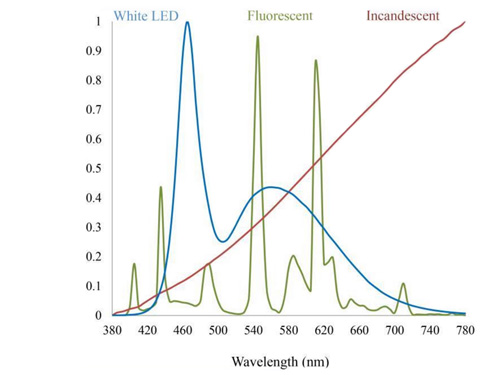
The following graphic illustrates the differences in color spectrum between an incandescent light, which has very little blue, compared to fluorescent light and white LED.
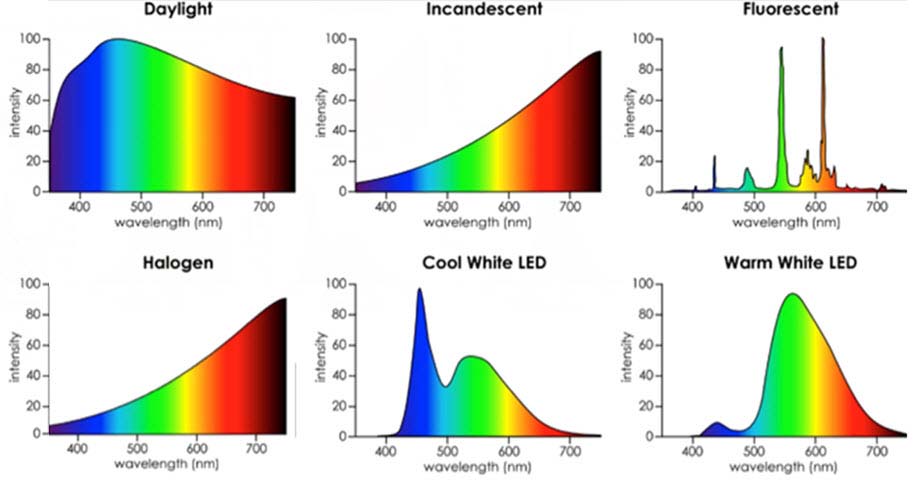
This next graph illustrates the differences between daylight, incandescent, fluorescent, halogen, cool white LED and warm white LED. As you can see, there's a tremendous difference between incandescent and warm LED. While they may look the same to the naked eye, there's no comparison when it comes to their actual light qualities.
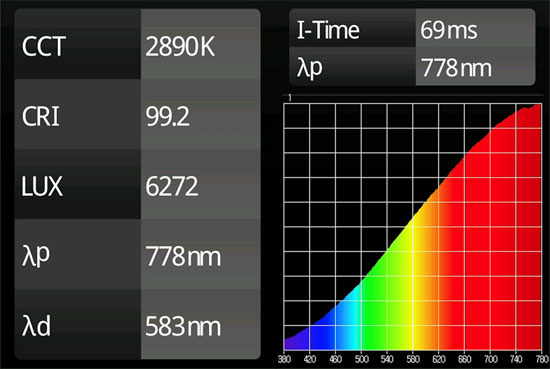
Looking at the spectral differences between incandescent and halogen lamps, there seems to be no difference at all. In order to elucidate the disparity, Wunsch did some measurements of incandescent and halogen lamps using his UPRtek MK350S spectrometer. The differences are almost imperceptible, indeed.
Spectrum of a standard incandescent lamp: Correlated color temperature (CCT) = 2890 K.
Spectrum of a energy saving halogen lamp: Correlated color temperature (CCT) = 2842 K.
How to Make Digital Screens Healthier
When it comes to computer screens, Wunsch suggests reducing the correlated color temperature down to 2,700 K — even during the day, not just at night. Many use f.lux to do this, but I have a great surprise for you as I have found a FAR better alternative that was created by Daniel, a 22 year old Bulgarian programmer that Ben Greenfield introduced to me.
He is one of the rare people that already knew most of the information in this article. So he was using f.lux but was very frustrated with the controls. He attempted to contact them but they never got back to him. So he created a massively superior alternative called Iris. It is free, but you'll want to pay the $2 and reward Daniel with the donation. You can purchase the $2 Iris software here. OLED screen technology is another development that may be better than conventional screens.
"[With] the OLEDs technology, I'm not sure if the color is really stable in every angle you can look at the display," Wunsch says. "But definitely, if you have the screen technology where black is really black, then you have less radiation coming into your eyes and the OLEDs technology is able to provide this.
So the high contrasts between the black and white, all the black areas in the thin-film-transistor (TFT) screen or the standard screen are not really black. They are also emitting shortwave radiation. The OLED screen only emits where you see light, where there is black on the screen, there is no light. This might be preferable as long as you have no problems with the [viewing] angle."
To Protect Your Health and Vision, Stick to Incandescent Lights
LEDs are a perfect example of how we're sabotaging our health with otherwise useful technology. However, with knowledge, we can proactively prevent the harm from occurring. In summary, we really need to limit our exposure to blue light, both during the daytime and at night. So for nighttime use, swap out your LEDs for clear bulb incandescents, or low-voltage incandescent halogen lights that are run on DC power.
I also strongly recommend using blue-blocking glasses after sundown, even if you use incandescent light bulbs. Without these modifications, the excessive blue light from LEDs and electronic screens will trigger your body to overproduce ROS and decrease production of melatonin, both in your pineal gland and your retina, the latter of which will prevent repair and regeneration, thereby speeding up the degeneration of your eyesight.
"One thing to emphasize again, it's not the blue light coming from the sun itself which we should be concerned about. It's the blue light, the singular high energy visual light (HEV), which comes from cold energy-efficient non-thermal light sources. This is what causes the problem, not the blue light which comes together with longer wavelengths in a kind of natural cocktail that has the beneficial near-infrared spectrum …
The light surrogates from non-thermal light sources, these are [what cause] problems, and you have to be clever to avoid these Trojan horses. If you want to make it [safe], stay with the candles, stay with the incandescents," Wunsch says.
Another Healthy Light Alternative
Candles are even a better light source than incandescent bulbs, as there is no electricity involved and is the light that our ancestors have used for many millennia so our bodies are already adapted to it. The only problem is that you need to be very careful about using just any old candle as most are toxic.
As you may or may not know, many candles available today are riddled with toxins, especially paraffin candles. Did you know that paraffin is a petroleum by-product created when crude oil is refined into gasoline? Further, a number of known carcinogens and toxins are added to the paraffin to increase burn stability, not including the potential for lead added to wicks, and soot invading your lungs.
To complicate matters, a lot of candles, both paraffin and soy, are corrupted with toxic dyes and fragrances; some soy candles are only partially soy with many other additives and/or use GMO soy. There seems to be a strange mind-set that exposure to small amounts of toxins is OK, even though the exposure is exponential over time!
The soy is non-GMO, is clean burning without harmful fumes or soot, is grown in the U.S. and is both sustainable and renewable. Also, my candles are completely free of dyes. The soy in these candles is not tested on animals, is free of herbicides and pesticides.
It's also kosher, 100 percent natural and biodegradable. All of my fragrances are body safe, phthalate- and paraben-free, and contain no California prop 65 ingredients. The wicks are simply flat braided cotton coated in a natural vegetable wax and self-trimming, which reduces carbon build up.
Enjoying a Circle of Life Farms naturally good soy candle and following the simple burn instructions — located inside the candle lid — will give approximately 70+ hours of burn time. Every candle is hand-poured with love for you to enjoy a cooler, cleaner burn, all while being kind to the both the environment and yourself.
You can search online healthy candles, but if you like, you can use the ones I found at www.circleoflifefarms.com. This is not an affiliate link and I earn no commissions on these candles; I just thought you might benefit from the ones I now use in my home.