Pages

Showing posts with label Feet. Show all posts

Thursday, 23 December 2021

Have Your Lungs Checked If You Notice This on Your Fingers or Toes

THIS SURPRISING SYMPTOM COULD SIGNAL A SERIOUS PROBLEM WITH YOUR LUNGS.

Lauren Gray

July 25, 2021


Amid the pandemic, millions of Americans have seen firsthand the devastating effects of serious lung conditions. And while the CDC says that the COVID crisis alone has caused over 2.3 million hospitalizations in the U.S. to date, an additional 37 million Americans live with a chronic lung condition, according to the American Lung Association.

Kick Turf Toe to the Curb


However, experts say that some of the worst lung conditions, including lung cancer, can be notoriously difficult to diagnose during the stages at which they're still curable. One study published in the journal Primary Health Care Research and Development found that due to complex presentations, up to 20 percent of lung cancer cases are initially overlooked, even after X-rays. That said, those same researchers suggested that "greater vigilance for patients presenting with atypical symptoms" would aid in prompt diagnosis.

One symptom in particular, which presents in the fingers or toes, can clue you into a serious lung condition. Read on to find out what to look for, and to learn more about the underlying cause.

RELATED: If You Feel This at Night, You Need to Get Your Liver Checked, Doctors Say.

Digital clubbing can indicate a serious lung condition.

Lung x-ray
Shutterstock

While many lung conditions are often difficult to diagnose and may go untreated for prolonged periods of time, there's one sign that should tip you off to a serious problem: clubbing of the fingers or toes. According to the Mayo Clinic, this is known as digital clubbing, and it's common among patients with lung cancer and pulmonary fibrosis, a chronic lung condition in which the tissue surrounding the lungs becomes scarred. It can also indicate lung abscesses, cystic fibrosis, chronic obstructive pulmonary disease (COPD), or a chronic lung infection.

While medical professionals are still working to understand the underlying causes of digital clubbing, they do know that it occurs when the body struggles to get enough oxygen into the bloodstream. As a result, fluid concentrates within the extremities, creating a swelling or rounding effect.

RELATED: If Your Breath Smells Like This, Get Your Liver Checked, Experts Say.

Here's what to look out for.
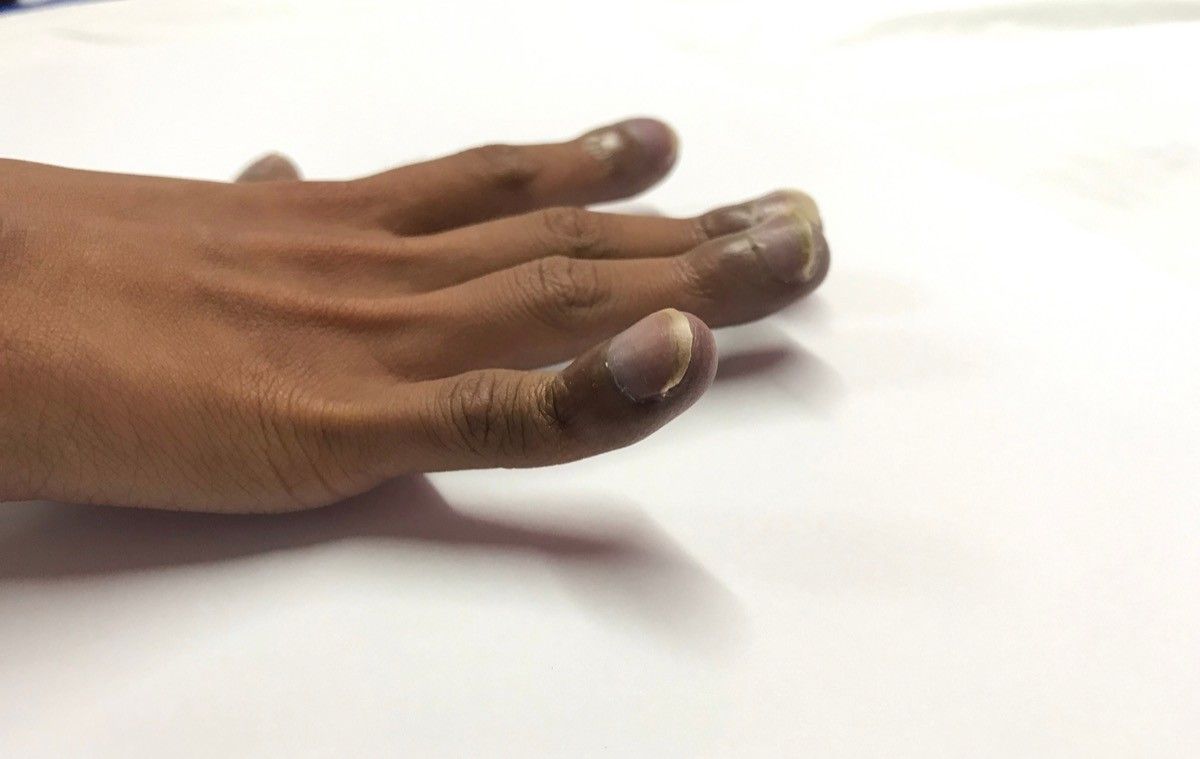
Digital Clubbing
Shutterstock

According to Pulmonary Fibrosis News, digital clubbing "typically occurs in stages, with the fingernails lifting from the nail bed first." From there, the fingertips become bulbous and begin bulging. A report from Mount Sinai's health library says that the nail beds may also soften, and the nails "may seem to 'float' instead of being firmly attached." They often "form a sharper angle with the cuticle," and they may also curve sharply downward in a convex fashion.

While other symptoms of lung conditions may develop slowly over time, digital clubbing tends to develop over a matter of just weeks.

For more health news delivered straight to your inbox, sign up for our daily newsletter

Digital clubbing can also indicate a range of other conditions.

Middle-aged man being examined by a female doctor in a doctor's office. Patient complains to the doctor of pancreas pain.
iStock

While lung cancer is the most common cause of digital clubbing, and 65 percent of people with pulmonary fibrosis also present with this symptom, there are cases in which the clubbing is the result of another underlying condition. Most often, these are conditions related to the heart, including congenital heart defects, and infections in the lining of the heart chambers or valves, among others.

Mount Sinai points out that in other, rarer cases, digital clubbing may suggest any of the following conditions: celiac disease, liver disease, dysentery, Graves' disease, a thyroid disorder, or one of several types of cancer.

Here's what to do if you're experiencing digital clubbing.

iStock

Most of the illnesses that cause digital clubbing are serious and require immediate medical care, so you should contact your doctor immediately if you notice this symptom. While there is no treatment for digital clubbing specifically, it may go away as you treat the underlying cause.

Treatment may include a combination of chemotherapy, surgery, and radiation to treat cancer, a combination of medication and therapies to treat various other lung conditions, or a combination of surgery and medication to treat various heart conditions, depending on the condition causing the clubbing.

https://bestlifeonline.com/news-lungs-clubbing/

Sunday, 31 October 2021

High cholesterol: Three walking-related symptoms ...

High cholesterol: Three walking-related symptoms warning your levels are dangerously high


High cholesterol is when a person has too much of a fatty substance known as cholesterol in their blood. Cholesterol can build up in your arteries which, over time, can cause a blockage. This may trigger a stroke or a heart attack. Early symptoms you may be at risk include any of these three walking-related signs.

"Achilles tendons are the most common sites of tendon xanthomas," explains a study published in the journal Lipids in Health and Disease.

Tendon xanthomas are cholesterol deposits in tendons.

They appear as slowly enlarging papules or subcutaneous nodules attached to tendons.

According to the study researchers, "Achilles tendon thickening is the early characteristic of Achilles tendon xanthomas".

High cholesterol: Signs in legs© Getty Images High cholesterol: Signs in legs

Tendons connect the muscles to the bones and are made up of a tough, fibrous material.

Tendons serve as tension bands which help the muscles and bones work together during movement.

The Achilles is the strongest of all tendons and is located at the back of the legs and connects the calf to the heel bone.

Tendon problems can arise from sudden injury or repetitive movements.

Having high cholesterol is known to put a person's tendons at risk.

Elevated cholesterol may cause issues like Achilles tendonitis, which is when your Achilles tendon becomes inflamed and irritated.

Symptoms include:

  • Pain climbing stairs
  • Pain in your heel after physical activity
  • Swelling in your heel
  • Weakness in your lower leg.

High cholesterol: Achilles tendon© Getty Images High cholesterol: Achilles tendon

Small lumps in the Achilles tendon are sometimes caused by high cholesterol levels, resulting in cholesterol deposits in the tendon itself, said Vascular Health Clinics

The health site continued: "Aside from treating cholesterol itself, treatment for xanthomas involves taking a biopsy of the lesion but leaving the nodules intact.

"Xanthoma of the Achilles tendon is a rather rare, interesting orthopaedic condition that has important ramifications in internal medicine and dermatology because the lesion is associated with a specific disturbance of lipid metabolism."

How to lower your cholesterol levels

A few small swaps can make a big difference to your cholesterol level, said the British Heart Foundation.

It advised simple methods to help naturally lower your levels which include:

  • Swapping butter to vegetable oil spreads like sunflower, olive or rapeseed oil spreads
  • Switching whole milk to skimmed milk
  • Using natural yoghurt instead of sour cream or double cream
  • Replacing regular mince with leaner, lower-fat options
  • Swapping red or processed meat for fish, turkey or chicken without the skin, or plant-based proteins such as lentils, soya or Quorn
  • Switch your crisps for unsalted nuts
  • Having reduced-fat cheese instead of regular cheese
  • Ordering less takeaways.

https://www.msn.com/en-gb/health/familyhealth/high-cholesterol-three-walking-related-symptoms-warning-your-levels-are-dangerously-high/ar-AAP0m7A?ocid=msedgntp

Monday, 18 January 2016

Your FEET could be trying to tell you if you've got serious health problems

Experts say the state of our feet can reveal a number of other health issues

They may spend most of the year hidden away under socks, but our feet are in fact a window to what’s really happening in our bodies.
“We neglect our feet and put up with signs and symptoms that, in any other part of the body, would have us running to medical professionals,” says podiatrist Jake Heath from One Wellness Clinic in Wimpole Street, London.
“Yet noticeable changes can be indicators of wider health issues.”
So it might be time to take a closer look at those tootsies…

Enlarged big toe

It could be… gout
Not only the preserve of men with pot bellies and a rich diet. “Gout is a build-up of razor-sharp uric acid crystals in a joint,” explains Jake. “This can be caused by being overweight, certain medications or a high protein diet, but it can also be genetic.” For most people the first sign comes in the form of a sore, red, swollen big toe.


Woman with gout foot
Painful: Gout can be genetic or caused by diet

What to do: If you have pain in your big toe or another joint, such as the knee or elbow, see your GP, who can test for gout. Icing the joint and non-steroid anti-inflammatories can reduce pain. A low-protein diet, drinking lots of water and losing weight can also help.

Cold feet

It could be… hypothyroidism
Not that moment when you slip into bed – more if you suffer from particularly chilly hands and feet. Hypo­thyroidism is known as an underactive thyroid gland.
Cold feet can also be caused by Raynaud’s disease. “This is where the blood vessels to the toes and fingers are hyper­­sensitive to temper­­ature, stress, smoking and medication,” says Jake. “They constrict, reducing blood flow and making them appear white. Later, when the blood flow returns, they can be red, swollen and itchy.”
What to do: Other common signs of hypo­­thyroidism are tiredness, weight gain, aching muscles and depression. If you have these too see your GP for a thyroid function test. For Raynaud’s, avoid extreme temperatures.

Red ulcers or numbness

It could be… diabetes
Numbness or loss of sensation around the feet and red ulcers that don’t heal are major clues to undiagnosed type 2 diabetes.
“The start of persistent numbness and/or tingling in the toes can be the sign of peripheral nerve damage associated with type 2 diabetes,” says Jake.
“This can increase the chance of developing severe ulcers as the skin tissue breaks down unnoticed and exposes underlying layers of skin.Eventually these ulcers may require long-term antibiotics and in extreme cases amputations.”
What to do: Diabetes symptoms include a persistent thirst, needing to urinate more often, tiredness and weight loss. See your doctor at once if you notice these signs.

Club-shaped nails

It could be… a lung condition
Have your nails changed shape? If so, this could
be more than a cosmetic problem.
“Cardiovascular, lung or gastrointestinal problems, can lead to the clubbed appearance of all the nails on the toes and fingers,” says Jake. “The shape will change and they appear distorted.” This could be due to a cut in the blood’s oxygen levels.
What to do: “Speaking to your GP or podiatrist about changes in colour, or shape, of nails is a good idea,” says Jake.

Cut toenails
Nail it: Keep an eye on your talons

Hairless toes

It could be… vascular disease
Few of us would want hairy feet. But toes totally devoid of hair can be a problem. If the heart is struggling to pump enough blood to your extremities it will cause problems with your circulation. That will make the skin look shiny and hair will not grow there.
“Discoloured feet which appear red, white or purple with thick nails, loss of hair and thin, brittle, or shiny skin, can all be signs of underlying circulatory issues, or peripheral vascular disease,” says Jake.
What to do: See your GP or a podiatrist if you notice any of these symptoms.

Thickened, crumbling or discoloured nails

It could be… Psoriasis
“Nail pitting may be a sign of psoriasis, a chronic skin condition caused by an overactive immune system,” says Jake. Psoriasis affects 1–2% of the population and can be linked to stress, medication or genetics. Jake says half of patients with psoriasis will have nail problems. Other sym­ptoms are flaking, inflammation and thick white, silvery or red skin patches.
What to do: Treatments include steroid creams, light therapy and oral medications. If your nails are pitted see a GP.

Sore toe joints

It could be… rheumatoid arthritis
Small joints in the hands and feet are often the first to be affected by this auto-immune condition.
“The joint doesn’t move as well as it should,” says Jake. “People with other forms of arthritis have stiff joints in the morning but with rheumatoid arthritis it can be several hours before they ease. There can be swelling and fluid in the joint, which makes them puffy, and the toes often feel sensitive and tender.
“Over time it causes severe damage to the cartilage and joints, leading to a loss of movement and intense pain.”
What to do: See your GP immediately as early diagnosis is key to preventing damage to the joints and cartilage.

http://www.mirror.co.uk/lifestyle/health/your-feet-could-trying-tell-6357109

This post is on Healthwise