Pages

Showing posts with label Baking Soda. Show all posts

Friday, 24 January 2020

The dying officer treated for cancer with baking soda

The father of the alkaline diet, Robert O Young, is hailed as an inspiration by one of the UK's most popular food writers, Natasha Corrett, but he faces a jail sentence for practising medicine without a licence. 

  • 19 January 2017
Naima Houder-Mohammed
One patient who believed he could cure her cancer, British army officer Naima Houder-Mohammed, paid thousands of dollars for his alkaline treatment, which consisted mainly of intravenous infusions of baking soda.
In May 2009 Naima Houder-Mohammed was commissioned as a captain in the British army. The following year, tragedy struck. Naima was diagnosed with breast cancer.
She received treatment and was declared cancer-free. But in 2012, while training with the army skiing team, it was discovered the cancer had returned. Her condition was so serious she was offered end-of-life care.
"She refused to accept that this was the end," recalls her friend and former fellow officer, Afzal Amin.
"Naima was a fighter. She fought to get through selection for Sandhurst. She fought through Sandhurst and she fought her way through her life in everything she dealt with - army skiing or whatever it may have been. And this for her was another fight in that long list of victories."

Naima Houder-MohammedImage copyrightDAVID POOLE
Image captionNaima Houder-Mohammed

As her medical options were limited, Naima did what many of us would do - she turned to the internet for a solution.
She came across Dr Robert O Young, an American alternative health writer selling a message of hope for cancer patients online.
Naima began an email correspondence with him, which reveals how pseudo-science can be used to manipulate the vulnerable.
Young is the author of a series of books called the pH Miracle, which has sold more than four million copies around the world.
These books lay out his "alkaline approach" to food and health which has influenced many others, including the work of the British clean-eating guru Natasha Corrett, whose Honestly Healthy brand promotes her take on an alkaline diet.

Natasha Corrett


Natasha CorrettImage copyrightGETTY IMAGES

  • In the introduction to her book Honestly Healthy Cleanse, the food writer says acidity in the body causes "dis-ease", which can show itself in "everyday discomforts" like acne, dry skin and bloating, "to much more serious illnesses, such as cancer, diabetes, heart disease and obesity"
  • She says Young "discovered that eating a plant-based diet free from processed foods can help to cure terminal diseases in the body"
  • She adds that his work is not recognised by the medical industry, "perhaps because giant pharmaceutical organisations wouldn't be able to make money out of doctors prescribing vegetables"

In one email Young sent to Naima in July 2012, he told her "there is a great need for a daily regime focused on… hyper-perfusing the blood with alkalinity". He went on: "I would suggest your healing program is going to take at least 8 - 12 weeks. It will not be easy but you will be in a controlled environment that will give you the care you need."
Naima set about raising the money she would need - in one email Young mentioned a figure of $3,000 (£2,440) per day.
Naima's family used their savings, ran fund-raising events and managed to pull together tens of thousands of pounds with the help of a charity so that Naima could be treated by Young.
But the treatment did not have the outcome she was hoping for.
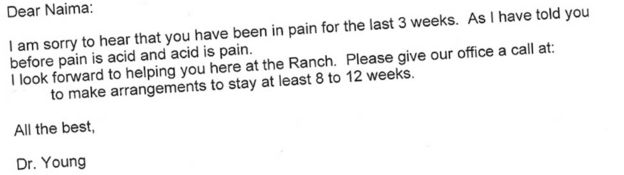
Email from Robert O Young to Naima Houder-Mohammed
Image captionEmail from Robert O Young to Naima Houder-Mohammed

On one recent sun-kissed Californian morning, we drove up into the hills outside San Diego to visit Young. As we turned off Paradise Mountain Road, the parched golden grass eventually gave way to groves of avocado trees and we entered a millionaire's paradise known as the "pH Miracle Ranch".
The front door, preposterously set behind a moat, is reached by walking across some stone slabs.
As Young welcomed us into the ranch, our eyes were drawn to an empty spherical fish-tank built into the wall that separated the living area from the kitchen.
Noting our interest, he began to share his alkaline view of the world, starting with what he calls the fish-bowl metaphor. "If the fish is sick - what would you do? Treat the fish or change the water?"
He went on: "The human body in its perfect state of health is alkaline in its design."

The pH of our blood is 7.4, which is slightly alkaline, so Young is broadly correct - although different compartments of our bodies, such as our stomach, function at very different pHs.
But then Young's "alkaline living" vision becomes complete fantasy. Young believes that in order to maintain the pH of our blood, we have to eat "alkaline" foods.
The main problem with this view is that it doesn't appear to take into account the stomach, which functions at a pH of about 1.5 and is the most acidic compartment in the body. Thus, everything we consume, regardless of its starting pH, becomes acidic before passing into the intestines.
Also, the categorisation of foods into alkaline or acidic does not appear to follow any consistent rules, with certain citrus fruits (full of citric acid) considered to be alkaline, for instance.
However, Young's view that alkalinity is good and acidity is bad goes beyond food. He told us: "All sickness and disease can be prevented by managing the delicate pH balance of the fluids of the body."
He believes that when your blood becomes acidic, something weird happens, and your blood cells transform into bacteria - a phenomenon he calls pleomorphism - thereby resulting in a diseased state.
This, frankly wild, view goes against all current scientific understanding.
When we put this to him, he simply disagreed, saying: "Germs are nothing more than the biological transformation of animal, human or plant matter. They're born out of that."
This is post-truth.

Dr Giles Yeo with Robert O Young
Image captionDr Giles Yeo with Robert O Young at the "pH Miracle Ranch"

The biggest problem is that because Young believes that disease emerges from acidity, then by extension disease can be reversed with alkalinity - echoing his fish-bowl metaphor that you don't treat the disease, but you change the environment.
When Young said Naima would be cared for in a controlled environment, he meant the pH Miracle Ranch, which has a large area set aside as a "clinic" to treat cancer.
Young told us he uses the term "cancerous" as an adjective to describe a state of acidity.
Since 2005 he has brought more than 80 terminally ill patients to stay at his ranch for months at a time. Treatment has included intravenous infusions of an alkaline solution of sodium bicarbonate - the same Arm and Hammer stuff you stick in your fridge to absorb smells.
This was the "healing programme" that was being sold to Naima.
There is no doubting the impact of Young's message. In an email, Naima wrote to him: "I'll be pronounced text book perfect in a few months."
According to her friend Afzal Amin: "Naima was supremely confident that, with her willpower and this therapy, she would be healed. That was the overriding emotion in her that yes, I am going to better."
We put it to Young that someone like Naima, in a terminally ill state, who was desperate for a cure, would buy anything, try anything to help get better.
He responded: "But I wasn't selling her anything… I didn't force her to come here, it was her decision."
Yet, in one email Young insisted on Naima paying for her treatment, before she stepped on to the plane.

Email from Robert O Young to Naima Houder-Mohammed

All in all, Naima and her family paid Young more than $77,000 (£62,700) for the treatment.
Young told us: "The doctors need to be paid and the people that are doing the massages need to be paid and the colonics, but I gave her the best price to make sure that those people were paid."
There is no evidence whatsoever that infusing an alkaline solution into your bloodstream will do anything against cancer. When we raised this with Young, he said: "These things need to be studied."
After about three months at Young's facility, her condition worsened and she was taken to hospital. Naima was brought back to the UK and died with her family. She was 27.
Afzal Amin told us: "They feel utterly betrayed. It's just horrific that somebody could exploit people for money. This is I think for them the most disturbing element, that for something as cheap as money he was just able to destroy people's lives."

Find out more

  • Dr Giles Yeo presents Horizon's Clean Eating - The Dirty Truth, produced by Tristan Quinn, on BBC Two at 21:00 GMT, Thursday 19 January
  • In the UK, you can watch it on iPlayer after transmission

Young's activities at the pH Miracle Ranch have not gone unnoticed by the authorities.
In 2011 the Medical Board of California began an undercover investigation after concerns were raised by a woman treated there.
Investigators were able to establish the prognosis of 15 cancer patients treated at the ranch - none of them outlived it.
One patient, Genia Vanderhaeghen, died from congestive heart failure - fluid around the heart - while being treated. Young told us he was "out of town" at the time.
According to an invoice we obtained, she had been given 33 intravenous sodium bicarbonate drips, each charged at $550 (£448), over 31 days. Some were administered by Young himself.

Robert O Young
Image captionRobert O Young

Last year Young was convicted of two charges of practising medicine without a license, and now faces up to three years in prison.
In court it was revealed that he is not a medical doctor and bought his PhD from a diploma mill.
We asked him if he felt remorse for what he had done. He said: "I don't have remorse because of the thousands if not millions of people that have been helped through the [alkaline diet] programme."
We asked Natasha Corrett to comment on the influence of Robert Young on Honestly Healthy. She told us: "We believe that our bodies should be fuelled with healthy and nutritious ingredients but we also believe that life is about having things in moderation."
Update, October 2018: Robert O Young was sentenced to three years and eight months in prison in 2017 for practicing medicine without a license.

https://www.bbc.com/news/magazine-38650739


ALSO READ:

Robert O. Young - author of the "pH Miracle" book - MUST READ

(Summary of articles on Dr Robert O Young and his pH miracle)


Tuesday, 17 September 2019

Curious Cook: Borax’s bounce factor

Bouncy food balls and crunchy crystal prawns could have a common secret.
Sunday, 11 Jan 2015

Foochew Fish Balls stuffed with minced pork are brought in from Sungai Pelek twice every week.
Foo chew fish balls stuffed with minced pork from Sungai Pelek.

Sin Kong coffee shops fishball noodles.
Sin Kong coffee shop's fish ball noodles.

It all started with tough pork. One evening, I bought a couple of packs of diced pork from a supermarket on the way home from work – normally, I like to cook something for dinner. Regrettably, the meat was really awful – sinewy, tasteless and not unlike boiled tough cardboard in texture. I simply had to throw most of it away.
For the next evening, I sprinkled about a teaspoon of baking soda on top of the second pack and worked that into the meat. Then I left it alone for about an hour and a half before cooking as I already knew how tough the meat was. Using the same recipe as the night before, this time the meat was soft and tender and rather delicious.
So the old trick of applying an alkali to loosen the amino acids in the meat proteins worked again – and I was relieved to be able to enjoy a good dinner.
An unlikely email
Then purely by chance, my editor passed me an email from an Australian chef and culinary lecturer who asked about the use of borax (known in Chinese as “pang sah” or peng sha) in the preparation of those translucent, crunchy “crystal” prawns beloved by Asian gourmets.
I hadn’t known this and originally it sounded unlikely that people would apply a chemical used for laundry detergents, fungicides, herbicides and insecticides on prawns – but I was wrong.
It seems that the West had been using it as a food preservative for almost a century and some Chinese restaurants have indeed been using borax to make crystal prawns for decades.
This practice has now been banned in many countries but apparently still continues unabated in some of the shadier restaurants.
What is also interesting is that borax can also be used to treat rice- and wheat-based products such as “cheong fun” (rice sheet rolls) “kway teow” (flat rice noodles) and “la mian” (hand-pulled wheat noodles).
At this point, it should be noted that borax is listed as “not acutely toxic” by several chemistry databases and it is also highly unlikely that any restaurant would leave significant amounts of the compound as residue in the food that they serve.
The symptoms of borax poisoning are abdominal pain, convulsions, diarrhoea, headaches, nausea, vomiting, skin rashes and renal failure.
So if you have experienced any of those symptoms after a dinner out, then I would suggest that you don’t go back again to the same restaurant, especially if you have had to replace a kidney or two.
By the way, it seems that Indonesia’s Directorate of Consumer Protection also warns of some risk of liver cancer if high amounts of borax are ingested for five years or more. So just being rated as “not acutely toxic” doesn’t mean the stuff isn’t potentially dangerous.
Now that the bad news is out of the way, let’s explore why borax is so effective at making prawn proteins and grain starches so distinctively rubbery and interesting in texture.
Borax is an important boron compound and is known by various chemical names – a few of the common ones are disodium tetraborate decahydrate, sodium tetraborate, disodium tetraborate or simply sodium borate. The chemical representation is Na2[B4O5(OH)4]·8H2O and it is a naturally-occurring inorganic compound, originally mined in Tibet centuries ago, but since then, huge deposits have been found in California, Nevada and Turkey – and now most of the world’s borax comes from those regions.
Har Kau/Prawn Dumplings from Ee Chinese Cuisine, Eastin Hotel Petaling Jaya.
Har kau (prawn dumplings) from Ee Chinese Cuisine, Eastin Hotel Petaling Jaya.

A Little Dim Sum Place restaurant review at Desa Sri hartamas,KL.
A Little Dim Sum Place restaurant at Desa Sri Hartamas, KL.

Funky borax
Borax is funky as it is one of the ingredients which can be used to make silly putty – one just has to combine white PVA glue with a borax solution in the right proportions and the result is a crude form of silly putty.
How it works is that PVA glue is normally made up of long chains (or polymers) of polyvinyl acetate molecules which slide easily against each other in a liquid solution.
The borax solution causes these long chains to cross-link to each other with molecules of borax acting as the dabs of glue between individual chains of polyvinyl acetate.
The actual cross-link bonding is done via the hydrogen atoms joined to the boron atom in the middle of the borax molecule (see diagram).
Apart from turning the glue from a liquid into a non-liquid, this cross-linking of PVA chains introduces a springy but malleable texture to the mix of the compounds – and hence we get a form of silly putty.
This isn’t really the silly putty you buy in shops as it is water-based and will dry out eventually. The same chemical process to induce hydrogen-based cross-linking for silly putty can also be used to make synthetic play slime by varying the proportions of PVA glue and borax solution – you can also add some colour dyes to make it more fun.
I don’t need to provide the chemical recipes here because they are easy to find in lots of chemistry-for-fun books.
Why lava flows so slowly
As a little curious diversion, the cross-linking of polymers is one reason why lava flows relatively slowly down from an erupting volcano. One would assume that lava flows slowly because it is dense molten rock – but molten metals are actually denser and flow a lot faster than lava.
So one explanation why lava flows are slower than expected relative to their density is because lava has a lot of silicon-based polymers – and these polymers cross-link due to the presence of gases like hydrogen sulphide and hydrogen disulphide mixed in with it.
The hydrogen atoms around the sulphur in the lava gases bond with the molten silicon-based polymers creating lots of silicon polymer cross-linkages – and this increases the viscosity of the lava substantially, slowing its speed down the mountainside.
I hadn’t realised this before so it’s quite cute what one can learn from researching the impact of borax on prawns.
A bakso stall in Jogjakarta
A bakso stall in Jogjakarta.

iplfishy 4...Freshly rolled fish balls. pix by: lew yong kan/24-11-2004/ipoh/chan li leen.
Freshly rolled fish balls.

Borax and prawns
Anyway, from the silly putty example above, one can start to deduce why borax causes the proteins in prawns to become like elastomers – this means that the prawns become more elastic and will attempt to recover in size and shape after the application of pressure, unless of course, one is chewing and breaking them down into little pieces while eating them.
If you have read some of the earlier articles, you would know that proteins are natural polymers made up of monomers (little strands) of amino acids. Fundamentally, proteins are polypeptides or complex chains of amino acids bonded by peptide bonds (simple amino acid monomers).
As such, many proteins are therefore not organised as straightforward linear chains – in other words, proteins do not tend to line up like strands of dried spaghetti but actually have shapes, which may be fan-like or circular or some other amorphous forms.
Borax acts on these polymers just as it acts on other polymers and will bind polymers together forming cross-linkages which change the texture and structure of the proteins.
With PVA glue, the polymers are mostly simple chains and the effect of borax was to turn the PVA polymers into a non-liquid and introduce a malleable texture to the compound mix.
With proteins, the polymers are complex chains in many configurations and therefore the cross-linking effect of borax is to turn the proteins into denser, springy clusters, changing them into a form of elastomer.
Basically, the process makes prawn proteins develop that particularly interesting, crunchy, elastic texture so prized by Chinese food gourmets.
Of course, borax will have the same effect on other proteins and hence it can also be used in meat balls and fish paste balls to impart a springy texture.
For the same reason, borax was used in the past to restore rotting meat and seafood to something like its original texture – but thankfully this practice has now been generally banned.
Borax is great on stuff where the protein density is not too high – hence it works best on prawns and fish which have lots of water, but it works less effectively on fresh animal flesh as it may render the meat rather tough (and who likes a chewy, rubbery pork chop?). It works well also with minced meats mixed with some other filler such as starches.
Next: Borax’s other unlikely food friends, sodium hydroxide and lye water.
https://www.thestar.com.my/lifestyle/food/features/2015/01/11/curious-cook-boraxs-bounce-factor

Monday, 29 April 2019

Curious Cook: Pesticides and other thoughts - MUST READ

Part of the research into glyphosate for the last article provided additional free insight into the use of pesticides and treatments for fresh vegetables and fruits. The interesting aspect was not only the surprising amount of residues but also the frequent use of multiple chemicals on single crops.
Curious Cook: Pesticides and other thoughts

Strawberries
As an example, the Environmental Working Group (EWG) has identified strawberries as probably the most contaminated fruit in terms of pesticides and fruit treatment compounds. A quick search through the United States Department of Agriculture (USDA)’s Pesticides Data Program (PDP) database revealed that strawberries for human consumption in the USA can be treated with combinations of over 70 different active compounds, with varying degrees of toxicity.
However in the amounts detected, the USDA and the Environmental Protection Agency (EPA) have indicated there are no severe threats to human health provided the residue levels are kept below recommended limits. Note there may be more chemicals used but the PDP database did not indicate every possible compound used on commercial strawberries; for example, glyphosate was not included.

Strawberries are one of the most contaminated fruits. Photo: Ted Rabbitts/Flickr
The European Food Safety Authority (EFSA) is probably more thorough in its monitoring of crop residues. It had also reviewed and published the Maximum Residue Limits (MRL) for over 485 chemicals which may be found on strawberries, though not all of them are regulated or actually permitted to be used – these MRLs are limits used by producers and test laboratories to analyse for food safety issues.
There were 109 chemicals originally approved for use on strawberries, including neonicotinoids (or neonics), often called “bee killers”. Since April 2018, three major neonics (clothianidin, imidacloprid and thiamethoxam) are banned from use in open fields though it seems thiamethoxam may still be applied in enclosed industrial greenhouses. The same detailed levels of EFSA documentation and processes apply for all other kinds of food crops.
Again, the EFSA suggests that permitted chemical residues in strawberries and other crops are safe for human consumption if they do not exceed their MRLs.
The dirty list
To be honest, the following list of fruits and vegetables was originally drawn up by the EWG, an organisation probably more known as an environmental lobbyist group than a proper scientific research outfit.
However, after struggling with the PDP and the EFSA pesticides databases, it became clear that there is no such thing as easy access to information regarding toxicity, dosage, frequency of application and consumer removal of many crop treatments without reading through the documentation of every formulation containing these chemicals and the diluents/surfactants used with such chemicals.
So after checking various items on the list as best as I could (and finding no significant discrepancies), I am assuming the EWG had done its homework properly when compiling the following list.
So, based on the analysis from the EWG, crops with the most treatment residues are: strawberries, spinach, kale, nectarine, apples, grapes, peaches, cherries, pears, tomatoes, celery, potatoes and hot peppers.
Potatoes are one of the crops with the highest pesticide residue. Photo: Sethoscope/Flick
The EWG also states that nearly 70% of all produce sold in the United States is contaminated with pesticide residues, though it does not warn that all such produce is necessarily bad for health, provided all such residues are below the recommended MRLs. It merely suggests that long-term ingestion or over-ingestion of such residues may have a detrimental effect on health, which is likely to be true for sections of the population.
The above list are vegetables and fruits which are commonly targeted by insects, fungi, bacteria and other pests, and are therefore often sprayed with various compounds to prevent loss of production. Regarding potatoes, major treatments are also applied after harvest to prolong the crop storage life. In Britain in 2004, 2,677,280 tonnes of potatoes were treated with various compounds such as imazalil, thiabendazole and/or stored using ethylene, a gas which inhibits the sprouting of tubers. The main treatment was fumigation with chlorpropham, which was applied to 2,257,603 tonnes, or over 84% of the potato crop for that year.
The clean list
Of all commercial fruit and food crops, the following were found by the EWG to contain the lowest amount of pesticide residues: avocados, sweet corn, pineapples, sweet peas (frozen), onion, papayas, eggplants, asparagus, kiwis, cabbage, cauliflower, cantaloupes, broccoli, mushrooms and honeydew melons.
Cauliflower is on the clean list. Photo: Liz West/Flickr
Most of the above either have thick, inedible skins which need to be removed before eating or have hydrophobic surfaces which repel water.
In summary, if it is not possible/feasible to consume organic produce, it might be worthwhile to focus on picking more of your greens and fruits from the clean list above.
A likely carcinogen
As a comment, imazalil (also known as enilconazole or chloramizole) is one of the most common pesticides found on fruits. A huge proportion of oranges and other citrus fruits as well as potatoes are routinely treated with imazalil, even though both the EPA and the World Health Organisation’s International Agency for Research on Cancer (IARC) categorise imazalil as “likely to be carcinogenic to humans”.

Oranges are treated with a chemical that is reputed to be carcinogenic. Photo: Frederique Voisin Demery/Flick
The concentration of this compound is mostly on the fruits’ skin and therefore exposure should be minimal if the skin of the fruit is discarded. This may not be so easy if fruits such as grapes are treated with the chemical (which is the case in many countries).
To remove residues, the best suggestion is to soak and wash produce in a 1% baking soda (sodium bicarbonate) water solution for 12-15 minutes, as the alkalinity apparently destabilises and loosens pesticide molecules.
Honey and babies
We had a new granddaughter arrive recently, and automatically my wife offered the standard French advice to refrain from giving her any honey-based drinks for at least a year. Then it occurred to me that I do not know the reason for this common warning, so it was worth investigating.
It turns out it involves the most toxic poison known to humans, Botulinum Type H (BTX-H), which needs a dose of only two nanograms or less per kilo of body weight to be lethal – this is known as the Lethal Dose (LD). By contrast, the very lethal poison batrachotoxin, commonly known as curare, has a LD of two micrograms, 1,000 times less powerful by volume than botulinum H toxin.

Honey can be dangerous to babies under one. Photo: Harsha K R/Flickr
And the reason why babies should not be given honey is because spores of clostridium botulinum bacteria are not infrequently found in honey. The digestive systems of very young babies are not able to kill such bacteria in their stomachs until they are over a year old. Left to breed, clostridium botulinum will produce enough botulinum toxin (BTX) to provoke health issues quickly.
Note that BTX is the cause of botulism, not the bacteria. The bacteria are widespread in the environment and many food products – it is impossible to avoid over a normal lifetime.
However, people normally do not get infected because the bacteria cannot survive exposure to oxygen or highly acidic conditions (pH 4.6) – regular stomach acid (pH between 1.5-3.5) will destroy any ingested bacteria. But BTX is unaffected by stomach acid and needs heat treatment at temperatures of 85°C or more for five minutes to deactivate the toxin. The bacteria can also enter the bloodstream via wounds, and then propagate.
There are several varieties of BTX which are classified as Types A through H, though most are not as lethal as Type H. The cosmetic treatment botox, for example, is based on BTX A or B.
All types of BTX profoundly affect the function of an important neurotransmitter called acetylcholine – this disrupts normal nerve signalling and causes muscle paralysis. Therefore botox treatments work by relaxing muscles on the face and reducing the effect of wrinkly skin.
The good news is antidotes exist for most types of BTX poisoning, provided treatment is received in time (although they can have side-effects) – however, this does not apply for BTX-H because it is highly unlikely to be survivable.
Summary
In summary, when ingesting food stored in a low-acid, low oxygen environment (such as packaged foods or old tins), make sure to heat it to 85°C for at least five minutes – this should also be done for re-sealed food stored at inadequate cold temperatures (above 3°C). And never ever give honey to young babies.

https://www.star2.com/food/2019/04/15/curious-cook-pesticides-and-other-thoughts/


Tuesday, 17 July 2018

Curious Cook: Observations about food in France in May – Part 2

The weather has been very (very) wet this May in France and I spent a lot of time reading with my dog curled up beside me. Fortunately, there is no shortage of interesting news to keep our minds busy. (Go here for Curious Cook: Observations about food in France in May – Part 1)

Eggs?
An egg a day keeps the strokes at bay ... or does it?
An egg a day keeps the strokes at bay … or does it?

A large study in China (conducted between 2004 and 2008 with 416,213 participants aged between 30 and 79 years) concluded that eating an egg a day reduced the risk of death via strokes by 28% and heart attacks by 18% across a wide demographic. Oddly, this food study provided no additional supporting dietary data.
So this extraordinary claim has to be viewed cautiously, because an earlier 2015 Korean study of 23,417 adults found that eating eggs actually increased artery calcification (a leading indicator of heart disease) – though it also noted that this was observed more in people who were overweight/obese and/or ate few vegetables. Statistically it is a common mistake to credit a single item (such as eggs) without considering all other associated factors which can affect predicated outcomes.
Therefore the safest interpretation of the China study is: eating an egg daily is fine for people on good diets and who are not overweight, which as it turns out, is something we already know anyway.
Fasting intermittently and diabetes?
As someone prone to sinusitis, every few months I restrict my calorie intake to around 200 calories a day for three to five consecutive days. This appears to reset the immune system and then I am fine for another few months – if you are curious, more details are somewhere in here.
I therefore follow a very intermittent fasting (IF) strategy, and not the more common IF diets which prescribe stuff like semi-fasting two days out of every week.
So headlines like “Fasting Diets Can Increase the Risk of Diabetes” emanating from a widely-reported talk at the 2018 European Society of Endocrinology Annual Meeting in Barcelona piqued my interest – especially as it asserted: “intermittent fasting diets may actually damage the pancreas and affect insulin function in normal healthy individuals, which could lead to diabetes and serious health issues”. This is a striking claim which would be remiss of me not to investigate.
Searching for study papers revealed the University of São Paulo had not published any. All that was available was a short transcript which noted that the research was conducted on Wistar rats, which have a totally different diurnal (daily) feeding cycle to humans. Starving a rat for just one day is roughly similar to starving a human for two to three weeks, starving mammals often react by developing insulin resistance which helps minimise weight loss – and there was no mention of the fasting period(s) used.
In any case, the research seemed to focus on markers associated with insulin resistance and it was unclear if any rats actually developed diabetes.
To be fair, I will review the paper when it is published but it is extremely likely the “normal healthy individuals” cited in Barcelona referred to rats rather than humans. Phew.
In any case, I had earlier bookmarked a paper from MIT which claimed that fasting boosts intestinal stem cells’ (ISCs) ability to regenerate, even in aged subjects. If you are curious, it was suggested fasting conditions may somehow cause ISCs to boost/re-activate the peroxisome proliferator-activator receptors (PPAR) responsible for fatty acid oxidation. This may be plausible as a lack of food should promote a more efficient digestive environment – however, the research was based on young and old mice, not humans. So until there is confirmation the same effect happens in humans, it is probably best to leave it as an interesting conjecture.
The spleen and baking soda
Baking Soda
Baking Soda
A paper from the Medical College of Georgia, USA, in the Journal Of Immunology claimed that ingesting sodium bicarbonate (NaHCO3, or baking soda) can reduce inflammation in both test rats and humans. This paper reads like an unfinished detective story.
The plot started originally with test research into slowing kidney failure rates by reducing blood acidity via the introduction of an alkaline compound, NaHCO3 – note that kidney failure causes increases in blood acid levels. Promising results led to a detailed, complex investigation of NaHCO3’s unexpected side effect on general inflammation.
The surprising outcome was a conclusion that NaHCO3 stimulated the mesothelial cells on the surface of the spleen (an organ involved in the immune system), and this had the effect of shifting the balance in the body from M1 (inflammatory) to M2 (anti-inflammatory) macrophages (which are special white blood cells involved in clearing pathogens, defective cells and other cellular debris from the body).
How this M1-to-M2 switch happens may be due to the production by the spleen’s mesothelial cells of acetylcholine, an important neuro-transmitter associated with reducing inflammation as well as learning and memory. This is an intriguing piece of research, with two additional notable items.
One is the apparent anti-inflammatory response is destroyed if the spleen is perturbed or damaged in any way; the second is the humans studied was a small group of 18 healthy young adults, and therefore probably statistically irrelevant.
I have read well over a thousand scientific papers, and the impression is that not all the research done was strictly warranted or worthwhile. However, if asked to choose the most intriguing paper of the month, this would probably be it, although it is a long way before further peer-reviewed research can confirm the findings reported.
Gut behaviour
An opinion piece from researchers in Oxford University in Nature magazine explored the reasons why human behaviours may be modified by the human gastrointestinal microbiota (HGM).
While such behavioural change may not be as extreme as, say, the changes invoked by the rabies virus, there are certainly bacteria in the HGM producing compounds which can make humans feel good or lousy.
Organisms that co-exist symbiotically within a host are known as symbionts – and symbionts are likely to have a major influence on host evolution by influencing host behaviour in a manner which benefits the symbionts and (hopefully) also the host.
Why I bracketed the word “hopefully” is because of an odd situation. Rodents infected with the brain parasite Toxoplasma gondii lose their aversion to the scent of cat urine, making them more likely to be caught and killed by cats. The reason is because the parasite can only reproduce in felines and it therefore needs to sacrifice its rodent host to be eaten by a cat.
This is not only a cat and mouse issue. Thirty to 50% of all humans today currently have toxoplasmosis, which means their brains are infected by Toxoplasma gondii.
Perhaps as a result of human immune responses to this infection, several conditions have been associated with toxoplasmosis. They include leukaemia, various neuro-degenerative diseases, neuroticism, aggression, impulsive behaviours, suicidal tendencies, etc – though one should note correlation is not necessarily proof of causation. Generally, toxoplasmosis is asymptomatic and the vast majority are not even aware of infection, though it might help explain why many humans like cats irrationally (as witnessed by the number of cat items on YouTube and Instagram).
The HGM situation is different as it comprises of many species of bacteria clustered together, which limits each individual strain’s ability to influence the host – any self-initiated aggressive attempt to boost an individual species is likely to be met with counter-measures from other bacteria. Therefore, quorum sensing generally keeps a healthy HGM in balance. More about this on: https://www.star2.com/living/viewpoints/2016/03/13/curious-cook-a-quorum-of-flavour-part-1/.
The HGM also resides within the Enteric Nervous System (ENS), a huge conglomeration of neurons stretching from the oesophagus to the anus and linked to the Central Nervous System (CNS) via the vagus nerve.
Hence, the HGM can transmit good and bad signals via the ENS to the CNS, and these signals can influence behaviour. An example is the tension-induced “butterflies in the stomach” feeling, which can provoke odd coping behaviours.
Pleasant signals may result from neurotransmitters (or precursors to neurotransmitters) created by certain species in the HGM in response to ingested food.
Less pleasant signals can arise from other HGM bacteria which spawn uncomfortable immune system responses as a result of stress or poor diet – note that for now, we exclude the different, strident reactions to external pathogenic invasions or chemically-disruptive events (eg. smoking, alcohol, pollution, etc).
Both good and bad signals may alter (and reinforce) host behaviour in ways to benefit different bacteria within the HGM. Feeling good may cause the host to seek and ingest more food linked to pleasure.
Bad feelings may lead to the host also ingesting more to compensate for feeling lousy or malnourished. Either way, such changes in host behaviour can benefit certain adept bacteria in the HGM without being disruptive to other bacteria.
So if you are certain the brain in the head is always in charge of making decisions, you might want to think again.

https://www.star2.com/food/2018/07/17/curious-cook-observations-about-food-in-france-part-2/