Pages

Showing posts with label Mammograms. Show all posts

Tuesday, 12 November 2019

Doctors could soon spend less time looking at mammograms, thanks to artificial intelligence

As computers get better at spotting cancer, doctors will have more time to focus on treating patients.
15th March 2018 in Health

Blog post image

In the US alone, tens of millions of mammograms are performed each year. Analyzing these images takes up a lot of doctors' time. The use of computer assistance to help read mammograms is becoming widespread, but doubts persist about whether the practice is helpful enough to justify its steep price tag. Lower-cost deep learning systems, which train themselves to recognize cancer, could help. Thanks to deep-learning methods like those more commonly used to spot everyday objects in photographs, a new system identified cancer’s precise location more than 90 percent of the time in tests. We spoke with the study’s author, Dezso Ribli of Hungary’s Eötvös Loránd University, to learn more.

ResearchGate: What role does computer assisted detection already play in breast cancer detection?

Dezso Ribli: Computer assisted detection (CAD) is supposed to help the doctors detect lesions that could have been overlooked. In the United States, where mammograms are evaluated by one radiologist, CAD usage is widespread. In Europe, where mammograms are reviewed by two radiologists, CAD is practically not used.

While initial studies showed promising increases in cancer detection rates with CAD, recently a large study by Lehman et al. found no positive impact of CAD usage on radiologist performance. The benefits of the current technology are therefore questionable, while more than $400 million is spent on it yearly in the US.

RG: How is your new system different?

Ribli: Routinely used CAD solutions are based on methods that predate the revolution of deep learning in computer vision. With deep learning, carefully designed neural networks with many, many layers are trained to recognize visual patterns. Unlike previous methodologies, these neural networks learn the meaningful patterns and representations only from the data itself. In a nutshell, deep learning models can recognize objects on images if you show them enough labeled examples, and they “learn” by refining the parameters of subsequent filtering steps.

In some visual tasks, deep learning has decreased error rates by tenfold compared to previous technologies. We think that the old methods in CAD could be replaced by deep learning, and the accuracy of CAD could be drastically increased. Our system applies one of the best deep learning frameworks for object detection to mammography analysis.


 “In some visual tasks, deep learning has decreased error rates by tenfold compared to previous technologies.”


RG: How well did your system perform when you tested it?

Ribli: The system secured the 2nd place in The Digital Mammography DREAM Challenge, a prestigious data science competition with more than 1,200 registered participants. Our model was the only one of the best performing solutions able to accurately localize cancers, which is essential for a CAD system in order to be practically usable. Since then, the model's performance has been significantly improved. Details will be shared in another paper about the second phase of the challenge.

With the most recent public digital mammography dataset (INbreast) the model is able to detect more than 90 percent of the cancers with precise positions, while producing only 0.3 false positive detection per image.

RG: How does this model compare to standard mammography analysis methods?

Ribli: Unfortunately, direct comparison with currently used solutions is not possible, because those methods were never evaluated on the same datasets. But the results suggest that our model performs better than commercially available solutions.

RG: What were the limitations of your study?

Ribli: Publicly available mammogram datasets are rather small. Our model was mostly trained on around 2,000 scanned cancer images from the 1990s and a small number of additional cancers on digital images. To put that in context, deep learning models for recognizing everyday objects are usually trained on datasets containing hundreds of thousands or even millions of images.

We are sure that, with larger training datasets, the performance of deep learning CAD models will improve. Creating a huge training dataset is not an impossible task: In the US alone, tens of millions of screening mammography exams are performed annually.

RG: Could your approach be adapted to work with other kinds of imaging and other kinds of cancer?

Ribli: Yes, deep learning, and specifically object detection models, have the potential to help with any kind of cancer imaging or medical imaging.


 “Doctors will be able to concentrate their power of the hardest and most complicated cases, which are more suitable for a human mind.”


RG: Do you think there will be a point in the future where AI takes over breast cancer detection altogether, or will there always be a role for human radiologists in analyzing mammograms?

Ribli: Breast cancer screening is performed on the scale of a hundred million exams a year. I think in the next few decades AI is going to assist radiologists, and progressively take over the easier tasks, which are monotonous and tiring for humans. Doctors will be able to concentrate their power of the hardest and most complicated cases, which are more suitable for a human mind, and less suitable for a machine. AI will also relieve the pressure on doctors caused by a lack of specialized radiologists.

But keep in mind that, in the end, the detected cancers have to be validated with a biopsy, and surgeries are often performed. I think these tasks will be performed by human doctors for a long time. The potential role of AI in screening mammography is to handle the millions of routine imaging exams, presenting the potential cancers to the doctors who perform follow-up procedures.

RG: What’s next for this research?

Ribli: Larger training and testing datasets need to be collected to enable further improvements. One interesting direction is breast tomosynthesis, an imaging technique proven to be superior to standard mammography. Tomosynthesis analysis takes even more time for a radiologist, and CAD has a potential role in that modality too. Another very important next step is to close the gap between research and practice. We would like to test the system in a clinical setup and eventually introduce it to routine care.

A demonstration version of the CAD model is available here

Featured image by Margo Wright.

https://www.researchgate.net/blog/post/artificial-intelligence-is-getting-even-better-at-reading-mammograms

Tuesday, 22 October 2019

Breast cancer detected by thermal imaging scan in Edinburgh

A tourist has told of her "life-changing" visit to the Camera Obscura in Edinburgh after one of its thermal cameras detected she had breast cancer.
Thermal imaging scanImage copyrightBAL GILL
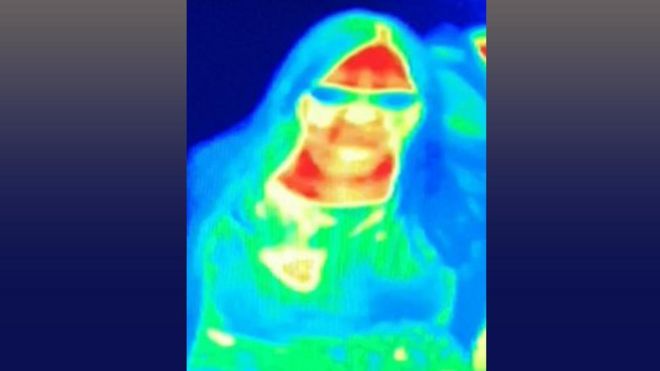
Image captionThe thermal imaging camera showed that Ms Gill's breast was a different colour
A tourist has told of her "life-changing" visit to the Camera Obscura in Edinburgh after one of its thermal cameras detected she had breast cancer.
Bal Gill, 41, from Slough in Berkshire, was at the Camera Obscura and World of Illusions at the top of the Royal Mile with her family in May.
When she went into the museum's thermal imaging camera room she noticed her left breast was a different colour.
When she returned home she saw a doctor who confirmed she had breast cancer.
She discovered that thermal imaging cameras can be used as a tool by oncologists.

Early stage breast cancer

Thermography, also called thermal imaging, uses a special camera to measure the temperature of the skin on the breast's surface.
It is a non-invasive test that does not involve any harmful radiation.
Cancer cells grow and multiply very fast. Blood flow and metabolism are higher in a cancer tumour as blood flow and metabolism increase, which makes skin temperature rise.
Camera ObscuraImage copyrightGETTY IMAGES
Image captionThe thermal camera was installed at Camera Obscura in 2009 and is a popular attraction
Ms Gill, a deputy-director of finance for a university, said: "We had been to Edinburgh Castle and on the way down we saw the museum.
"While making our way through the floors we got to the thermal imaging camera room. As all families do, we entered and started to wave our arms and look at the images created.
"While doing this I noticed a heat patch coming from my left breast. We thought it was odd and having looked at everyone else they didn't have the same. I took a picture and we carried on and enjoyed the rest of the museum."

'Life-changing visit'

A few days later when the mother-of-two returned home she was flicking through her photographs and saw the image.
On Google she found a number of articles about breast cancer and thermal imaging cameras. She was later diagnosed with early stage breast cancer.
She has since had two surgeries, including a mastectomy, and has a final surgery in November. She has been told she will not need chemotherapy or radiotherapy afterwards.
"I just wanted to say thank you, without that camera I would never have known," she said. "I know it's not the intention of the camera but for me it really was a life-changing visit.
"I cannot tell you enough about how my visit to the Camera Obscura changed my life."
The Thermal Camera, which was installed in 2009, is a popular part of the top Edinburgh attraction, and lets visitors see a visual of all their body hot spots.

'Really moved'

Andrew Johnson, general manager of Camera Obscura and World of Illusions said: "We did not realise that our thermal camera had the potential to detect life-changing symptoms in this way.
"We were really moved when Bal contacted us to share her story as breast cancer is very close to home for me and a number of our team.
"It's amazing that Bal noticed the difference in the image and crucially acted on it promptly. We wish her all the best with her recovery and hope to meet her and her family in the future."
Dr Tracey Gillies, NHS Lothian medical director, said: "In the past thermal imaging cameras have been experimented with to detect cancer, however, this has never been a proven screening tool.
"Early diagnosis of breast cancer improves the ability to treat the cancer and the chance of survival is higher. We encourage any woman that has received an invite to a screening to attend and anyone with concerns who does not qualify for the screening programme to visit their GP."

https://www.bbc.com/news/uk-scotland-edinburgh-east-fife-50139540

Thursday, 10 October 2019

Bottom Line: Breast Cancer Articles (page 2)

https://bottomlineinc.com/category/health/diseases-conditions/cancer/breast-cancer/page/3

BREAST CANCER

Earwax, Body Odor and Cancer — Is There a Connection?

Gene Variant Links Three Disparate Conditions In the department of strange but true... a recent Japanese study concerning breast cancer…
BREAST CANCER

Do You Really Need a Mammogram?

Women, you’ve been trained to be on the ball about keeping up with mammograms for breast cancer detection—and, while there’s…
BREAST CANCER

Vitamin D Deficiency Linked to Increased Breast Cancer Death Risk

Vitamin D is often in the news because most Americans get too little of it...and because deficiencies are associated with…
BREAST CANCER

Breast Cancer Guide: Prevent, Detect, Treat, Recover

Advances in Breast Cancer Treatment Women who have breast cancer are now living longer than they did only five years…
BREAST CANCER

Breast Cancer Rehab: Vital Therapies Survivors Need But Don’t Get

For many breast cancer patients, the challenges don’t end on the last day of treatment. They continue to suffer from…
BREAST CANCER

Vitamin D Eases Breast Cancer Drug Pain

Drugs called aromatase inhibitors, which are used to treat breast cancer, can make muscles and joints so painful and stiff…
BREAST CANCER

Help for Lymphedema: Preventing Arm Swelling After Breast Cancer Surgery

When a friend of mine went to her first breast cancer support group meeting, she was surprised that the conversation…
BREAST CANCER

Lack of Sleep Increases Breast Cancer Recurrence Risk

We all have occasions when we stay up late because we're too busy for bed…or when we toss and turn,…
BREAST CANCER

Migraine Headache Linked to Lower Breast Cancer Risk

Silver Lining for Sufferers... Migraineurs May Have Less Cancer Could there be an upside to the misery of migraines? Yes,…
BREAST CANCER

New Clarity on Breast Cancer Screening

“I might be dead by now if I had done what those guidelines are now telling women to do. In…
BREAST CANCER

Best Cancer-Screening Tests for Women with Dense Breasts

Have you ever been told that you have dense breasts? It’s an important piece of information because women who have…
BREAST CANCER

Advances in Breast Cancer Treatment

Five recent advances are dramatically changing treatment approaches… Women who have breast cancer are now living longer than they did…
BREAST CANCER

Key to Preventing Lymphedema After Breast Cancer

After breast cancer treatment, about half of patients develop a distressing and potentially disfiguring complication called lymphedema. The condition involves…
BREAST CANCER

Breakthrough Test for Breast Cancer Risk

If you wonder how likely you are to get breast cancer, the new Halo "breast pap" test can give you…
BREAST CANCER

Mighty Mushrooms Combat Breast Cancer

Breast cancer. Those two words strike fear into the heart of just about any woman—and with good reason. According to…
BREAST CANCER

Can a Painkiller Keep Breast Cancer Away?

Surgical Analgesic May Reduce Breast Cancer Recurrence You certainly don’t have to be a middle-aged woman to yearn for good…
BREAST CANCER

Thermography: The Breast Test Doctors Fight About

Utter the word thermography in a roomful of breast specialists and you’re likely to set sparks flying. Some doctors say…
BREAST CANCER

Should You Be Screened for Breast Cancer Genes?

If your family tree includes one or more relatives with a history of breast cancer, you probably know that you…
BREAST CANCER

Carbs Raise Risk for Breast Cancer—But Which Ones?

A new study shows that when it comes to preventing breast cancer recurrence, not all carbs are created equal—certain kinds…
BREAST CANCER

Breast Reconstruction Advances

A breast cancer diagnosis can be devastating, of course…and my heart goes out to each of the approximately 254,000 American…
BREAST CANCER

Ductal Carcinoma in Situ: The “Noncancer” Breast Cancer

Patients are confused, and no wonder—because doctors don’t even agree on the name, much less on how aggressively to treat…
BREAST CANCER

Dense Breasts Increase Your Cancer Risk—Here’s What Helps

Guys may not understand this, but we women really do sit around talking about things like how dense our breasts…
BREAST CANCER

Tender Breasts Mean Increased Cancer Risk for Hormone Therapy Users

If you are considering or currently using hormone therapy (HT) to ease menopausal symptoms such as hot flashes and night…
BREAST CANCER

Taking Off Just a Few Pounds Protects Your Breasts

Have you heard the news about the big payback for shedding just a little extra body baggage? Here’s the scoop:…
BREAST CANCER

For Breast Cancer Radiation, Facedown Position May Be Safer

A woman with breast cancer who has had a lumpectomy also may have radiation to improve her odds of beating…
BREAST CANCER

The Breast Cancer Risk That’s as Bad as the Gene

Don’t we all want to weep when we think of kids battling cancer…and isn’t it great to know that most…
BREAST CANCER

Breast Cancer Update: Radiation or Not?

Early-Stage Breast Cancer Patients May Fare Better Without Radiation Therapy Many women with breast cancer want to do anything and…
BREAST CANCER

Easier At-Home Prep for Breast Reconstruction Patients

After the wrenching experience of mastectomy, breast reconstruction can help restore a woman’s sense of wholeness. Yet fewer than half…
BREAST CANCER

Closer to a Breast Cancer Cure

You’re no doubt familiar with the old saying that if you want to succeed in business, you must "build a…
BREAST CANCER

Do You Need This New Breast Test… Or Could It Do More Harm Than Good?

When a friend told me that she was scheduled for a test called breast-specific gamma imaging (BSGI), I was concerned.…
BREAST CANCER

Nervous About Needing a Breast MRI? Here

My coworker’s mammogram revealed a suspicious area in one breast, so her doctor recommended a magnetic resonance imaging (MRI) test…
BREAST CANCER

Combination MRI and Mammo Finds More Cancers

High-Risk Women May Identify More Cancers with One of Each, Six Months Apart At present, the gold standard of care…
BREAST CANCER

Squeaky Clean and… More Likely to Get Breast Cancer?

Breast Cancer and Chemicals in Cosmetics and Household Products Are you using personal-care and household products that are linked to…
BREAST CANCER

Breast Cancers That Disappear Without Treatment

Will "Watch & Wait" Someday Be Treatment Strategy for Some Breast Cancers? Mammograms save many lives, but screening for breast…
BREAST CANCER

Walnuts Slow Breast Tumor Growth in Mice

Two Ounces of Walnuts a Day Can Slow Growth of Cancer It’s time to bring back Waldorf Salad — that delicious…
BREAST CANCER

Apples Fight Breast Cancer

More Apples, Less Breast Cancer An apple a day may not only keep the doctor away — new research shows that…
BREAST CANCER

Pomegranates May Help Prevent Breast Cancer

The hormone estrogen causes certain breast cancer cells to proliferate. Lab finding: Compounds called ellagitannins, which are plentiful in pomegranates,…
BREAST CANCER

Breast Cancer Update

New treatments... new options... new hope Research on breast cancer is leading to new approaches to treatment and increasing the…
BREAST CANCER

Cutting Away Breast Cancer Concerns

More Women Now Choose Double Mastectomy for Curable DCIS Breast Cancer Significant advances in diagnosis and treatment mean that we…
BREAST CANCER

Post-Menopause Weight Gain = Higher Breast Cancer Risk

It's Never Too Late to Reap Anti-Cancer Benefits of Weight Loss Some women shrug off their post-menopausal weight gain as…
BREAST CANCER

Better than a Mammogram?

New Technology Makes Breast Thermography Better, More Effective Till now, I’d only ever encountered ads and information on breast thermography…
BREAST CANCER

Soy for Breast Cancer

Villain or protector? There has been a lot of controversy about the benefits of soy as it relates to cancer.…
BREAST CANCER

Plant-Based Diet Increases Breast Cancer Survival

Post-Menopausal Women with Cancer Lived Longer with Lignan-Rich Diet We already know that plant-rich diets are rich in health benefits,…
BREAST CANCER

New Test Can Reduce the Need for Breast Biopsies

When breast lesions look suspicious on mammograms and ultrasounds, biopsies often are done—but 80% of breast biopsies turn out to…
BREAST CANCER

Get Through the Mammogram Maze

There has been so much controversy lately about mammography for detecting breast cancer—whether to have a mammogram at all and…
BREAST CANCER

How Red Wine Affects Breast Cancer Risk

If you’re a woman, then you already know that one daily drink of alcohol may raise your risk for breast…
BREAST CANCER

The Authoritative Breast Cancer Update

What you need to know about new recommendations on mammography—and when to use other screening tests When the US Preventive…
BREAST CANCER

Multivitamins and Breast Cancer Recurrence

Any woman who has faced breast cancer wants to do all within her power to prevent a recurrence, of course,…
BREAST CANCER

Not All Breast Cancer Radiation Is Created Equal

Women with early-stage breast cancer who need to undergo lumpectomy must choose one of three types of radiation. If you’re…
BREAST CANCER

Brush Your Teeth to Protect Your Breasts

Can keeping teeth healthy help fend off breast cancer? It might, according to a recent study from Karolinska Institute in…