Pages

Thursday, 23 August 2018

How To Choose The Best Lenses For Your Glasses


A startup wants to give you an eyeglass prescription without you having to set foot in an optometrist’s office


Smart Vision Labs’ device in action.
 
Smart Vision Labs
If you’ve ever been to the eye doctor, you are most likely familiar with the big metal fixture patients peer through while answering questions about the letters on the chart.
That experience could be heading for a massive makeover, complete with an iPhone-powered device that’s a fraction of the size.
The technology, from the New York-based Smart Vision Labs, is designed to complete an eye exam in just a few minutes and doesn’t require the in-person assistance of an eye doctor.
Smart Vision officially launched for use in stores in July 2016, and it has made its way into 50 stores. The company raised $6.1 million in 2015 in a round led by TechStars Ventures.
Business Insider has also learned that Warby Parker has recently started piloting the device at a few of its New York City locations, including Grand Central Station.
A Smart Vision Labs device at the Warby Parker in Grand Central.
 
Business Insider

Here’s how it works:

As part of the exam, you’re asked a series of questions about your vision and history. The technology then runs you through three different tests: visual acuity (that’s your standard letters on a chart), pupillary distance, and refraction error management. It’s a pretty passive test in which you mostly just stare right in front of you. Once that’s all done, the information gets sent to one of the optometrists and ophthalmologists with whom Smart Vision contracts. In about 24 hours, you get your results sent via email.
The results are pretty straightforward. I took the test as a demo, comparing the result to my eyeglasses prescription. The test reached the same conclusion my optometrist had a few weeks ago when I went in for a checkup.
Smart Vision Labs
The device is based on a combination of old and new technology that Smart Vision has developed, CEO Yaopeng Zhou told Business Insider. For example, the pupillary distance test, which measures the distance between your eyes’ pupils, has traditionally been done with a binocular-like device. The visual acuity isn’t any different (just smaller) from your traditional letter chart.
The refraction error test – which measures the shape of your eyes to determine what kind of prescription you might need to correct your vision – is the one Smart Vision spent the most time turning into a cheaper, portable technology. It uses technology adapted from what doctors use in Lasik surgery, which is used to correct a person’s eyesight.
Smart Vision’s technology has been cleared by the Food and Drug Administration, and the site links to two published papers validating the technology, both funded by the company. As far as accuracy goes, Zhou said it had a 1% remake rate – much lower than the 10% average for traditional optometry practices.
It’s important to note, however, that you won’t be getting a full workup, like getting your eyes dilated (which can detect eye problems). If a test picks up on anything, Zhou said, the company will let you know to consult a doctor.
This kind of approach worries some eye doctors, who are concerned telemedicine approaches like Smart Vision, in which there a doctor isn’t necessarily in the room, could be bad for patients.
“Telemedicine as a tool to help a doctor better care for a patient is absolutely acceptable to most doctors including myself,” April Jasper, a practicing optometrist who is the president of the Florida Optometric Association, told Business Insider in an email. “When telemedicine is advertised and promoted as a substitute for a comprehensive eye health examination, most doctors are going to have a serious concern for our patients safety.”
Essentially, there’s a time and a place for which it could be helpful, but there may not be a future in which we can just get our eyes tested through a series of remote tests without any direct doctor supervision.
“There is no telemedicine technology at this time that is a substitute for a comprehensive eye health evaluation and many of the companies out there are misleading patients into thinking their technology performs as a replacement,” she said. “And a disclaimer in small print does not justify placing a patients vision or even life is at risk.”

Finding a market in glasses stores, pharmacies, and on the go

Smart Vision’s technology out in the field.
 
Smart Vision Labs
Beyond its use in the pilot program at Warby Parker, Smart Vision hopes to place the device in other nontraditional spots that don’t necessarily have an optometrist.
Zhou said his goal was to have the device in retail stores and pharmacies and in use in developing countries, since it’s portable.
Smart Vision provides the hardware free, instead charging a fee for each assessment the location performs.
Zhou says the stories using their technology have seen a “big jump in revenue.”
Today, the technology is being used in San Francisco, Los Angeles, San Diego, and around New York state (mainly in the city).
https://www.businessinsider.my/smart-vision-labs-iphone-powered-eye-exams-warby-parker-stores-2017-2/

SEE ALSO:


On Lenses, see:

http://ophthalmiclenses.blogspot.com/2012/05/all-about-mr-seriesmr-8-mr-7-mr-10-mr.html

https://healthticket.blogspot.com/2018/08/how-to-choose-best-lenses-for-your.html

https://healthticket.blogspot.com/2020/02/sticker-shock-why-are-glasses-so.html

Is Coconut Oil ‘Pure Poison’? Here’s What Studies Actually Say

A Harvard professor recently went on a rant against coconut oil that’s got everyone spooked. Don’t fret just yet.
FOOD & DRINK 
08/22/2018 04:58 pm ET


If you add coconut oil to your morning smoothie, stir fry your veggies in it, or swish it around in your mouth in the name of your oral hygiene, you’re probably not thrilled by Harvard professor Dr. Karin Michels’ recent declaration that coconut oil is “pure poison.”  (Coconut oil is 'pure poison', says Harvard professor)

Thanks to its high levels of saturated fat, Michels argued, coconut oil is “one of the worst foods you can eat.” She added that coconut oil is actually more unhealthy than traditional lard. While Michels isn’t wrong about the whole saturated fat thing — coconut oil contains 12 grams of saturated fat per tablespoon — the coconut oil conversation is more nuanced than Michels’ statement is leading people to believe. Let’s take a closer look.

The Conflicting Science Around Coconut Oil

During the low-fat craze a few decades back, coconut oil was something dieters wouldn’t touch in a million years. Why would they cook their vegetables and meat in pure fat? But as doctors and nutritionists came to understand that simple carbohydrates and sugar are more likely to lead to weight gain than fat is, researchers began studying coconut oil, and people started giving it another chance.

While scientists never reached any conclusions that should have elevated coconut to its extreme superfood status, what they found wasn’t all bad — and it certainly wasn’t poison.

Coconut oil is is packed with phytochemicals that have beneficial antioxidant, anti-inflammatory properties. In other words, coconut oil consumption could help prevent disease. Another study found that coconut oil raises the body’s levels of beneficial HDL cholesterol, or “good” cholesterol.

These findings are helpful, but a lot of the information floating around about coconut oil and its fat-burning properties is a bit skewed.

For example, a 2008 study out of Columbia University found that regularly consuming 100 percent medium-chain fatty acids causes the body to burn fat and leads to weight loss. This became one of the most commonly cited coconut oil studies, but here’s the thing: Coconut oil only contains 14 percent medium chain fatty acids. In other words, coconut oil is not necessarily a magical fat-burning oil. Study co-author Marie-Pierre St-Onge went on to say, “I think the data that we’ve shown with medium chain fatty acids have been extrapolated very liberally. ... I’ve never done one study on coconut oil.”


How Much Coconut Oil Should You Actually Eat?


In 2017, the American Heart Association analyzed years of research and data on the link between saturated fat and heart disease and released a report stating that there was an alarmingly strong link between the two.

Coconut oil is 82 percent saturated fat, and this word of warning caused people all over the country to swear off their coconut oil smoothies and stir-fries. And while there’s no question that downing spoonfuls of coconut oil on a daily basis is a bad idea, if you like the taste, there’s no reason to ditch it altogether.

But it’s probably best to stick to one tablespoon a day, and pay attention to what kind of coconut oil you’re consuming. One study found that virgin coconut oil doesn’t seem to have the same harmful effects as highly processed oils, so become more of a label detective the next time you go grocery shopping and stick with virgin.

At The End Of The Day, It’s All About Balance

Max Lugavere, author of the book Genius Foods, posted a Facebook video on Tuesday to help combat the hysteria surrounding Michels’ comments. He also told HuffPost that calling coconut oil poisonous is “hyperbolic, click-baity and not supported by any good evidence.”

“The most recent meta-analysis of fat consumption, cardiovascular disease and early mortality has not defined any clear association between saturated fat consumption and risk for heart disease or early death,” he said. “On the other hand, coconut oil is also not the miracle food most health gurus will make it out to be. Although, it does contain medium chain triglycerides, which can be beneficial in certain contexts. But in terms of the healthy oil that is most supported from an evidence standpoint, that trophy must go to extra-virgin olive oil, which is the hallmark of the Mediterranean dietary pattern, adherence to which is associated with a risk reduction for a broad array of conditions.”

So no, coconut oil isn’t poison. In fact, it probably has some solid health benefits. It only becomes dangerous when you consume too much of it, so as long as you moderate your consumption, feel free to keep drinking those mouth-watering pineapple-coconut oil smoothies that taste suspiciously like a piña colada.

Coconut oil is 'pure poison', says Harvard professor

It is feted as a healthy choice but the oil, which is high in saturated fat, is ‘one of the worst things you can eat’ says expert


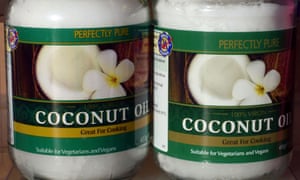
Jars of coconut oil for cooking


 Coconut oil contain 86% saturated fat - far more than butter, lard or dripping. Photograph: Jeff Blackler/Rex/Shutterstock

For certain health food shops and wellbeing sites it is the panacea that helps everything from bad hair and mental grogginess to obesity and haemorrhoids. But the carefully-crafted image of coconut oil as a cure for many ills has been roundly rejected by a Harvard professor.
Karin Michels, an epidemiologist at the Harvard TH Chan school of public health, poured scorn on the superfood movement and singled out the fad for coconut oil in particular, calling the substance “one of the worst things you can eat” that was as good for wellbeing as “pure poison”.
Michels made her comments in a recent lecture entitled “Coconut oil and other nutritional errors” at the University of Freiburg, where she holds a second academic position as director of the Institute for Prevention and Tumour Epidemiology. The speech, delivered in German, has now been watched nearly a million times on YouTube.
Michels based her warning on the high proportion of saturated fat in coconut oil, which is known to raise levels of so-called LDL cholesterol, and so the risk of cardiovascular disease. Coconut oil contains more than 80% saturated fat, more than twice the amount found in lard, and 60% more than is found in beef dripping.
Last year, the American Heart Association reviewed the evidence on coconut oil among other foodstuffs. While three quarters of the US public considered coconut oil to be healthy, the review noted that only 37% of nutritionists agreed. The authors attributed the gulf in perception to the marketing of coconut oil in the popular press. “Because coconut oil increases LDL cholesterol, a cause of CVD, and has no known offsetting favourable effects, we advise against the use of coconut oil,” the review concluded.
Other organisations have issued similar warnings. “Coconut oil can be included in the diet, but as it is high in saturated fats should only be included in small amounts and as part of a healthy balanced diet,” the British Nutrition Foundation said. “There is to date no strong scientific evidence to support health benefits from eating coconut oil.”

UK sales of coconut oil have surged from £1m to £16.4m in the past four years.
Pinterest
 UK sales of coconut oil have surged from £1m to £16.4m in the past four years. Photograph: Alamy Stock Photo

Despite the advice, promotions from health food shops such as Holland and Barrett, and celebrity endorsements from Gwyneth Paltrow and others, have helped UK sales of coconut oil surge in recent years from about £1m to £16.4m in the past four years, according to the consumer research group Kantar. In the US, coconut oil sales appear to have peaked in 2015 at $229m, according the market research firm Spins.
“Coconut oil is about 86% saturated fat, about one-third more saturated fat than butter,” said Victoria Taylor, a senior dietician at the British Heart Foundation.
“We know that diets high in saturated fat are associated with increased non-HDL cholesterol in the blood, and high cholesterol is a risk factor for coronary heart disease and stroke.
“There has been speculation that some of the saturated fat present in coconut oil may be better for us than other saturated fats, but so far there is not enough good-quality research to provide us with a definitive answer.
“What we do know is that replacing saturated fats with unsaturated fats like vegetable oil, olive oil and sunflower oil, and their spreads, has been shown as an effective way to help reduce LDL cholesterol levels, so this would be a healthier choice.
“For the time being, if you like the taste of coconut oil, then, as with butter, it’s fine to use it every now and then. However, it’s best to restrict yourself to small amounts and use unsaturated oils as an everyday choice instead.”
https://www.theguardian.com/food/2018/aug/22/coconut-oil-is-pure-poison-says-harvard-professor


See also other articles on Healthwise:

Is Coconut Oil ‘Pure Poison’? Here’s What Studies Actually Say

Claims about the benefits of coconut oil - Is it true?

Coconut Oil – Are You Coco-Nuts to Eat It?

American Heart Association President Suffers Heart Attack at 52

Coconut Oil - The Benefits of