Pages

Tuesday, 20 March 2018

Essential oils linked to abnormal breast development in boys

A new study has found that essential oils such as lavender and tea tree oils are connected to development of abnormal breast development in young boys. They researchers found eight different chemicals present in these oils that can interfere with hormonal development in boys. The study results are to be presented today (19th of March 2018) at ENDO 2018, the Endocrine Society's 100th annual meeting in Chicago.
March 19, 2018

Image Credit: AmyLv / Shutterstock
Breast development in males is termed as gynaecomastia and this is a condition which has been associated with certain disease conditions and also as a side effect of certain drugs or medications. In many there may be no cause. In general gynecomastia is a rare condition.
The American study now has found that chemicals present in the essential oils can help increase the estrogen or female hormones in the boys and suppress the testosterone or male hormone. This reaction of course is different in different persons.
People use these essential oils directly as well as in daily use products such as lotions, moisturizers, creams, soaps, shampoos, hair styling products etc. Some of these are also used as part of alternative medical procedures. According to J. Tyler Ramsey from the National Institute of Environmental Health Sciences (NIEHS), in North Carolina, who led this new research, use of these oils in any form needs to be with caution among boys. He called these oils “endocrine disruptors” or agents that can alter the hormonal make up and create problems. He said that most of these oils are generally perceived to be safe. He said that there were quite a few reported cases of male gynecomastia after these oils were used over the skin. The symptoms came down once the oils were stopped.
Dr Kenneth Korach, a co-author in this study, has shown in his earlier work that lavender and tea tree oils can affect male characteristics development and puberty and growth among males. This new study looked at the chemicals within these oils. They narrowed it down to eight chemicals out of the hundreds present in these oils. Four of these chemicals are present in both oils. These four are eucalyptol, 4-terpineol, dipentene/limonene and alpha-terpineol. The other four including linalyl acetate, linalool, alpha-terpinene and gamma-terpinene, were in either of the oils.
The team then isolated the chemicals and tested them on human cells within the laboratories. They noted that these chemicals successfully increased estrogen levels and reduced testosterone levels in varying degrees. Ramsey said, these two oils need further study. These eight chemicals are also found in 65 other essential oils he said. These too need thorough investigation before boys are exposed to them.
The U.S. Food and Drug Administration (FDA) approves of the labels on essential oils as GRAS (generally recognized as safe) with usage as directed. This new study from the NIEHS shows that their use maybe with caution especially among pre-pubescent boys.

https://www.news-medical.net/news/20180319/Essential-oils-linked-to-abnormal-breast-development-in-boys.aspx


 - - - - - - -


More evidence essential oils 'make male breasts develop'

Essential oils in bottlesImage copyrightGETTY IMAGES
A suspected link between abnormal breast growth in young boys and the use of lavender and tea tree oils has been given new weight, after a study found eight chemicals contained in the oils interfere with hormones.
Gynaecomastia is rare, and there is often no obvious cause.
But there have been a number of cases linked to use of these essential oils.
The American study found that key chemicals in the oils boost oestrogen and inhibit testosterone.
Not everyone will have the same reaction to an essential oil.
The plant-derived oils are found in a number of products such as soaps, lotions, shampoos and hair-styling products. They're also popular as alternative cleaning products and medical treatments.
Lead researcher J. Tyler Ramsey from the National Institute of Environmental Health Sciences (NIEHS), in North Carolina, suggested caution when using the oils.
"Our society deems essential oils as safe. However, they possess a diverse amount of chemicals and should be used with caution because some of these chemicals are potential endocrine disruptors."
A growing number of reported cases of male gynaecomastia have coincided with topical exposure to the oils.
After they stopped using the products, the symptoms subsided.
A previous study by Dr Kenneth Korach - who was also co-investigator for this study - found that lavender and tea tree oil had properties that competed with or hindered the hormones that control male characteristics, which could affect puberty and growth.

Essential oil dripping in bottleImage copyrightGETTY IMAGES
The new study looked at eight key chemicals from the hundreds that make up the oils. Four of the tested chemicals appear in both oils and the others were in either oil.
They were tested on human cancer cells in the laboratory to measure the changes.
The researchers found all eight demonstrated varying degrees of promoting oestrogen and/or inhibiting testosterone properties.
"Lavender oil and tea tree oil pose potential environmental health concerns and should be investigated further," said Mr Ramsey.
Many of the chemicals tested appear in at least 65 other essential oils, which is of concern, he added.

Presentational grey line

Essential oil guidelines

  • Precautions should be observed when using essential oils since they are highly concentrated
  • Do not apply undiluted essential oils directly to the skin
  • Never use undiluted oils on children under the age of three
  • If you are pregnant you should seek the advice of your doctor, midwife before using essential oils
  • When used appropriately, essential oils and aromatherapy products are safe for all the family
  • Source: Aromatherapy Trade Council
Presentational grey line
Prof Ieuan Hughes, emeritus professor of paediatrics at the University of Cambridge said the findings "have confirmed why an individual using such oils containing these chemicals may develop breast tissue".
"The anti-male hormone effects are rather unexpected and it is not possible to comment further without the data.
"Of course, not everyone exposing themselves to such oils has adverse effects, so it is possible there are particular individuals who may be more sensitive to the effects of the chemicals, or perhaps are using the products in excess.
He said attention should be given to better regulation of these products.
Prof Hughes added: "Clearly, the longer-term effects of such exposure are unknown."
Dr Rod Mitchell, honorary consultant paediatric endocrinologist at the Queens Medical Research Institute in Edinburgh said the study "is important in establishing a possible mechanism for the suggested link between gynaecomastia and exposure to lavender and tea tree oils".
"However, there are important factors that must be taken into account when interpreting these results. The tests are conducted in cancer cells, which may not represent the situation in normal breast tissue.
"The concentration (dose) to which the cells are exposed may not be equivalent to exposure in humans. There is a complex relationship between oestrogen, testosterone and other hormones in the body, that cannot be replicated in these experiments."
He called for further larger studies.
"At present, there is insufficient evidence to support the concept that exposure to lavender and tea tree oil containing products cause gynaecomastia in children, and further epidemiological and experimental studies are required."
The study results will be presented on 19 March at the Endocrine Society's annual meeting in Chicago.

http://www.bbc.com/news/health-43429933

Sunday, 18 March 2018

Stem cell transplant 'game changer' for MS patients

Doctors say a stem cell transplant could be a "game changer" for many patients with multiple sclerosis.
Results from an international trial show that it was able to stop the disease and improve symptoms.
  • 18 March 2018
  •  
It involves wiping out a patient's immune system using cancer drugs and then rebooting it with a stem cell transplant.
Louise Willetts, 36, from Rotherham, is now symptom-free and told me: "It feels like a miracle."
A total of 100,000 people in the UK have MS, which attacks nerves in the brain and spinal cord.
Just over 100 patients took part in the trial, in hospitals in Chicago, Sheffield, Uppsala in Sweden and Sao Paulo in Brazil.
They all had relapsing remitting MS - where attacks or relapses are followed by periods of remission.
The interim results were released at the annual meeting of the European Society for Bone and Marrow Transplantation in Lisbon.

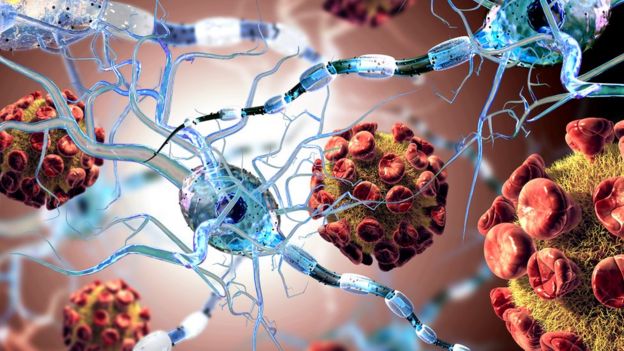
Nerve connections damaged in MSImage copyrightTHINKSTOCK
Image captionNerve connections become damaged in people with MS

The patients received either haematopoietic stem cell transplantation (HSCT) or drug treatment.
After one year, only one relapse occurred among the stem cell group compared with 39 in the drug group.
After an average follow-up of three years, the transplants had failed in three out of 52 patients (6%), compared with 30 of 50 (60%) in the control group.
Those in the transplant group experienced a reduction in disability, whereas symptoms worsened in the drug group.
Prof Richard Burt, lead investigator, Northwestern University Chicago, told me: "The data is stunningly in favour of transplant against the best available drugs - the neurological community has been sceptical about this treatment, but these results will change that."

Multiple sclerosis
  • Multiple sclerosis (MS) is a condition which can affect the brain and/or spinal cord
  • It can cause problems with vision, arm or leg movement, sensation or balance
  • Average life expectancy is slightly reduced
  • It is estimated that there are more than 100,000 people diagnosed with MS in the UK
Source: NHS

The treatment uses chemotherapy to destroy the faulty immune system.
Stem cells taken from the patient's blood and bone marrow are then re-infused.
These are unaffected by MS and they rebuild the immune system.
Prof John Snowden, haematologist and director of blood and bone marrow transplantation at Sheffield's Royal Hallamshire Hospital, told me: "We are thrilled with the results - they are a game changer for patients with drug resistant and disabling multiple sclerosis".
Prof Basil Sharrack, neurologist and director of MS research at Royal Hallamshire Hospital, told me: "This is interim analysis, but with that caveat, this is the best result I have seen in any trial for multiple sclerosis."

'Lived in fear'

Louise was diagnosed with MS in 2010 when she was only 28.
She told me: "MS ruled my life and I lived in fear of the next relapse.
"The worst time was not being able to get out of bed because I had no stability in my body - I struggled to walk and even spent time in a wheelchair.
"It also affected my cognition - it was like a brain fog and I misread words and struggled to keep up with conversations."
The BBC's Panorama filmed her undergoing her transplant in October 2015 and she is now back to full health.
She got married to her partner Steve, on the first anniversary of her transplant, and their baby daughter Joy is now a month old.
"I feel like my diagnosis was just a bad dream. I live every day as I want to, rather than planning my life around my MS."
The transplant costs around £30,000, about the same as the annual price of some MS drugs.
Doctors stress it is not suitable for all MS patients and the process can be gruelling, involving chemotherapy and a few weeks in isolation in hospital.
Dr Susan Kohlhaas, director of research at the MS Society, said the stem cell transplant HSCT "will soon be recognised as an established treatment in England - and when that happens our priority will be making sure those who could benefit can actually get it".
She added: "We've seen life-changing results for some people and having that opportunity can't depend on your postcode."

http://www.bbc.com/news/health-43435868#


More on this story


Tuesday, 13 March 2018

Curious Cook: The gluttony of health diets, part 1

I like watching my dog eat – there is a certain uncomplicated joy in the way he munches his food, profoundly trusting in us to provide him with healthy nutrition.
Humans have the same need for nutrition, of course – but the major difference is that we have infinitely more tasty options and histrionic diversions. 
Curious Cook: The gluttony of health diets, part 1
This inevitably causes many people to overindulge, making more profits for the food industries, which then create even more alluring options. It is the contemporary cycle of food consumption, wildly exacerbated by the vast communications infrastructure of the modern world. Such careless indulgence inexorably raises health issues, accompanied by guilt and worry which then usually lead to some form of dieting – and therein lies an unusual problem.
When I go to pet shops, the dog food options are limited. I can get food for big dogs, small dogs, old dogs, young dogs, dogs with skin conditions, overweight dogs – and that is about it.
By contrast, the “healthy diet” options for humans appear infinite, with a new diet fad appearing almost daily. All these diets are self-declared “miracles” by “experts” in white coats – and there is ALWAYS someone featured expressing gratitude for some new diet which “worked when all others failed”. Then there are the books, packaged meals and subscription plans – dieticians need to make a living too.
diets
New diet fads appear almost daily, and all of them are self-declared ‘miracles’ by ‘experts’. Photo: VisualHunt
After perusing (very) many dietary fads (or “plans” as they prefer to be called), I thought it useful to condense all these plans into a couple of pithy pages. Diet plans are decomposed into their underlying premise rather than individually analysed (as there are just too many diets) – by premise, I mean division into categories such as calorie restricted, food group limited, time restricted, supplemental, combinational or fanciful. Then the claimed benefits and objectively-determined attributes of each category will be summarised.
Not all diet plans are about losing weight; some claim to promote longevity or reduce skin problems, others seemingly offer better brain function, improved cardiovascular capacity, pain management, or even enhanced physiques, etc – the variants are endless. Many diet plans cross category boundaries (eg. most weight loss diets are calorie-restricted in some way), so many plans adopt the positive and negative attributes of more than one category. After reviewing so many plans, I simply needed a new way to look at how many fads claim to work and categorisation has significantly helped in understanding the concepts behind all diet plans.
It is also acknowledged that people are inherently different – not only genetically, but also in their underlying health, digestive capabilities (eg. differences in HGM, or human gastrointestinal microbiota), environments (eg. stress levels, work patterns, exposure to pollutants), income, cultural backgrounds and access to food options. As such, particular diet plans may have quirks which may suit certain people better than others – in short, it is extremely improbable that even a simple diet with a single premise (eg. weight loss) would work equally well across a large group of followers.

Latest hits

According to Time magazine, the expected dietary hits for 2018 are the DASH Diet, Mediterranean Diet, Flexitarian Diet, Weight Watchers, MIND Diet, TLC Diet and Volumetrics. I could have picked other magazines and they would have confusingly different lists of top diets – that is why it may be worthwhile to look at diet plans in a new way.
If you are curious about the acronyms, DASH means Dietary Approaches to Stop Hypertension, MIND stands for a mix of Mediterranean and DASH and TLC is Therapeutic Lifestyle Changes.
Not all diet plans are about losing weight; some claim to promote longevity or reduce skin problems, others seemingly offer better brain function, improved cardiovascular capacity, pain management, or even enhanced physiques, etc – the variants are endless.
If you are still inquisitive, the DASH diet claims to help alleviate high blood pressure and is similar to other food group restricted diets but with added emphasis on reducing salt intake. The MIND diet is another food group restricted diet claimed to slow cognitive decline and the TLC diet focuses on cholesterol reduction via a combination of calorie restriction, food group restriction, exercise and in some cases, drugs as well. You will understand more from the essence of each category below.
And so we start with categorisation of diets based on their major characteristics. As mentioned, many diets stray into multiple categories and the significance will be obvious later.

Category 1 – Calorie restricted diets

These diets basically limit the number of consumable calories. The premise is reducing the intake of calories inhibits the body’s proclivity to store excess calories as fat. Also, eating fewer calories means that the body will switch to burning stored fat, thereby causing weight loss.
In practice, this approach is often effective in the short term, because the logic is irrefutable. However, the strain of reducing food intake means that the body might adopt a slower metabolic rate – this means that the rate of weight loss due to burning stored fat may slow after a while. Reducing calories usually also messes with the hormonal interplay for managing hunger, causing wild mood swings and making it common to develop severe food cravings – this is the primary reason why many people give up calorie-reduced diets after a while.
One important thing to note is that not all calories are equal – much depends on whether food has been cooked or not. For example, weight-for-weight, cooked carrots have far more digestible calories than raw carrots. This is the Thermic Effect of Food (TEF) where calories from raw, uncooked food need more energy for digestion while calories in cooked food are far easier to absorb – hence cooked foods may introduce 15% to 35% more calories than the raw versions. Oddly, TEF is a significant point which is seldom mentioned by many calorie-restricted diets.
diets
One of the reasons attributed to the long life of Okinawans is the type of food their eat.
There is an interesting variant based originally on the diets of Okinawans. Normally, most food would have over one calorie per gram, but some diets specify consuming meals where the number of calories is less than the weight of the food in grams. This ostensibly can help improve longevity – at least, that is one hypothesis to explain the unusual ages of older Okinawans.

Category 2 – Food group limited diets

Food groups can vary depending on the diet plan – and general food groups are animal meats, fish, shellfish, plants, fruits, grains, sugars, dairy, etc. It may also extend to wider groups such as carbohydrates, fats, animal proteins, plant proteins, high-fibre foods, etc. Yet more groups may include organic produce, processed foods, low-fat, selected vegetable oils, specific vinegars, etc.
Certain diets specifically exclude or include only some groups. There seems to be no limit to the ingenuity of food groups invented to fit into many dietary plans, depending on the diet hypothesis proposed; eg. weight loss, health, longevity, etc.
diets
Some high-protein diets include mostly meats while excluding carbohydrates and fruits. Photo: VisualHunt/Matt Biddulph
Generally, if the food groups allowed in a plan are diverse enough and contain adequate nutrients and fibre, then there are no real concerns. However, many diets specifically exclude important groups – for example, some high-protein diets include mostly meats while excluding carbohydrates and fruits. This may be tolerable for people in good health but may not be the best option for someone with chronic constipation. Also, little attention is paid to what happens to the HGM when drastically switching to new food groups.
Many diets are often presented as “one size fits all” – however, like shoes, that is seldom true. It also matters if the permitted food groups are items you enjoy eating.

Category 3 – Time restricted diets

Applying time restrictions is a more recent development, and several diets arose from research at US universities several years ago where heavily restricting calories for a few days was found to boost the immune system significantly. The reasons for this effect are unclear but may have been an adaptive mechanism to boost body defences during ancient times of food shortages. Palaeolithic humans were nomadic hunter-gatherers and during times of famine, they wandered to new lands and thus encountered different microbial flora – so an improved immune system would have been beneficial.
Time-deprived diets require periods of curtailed calorie consumption (eg. two days each week or a few days a month) – and are generally proposed as a way to boost health and longevity.
Some newer alternative intermittent fasting (IF) diets restrict the time during the day when food can be eaten; eg. circumscribing eating to only an eight-hour window each day. Why this should work is not scientifically explained – perhaps such a plan would avoid snacking continuously during the day. In mice experiments, it was claimed that IF provided more time and resources for the test mammals to repair their bodies, though the diurnal (daily) feeding cycle for mice is completely different from humans. There were also some minor IF studies on humans but the sample sizes were too small to be reliable.
One advantage of some time-limited diets appears to be no requirement for altering existing food habits (or even quantities), except during restricted periods.

Part 2 will define a few more categories of diets, along with comments about how we eat in general.

https://www.star2.com/food/2018/03/11/gluttony-health-diets-part-1

Part 2